


A senior engineer stays late for six years. She covers for a struggling teammate, mentors two juniors into promotions, and turns down a recruiter every spring because she believes the company will take care of her when it counts. Then a reorg lands. Her project is handed to a new hire brought in above her, and the manager who made her all those warm, vague promises has moved to another division. Nobody broke a written rule. Her salary never dropped. Yet she is done. She updates her resume that night, and within a month she is gone, telling friends she left over “respect,” not money.
What broke was a contract nobody ever signed. There was no clause about the reorg, no line item for loyalty, no signature on the promise she thought she heard. The legal employment agreement was honored to the letter. The deal that actually governed her behavior for six years lived entirely in her head, and the moment she decided it had been violated, six years of goodwill evaporated in a single evening.
That invisible deal has a name. The psychological contract is each person’s private belief about the reciprocal obligations between them and their organization: what I owe you, and what I believe you owe me back. It is unwritten and mostly unspoken, which is exactly why it is more powerful than the document HR keeps on file. People do not quit over the contract they signed. They quit over the one they imagined, and then watched get broken.
Denise Rousseau turned this idea from a vague intuition into one of the most studied constructs in organizational behavior. Her work explains why two employees offered the identical layoff package walk away feeling opposite things, why the most dangerous breaches are the ones the company never noticed making, and why a broken promise at work registers in the brain like physical pain. Below is the full mechanism: where the idea came from, the three contract types, the difference between breach and violation that changes how you manage people, and the crosswalk that turns a forty-year-old theory into a design instrument through the Octalysis Framework.
Speed Run Notes
- The psychological contract is your private belief about the mutual obligations between you and your employer. It is unwritten, and it drives behavior far more than the contract you actually signed.
- Rousseau named three types: transactional (short-term, economic), relational (open-ended, emotional), and balanced (open-ended commitment plus explicit performance terms). A fourth state, transitional, is what a contract looks like while it is falling apart.
- Breach and violation are not the same thing. Breach is noticing the promise was not kept. Violation is the anger and betrayal that can follow. Whether one becomes the other depends on the story the employee tells about why.
- Breach is the norm, not the exception. Most employees report one within two years, and the meta-analytic evidence ties it to lower satisfaction, lower commitment, and higher turnover.
- A broken contract hurts because the brain registers social betrayal with the same circuitry as physical pain. That is why people remember a workplace betrayal long after they forget the paycheck.
- The design lever: map each contract type onto the 8 Core Drives of Octalysis. The crosswalk shows which motivation a breach collapses first, and how to design the unwritten deal on purpose instead of leaving it to luck.
In This Article
- What Is the Psychological Contract?
- Where the Idea Came From: Argyris to Rousseau
- The Three Types: Transactional, Relational, Balanced
- Breach vs Violation: The Distinction That Changes Everything
- What Happens in the Brain When a Contract Breaks
- The PC × Octalysis Core Drive Crosswalk
- The Breach Collapse-Order Map
- The 6-Step PC × Octalysis Audit
- The Four Experience Phases of a Contract
- i-Deals: Designing the Personal Exception Honestly
- The Psychological Contract in the Real World
Author Credibility: Yu-kai Chou

Yu-kai Chou created the Octalysis Framework after studying gamification since 2003 — years before the term entered mainstream vocabulary. As a Human-Systems Architect & Behavioral Designer, his framework has been applied by LEGO, Microsoft, Porsche, Coca-Cola, Salesforce, and MrBeast, impacting over 1.5 Billion Users.
Chou has taught the Octalysis methodology at Harvard, Stanford, Yale, Tesla, Google, BCG, and IDEO.
His work has been cited by Harvard, Stanford, MIT, Forbes, Wall Street Journal, Wired, US Department of Energy, NIST, NSF, NCBI, US Department of Education, ClinicalTrials.gov, and Google Scholar — with 3,700+ more academic publications. Explore his books here.

What Is the Psychological Contract?
The psychological contract is the set of beliefs a person holds about the terms of an exchange relationship between themselves and another party. At work, that other party is the organization, and the beliefs are about reciprocal obligation: the things I feel bound to give, and the things I feel I have been promised in return.
Rousseau’s definition is precise and worth sitting with. The psychological contract lives in the mind of one individual. It is not a meeting of two minds the way a legal contract is. It is one person’s perception of a promise, made and accepted, that creates an obligation. You can have a vivid, detailed psychological contract with your employer that your employer has no idea exists, because you built it out of an offhand comment in your interview, the way your boss treated the person before you, and a hundred small signals you read as commitments.
This is the part most managers miss. The psychological contract does not require the company to actually promise anything. It requires the employee to believe a promise was made. A recruiter who says “people who do well here tend to move up fast” has, in the employee’s mind, signed something. Eighteen months later, when a slower-moving reality fails to match that imagined clause, the employee experiences a breach the company never knew it created.
Three features make this construct so useful. It is subjective, so two people in identical roles can hold completely different contracts. It is about promises rather than expectations, which is a sharper category: I can expect rain without feeling betrayed by it, but a broken promise carries the sting of obligation unmet. And it is reciprocal, built on the deep human logic of exchange that equity theory formalized: I gave, therefore I am owed.
Where the Idea Came From: Argyris to Rousseau
The phrase is older than most people think. Chris Argyris coined “psychological work contract” in his 1960 book Understanding Organizational Behavior, describing an unspoken arrangement between factory workers and their foremen: the workers would keep productivity high and grievances low, as long as the foremen respected the norms of their informal culture and left them alone. The deal was never stated. Both sides understood it anyway, and both behaved as though breaking it carried real consequences.
Harry Levinson pushed the idea further in 1962 with the concept of reciprocation, drawing on interviews with hundreds of employees to show that workers carry detailed, emotionally charged expectations of what the organization owes them, most of which they have never articulated and the organization has never agreed to. Edgar Schein, through the 1960s and 1970s, made the contract central to organizational psychology, arguing that the degree of match between what the person expects to give and get, and what the organization expects to give and get, predicts satisfaction and commitment far better than pay alone.
For two decades the idea floated as a useful metaphor that nobody could measure. Then Rousseau published her 1989 paper, Psychological and Implied Contracts in Organizations, and made one move that changed the field: she relocated the contract from the relationship into the individual mind. Earlier theorists treated it as a mutual, shared understanding, which is almost impossible to study because you can never pin down whose understanding counts. Rousseau redefined it as one person’s belief about promised obligations. That sounds like a small shift. It was the move that made the construct measurable, because now you could survey an individual about what they believed they were promised and whether they felt those promises were kept.
Her 1995 book, Psychological Contracts in Organizations, built the full architecture: where contracts come from, how they are encoded, how they change, and how they break. Everything that followed, from the breach research to the modern work on remote and gig labor, is a footnote or an extension to the framework she laid down. When people say “the psychological contract” today, they mean Rousseau’s version.
The Three Types: Transactional, Relational, Balanced
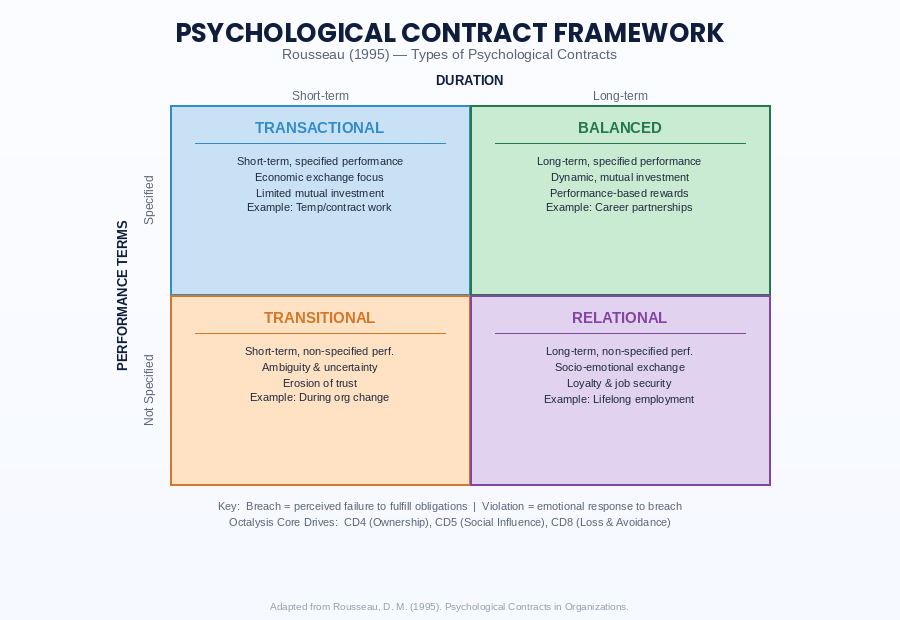
Rousseau’s most practical contribution is a typology. Not all psychological contracts are the same shape, and the shape determines what counts as a breach. She organized them along two dimensions: time frame (short-term versus open-ended) and performance terms (specified versus unspecified). Cross those two and you get the contract types that every working relationship falls into.
Transactional Contracts: The Economic Deal
A transactional contract is short-term and narrowly economic. The terms are specified, the time frame is bounded, and the loyalty runs shallow on both sides. I do this defined work, you pay this defined amount, and neither of us pretends to owe the other much beyond that. A contractor hired for a three-month build, a retail worker during the holiday rush, a consultant on a fixed scope: these are transactional by design.
Transactional contracts are not cynical or broken. They are honest about what they are. The danger comes when one side thinks the contract is transactional and the other thinks it is something warmer. The seasonal hire who assumed the job would convert to permanent, the freelancer who expected to be looped into the team’s future, both are running a richer contract than the company signed up for. When the bounded deal ends exactly as written, they still feel a breach, because the document in their head had clauses the real arrangement never contained.
Relational Contracts: The Loyalty Deal
A relational contract is open-ended and emotional. The terms are fuzzy, the horizon is long, and the currency is loyalty, security, mutual investment, and identity. This is the contract the engineer in the opening story was running: I give you my best years and my discretionary effort, you look after me when it counts. Nobody writes down “look after me.” Everybody who holds a relational contract believes it is in there.
Relational contracts produce the deepest commitment and the deepest betrayals. Because the terms are unspecified, almost any disappointment can be read as a violation, and because the investment is emotional, the violation cuts to identity rather than to wallet. This is why the long-tenured loyal employee is often more dangerous when they turn than the mercenary contractor ever could be. The mercenary never promised you their heart. Research on organizational commitment shows that the affective, identity-based bond is exactly the kind that, once broken, is hardest to rebuild.
Balanced and Transitional: The Modern Hybrid and the Breakdown
The balanced contract is Rousseau’s answer to the realization that the pure transactional and pure relational forms are both unstable in modern work. A balanced contract is open-ended like a relational one, but it carries explicit, renegotiable performance terms like a transactional one. The deal is roughly: we are committed to each other for the long run, and that commitment is conditional on clearly stated, evolving contributions from both sides. Stay, grow, deliver against terms we will keep updating, and we keep investing in you. It is the contract a healthy modern company actually wants, because it pairs the deep engagement of the relational form with the accountability of the transactional one.
The fourth box in the matrix is the transitional contract, and it is not really a contract at all. It is the state a working relationship enters when the old contract has collapsed and no new one has formed: during a merger, a mass layoff, a sudden change of ownership, or a leadership purge. In the transitional state, people report high uncertainty, low trust, and an open question about what, if anything, is still owed. Naming it matters, because organizations going through upheaval often think their problem is morale or communication when their real problem is that thousands of psychological contracts have all dissolved at once and nothing has replaced them.
Breach vs Violation: The Distinction That Changes Everything
Here is the single most useful idea in the entire literature, and the one managers get wrong most often. Breach and violation are not synonyms. Elizabeth Morrison and Sandra Robinson separated them in their 1997 paper When Employees Feel Betrayed, and the separation is the difference between a relationship you can save and one you cannot.
Breach is a cognition. It is the moment an employee notices, or believes they notice, that an obligation has not been met. The bonus that did not come. The promotion that went to someone else. The flexibility that quietly disappeared. Breach is the mental ledger registering a debit: you said you would, and you did not.
Violation is an emotion. It is the hot, affective response that can follow a breach: anger, resentment, a sense of betrayal and injustice. Crucially, violation does not automatically follow breach. A breach can be noticed and shrugged off. The same breach can detonate into violation. What decides which path it takes is the story the employee constructs about why the promise was broken.
Morrison and Robinson’s model traces that story through a sensemaking process. After a breach, the employee asks two silent questions. First, was this reneging or incongruence? Reneging means the organization could have kept the promise and chose not to. Incongruence means the two sides genuinely understood the promise differently, with no bad faith. Second, was it fair? Did the organization explain itself, apply its rules consistently, treat me with dignity in the process? An employee who concludes “they could have, they chose not to, and they did not even bother to explain” experiences violation. An employee who concludes “the market collapsed, they were straight with me, and they treated everyone the same way” often experiences only breach. Same missing bonus. Opposite outcome.
This is why the mechanics of organizational justice sit right at the center of contract management. The fairness of the process, not just the fairness of the outcome, is what determines whether a broken promise becomes a wound. Most companies obsess over the outcome (the size of the bonus, the title of the role) and neglect the process (how the decision was explained and delivered), which is exactly backwards. The process is the part that turns breach into violation, and the process is the part you control even when the outcome is forced on you.
How a Breach Actually Unfolds
Breach is not usually a single dramatic event. Robinson and Morrison’s 2000 longitudinal study, The Development of Psychological Contract Breach and Violation, followed employees across their first eighteen months and showed that breach accumulates, and that whether it is felt depends on factors present long before any promise is broken. Employees who had more interaction with the organization during recruitment, and who felt they had upheld their own side of the bargain, were more likely to register a breach when one occurred, because they were keeping a closer ledger.
An earlier study by Robinson, Kraatz, and Rousseau, published in the Academy of Management Journal in 1994, tracked how the contract itself drifts over time. Over the first two years on the job, employees came to believe they owed their employer less, while believing the employer owed them more. The ledger tilts. And when employees perceived that the employer had failed to deliver on its obligations, their own sense of obligation eroded further in response. A breach does not just create a single grievance. It rewrites the whole contract in the employee’s favor, lowering what they feel bound to give.
Sandra Robinson and Denise Rousseau put a number on how common this is, and the number is uncomfortable. In a study pointedly titled Violating the Psychological Contract: Not the Exception but the Norm, a majority of the employees they surveyed reported that their employer had failed to meet at least some of its obligations within the first two years. Breach is not a rare malfunction. It is the baseline condition of employment, which means the real managerial question is never “how do we avoid all breach” (you cannot) but “how do we keep breach from curdling into violation.”
What Breach Costs: The Evidence
The most authoritative answer comes from Hao Zhao and colleagues, whose 2007 meta-analysis in Personnel Psychology pooled the results across dozens of studies to map exactly what breach does to people and performance. Their causal chain runs in a clean sequence: breach (the cognition) feeds affect (violation and mistrust toward management), which feeds attitudes (lower job satisfaction, lower organizational commitment, higher intention to leave), which finally feeds behavior (less organizational citizenship, weaker in-role performance, and turnover).
The pattern in the numbers is sharp. Breach showed a strong negative association with job satisfaction, a moderate negative association with commitment, and a moderate positive association with intention to leave. It was reliably linked to every outcome the analysis examined, with one telling exception: actual turnover. People who feel breached want to leave, report they intend to leave, and quietly withdraw their discretionary effort long before they walk. The behavior that shows up first is not resignation. It is the silent downgrade from a relational contract back to a transactional one, the employee who stops mentoring, stops covering, stops volunteering, and starts doing precisely what the job description requires and nothing more.
That silent downgrade is the expensive part, because it does not appear in any exit interview. It surfaces as a slow decline in the discretionary behaviors that make a team great, the affective events that shape how people feel at work accumulating into a quiet verdict. Sustained breach also tracks closely with burnout, particularly the cynicism dimension, where an employee who once believed in the deal now treats the whole enterprise with detached contempt. By the time turnover shows up in the dashboard, the contract broke months or years earlier.
What Happens in the Brain When a Contract Breaks
Why does a broken workplace promise hurt out of all proportion to its economic size? People will accept a smaller raise gracefully and then rage for years about a promotion they were “promised” and denied, even when the promotion was worth less than the raise. The intensity does not match the economics. It matches something older.
Naomi Eisenberger, Matthew Lieberman, and Kipling Williams ran a study in 2003, published in Science under the title Does Rejection Hurt?, that helps explain it. They scanned people playing a simple online ball-tossing game called Cyberball, then had the other “players” (actually the computer) stop throwing them the ball, freezing them out. Social exclusion, in a trivial game, with strangers who did not exist. And the brain responded by lighting up the anterior cingulate cortex, one of the same regions that registers the distress of physical pain. The more excluded people felt, the more that region activated.
The implication is direct. The brain did not evolve a separate, gentler system for social injury. It routes betrayal, exclusion, and broken trust through circuitry built for bodily harm. When an organization breaks a psychological contract, the employee is not being dramatic when they describe it as painful. The pain is literal at the level of neural processing, which is why it is remembered with the vividness of an injury and forgiven with the difficulty of one.
There is a second mechanism worth naming. The brain runs on prediction. Reward signaling tracks not absolute outcomes but the gap between what was expected and what arrived, the prediction error that decades of work on dopamine systems have mapped in detail. A psychological contract is, in neural terms, a standing prediction about what the organization will deliver. A breach is a negative prediction error: reality came in below the forecast the contract had set. This is why the same outcome feels completely different depending on the contract. A flat bonus delivered to someone who expected nothing is neutral. The identical flat bonus delivered to someone whose contract predicted a raise is a loss, processed with all the asymmetric sting that prospect theory and loss aversion describe. The event is fixed. The contract sets the reference point, and the reference point decides whether the event reads as a gift or a theft.
The PC × Octalysis Core Drive Crosswalk
Everything above is diagnosis. Here is where it becomes design. Rousseau gives us the anatomy of the unwritten deal, but she does not tell you which levers to pull to build a healthy one or which motivation a given breach will damage. The Octalysis Framework does, because it breaks all human motivation into 8 Core Drives, and each contract type turns out to run on a specific subset of them. Map the contract onto the Core Drives and the abstract becomes operational. You stop asking “is our culture good” and start asking “which Core Drives is our contract actually built on, and what happens to each one if we break it.”
Here is the crosswalk, contract type by contract type.
Transactional Contracts Run on CD2, CD4, and CD8
A transactional contract is powered by three Core Drives, and notably none of them are the warm ones. The engine is Core Drive 2 (CD2): Development & Accomplishment, the drive to make progress and hit defined targets. A transactional deal is a clean accomplishment loop: do the specified work, clear the bar, get paid. The second drive is Core Drive 4 (CD4): Ownership & Possession, but in its accrual form, the accumulation of earned compensation, hours banked, deliverables shipped. Here CD4 is about the tally, not the attachment. The third is Core Drive 8 (CD8): Loss & Avoidance, the drive to not lose what you have or fail what you committed to. The contractor delivers on time partly to earn the fee and partly to avoid the penalty, the bad reference, the lost renewal.
What this tells a designer is blunt. A transactional contract has no emotional reserve to draw on, so it is fragile in a specific way: break the accomplishment loop or the accrual and there is nothing else holding the person. But it is also clean. Because the terms are specified, breach is unambiguous and so is repair. You missed the payment, you fix the payment, the contract is whole again. Transactional contracts hurt less when broken precisely because they were never load-bearing on identity.
Relational Contracts Run on CD1, CD5, and CD4
A relational contract runs on an entirely different set, and this is the heart of the crosswalk. The first drive is Core Drive 1 (CD1): Epic Meaning & Calling, the belief that you are part of something larger than yourself, that the work matters and that you were chosen to do it. The second is Core Drive 5 (CD5): Social Influence & Relatedness, the bonds of belonging, mentorship, mutual loyalty, and being known. The third is Core Drive 4 (CD4): Ownership & Possession again, but now in its deep form: psychological ownership, the felt sense that this is my team, my company, my mission, not merely my job.
That CD4 appears in both contract types, wearing two different faces, is the most important insight in the crosswalk. In the transactional contract, CD4 is a ledger of what you have accrued. In the relational contract, CD4 is an identity you have absorbed. The literature on psychological ownership shows that when people invest themselves in something over time, they begin to experience it as an extension of the self. The relational contract is built on exactly that. It is why a long-tenured employee says “we” without thinking, and why breaching their contract does not feel like a transaction failing. It feels like a part of the self being repudiated.
Relational contracts are powerful and dangerous for the same reason: they are anchored in CD1 and CD5, the White Hat, meaning-and-belonging drives that produce the deepest, most durable motivation. When they hold, you get an employee who would run through walls. When they break, you do not get a billing dispute. You get a person whose sense of meaning and belonging has been injured, processed by the brain as the social pain described above.
Balanced Contracts Engage All Eight, with CD3 as Connective Tissue
The balanced contract is the only type that engages all 8 Core Drives, which is exactly why it is the most resilient and the hardest to build. It carries the transactional engine (CD2, CD4-accrual, CD8) and the relational engine (CD1, CD5, CD4-ownership) at the same time. What integrates the two halves is Core Drive 3 (CD3): Empowerment of Creativity & Feedback, the connective tissue of the whole structure.
CD3 is the drive to create, to exercise agency, and to get meaningful feedback on the results. In a balanced contract, CD3 is what keeps the relationship alive as conditions change: both sides keep adjusting the terms, contributing ideas, and responding to feedback rather than freezing the deal in place. A relational contract without CD3 calcifies into entitlement (I have been loyal, therefore I am owed, regardless of what I now contribute). A transactional contract without CD3 stays a vending machine. CD3 is the renegotiation engine, the thing that lets a long-term commitment stay honest by keeping the performance terms live.
The two remaining drives act as moderators rather than foundations. Core Drive 6 (CD6): Scarcity & Impatience shows up as the pull of a hard-to-get role, a limited cohort, an exclusive track, and it intensifies whatever contract already exists. Core Drive 7 (CD7): Unpredictability & Curiosity shows up as the energizing uncertainty of a new challenge or an evolving mandate. Used well, CD6 and CD7 add spice to a balanced contract. Used badly, they become Black Hat pressure: manufactured scarcity (“you are lucky to be here”) and destabilizing unpredictability (“nobody knows what this org will look like next quarter”) that corrode trust rather than build it. They are seasoning, not structure. A contract that leans on CD6 and CD7 as its foundation is a contract running on anxiety.
The Breach Collapse-Order Map
Now the crosswalk pays off with something Rousseau’s framework alone cannot give you: a prediction about what breaks first. When a psychological contract is breached, the Core Drives do not fail all at once or at random. They collapse in a consistent order, and knowing that order tells you both what you are about to lose and where to intervene.
Core Drive 1 (Epic Meaning) collapses first. The instant an employee concludes the deal has been violated, the story they told themselves about being part of something larger is the first casualty. The mission they believed in starts to look like a slogan used to extract unpaid effort. CD1 is the highest, most fragile motivation because it depends entirely on belief, and breach is, at its core, an attack on belief.
Core Drive 5 (Social Influence & Relatedness) goes second. Once the meaning curdles, the belonging follows. The employee withdraws from the bonds: less mentoring, less informal loyalty, a quiet exit from the social fabric that made them give discretionary effort. The “we” becomes “they.” This is the stage colleagues notice before any manager does.
Core Drive 4 (psychological ownership) goes third. The felt sense of “my company, my mission” is durable because it is woven into identity, so it takes longer to dislodge. But sustained breach eventually pries it loose, and when it goes, the relational contract has effectively reverted to a transactional one. The person still does the job. They no longer own it.
Core Drive 2 and Core Drive 8 hold longest. The accomplishment loop and the loss-avoidance drive are the last to fail, because they are economic and self-protective rather than relational. A thoroughly disillusioned employee will still hit their targets (CD2) and still avoid getting fired (CD8) right up until the day they leave. This is the tragic, expensive endgame of an unrepaired breach: a person whose meaning, belonging, and ownership are gone, running purely on the transactional minimum, indistinguishable on paper from an engaged employee and completely hollow underneath.
The collapse-order map is a diagnostic clock. If you can see CD1 wobbling, you have time and the cheapest possible repair, which is honest re-explanation of the mission and the breach. If you are already watching CD4 detach, the relational contract is nearly gone and rebuilding it will cost far more than the breach ever saved. Most organizations do not look until CD2 and CD8 are all that is left, which is to say they look at the exit interview.
The 6-Step PC × Octalysis Audit
Diagnosis and crosswalk combine into a procedure you can run on any team, product, or onboarding flow. The audit borrows its measurement spine from Robinson and Morrison’s Psychological Contract Inventory, the validated instrument that asks people what they believe was promised and whether it was delivered, and it routes the findings through the Octalysis Strategy Dashboard, the standard Octalysis practice of scoring each of the 8 Core Drives across the experience. The last step is an honesty check borrowed from choice-architecture ethics.
Step 1: Surface the actual contract. Do not assume you know what people believe they were promised. Use the Psychological Contract Inventory logic: ask employees directly what obligations they believe the organization took on, and what they believe they owe in return. The gap between what leadership thinks it promised and what employees think they were promised is your first and largest source of latent breach.
Step 2: Classify each contract. For each role or segment, locate it in Rousseau’s matrix. Is this relationship transactional, relational, balanced, or sitting in a transitional breakdown? Misclassification is itself a breach generator, because you will manage a relational employee with transactional tools, or vice versa, and both feel like a violation to the person on the receiving end.
Step 3: Run the crosswalk. Translate each contract into its Core Drives using the map above. A relational contract that scores high on CD2 (accomplishment) but near zero on CD1 (meaning) is not actually relational. It is a transactional contract that people have mistaken for loyalty, and it will not survive its first real test.
Step 4: Score the Strategy Dashboard for delivery, not intention. For each Core Drive the contract relies on, score how strongly the actual experience delivers it, not how strongly you meant to. A company can intend deep CD5 belonging and deliver an org chart and a Slack channel. The Dashboard forces the comparison between the contract’s promised Core Drives and the experience’s delivered Core Drives. Every gap is a breach waiting to be noticed.
Step 5: Map the collapse order against your weak Core Drives. Overlay the collapse-order map. If your relational contracts are thin on exactly CD1 and CD5, the two drives that fail first, you are running on borrowed time, because the parts most exposed to breach are the parts you under-built. Prioritize reinforcement where fragility and reliance overlap.
Step 6: Apply the publicity test. Before shipping any mechanic that shapes the contract, a streak, a loyalty tier, a retention bonus, a counteroffer, run the publicity test drawn from work on transparent choice architecture: would you be comfortable if the person on the other side could read the full reasoning behind this design? If the honest answer is no, you are not designing a contract. You are designing a trap, and traps generate violation the moment they are seen for what they are. The publicity test is the line between influence and manipulation, and it is the cheapest insurance against the kind of breach that becomes a public scandal.
The Four Experience Phases of a Contract
A psychological contract is not static. It is born, it sets, it deepens or frays, and it eventually resolves. Octalysis already models any motivational experience across four phases, and the psychological contract maps cleanly onto them, which gives you a timeline for when each kind of breach is most likely and most damaging.
Discovery is before and during hiring, when the contract is being written in the candidate’s head out of job ads, interviews, Glassdoor reviews, and the behavior of everyone they meet. This is where the most consequential over-promising happens, because the organization is in sales mode and the candidate is encoding every flattering signal as a commitment. The contract you accidentally write during Discovery is the contract you will be held to for years.
Onboarding is the first weeks and months, when the candidate’s imagined contract collides with reality for the first time. Robinson and Morrison’s longitudinal work shows breach perceptions forming early and shaping everything after. A small, well-handled mismatch in Onboarding teaches the employee that this organization renegotiates honestly. A small, ignored one teaches them that the contract was fiction, and they recalibrate downward immediately.
Scaffolding is the long middle, the years of ordinary work where the contract is tested by hundreds of small deliveries and small disappointments. This is where the balanced contract earns its keep, because the CD3 renegotiation engine keeps the terms current as the employee grows and the role changes. Most relational contracts that survive do so because someone kept the deal honest through the Scaffolding years, not because the original promise was perfect.
Endgame is the long-tenured state, when the employee has given years and the contract is at its most relational and most fragile. The opening story lives here. Endgame breaches are the most expensive of all, because the collapse order runs furthest: a person with a decade of CD1 meaning and CD5 belonging and CD4 ownership has the most to lose, and loses all of it when the contract finally breaks. The cruel irony is that organizations relax exactly here, assuming a ten-year veteran is safe, when a ten-year veteran is carrying the heaviest contract in the building.
i-Deals: Designing the Personal Exception Honestly
Rousseau’s later work introduced a tool that sits at the cutting edge of contract design: the idiosyncratic deal, or i-deal. An i-deal is a customized arrangement an individual employee negotiates for themselves, different from their peers, that benefits both the person and the organization: a tailored schedule, a special development track, a unique role carved to fit a specific talent. Done right, the i-deal is the highest expression of a healthy contract, because it treats the person as an individual with specific value rather than a slot in a grid.
On the crosswalk, the i-deal is a precise combination of three Core Drives. It is Core Drive 3 (Empowerment of Creativity & Feedback), because the employee co-creates the terms of their own deal rather than accepting a template. It is Core Drive 4 (Ownership & Possession), because a deal you negotiated for yourself is owned in a way a standard package never is. And it is Core Drive 5 (Social Influence & Relatedness), because being granted an exception signals that you specifically are valued and trusted. The job-crafting research, where employees reshape their own roles, points the same way: agency over your own terms deepens the contract. (See the deeper treatment in the job crafting framework.)
But i-deals carry a built-in hazard, and it is a fairness hazard. An exception granted to one person is, by definition, visible to others, and what feels like recognition to the recipient can feel like favoritism to everyone else, breaching their contracts to repair one. This is where the publicity-test honesty guard becomes non-negotiable. An i-deal passes the test if its logic could be stated openly: this person negotiated this arrangement, here is the value exchange that justifies it, and the same path is available to anyone who can make the same case. An i-deal fails the test when it is a secret special favor that only survives because the rest of the team cannot see it. The honest i-deal strengthens the whole web of contracts by showing that the organization rewards initiative. The dishonest one is a landmine that detonates the moment it surfaces, because a hidden exception is read, correctly, as a statement that the stated rules are negotiable for favorites and binding for everyone else.
Where the Theory Falls Apart
The psychological contract is one of the most generative ideas in organizational behavior, and it has real cracks. Treating it as gospel is its own kind of design error, so here is where careful people push back.
The first criticism is about measurement. Because the contract lives in one person’s head and is built from perceived promises, researchers have struggled to agree on how to measure it. Do you ask about the content of the contract (what specific things were promised) or its features (how relational or transactional it feels)? Rousseau and Tijoriwala laid out the competing approaches and showed that different instruments can produce different pictures of the same relationship. A construct that is hard to pin down is a construct that is easy to over-claim.
The second criticism, pressed hardest by Cullinane and Dundon, is that the theory can quietly take the organization’s side. By framing the relationship as an exchange of mutual obligations between two roughly equal parties, the psychological contract can paper over the real power asymmetry of employment. The employer writes the rules, sets the pay, and holds most of the leverage. Calling a deeply unequal relationship a “contract” between partners can make structural exploitation feel like a fair bargain that simply went wrong, when the bargain was never between equals to begin with.
The third is the causal-direction problem that haunts any self-report construct. We usually measure breach after the fact, by asking unhappy employees whether they feel their contract was broken. But an employee who is already disengaged, for reasons that have nothing to do with any promise, may reinterpret ordinary events as breaches to justify how they already feel. Breach may sometimes be a story people tell to explain their dissatisfaction rather than the cause of it. The honest position is that the arrow runs both ways, and the clean causal model is cleaner on paper than in a human being.
None of this sinks the theory. It sharpens how you use it. The contract is a powerful lens precisely because it is subjective, and the same subjectivity is what makes it slippery to measure and easy to weaponize. Hold both at once.
The Psychological Contract in the Real World
The construct was built for the mid-century career: one employer, decades of tenure, an implicit promise of security in exchange for loyalty. That world is mostly gone, which makes the psychological contract more relevant, not less, because the old default contract has shattered and nothing standard has replaced it.
Consider gig and platform work. Wood and colleagues, studying remote platform workers, documented a relationship in which the “employer” is an algorithm, the terms can change without notice, and there is no manager to renege in person, only a policy update. The psychological contract in gig work is thin, brittle, and constantly breached by design, which helps explain the simmering resentment platform workers report even when the pay is acceptable. There is no relational contract on offer, only an endless transactional one with a counterparty that cannot be held accountable. The closest cousin to the contract here is perceived organizational support, the felt sense that the organization values you and has your back, and in algorithmic work that sense is structurally near zero.
Remote and hybrid work rewrote the contract again. The promise of flexibility became, for many, an implicit clause, and the return-to-office mandates of recent years landed as mass breaches: a benefit people had encoded as a permanent term of their deal was withdrawn, and the violation response was exactly what the theory predicts. Notice the pattern. The companies that explained the reasoning, applied the policy consistently, and treated the change as an honest renegotiation absorbed far less damage than those that simply decreed it, even when the final policy was identical. Process, again, decided whether breach became violation. A blunt mandate also reliably triggers the autonomy backlash that reactance theory describes, where removing a freedom makes people want it more and resent the remover.
And then there is AI. As organizations automate, they are breaching a contract clause most employees never spoke aloud but absolutely hold: that their accumulated skill and experience would keep mattering. Watching a system absorb the work you spent a decade mastering is a breach of a promise about your own relevance, and it detonates the meaning and ownership drives, CD1 and CD4, exactly the ones the collapse-order map says go first and hurt most. Organizations rolling out AI as a pure efficiency play, with no honest renegotiation of what people are now for, are writing transitional contracts at scale and acting surprised when trust craters. The lesson Rousseau handed us in 1989 is the one the AI transition most needs: the deal in people’s heads is real, it is fragile, and breaking it quietly costs more than breaking it never would have. Any honest choice architecture for the AI era has to renegotiate the contract in the open rather than let it rot in silence.
The Deal You Are Already Making
Every organization is already party to thousands of psychological contracts. The only question is whether you are designing them or discovering them at the exit interview. The engineer in the opening story did not leave because of a clause in a handbook. She left because a deal she had been honoring for six years turned out, in her reading, to be one-sided, and the moment that became clear, the meaning went, then the belonging, then the ownership, until all that remained was a person doing the minimum until she found the door.
Rousseau’s gift was to make the invisible visible. The crosswalk turns her diagnosis into an instrument: surface the contract, classify it, map it to the Core Drives, score what you actually deliver, watch the collapse order, and run every retention mechanic through the publicity test before you ship it. Do that, and you stop gambling on which emotion your people will feel about the deal. You start designing it.
If you want the full toolkit behind the crosswalk, the 8 Core Drives are laid out in depth across my books, and the complete catalog of behavioral models a designer should know lives in the Behavioral Framework Library. Start with one team this week: ask people what they believe you promised them. The gap between their answer and yours is the contract you have been making without knowing it.
Frequently Asked Questions About the Psychological Contract
What is the psychological contract?
The psychological contract is an individual’s belief about the reciprocal obligations between them and their organization: what I owe you, and what I believe you owe me in return. Denise Rousseau defined it as a set of beliefs about a promised exchange, held in the mind of one party. It is unwritten and mostly unspoken, and it governs how people actually feel about the deal far more than the formal employment contract they signed.
Who came up with the psychological contract?
Chris Argyris coined the phrase “psychological work contract” in 1960, and Harry Levinson and Edgar Schein developed the idea of reciprocal expectations through the following decades. The modern theory belongs to Denise Rousseau, whose 1989 paper redefined the contract as an individual-level belief about promised obligations rather than a shared agreement, which made it measurable and launched three decades of research.
What are the three types of psychological contract?
Rousseau described transactional, relational, and balanced contracts. Transactional contracts are short-term and economic: specified pay for specified work, low loyalty on both sides. Relational contracts are open-ended and emotional, built on loyalty, security, and mutual investment with no fixed endpoint. Balanced contracts combine the two, pairing open-ended commitment with explicit, renegotiable performance terms. A fourth category, transitional, is not a true contract but the breakdown state during upheaval like a merger or mass layoff.
What is the difference between psychological contract breach and violation?
Breach is the cognition that an obligation has not been met: I notice you did not deliver what I believed you promised. Violation is the emotional reaction that can follow: anger, betrayal, and a sense of injustice. Morrison and Robinson drew this line in 1997. The distinction matters because breach is common and survivable, but whether it curdles into violation depends on how the employee interprets why the promise was broken, especially whether the process felt fair.
How common is psychological contract breach?
Far more common than managers assume. Robinson and Rousseau found that a majority of employees reported some breach within the first two years on the job, which led them to call violation “the norm rather than the exception.” Zhao and colleagues’ 2007 meta-analysis confirmed that breach is reliably linked to lower job satisfaction, lower commitment, higher turnover intentions, and reduced citizenship behavior.
Why does a broken promise at work hurt so much?
Because the brain processes social rejection and betrayal using circuitry it also uses for physical pain. Eisenberger, Lieberman, and Williams showed in 2003 that social exclusion activates the anterior cingulate cortex, a region involved in the distress of bodily pain. A broken psychological contract is registered as a genuine injury, which is why people remember a betrayal at work for years after they have forgotten the salary attached to it.
How do you apply the psychological contract with the Octalysis Framework?
Map each contract type onto the 8 Core Drives. Transactional contracts run on Core Drive 2 (Development & Accomplishment), Core Drive 4 (Ownership & Possession) in its accrual form, and Core Drive 8 (Loss & Avoidance). Relational contracts run on Core Drive 1 (Epic Meaning & Calling), Core Drive 5 (Social Influence & Relatedness), and the psychological-ownership side of Core Drive 4. Balanced contracts engage all eight, with Core Drive 3 as connective tissue. Reading the contract through the Core Drives tells you which motivation a breach will damage first.
Can you repair a broken psychological contract?
Yes, but not by pretending it did not happen. Repair starts with acknowledgment, because an unexplained breach is read as betrayal while an explained one is read as a circumstance. Then comes credible recommitment and small, visible deliveries that rebuild the expectation of reciprocity. Rousseau’s work on idiosyncratic deals shows that renegotiating the contract openly, rather than letting it quietly rot, is often what saves the relationship.
References
- Argyris, C. (1960). Understanding Organizational Behavior. Dorsey Press.
- Levinson, H., Price, C. R., Munden, K. J., Mandl, H. J., & Solley, C. M. (1962). Men, Management, and Mental Health. Harvard University Press.
- Blau, P. M. (1964). Exchange and Power in Social Life. Wiley.
- Schein, E. H. (1980). Organizational Psychology (3rd ed.). Prentice-Hall.
- Rousseau, D. M. (1989). Psychological and implied contracts in organizations. Employee Responsibilities and Rights Journal, 2(2), 121-139.
- Rousseau, D. M. (1990). New hire perceptions of their own and their employer’s obligations: A study of psychological contracts. Journal of Organizational Behavior, 11(5), 389-400.
- Robinson, S. L., Kraatz, M. S., & Rousseau, D. M. (1994). Changing obligations and the psychological contract: A longitudinal study. Academy of Management Journal, 37(1), 137-152.
- Robinson, S. L., & Rousseau, D. M. (1994). Violating the psychological contract: Not the exception but the norm. Journal of Organizational Behavior, 15(3), 245-259.
- Rousseau, D. M. (1995). Psychological Contracts in Organizations: Understanding Written and Unwritten Agreements. Sage.
- Morrison, E. W., & Robinson, S. L. (1997). When employees feel betrayed: A model of how psychological contract violation develops. Academy of Management Review, 22(1), 226-256.
- Rousseau, D. M., & Tijoriwala, S. A. (1998). Assessing psychological contracts: Issues, alternatives and measures. Journal of Organizational Behavior, 19(S1), 679-695.
- Robinson, S. L., & Morrison, E. W. (2000). The development of psychological contract breach and violation: A longitudinal study. Journal of Organizational Behavior, 21(5), 525-546.
- Pierce, J. L., Kostova, T., & Dirks, K. T. (2001). Toward a theory of psychological ownership in organizations. Academy of Management Review, 26(2), 298-310.
- Colquitt, J. A. (2001). On the dimensionality of organizational justice: A construct validation of a measure. Journal of Applied Psychology, 86(3), 386-400.
- Thaler, R. H., & Sunstein, C. R. (2003). Libertarian paternalism. American Economic Review, 93(2), 175-179.
- Eisenberger, N. I., Lieberman, M. D., & Williams, K. D. (2003). Does rejection hurt? An fMRI study of social exclusion. Science, 302(5643), 290-292.
- Rousseau, D. M. (2005). I-deals: Idiosyncratic Deals Employees Bargain for Themselves. M.E. Sharpe.
- Conway, N., & Briner, R. B. (2005). Understanding Psychological Contracts at Work: A Critical Evaluation of Theory and Research. Oxford University Press.
- Cullinane, N., & Dundon, T. (2006). The psychological contract: A critical review. International Journal of Management Reviews, 8(2), 113-129.
- Zhao, H., Wayne, S. J., Glibkowski, B. C., & Bravo, J. (2007). The impact of psychological contract breach on work-related outcomes: A meta-analysis. Personnel Psychology, 60(3), 647-680.
- Lieberman, M. D. (2013). Social: Why Our Brains Are Wired to Connect. Crown.
- Wood, A. J., Graham, M., Lehdonvirta, V., & Hjorth, I. (2019). Good gig, bad gig: Autonomy and algorithmic control in the global gig economy. Work, Employment and Society, 33(1), 56-75.
- Chou, Y. (2015). Actionable Gamification: Beyond Points, Badges, and Leaderboards. Octalysis Media.
Related Reading
- Perceived Organizational Support: the reciprocity-based cousin of the psychological contract
- Organizational Commitment: the affective, continuance, and normative bonds a broken contract damages
- Organizational Justice: why a fair process is what keeps breach from becoming violation
- Equity Theory: the exchange logic of inputs and outcomes underneath every contract
- The Octalysis Framework: the complete guide to the 8 Core Drives behind the crosswalk
- The Behavioral Framework Library: every psychological model a designer should know