

Author Credibility: Yu-kai Chou

Yu-kai Chou created the Octalysis Framework after studying gamification since 2003 — years before the term entered mainstream vocabulary. As a Human-Systems Architect & Behavioral Designer, his framework has been applied by LEGO, Microsoft, Porsche, Coca-Cola, Salesforce, and MrBeast, impacting over 1.5 Billion Users.
Chou has taught the Octalysis methodology at Harvard, Stanford, Yale, Tesla, Google, BCG, and IDEO.
His work has been cited by Harvard, Stanford, MIT, Forbes, Wall Street Journal, Wired, US Department of Energy, NIST, NSF, NCBI, US Department of Education, ClinicalTrials.gov, and Google Scholar — with 3,700+ more academic publications. Explore his books here.

So what does that have to do with me?
I just learned that Marisa is sharing her secrets away in a free brand-new Guide.
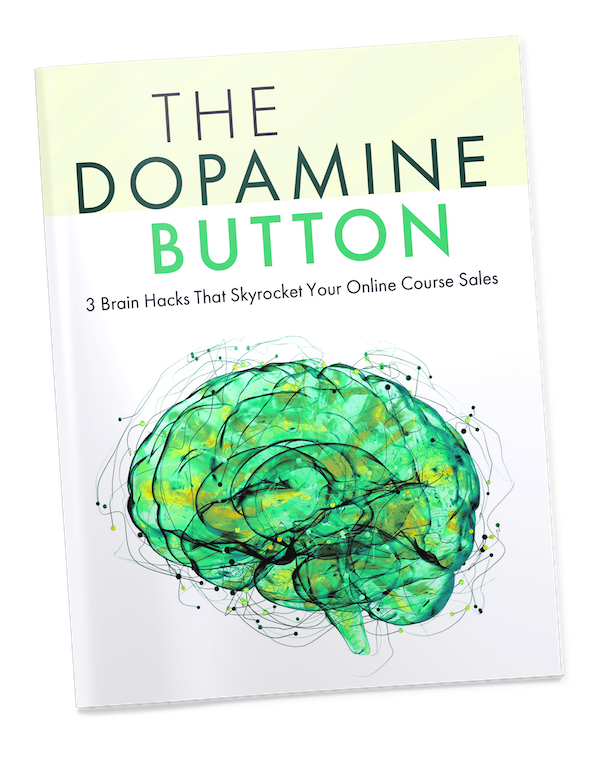
It’s called The Dopamine Button: 3 Brain Hacks That Skyrocket Your Online Course Sales (the original campaign page is no longer available, but you can check out Marisa’s site for her latest resources).

If you’re selling any kind of course, coaching program or digital product you’ll want to look into this.
Marisa will basically show you:
- The 3 simple “hacks” to turn your course into an engaging & fun experience students WANT to take over and over — tapping into Core Drive 3: Empowerment of Creativity & Feedback
- The counterintuitive strategy Marisa developed to instantly stand out from the competition and make more sales than ever — aligned with Core Drive 2: Development & Accomplishment
- The secrets of Silicon Valley’s “tech bros” that practically guarantee customer success and automatic testimonials — driven by Core Drive 5: Social Influence & Relatedness
I was so excited about this free guide that I asked to partner up with her.
Hopefully we’ll see more from this partnership soon!
Check out Marisa Murgatroyd’s site here
Related Reading
- The Octalysis Framework for Gamification & Behavioral Design
- What is Gamification? Definition, Examples & Framework
- Actionable Gamification: Beyond Points, Badges & Leaderboards
- Learn from an OP Member who made $33M
- The 10 Best Productivity Apps That Use Gamification
- 90+ Gamification Examples & Cases with ROI Stats
Have you heard of the Great Resignation?
That’s when people quit their jobs during COVID-19, and ride off into the sunset to start a new glorious journey of self-employment.
But guess what, the Great Resignation is turning into the Great Regret for many people, as they struggle to find viable ways to stay afloat without a job.
In fact, even now 29% of those who quit their jobs have gone back to full-time employment (and those are the lucky ones, many of them can’t even get their jobs back).
At the same time, the online education industry is nearing a billion dollars A DAY in sales.
That’s a lot of people buying a lot of courses!
Don’t you feel there is some kind of imbalance here, AKA a Great Opportunity!
Now many people want to create an online course, but most would-be course creators end up throwing their courses in the trash because of low sales, low engagement and low student results.
So how do you avoid the dreaded course graveyard and create a course your students not only buy and finish, but will get so much value from they buy from you again and again?
Of course, one way is just to upgrade your fundamental skills in the Octalysis Framework and Behavioral Design through my Octalysis Prime mentorship program (It’s like downloading my brain with over 1000 videos on understanding how the human mind works and creating desired behaviors).

⚡ Speed Run Notes
- The online course business is structurally gamification — you're selling a behavior change wrapped in a lesson. The content is the packaging. The behavior change is the product. Course creators who understand this outperform creators who think they're selling information.
- The first course should teach one specific transformation, not a topic. “Intro to Marketing” is a topic. “Get your first 100 email subscribers in 30 days” is a transformation. The transformation sells; the topic sits on shelves.
- CD2 (Accomplishment) is the drive students buy, even when they think they're buying information. They want to feel capable at the end. Courses that don't engineer that feeling — even accurate, well-taught courses — are remembered as “I never finished it.” Accomplishment is the retention metric.
- Course completion rates are the honest metric, not signups. High-signup/low-completion is a cash grab. High-signup/high-completion is a real business. The difference shows up in word of mouth, which is the real growth engine for courses.
- The deepest insight: the best courses are communities wearing a curriculum as disguise. Students pay for the material and stay for the people. The community is where long-term retention lives. Courses without community are one-time transactions; courses with community are subscriptions with lifetime value.