

What if the most powerful classroom tool wasn’t a textbook, but a game?
Research shows that 80% of learners report higher effectiveness with gamified learning, and the gamification in education market is projected to grow from $3 billion in 2025 to over $40 billion by 2035. The evidence is clear: when you design learning experiences using the right motivational Core Drives, students don’t just learn more. They want to learn more.
This article breaks down five educational games that prove it. Each one uses specific behavioral design principles from the Octalysis Framework, from Core Drive 2: Development & Accomplishment to Core Drive 3: Empowerment of Creativity & Feedback — to transform subjects like math, reading, writing, history, and entrepreneurship from chores into adventures.

Written by Christine Yee, with Octalysis analysis by Yu-kai Chou
⚡ Speed Run Notes
- The five games: Timez Attack (multiplication), Raz-Kids (reading), BoomWriter (writing), Frequency 1550 (history), and Dinorama (entrepreneurship and personal finance).
- Each game succeeds by activating specific Octalysis Core Drives: accomplishment, creativity, ownership, and social influence, rather than relying on rote memorization.
- Dinorama stands out as a rare educational game that uses Black Hat Core Drives (Scarcity, Unpredictability, Loss) to simulate real business pressure.
- Researchers at the University of Amsterdam and the University of Utrecht found students using Frequency 1550 remembered more and showed higher mastery than peers in traditional classes.
- Games supplement a curriculum best when students also design their own games, exercising Core Drive 3: Empowerment of Creativity & Feedback.
Table of Contents
- Why Academic Games Work Better Than Flashcards
- 1. Timez Attack — Making Multiplication an Adventure
- 2. Raz-Kids — Turning Reading Into a Reward Loop
- 3. BoomWriter — Collaborative Storytelling That Hooks Young Writers
- 4. Frequency 1550 — GPS-Powered History Lessons
- 5. Dinorama — Teaching Kids Entrepreneurship Through a Dinosaur Park
- The Value and Challenge of Education Gamification
About Yu-kai Chou: Human-Systems Architect

Yu-kai Chou created the Octalysis Framework after studying gamification since 2003 — years before the term entered mainstream vocabulary. As a Human-Systems Architect & Behavioral Designer, his framework has been applied by LEGO, Microsoft, Porsche, Coca-Cola, Salesforce, and MrBeast, impacting over 1.5 Billion Users.
Chou has taught the Octalysis methodology at Harvard, Stanford, Yale, Tesla, Google, BCG, and IDEO.
His work has been cited by Harvard, Stanford, MIT, Forbes, Wall Street Journal, Wired, US Department of Energy, NIST, NSF, NCBI, US Department of Education, ClinicalTrials.gov, and Google Scholar — with 3,700+ more academic publications. Explore his books here.

Why Academic Games Work Better Than Flashcards
Academic games are learning games designed to teach curriculum subjects (math, reading, writing, history) through play instead of rote memorization. The best academic games for students turn practice into a quest with clear goals, instant feedback, and real stakes, which is why they beat flashcards for long-term retention.
Learning should be fun. But that’s not the experience most kids have in conventional schooling.
Reading and math can be frustrating for a child who doesn’t understand the underlying concepts or the larger picture of what they’re learning. In many cases, students are structurally encouraged to rote memorize information and go through the motions of a curriculum.
Without the right building blocks for comprehension and critical thinking, school becomes more daunting as courses get harder with each grade level.
By integrating imagination, creativity, and game mechanics with the desired information, knowledge comes to life in meaningful ways. Compared to traditional grading systems, this offers a far more effective way to inspire Core Drive 2: Development & Accomplishment as well as Core Drive 3: Empowerment of Creativity & Feedback.
Immersive game environments incorporate visual, auditory, and tactile modes of exchanging information with players. This creates an interactive learning environment where engagement is the key to success.
The rewards gained from feeling a genuine sense of achievement, and having the ability to creatively solve and master challenges become far more meaningful than a letter on a report card.
With games, it’s also possible to leverage other forms of motivation such as Core Drive 4: Ownership & Possession and Core Drive 5: Social Influence & Relatedness to add a greater sense of personal meaning and significance to what students are learning.
Here are five examples of educational games that demonstrate these principles in action.
1. Timez Attack — Making Multiplication an Adventure
The conventional way of teaching multiplication tables is through flash cards. The prime example of rote learning.
No one really enjoys mindless memorization tasks, but it’s considered effective for making basic information stick. The game Timez Attack (now part of Imagine Learning) demonstrates a better way for kids to master this basic math skill.
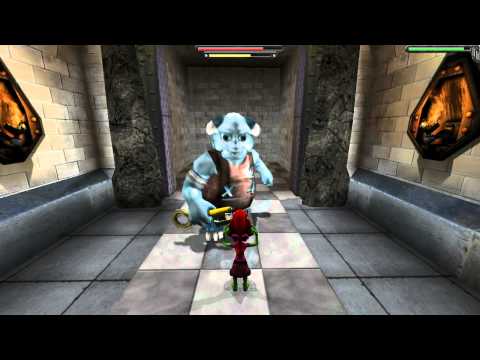
The graphics are done in 3D animation and the story takes place in a castle-like setting, putting kids in the mode of playing an immersive, adventurous video game.
The player demonstrates their visual understanding of problems like 2×2 by throwing sets of numbers at a wall. They figure out how many number sets equate to the multiplication problem. Getting this right is an example of Core Drive 3: Empowerment of Creativity & Feedback. The player feels clever for solving it their own way.
Periodically, an ogre appears to jog the player’s memory of previous multiplication questions, reinforcing long-term retention. Getting past the ogre by producing the right answer triggers Core Drive 2: Development & Accomplishment as students grow more confident in their mastery.
2. Raz-Kids — Turning Reading Into a Reward Loop

Raz-Kids is an animated e-book repository where subtle game mechanics are woven into the reading experience. Reading is something many kids struggle with throughout their school years, and without the right foundation, it becomes an unpleasant chore.
Raz-Kids helps students master sight reading and phonics interactively. It includes a microphone feature where kids can record themselves reading aloud.
Recordings can be saved for parents and teachers to listen to and provide feedback. A natural application of Core Drive 5: Social Influence & Relatedness. It also gives kids a chance to step back and hear themselves read, processing the concepts being conveyed.
Comprehension quizzes reinforce what they’ve learned. Students earn stars as they pass quizzes, which can be spent as virtual currency to personalize their rocket clubhouse. A classic example of Core Drive 4: Ownership & Possession that gives students something to call their own.
3. BoomWriter — Collaborative Storytelling That Hooks Young Writers
How do you teach children to love writing and develop their creative skills?
BoomWriter offers the opportunity for kids to create stories and build their abilities through online collaboration. It’s largely driven by Core Drive 5: Social Influence & Relatedness.
Published guest authors contribute story starters. Students in a class choose one and write additional chapters. Teachers view submissions and make suggestions and edits as needed.
The chapters are read to the class (without names revealed) and students vote on which ones make it into the final book, which can then be sold in the BoomWriter stores. That’s Core Drive 2 (accomplishment of being selected) combined with Core Drive 4 (ownership of a published book).
For students whose entries make it in, Boom Dollars are awarded and can be spent on accessories for their personal avatar. Each profile displays scores like number of books published, entries submitted, and peer votes received.
4. Frequency 1550 — GPS-Powered History Lessons

Note: 7scenes, the original developer, has rebranded as Stqry.
Frequency 1550 focused on teaching history to middle school students using a combination of mobile and GPS technology. It integrated historical sites in Amsterdam with actual learning goals from the school curriculum.
The overall objective was to complete as many assignments as possible to earn points (Core Drive 2). Tasks included answering questions about various locations and creating relevant media (videos and photos), which activated Core Drive 3: Empowerment of Creativity & Feedback.
Researchers at the University of Amsterdam and the University of Utrecht compared learning outcomes. The result: students who learned through Frequency 1550 remembered significantly more and demonstrated much higher mastery compared to the control group using traditional curricula.
This is a powerful example of how gamification can turn passive information consumption into active, location-based learning.
5. Dinorama — Teaching Kids Entrepreneurship Through a Dinosaur Park

For kids who want to make a dream or idea a reality, understanding entrepreneurship early is invaluable.
Dinorama is an app where players run their own dinosaur park. A direct activation of Core Drive 4: Ownership & Possession. They feed and care for their animals while learning financial concepts: earning interest by keeping money in a bank, distinguishing necessary versus nice-to-have expenses, maintaining an emergency fund, adjusting spending when customers drop, and purchasing inventory in bulk for volume discounts.
While most educational games rely on White Hat Core Drives (the positive, feel-good motivators), Dinorama is somewhat unique. It naturally incorporates Black Hat Core Drives that are intrinsic to running a business:
- Core Drive 6: Scarcity & Impatience, where limited resources force prioritization
- Core Drive 7: Unpredictability & Curiosity, with unexpected events like supply shortages
- Core Drive 8: Loss & Avoidance, with consequences for poor financial decisions
These variables teach kids to plan for and mitigate real-world consequences by taking appropriate action in the present.
Here is how the two families map onto the Octalysis octagon. The White Hat Core Drives sit at the top:

The Black Hat Core Drives that power Dinorama’s tension sit at the bottom:

The Value and Challenge of Education Gamification
Games are excellent tools for supplementing how information is taught. Through imaginative contexts and game mechanics, what was once perceived as boring comes to life.
However, a gamified curriculum should not completely replace traditional reading assignments.
Paul Anderson, an AP Biology teacher in Montana, discovered that while his use of gamification helped students easily master complicated concepts, they remained weak in reading comprehension. Students will still face complex reading materials at the university level and in their careers. They can’t always depend on fun games to help them excel.
The solution? Ask students to create their own game designs to exercise their ability to reframe dry subject matter in imaginative ways. This activates Core Drive 3: Empowerment of Creativity & Feedback at the highest level. The student becomes the designer, not just the player.
Related Reading
- The Octalysis Framework for Gamification & Behavioral Design
- What is Gamification?
- Top 10 Education Gamification Examples
- Core Drive 3: Empowerment of Creativity & Feedback
- Best Gamification Education Apps
- Books by Yu-kai Chou