
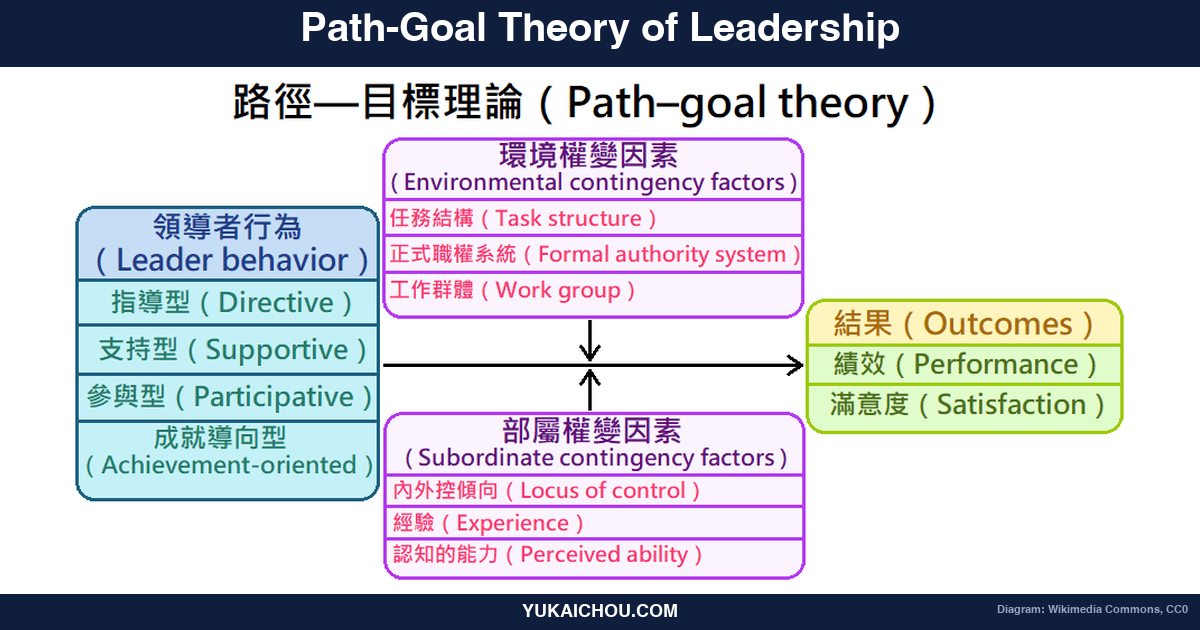

Short answer: Path-Goal Theory is a contingency theory of leadership holding that a leader’s job is to clear obstacles on the path between a subordinate and a goal, then choose the behavior that makes the remaining path feel walkable.
Robert House published it in 1971, and the four familiar styles — Directive, Supportive, Participative, and Achievement-Oriented — arrived in 1974 with Terence Mitchell.
The theory’s predictive power sits in its two contingency moderator sets: subordinate characteristics (ability, locus of control, affiliation needs, authoritarianism) and environmental characteristics (task structure, formal authority, work group cohesion).
House published a reformulated eight-behavior version in 1996 that he considered the corrected theory, and it is rarely taught.
Robert House published Path-Goal Theory in 1971 with a single, almost embarrassingly simple claim: the leader’s job is to clear obstacles between the worker and the goal, then choose the behavior that makes the path feel walkable. Fifty-five years later, every workplace gamification deck still reaches for “directive, supportive, participative, achievement-oriented” like it explains why a team is stuck. Most of those decks miss the part that actually matters.
The part that matters is not the four styles. It is the contingency formula sitting underneath them — the claim that the right style is a function of two moderating variables (who the subordinate is, what the environment already supplies) and that leaders who pick wrong are not just unhelpful, they are actively demotivating. If your team is checked out, Path-Goal Theory says the answer is rarely “be more supportive.” It is almost always “stop providing what the environment already provides, start providing what it doesn’t.”
This guide rebuilds Path-Goal Theory from the original 1971 paper, the 1974 four-style expansion, and House’s own 1996 reformulation. Then it lays the framework against the Octalysis Core Drives to show which leadership behavior activates which motivational engine, and where the theory quietly underspecifies the answer. By the end you will have a 6-step audit you can run on your own team this week to find out which style each direct report actually needs, and the publicity test that separates legitimate leadership calibration from comfort-zone management.
Speed Run Notes
- Path-Goal Theory is a contingency theory: there is no best leader style. The right style is the one that fills the gap between what the environment already provides and what the worker needs to reach the goal.
- Four leader behaviors (Directive, Supportive, Participative, Achievement-Oriented) moderated by two contingency sets: subordinate characteristics + environmental characteristics. Style + context predict outcomes.
- The 1996 reformulation expanded to 8 behaviors and named the path-clarification mechanism explicitly. The field never adopted it, which is a problem for the original 4-style version everyone still uses.
- Octalysis crosswalk: Directive fires Core Drive 2 + lowers Core Drive 8; Supportive fires Core Drive 5; Participative fires Core Drives 3 + 4; Achievement-Oriented fires Core Drives 2 + 1.
- Wofford & Liska 1993 meta-analysis (120 studies): Supportive leadership predicts satisfaction (r=.25); Directive shows the predicted moderation by task structure but with smaller effects.
- The Elephant: most leaders pick the style they are comfortable with, then call it “the right style for this situation.” Path-Goal Theory was meant to be the discipline that breaks that loop. It mostly hasn’t.
In This Article
- What Is Path-Goal Theory?
- The Four Leader Styles
- The Two Contingency Moderator Sets
- House’s 1996 Reformulation
- What House Got Right
- Where Path-Goal Theory Falls Apart
- What’s Really Happening Inside the Brain
- Path-Goal Theory vs Other Theories
- Path-Goal Theory in the Real World
- The Elephant in the Room
- How to Apply Path-Goal Theory with the Octalysis Framework
Author Credibility: Yu-kai Chou

Yu-kai Chou created the Octalysis Framework after studying gamification since 2003 — years before the term entered mainstream vocabulary. As a Human-Systems Architect & Behavioral Designer, his framework has been applied by LEGO, Microsoft, Porsche, Coca-Cola, Salesforce, and MrBeast, impacting over 1.5 Billion Users.
Chou has taught the Octalysis methodology at Harvard, Stanford, Yale, Tesla, Google, BCG, and IDEO.
His work has been cited by Harvard, Stanford, MIT, Forbes, Wall Street Journal, Wired, US Department of Energy, NIST, NSF, NCBI, US Department of Education, ClinicalTrials.gov, and Google Scholar — with 3,700+ more academic publications. Explore his books here.

What Is Path-Goal Theory?
Path-Goal Theory is a contingency theory of leadership published by Robert J. House in 1971 in Administrative Science Quarterly. The theory makes a single load-bearing claim: a leader’s effectiveness depends on the behavior the leader chooses, and the right behavior is a function of two contingency sets — the characteristics of the subordinate and the characteristics of the work environment. There is no universally best style.
The intellectual lineage matters. House built Path-Goal Theory on top of Victor Vroom’s 1964 expectancy theory of motivation. Vroom’s claim was that motivation equals expectancy (the perceived probability that effort produces performance) times instrumentality (the perceived probability that performance produces rewards) times valence (the perceived attractiveness of the rewards). House asked a follow-on question: what does the leader do that moves any of those three terms? Path-Goal Theory was his answer.
The metaphor is literal. A subordinate is walking a path from current effort toward a future goal. The path has obstacles. Some obstacles are about clarity (the worker doesn’t know what good looks like). Some are about ability (the worker has the goal but not the skill). Some are about environment (the team is hostile, the task is ambiguous, the formal authority system is unclear). The leader’s job is to look at the specific path this specific worker is walking, identify which obstacle is currently in the way, and supply the leadership behavior that removes it.
Here is the part most summaries miss. House’s original framing was deliberately functional, not personality-based. He was not saying “some leaders are directive, some are supportive.” He was saying “the same leader uses different behaviors with different subordinates and at different times, because the obstacle in the path is different.” Trait theories of leadership had collapsed in the 1960s under Stogdill’s reviews. Path-Goal Theory was part of a generation of theories — alongside Fiedler‘s Contingency Theory and Hersey & Blanchard’s Situational Leadership — that replaced “what kind of leader are you” with “what does this situation require.” The original House framing has more in common with Situational Leadership than most modern uses of the four styles suggest.
The empirical record on the original 1971 formulation is mixed. Wofford & Liska’s 1993 meta-analysis of 120 studies found Supportive leadership predicts satisfaction reliably (r=.25) and shows weak but consistent moderation by environmental ambiguity. Directive leadership shows the predicted negative moderation by task structure (more useful when the task is unclear, less useful when clear) but with effect sizes smaller than House anticipated. Participative leadership shows positive effects on satisfaction when subordinates have high autonomy needs, weaker effects otherwise. Achievement-Oriented leadership shows the smallest and most context-dependent effects in the meta-analytic record.
None of that killed the theory’s influence on practice. The four-style typology is one of the most-cited leadership frameworks in business schools and MBA programs. The question is whether that influence is because the theory is right, or because the typology is just intuitive enough to be memorable and just vague enough to fit any situation after the fact. The honest answer is closer to the second than the first.
The Four Leader Styles
House’s 1971 paper named two styles — Directive and Supportive — drawing on the Ohio State leadership studies (Initiating Structure and Consideration). The 1974 paper with Mitchell added Participative and Achievement-Oriented. The full four-style typology is what gets taught today.
Directive Leadership
Directive leadership (originally called “instrumental” in the 1971 paper) is the behavior of telling subordinates what to do, when to do it, and how to do it. It includes clarifying roles, setting performance standards, scheduling work, and explaining the rules. Directive behavior is most useful when the task is ambiguous, the worker is new, the rules are unclear, or the worker lacks ability. It is most counterproductive when the task is already well-structured and the worker already knows what good looks like — under those conditions Directive leadership reads as micromanagement and dampens motivation.
The Octalysis mechanism is clean. Directive leadership activates Core Drive 2 (CD2): Development & Accomplishment by making the path to mastery explicit, and reduces Core Drive 8 (CD8): Loss & Avoidance by removing the dread of not knowing what is expected. The structural failure mode is that leaders who default to Directive behavior with experienced workers convert a CD2 lift into a CD8 spike (the worker feels distrusted), then call the resulting disengagement “low motivation.”
Supportive Leadership
Supportive leadership is the behavior of being friendly, approachable, concerned for subordinate well-being, and treating subordinates as equals. House drew it from the Ohio State Consideration dimension. Supportive behavior is most useful when the task is stressful, tedious, or dangerous — conditions where the environment is supplying a lot of negative affect that the leader needs to buffer. It is least differentiating when the task is already pleasant and the social fabric is already strong.
The Octalysis mechanism is also clean. Supportive leadership activates Core Drive 5 (CD5): Social Influence & Relatedness by creating the relational substrate that converts arms-length employment into actual social bond. Frederic Laloux’s Reinventing Organizations work on Teal organizations is downstream of the same insight, even though it does not cite Path-Goal Theory: the relational layer is not a soft skill, it is a structural buffer against environmental stressors that would otherwise crush performance.
Participative Leadership
Participative leadership is the behavior of consulting subordinates, soliciting their input, and incorporating their suggestions into decisions. It is most useful when subordinates have high need for autonomy, when they have task-relevant expertise the leader does not, and when the decision affects them in ways they will have to live with. It is least useful when the decision must be made quickly, when subordinates lack the information needed to contribute meaningfully, or when subordinates have low ego involvement with the task.
The Octalysis mechanism is the cleanest of the four. Participative leadership activates Core Drive 3 (CD3): Empowerment of Creativity & Feedback by giving subordinates real input into the decision shape, and activates Core Drive 4 (CD4): Ownership & Possession by converting the resulting decision into something the worker partly authored. The structural failure mode is theatrical participation — the leader who solicits input then ignores it. Theatrical CD3 is worse than no CD3 because it conditions workers to expect a stake they will not get.
Achievement-Oriented Leadership
Achievement-Oriented leadership is the behavior of setting challenging goals, expecting subordinates to perform at their highest level, and showing confidence that they will meet the standard. House and Mitchell added this style in 1974 to address the gap they saw in the original two styles — neither Directive nor Supportive captured the leader behavior that pulls subordinates upward through challenge. Achievement-Oriented is the closest the original Path-Goal Theory comes to what Bass would later name Transformational Leadership.
The Octalysis mechanism: Achievement-Oriented activates Core Drive 2 (CD2): Development & Accomplishment through the challenge-confidence pairing, and activates Core Drive 1 (CD1): Epic Meaning & Calling when the challenging goal is framed as part of a larger purpose. The empirical record is weakest here — the style works when subordinates already have high need for achievement (McClelland 1961 nAch construct), much less so otherwise. This is one of the places where the contingency moderation is doing more work than the style itself.
The Two Contingency Moderator Sets
The four styles are only half of Path-Goal Theory. The other half is the two contingency moderator sets that determine which style fits a given situation. Skip these and you have a personality typology, not a contingency theory.
Subordinate Characteristics
Four subordinate characteristics moderate the style-outcome relationship. Ability: subordinates with high task ability find Directive leadership redundant and demotivating. Low-ability subordinates need it. Locus of control: subordinates with internal locus of control (those who believe outcomes are under their own control) prefer Participative leadership. Subordinates with external locus prefer Directive. Need for affiliation: high-affiliation subordinates respond more strongly to Supportive leadership; low-affiliation subordinates may find it intrusive. Authoritarianism: high-authoritarian subordinates accept Directive leadership readily; low-authoritarian subordinates resist it.
None of these are personality fixed traits the leader cannot influence. They are state-trait blends. A worker’s locus of control can shift based on whether the work environment has given them legitimate reasons to believe their actions matter. A worker’s apparent need for affiliation can be downstream of how isolated the work has been. The contingency moderation is real, but the moderator variables are themselves partly downstream of prior leadership choices.
Environmental Characteristics
Three environmental characteristics moderate the style-outcome relationship. Task structure: highly-structured tasks (assembly line, routine processing) reduce the value of Directive leadership; ambiguous tasks (research, creative work) increase it. Formal authority system: strong, clear authority structures (military, regulated industries) substitute for Directive leadership. Weak structures require the leader to supply what the system does not. Primary work group: cohesive, supportive work groups substitute for Supportive leadership. Fragmented or hostile groups require the leader to compensate.
The crucial design implication is the substitution principle. If the environment already supplies clarity (clear task structure, strong authority system), Directive leadership is redundant and dampening. If the environment already supplies relational support (cohesive work group, mentorship culture), Supportive leadership is redundant. The leader’s job is to fill what the environment leaves missing, not to layer the leader’s preferred behavior on top of what the environment is already providing.
Steven Kerr and John Jermier formalized this insight in 1978 as the “Substitutes for Leadership” theory — an extension of Path-Goal Theory that ended up being more influential than the original four-style typology, because it answered the question Path-Goal Theory was implicitly asking but did not explicitly state: when does a leader add value, and when does the leader just add noise?
House’s 1996 Reformulation
By the mid-1990s, House had spent 25 years watching the empirical record on the four-style version come in mixed at best. His 1996 reformulation in The Leadership Quarterly, “Path-goal theory of leadership: Lessons, legacy, and a reformulated theory,” was an attempt to fix what he saw as the field’s misreading of the original theory.
The reformulation expanded the four behaviors to eight: Path-Goal Clarifying, Achievement-Oriented, Work-Facilitation, Supportive, Interaction-Facilitation, Group-Oriented Decision Process, Representation-Networking, and Value-Based. House also named the mediating mechanism explicitly — the leader’s behavior affects subordinate motivation through three channels: making the work meaningful (CD1 territory in Octalysis terms), increasing subordinate self-efficacy (CD2 territory), and clarifying the path between effort and outcome (the original 1971 mechanism).
The field largely did not follow. The eight-behavior typology was too granular to teach in a single class session. The original four-style version stayed in textbooks. Most modern uses of Path-Goal Theory cite the 1971 paper or the 1974 Mitchell collaboration, not the 1996 reformulation that House himself considered the corrected version. This is one of the most-noted failures of academic theory propagation in organizational behavior — the corrected version was published, peer-reviewed, and largely ignored.
The lesson for practitioners is to read Path-Goal Theory as a research program, not a frozen 1971 typology. The mechanism House named in 1996 (meaningfulness + self-efficacy + path clarification) maps cleanly onto the Octalysis Core Drives in a way the original four styles do not. CD1 is meaningfulness. CD2 is self-efficacy. The path clarification is the bridge that connects expectancy to instrumentality in Vroom’s 1964 equation. If you teach Path-Goal Theory at all, teach the 1996 version.
What House Got Right
The deepest thing House got right was the substitution principle. The leader’s job is not to perform a style. The leader’s job is to look at what the environment is already providing and supply what it is not. Most leadership writing before 1971 was about what good leaders do; Path-Goal Theory was about what good leaders supply. The shift from doing to supplying is small in language but large in implication.
The second thing House got right was the dyadic specificity. The right style depends on this specific subordinate’s characteristics, not the team’s average characteristics. A leader running the same Directive style across an experienced senior and a newly-hired junior is making two different mistakes at once — over-directing the senior and under-directing the junior. The Path-Goal Theory frame demands per-dyad calibration. Graen and Uhl-Bien’s Leader-Member Exchange Theory extended this dyadic-specificity claim into a full theory of relationship quality differentiation; Path-Goal Theory got there first on the behavior-calibration side.
The third thing House got right was treating leader behavior as an instrument that affects motivation through specific mediating mechanisms, not a black box. The 1996 reformulation made the mechanisms explicit (meaningfulness, self-efficacy, path clarification). Most pre-1971 leadership writing assumed leadership effects were direct — “good leadership causes good performance.” House insisted the chain runs through the subordinate’s cognition and motivation. That insistence is what made Path-Goal Theory compatible with the cognitive-behavioral turn in organizational psychology in the 1980s, while older trait theories died on the vine.
The fourth thing House got right, in spirit even where he got it wrong in the specifics, was the contingency-moderation logic. Even where the original four-style empirical record is mixed, the meta-claim that “the right behavior depends on what the worker and the environment require” is a permanent part of how organizational psychology thinks about leadership now. Every contingency theory of leadership since 1971 — Situational Leadership, Substitutes for Leadership, Vroom-Yetton, Leader-Member Exchange — sits in a conceptual space House helped open.
Where Path-Goal Theory Falls Apart
Critique 1: The Construct Overlap Problem
The four styles are not orthogonal. Directive leadership is empirically close to the Ohio State Initiating Structure dimension. Supportive leadership is empirically close to the Ohio State Consideration dimension. Participative leadership overlaps heavily with Vroom-Yetton’s decision-making styles. Achievement-Oriented leadership overlaps with the Transformational Leadership Inspirational Motivation dimension. Schriesheim and Neider (1996) showed that the four styles fail discriminant validity in most factor-analytic studies — they collapse into two or three underlying factors, not four.
The practical implication is that a leader who is rated “high on Supportive” by subordinates is probably also being rated high on at least one other style. The leader’s self-perception of having a distinctive Participative style may not match what subordinates perceive. The four-style language gives leaders a vocabulary for self-categorization that the empirical structure does not support.
Critique 2: The Mediation Black Box
The 1971 paper claimed leader behavior affects subordinate motivation through expectancy, instrumentality, and valence (the three terms of Vroom’s equation). Subsequent empirical work struggled to measure those mediators cleanly. By 1996 House himself proposed three different mediators (meaningfulness, self-efficacy, path clarification). The field has never converged on which mediators actually do the work, which means the theory cannot tell a practitioner why a given leadership intervention worked or failed in a given case. “It was the right style for the situation” is post-hoc; the theory does not predict the mediator path the leadership effect traveled through.
This is where Octalysis adds prescriptive value the original theory does not. The Core Drive crosswalk specifies which motivational mechanism each leader behavior activates, so a leader who tried Supportive leadership and got no response can ask “was the CD5 channel blocked, or was the environment already supplying CD5 such that more Supportive behavior is redundant?” Path-Goal Theory cannot ask that question in its own vocabulary.
Critique 3: The Measurement Instrument Drift
There is no single canonical Path-Goal Theory measurement instrument. House and his collaborators used different scales across different studies. Indvik 1986 used one operationalization, Wofford and Liska 1993 normalized across multiple. The lack of a canonical instrument is partly why the meta-analytic record is so mixed — studies are not all measuring the same thing. Compare to the Leader-Member Exchange literature, which converged on the LMX-7 instrument by the mid-1990s and saw effect sizes stabilize as a result, or to the Authentic Leadership literature which converged on the ALQ. Path-Goal Theory never had its LMX-7 moment. The 1996 reformulation should have included a canonical instrument; it didn’t.
What’s Really Happening Inside the Brain
Path-Goal Theory predates the neuroscience tools that would let us specify what each leader behavior is doing to the subordinate’s brain. Three decades of neuroimaging work since the 1990s has filled in the picture, and it largely vindicates House’s mediator intuitions even where the original theory could not name them.
Directive leadership reduces ambiguity in the prefrontal cortex’s task-representation circuits. Wolfram Schultz’s 2016 review in Nature Reviews Neuroscience on reward-prediction-error signaling shows that ambiguous task structures produce sustained anterior cingulate cortex activation associated with cognitive load and uncertainty stress. Clear task structure (from environment or leader) reduces that load. This is the neural correlate of the CD8 reduction the Octalysis crosswalk names — the worker is not experiencing “less stress” abstractly, the worker’s brain is doing less work to construct the task representation.
Supportive leadership activates the social-cognition circuits Matthew Lieberman maps in Social: the medial prefrontal cortex, temporoparietal junction, and right inferior frontal gyrus that handle other-person mentalizing. Lieberman’s “social pain hypothesis” work with Naomi Eisenberger showed that social exclusion activates the same anterior cingulate regions as physical pain. Supportive leadership is the inverse: it produces the social-inclusion signal that quiets the same regions. The CD5 mechanism is not metaphorical; it is a measurable neural state.
Participative leadership activates the medial prefrontal cortex differently — through self-referential processing (Northoff et al 2006) and the sense of agency associated with anterior insula activation in choice tasks. The CD4 mechanism (Ownership) shows up in the brain as the same agency-network activation that distinguishes self-caused outcomes from observed-other outcomes. The empirical implication is that theatrical Participative leadership — soliciting input that does not affect the decision — produces the agency-network activation initially, then a sharper deactivation when the worker discovers their input was ignored. The neural cost of theatrical participation may be higher than no participation at all.
Achievement-Oriented leadership activates the dopaminergic reward-prediction circuits in the ventral tegmental area and ventral striatum, but only when the challenging goal is perceived as both stretch and achievable. Wolfram Schultz’s reward-prediction-error work shows that goals perceived as unachievable produce no anticipatory dopamine signal — the brain treats them as not-worth-pursuing. The CD2 + CD1 channel the Octalysis crosswalk names requires the challenge be calibrated; the wrong dose collapses the mechanism entirely.
Path-Goal Theory vs Other Theories
vs Situational Leadership (Hersey & Blanchard 1969)
Both are contingency theories. Both name leader styles and contextual moderators. The difference is the moderator variable. Situational Leadership uses follower readiness (a blend of ability and willingness) as the single moderator and maps to four leader styles (Telling, Selling, Participating, Delegating). Path-Goal Theory uses two moderator sets (subordinate characteristics + environmental characteristics) and maps to four different leader styles. Path-Goal Theory’s environmental moderator is the key distinction — Situational Leadership has no place to put “the environment already supplies clarity, so leader Directive behavior is redundant.” Path-Goal Theory does. In practice, the two theories complement: use Situational Leadership for the developmental progression (Telling to Delegating as readiness grows), use Path-Goal Theory for the environmental substitution check (does the environment already supply what I’m about to supply?).
vs Leader-Member Exchange Theory (Graen & Uhl-Bien 1995)
Path-Goal Theory is style-focused; LMX is relationship-focused. Path-Goal Theory says the leader chooses a behavior style to fit the subordinate and environment. LMX says the leader develops different-quality relationships with different subordinates over time (in-group versus out-group), independent of style. The two are compatible: a leader can run a different Path-Goal Theory style for each subordinate, and the cumulative effect of those style choices is partly what constructs the in-group/out-group differentiation LMX measures. The LMX-7 instrument measures the outcome state; Path-Goal Theory specifies the behavioral inputs that move that state.
vs Transformational Leadership (Bass 1985)
Path-Goal Theory is largely transactional — it specifies the leader behavior that clarifies the path between current effort and current reward. Bass’s Transformational Leadership adds the dimension Path-Goal Theory’s Achievement-Oriented style was reaching for but never fully developed: the leader behavior that changes what subordinates value, not just what they do. Bass’s Idealized Influence, Inspirational Motivation, Intellectual Stimulation, and Individualized Consideration components map loosely onto Path-Goal Theory’s four styles (with Achievement-Oriented closest to Inspirational Motivation), but the mechanism is different. Transformational Leadership changes the subordinate’s valence term in Vroom’s equation; Path-Goal Theory changes the expectancy and instrumentality terms.
vs Expectancy Theory (Vroom 1964)
Path-Goal Theory is the leader-behavior extension of Expectancy Theory. Vroom specified the cognitive equation subordinates use to compute motivation. House specified the leader behaviors that affect each term of that equation. The two are not competing theories; they are nested. Path-Goal Theory is the answer to “what does the leader do that moves the expectancy or instrumentality terms in Vroom’s equation?” When the empirical record on Path-Goal Theory comes in mixed, part of the issue is that the underlying Expectancy Theory measurements were also mixed. The contingency moderation that does the work in Path-Goal Theory is partly the moderation that already exists in Vroom’s equation when measured carefully.
Path-Goal Theory in the Real World
Software Engineering Management
Software engineering teams are the cleanest contemporary test bed for Path-Goal Theory because the four styles map almost directly onto observed engineering-management archetypes. Directive leadership is the technical-lead pattern where the senior engineer specifies architecture, sets coding standards, and reviews critical PRs. Supportive leadership is the engineering-manager pattern where the manager handles 1:1s, career conversations, and emotional regulation during incidents. Participative leadership is the RFC-and-design-doc culture where major decisions go through written proposal and team review. Achievement-Oriented leadership is the staff-engineer pattern where someone names an ambitious technical goal (rewrite the deployment pipeline, kill the legacy service, eliminate the on-call paging volume) and recruits the team into it.
The Path-Goal Theory diagnostic is that high-functioning teams have at least one person playing each style well, and the four styles are not necessarily the same person. Will Larson’s Staff Engineer and Camille Fournier’s The Manager’s Path both describe this as a structural division. The Path-Goal Theory contribution is that the division is not just a labor-allocation convenience — it is a contingency match. The same team needs different styles for different members at different times, and treating the four styles as the responsibility of a single manager guarantees that manager will under-supply three of them.
Healthcare Leadership
Healthcare teams are the highest-stakes Path-Goal Theory test bed because the environmental moderator variability is enormous. An ICU charge nurse on a code is running Directive leadership pure (the path to the goal — stabilizing the patient — is clear and the standard protocols supply path clarification at machine speed). The same nurse running a unit-staffing conversation an hour later needs Participative leadership (the path is unclear, subordinate input is essential, the environment is not supplying clarity). The same nurse mentoring a new graduate at end of shift needs Supportive leadership (the environmental stressors are high, the social fabric is the buffer). Healthcare leadership is where Path-Goal Theory’s style-shifting demand becomes most obvious: the same leader runs all four styles within an 8-hour shift, often within a 30-minute window, because the environment changes that fast.
The Aiken et al 2014 Lancet healthcare workforce study across 12 European countries showed that workplace burnout correlates with management failures that read in Path-Goal Theory terms as systematic under-supply of Supportive leadership in environments where the work itself supplies all the stressors. The structural fix is not “managers should be nicer.” The structural fix is “the environment is already at maximum stress load; the leader’s job is to supply the buffer the environment is not supplying.” That diagnostic phrasing is Path-Goal Theory’s contribution.
Remote and Distributed Work
Distributed work has reshuffled the Path-Goal Theory contingency moderators in ways the original theory could not have anticipated. The environmental moderator “primary work group” used to be largely a function of co-location; in a fully-distributed team, the primary work group exists only insofar as the leader and the team structure deliberately construct it. The “formal authority system” moderator used to be largely visible (org chart, badge colors, office layout); in distributed work, much of that visibility evaporates. The result is that distributed-team leaders need to supply MORE Supportive leadership and MORE Path-Goal Clarifying leadership than co-located leaders, because the environment supplies less of both. GitLab’s handbook-first remote culture and the asynchronous-by-default conventions Doist, Buffer, and Automattic developed are downstream applications of the Path-Goal Theory substitution principle, even when those teams do not cite it.
Cross-Cultural Leadership
House’s later work (after Path-Goal Theory) led the GLOBE Project — the largest cross-cultural study of leadership ever conducted, covering 62 societies and over 17,000 middle managers. GLOBE found systematic cross-cultural variation in which leader styles are seen as effective. High power-distance cultures (much of East Asia, the Middle East) tolerate and expect more Directive leadership; low power-distance cultures (Scandinavia, the Netherlands) expect more Participative. House’s contribution after Path-Goal Theory was the recognition that the contingency moderators include cultural variables the 1971 theory did not name. A US-trained manager running a US-default style mix in a Korean subsidiary is making a contingency-mismatch error Path-Goal Theory predicted but could not specify until GLOBE supplied the cross-cultural data.
The Elephant in the Room
Path-Goal Theory’s most uncomfortable claim is that most leaders pick the style they are personally comfortable with, then construct post-hoc justifications for why that style was right for the situation. The contingency moderation that the theory demands — pick the style that fills the gap between what the environment supplies and what the worker needs — is harder than the four-style typology suggests, because it requires the leader to act against personal preference when the contingencies demand it.
The leader who is naturally Supportive ends up running Supportive leadership with subordinates who needed Directive structure, then describes the resulting underperformance as “they weren’t motivated.” The leader who is naturally Directive ends up over-specifying tasks for senior subordinates who needed autonomy, then describes the resulting disengagement as “they couldn’t take feedback.” The leader who is naturally Participative ends up running theatrical consultation in situations that needed decisive action, then describes the resulting paralysis as “the team couldn’t reach consensus.” Each leader sees their default style as appropriate. Each is making the contingency error Path-Goal Theory exists to prevent.
The honest diagnostic is the publicity test imported from the Libertarian Paternalism pillar: would your current style choice for each direct report survive being described accurately to that direct report, including which contingency moderators you assessed and which leader behavior you concluded was the right fit? Most leaders cannot answer in the affirmative for most of their direct reports. They have not assessed the contingencies; they have run their default style and called it intentional. Path-Goal Theory says the default-style-and-rationalize pattern is the single most common leadership failure mode, and the 4-style typology was meant to be the discipline that breaks the pattern. In practice, the typology has often made the pattern worse — giving leaders four equally-respectable labels to attach to their default behavior.
The structural fix is not “be a better leader.” The structural fix is the Path-Goal Theory contingency audit applied per dyad, on a recurring cadence, with the publicity-test gate applied to each choice. The audit is uncomfortable because it forces the leader to confront the default-comfort pattern. The publicity test is uncomfortable because it forces the leader to verbalize the contingency assessment in a form the subordinate could evaluate. Both discomforts are the point. Leadership development that does not produce those discomforts is producing comfort, not development.
How to Apply Path-Goal Theory with the Octalysis Framework
This is the section the Path-Goal Theory literature has been missing for fifty years. The theory names four leader styles and two contingency moderator sets but does not specify which motivational mechanism each style activates inside the subordinate. The Octalysis Framework supplies the missing layer.

The Octalysis Framework with Game Techniques around each of the 8 Core Drives. Each Path-Goal Theory leader style activates a specific Core Drive bundle through specific behavioral surfaces.
The Style-to-Core-Drive Crosswalk
Each Path-Goal Theory leader style activates a specific Core Drive bundle. The crosswalk gives practitioners the prescriptive layer the original theory leaves implicit.
Directive leadership activates Core Drive 2 (CD2): Development & Accomplishment by making the path to competence explicit, and reduces Core Drive 6 (CD6): Scarcity & Impatience and Core Drive 8 (CD8): Loss & Avoidance by removing the dread of unclear expectations. Behavioral surfaces: written role definitions, performance standards documented in advance, scheduled work plans, explicit rule statements. The wrong-context failure mode is when the environment already supplies clarity (the task is well-structured, the standards are obvious), Directive behavior layers redundant clarity on top and the CD2 lift collapses into a CD8 spike as the worker reads the redundancy as distrust.
Supportive leadership activates Core Drive 5 (CD5): Social Influence & Relatedness by creating the relational substrate that buffers environmental stressors. Behavioral surfaces: regular 1:1s with non-task content, recognition of effort independent of outcome, accessibility during difficulty, treating subordinates as full persons rather than function-holders. The wrong-context failure mode is when the environment already supplies CD5 (cohesive team, strong mentorship culture), additional Supportive behavior from the leader is redundant and can read as intrusive.
Participative leadership activates Core Drive 3 (CD3): Empowerment of Creativity & Feedback by giving subordinates real input into the decision shape, and activates Core Drive 4 (CD4): Ownership & Possession by converting the resulting decision into something the worker partly authored. Behavioral surfaces: structured consultation before decisions, RFC and design-doc culture, formal input channels with documented response. The wrong-context failure mode is theatrical participation — soliciting input that does not change the outcome — which produces the agency-network activation initially and a sharper deactivation when the worker discovers their input was ignored.
Achievement-Oriented leadership activates Core Drive 2 (CD2): Development & Accomplishment through the challenge-confidence pairing, and activates Core Drive 1 (CD1): Epic Meaning & Calling when the challenging goal is framed as part of a larger purpose. Behavioral surfaces: explicit stretch-goal articulation, confidence statements that name specific subordinate capabilities, mission framing that connects the immediate task to the larger why. The wrong-context failure mode is challenge calibration error — goals perceived as unachievable produce no anticipatory dopamine signal and the brain treats them as not-worth-pursuing.
Cross-cutting moderators. Core Drive 7 (CD7): Unpredictability & Curiosity belongs to none of the four styles directly but moderates all of them. A leader who introduces calibrated novelty (variety in task assignment, surprise recognition, new challenge surfaces) keeps any of the four styles fresh. Wrong-dose CD7 (chaotic unpredictability) wrecks all four styles because it destroys the path clarity each style is trying to supply.
The 6-Step Path-Goal Theory × Octalysis Audit
This is the diagnostic procedure the original Path-Goal Theory pointed toward but never specified. Run it per dyad, not per team.
- Assess subordinate contingency moderators. For each direct report: rate their task ability (low/medium/high), locus of control (external/mixed/internal), need for affiliation (low/medium/high), and authoritarianism preference (low/medium/high). These ratings are state-trait blends — revisit them every six months.
- Assess environmental contingency moderators. For each subordinate’s primary task domain: rate task structure (ambiguous/mixed/structured), formal authority clarity (weak/medium/strong), and work group cohesion (fragmented/mixed/cohesive). The substitution principle: where the environment is strong on a moderator, the leader supplying the same dimension is redundant.
- Map the contingency profile to a primary style. Low ability + ambiguous task + weak authority structure = primary need is Directive. High stress environment + low work group cohesion = primary need is Supportive. High need for autonomy + high task ability + decision affects subordinate = primary need is Participative. High need for achievement + clear competence + room to stretch = primary need is Achievement-Oriented. Most direct reports have a primary need and a secondary need.
- Identify the Core Drive currently under-activated. Per the crosswalk above, the primary style maps to a specific Core Drive bundle. Ask: which of these Core Drives is the subordinate’s current state most clearly under-supplied on? The under-supplied Core Drive is the strongest intervention target.
- Run the publicity test. Would your style choice for this subordinate survive being described accurately to them, including which contingency moderators you assessed, which Core Drive you concluded was under-activated, and which behavioral surface you intend to deploy? If the answer is no, the style choice is not contingency-driven — it is default-comfort — and the audit failed.
- Re-measure at six months. Did the targeted Core Drive shift? Did the subordinate’s contingency profile shift (ability grew, locus shifted internal, work group cohered)? If yes on both, the intervention was structural and the next audit recalibrates. If the contingency profile shifted but motivation did not, the wrong Core Drive was targeted. If neither shifted, the intervention was theatrical not structural — the leader supplied the behavior surface but the surface did not connect to the Core Drive mechanism.
Path-Goal Theory and the Octalysis Experience Phases
The Octalysis Framework specifies four Experience Phases (Discovery, Onboarding, Scaffolding, Endgame) that subordinates traverse as they grow into a role. Each phase has dominant contingency moderators, which produces a phase-style alignment that the original Path-Goal Theory could not name without the Octalysis layer.
Discovery and Onboarding are dominated by low subordinate task ability and ambiguous environmental task structure. The primary need is Directive leadership. The CD2 channel is the load-bearing motivational mechanism. Scaffolding is dominated by growing task ability and increasing environmental complexity. The primary need shifts toward Participative leadership as the subordinate’s autonomy needs increase, with Achievement-Oriented elements added as competence permits stretch goals. The CD3 + CD4 channels come online. Endgame is dominated by high task ability and high autonomy needs. The primary need is Achievement-Oriented leadership with Supportive elements to buffer the increased stakes of late-phase work. CD1 + CD2 + CD5 are the load-bearing channels. A leader who runs the same style across all four Experience Phases is making the contingency error Path-Goal Theory exists to prevent — the style that worked at Discovery becomes the style that fails at Endgame.
Practical Steps
- Pick three direct reports. Not all of them — the audit takes deliberate time and rushing it produces the theatrical version. Three is enough to confront the default-comfort pattern; more dilutes the discomfort.
- Run the contingency assessment. Write out the subordinate moderator ratings and the environmental moderator ratings for each of the three. Do this in writing — verbal assessment lets you skip the moderators you do not want to confront.
- Identify your default style. Before mapping the contingency profile to a recommended style, write down what style you currently run with each of the three. Be honest. The default-comfort pattern is invisible until you name it.
- Map the contingency profile to the recommended primary style per the crosswalk. Note where the recommendation matches your current default and where it does not. The mismatch list is the audit’s actual finding.
- Pick one mismatch to address. Not all of them — addressing all mismatches at once produces the theatrical leadership pivot that subordinates read as fake. One mismatch, one Core Drive intervention, one behavioral surface change, sustained for six months.
- Run the publicity test on the chosen intervention. If you would not be willing to describe accurately what you are doing and why to the subordinate, do not do it. The publicity test is the gate that distinguishes structural intervention from theatrical pivot.
- Re-measure at six months. The cadence matters — faster than six months reads to subordinates as instability; slower lets the original contingency assessment drift out of date. At the six-month mark, redo the audit on the same three direct reports and add three new ones.
Path-Goal Theory Was the Beginning, Not the End
Path-Goal Theory was the start of the contingency-leadership research program in organizational behavior. Fifty-five years later, the four-style typology is in every MBA curriculum, the 1996 reformulation is in almost none of them, and the empirical record is mixed enough that thoughtful practitioners need a way to extract the theory’s permanent insights without inheriting its measurement weaknesses.
The permanent insights are three. First, the substitution principle — the leader’s job is to supply what the environment leaves missing, not to layer the leader’s preferred behavior on top of what the environment is already providing. Second, the per-dyad calibration demand — the right behavior depends on this specific subordinate’s characteristics, not the team’s average characteristics. Third, the publicity test as the gate between contingency-driven leadership and default-comfort leadership.
The Octalysis crosswalk supplies the prescriptive layer the original theory pointed toward but never specified — which Core Drive each behavior activates, which behavioral surfaces produce the activation, and which wrong-context failure modes look like leadership being applied when the actual effect is leadership being wasted or worse. The 6-step audit is the diagnostic that runs the contingency assessment on a cadence and forces the publicity-test gate at the intervention-design step. Run it on three direct reports this quarter. Then run it again in six months with the same three plus three new ones. Path-Goal Theory becomes useful when it is the discipline that breaks the default-comfort loop, not the typology that lets you label your default with one of four respectable names.
Frequently Asked Questions
What is Path-Goal Theory in simple terms?
Path-Goal Theory is a contingency theory of leadership that says the leader’s job is to clear obstacles on the subordinate’s path to a goal, and the right leader behavior depends on two contingency sets: the subordinate’s characteristics (ability, locus of control, affiliation needs, authoritarianism) and the environment’s characteristics (task structure, formal authority, work group cohesion). The theory names four leader styles — Directive, Supportive, Participative, Achievement-Oriented — and predicts that the right style is the one that fills the gap between what the environment already supplies and what the subordinate needs to reach the goal.
Who created Path-Goal Theory and when?
Robert J. House published the original Path-Goal Theory in 1971 in Administrative Science Quarterly. The four-style version came in 1974 with Terence Mitchell. House published a reformulated eight-behavior version in 1996 in The Leadership Quarterly; the 1996 version is rarely taught despite House himself considering it the corrected theory.
What are the four leader styles in Path-Goal Theory?
Directive (tell subordinates what, when, how; clarify roles and standards), Supportive (be friendly, approachable, concerned for well-being), Participative (consult subordinates and use their input), and Achievement-Oriented (set challenging goals, show confidence). The Octalysis crosswalk: Directive activates Core Drive 2 + reduces Core Drive 8; Supportive activates Core Drive 5; Participative activates Core Drive 3 + Core Drive 4; Achievement-Oriented activates Core Drive 2 + Core Drive 1.
What are the contingency moderators in Path-Goal Theory?
Two sets. Subordinate characteristics: ability, locus of control, need for affiliation, authoritarianism. Environmental characteristics: task structure, formal authority system, primary work group cohesion. The right leader style depends on the configuration of both sets — the leader supplies what the contingencies leave under-supplied.
How is Path-Goal Theory different from Situational Leadership?
Both are contingency theories with four leader styles. The difference is the moderator. Situational Leadership uses follower readiness (ability + willingness) as a single moderator. Path-Goal Theory uses two moderator sets (subordinate characteristics + environmental characteristics) — the environmental moderator is what Situational Leadership lacks. Path-Goal Theory can answer “does the environment already supply what I am about to supply?”; Situational Leadership cannot ask the question in its own vocabulary.
Is Path-Goal Theory empirically supported?
Mixed. The Wofford & Liska 1993 meta-analysis of 120 studies found Supportive leadership predicts satisfaction reliably (r=.25) and Directive shows the predicted moderation by task structure. The four styles fail discriminant validity in most factor-analytic studies (Schriesheim & Neider 1996). The 1996 reformulation was supposed to address the construct-overlap and mediation black-box critiques; the field did not adopt the reformulation.
What is the 1996 reformulation of Path-Goal Theory?
House’s 1996 paper in The Leadership Quarterly expanded the four behaviors to eight (Path-Goal Clarifying, Achievement-Oriented, Work-Facilitation, Supportive, Interaction-Facilitation, Group-Oriented Decision Process, Representation-Networking, Value-Based) and named three mediating mechanisms (meaningfulness, self-efficacy, path clarification). Most textbooks still teach the 1971 four-style version, which is one of the most-noted failures of academic theory propagation in organizational behavior.
What is the Octalysis crosswalk for Path-Goal Theory?
The crosswalk maps each leader style to the Core Drives it activates: Directive to Core Drive 2 + Core Drive 8 reduction; Supportive to Core Drive 5; Participative to Core Drive 3 + Core Drive 4; Achievement-Oriented to Core Drive 2 + Core Drive 1. Core Drive 7 moderates all four styles via calibrated novelty. The crosswalk supplies the prescriptive layer the original theory points toward but never specifies.
How do I run the Path-Goal Theory audit on my team?
Run the 6-step audit per dyad, not per team: (1) assess subordinate contingency moderators in writing; (2) assess environmental contingency moderators; (3) map the contingency profile to a primary recommended style; (4) identify the Core Drive currently under-activated; (5) run the publicity test on the proposed intervention; (6) re-measure at six months. Start with three direct reports, not the whole team — the audit takes deliberate time and rushing it produces the theatrical version.
What is the publicity test in Path-Goal Theory?
Imported from the Libertarian Paternalism pillar: would your style choice for a given direct report survive being described accurately to that direct report, including which contingency moderators you assessed and which leader behavior you concluded was the right fit? The publicity test is the gate that distinguishes structural contingency-driven leadership from default-comfort leadership rationalized after the fact.
References
- House, R. J. (1971). A path-goal theory of leader effectiveness. Administrative Science Quarterly, 16(3), 321-339.
- House, R. J., & Mitchell, T. R. (1974). Path-goal theory of leadership. Journal of Contemporary Business, 3(4), 81-97.
- House, R. J. (1996). Path-goal theory of leadership: Lessons, legacy, and a reformulated theory. The Leadership Quarterly, 7(3), 323-352.
- Wofford, J. C., & Liska, L. Z. (1993). Path-goal theories of leadership: A meta-analysis. Journal of Management, 19(4), 857-876.
- Indvik, J. (1986). Path-goal theory of leadership: A meta-analysis. Academy of Management Best Papers Proceedings, 46, 189-192.
- Schriesheim, C. A., & Neider, L. L. (1996). Path-goal leadership theory: The long and winding road. The Leadership Quarterly, 7(3), 317-321.
- Stinson, J. E., & Johnson, T. W. (1975). The path-goal theory of leadership: A partial test and suggested refinement. Academy of Management Journal, 18(2), 242-252.
- Vroom, V. H. (1964). Work and motivation. Wiley.
- Kerr, S., & Jermier, J. M. (1978). Substitutes for leadership: Their meaning and measurement. Organizational Behavior and Human Performance, 22(3), 375-403.
- House, R. J., Hanges, P. J., Javidan, M., Dorfman, P. W., & Gupta, V. (Eds.). (2004). Culture, leadership, and organizations: The GLOBE study of 62 societies. Sage.
- Bass, B. M. (1985). Leadership and performance beyond expectations. Free Press.
- Hersey, P., & Blanchard, K. H. (1969). Life-cycle theory of leadership. Training and Development Journal, 23(5), 26-34.
- Graen, G. B., & Uhl-Bien, M. (1995). Relationship-based approach to leadership: Development of leader-member exchange (LMX) theory of leadership over 25 years. The Leadership Quarterly, 6(2), 219-247.
- McClelland, D. C. (1961). The achieving society. Van Nostrand.
- Schultz, W. (2016). Dopamine reward prediction-error signalling: A two-component response. Nature Reviews Neuroscience, 17(3), 183-195.
- Lieberman, M. D. (2013). Social: Why our brains are wired to connect. Crown.
- Northoff, G., et al. (2006). Self-referential processing in our brain: A meta-analysis of imaging studies on the self. NeuroImage, 31(1), 440-457.
- Aiken, L. H., et al. (2014). Nurse staffing and education and hospital mortality in nine European countries. The Lancet, 383(9931), 1824-1830.
- Eisenberger, N. I., Lieberman, M. D., & Williams, K. D. (2003). Does rejection hurt? An fMRI study of social exclusion. Science, 302(5643), 290-292.
- Chou, Y. (2015). Actionable Gamification: Beyond Points, Badges, and Leaderboards. Octalysis Media.
Related Reading
- The Behavioral Framework Library — 137+ psychological models for behavioral designers.
- Situational Leadership: S-Tier Behavioral Designer’s Guide — the readiness-based contingency theory that complements Path-Goal.
- Leader-Member Exchange: S-Tier Behavioral Designer’s Guide — the dyadic relationship-quality extension.
- Authentic Leadership: S-Tier Behavioral Designer’s Guide — the inner-coherence engine that makes any style credible.
- The Octalysis Framework — the 8 Core Drives behind every leader behavior’s motivational mechanism.