
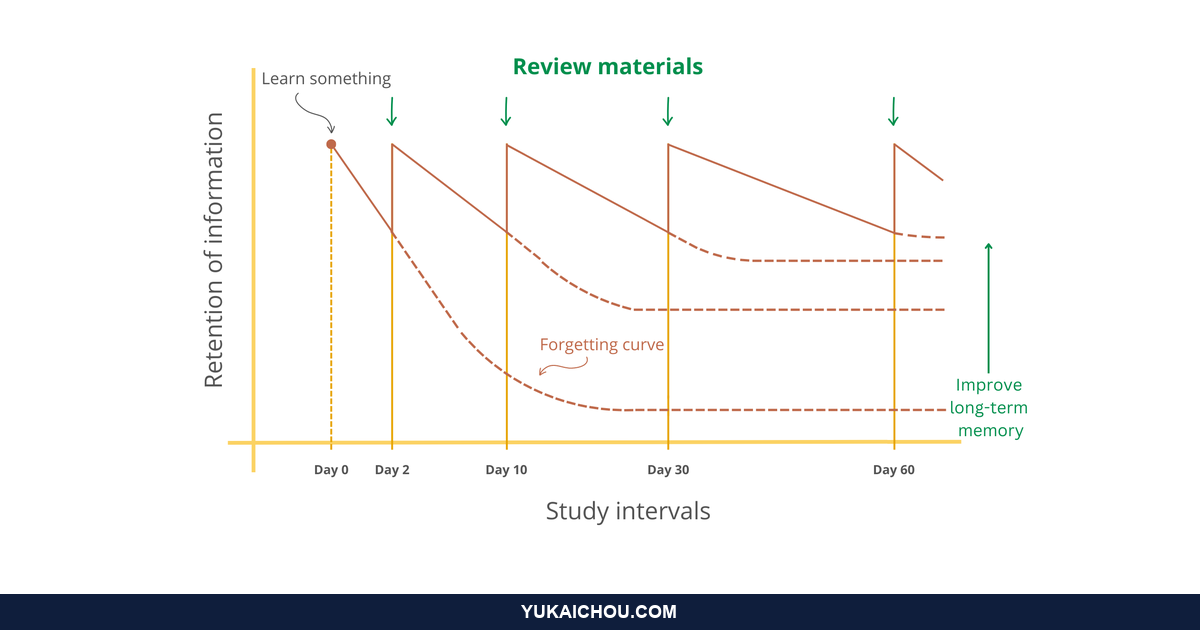

Short answer: Spaced repetition means reviewing material at increasing intervals, timing each review for the moment you are about to forget.
Hermann Ebbinghaus first measured the forgetting curve in 1885: memory drops steeply in the first hours and days, then levels off. Each well-timed review flattens the next stretch of the curve, so knowledge locks in for years with far less total time than cramming.
The review has to be active retrieval rather than re-reading, which is why flashcards beat highlighting.
Two people decide to learn 2,000 words of a new language. The first blocks off a heroic Saturday, pours a pot of coffee, and drills all 2,000 flashcards in a single twelve-hour marathon. By Sunday night they have seen every card and feel like a genius. The second person does twenty minutes a day, every day, and on most days the app shows them only the handful of words they are about to forget. The marathoner remembers almost nothing a month later. The twenty-minutes-a-day person is still fluent a year on. Same cards, same total hours, wildly different outcomes.
That gap is the entire subject of spaced repetition. It rests on the oldest quantified finding in all of psychology: Hermann Ebbinghaus, testing only himself in 1885, measured how fast memory leaks away and drew the curve that now carries his name. Memory decays on a predictable exponential, steepest in the first hours, and the single most reliable way to flatten that decay is to review the material at expanding intervals, each review landing right as the memory is about to slip. Cram and you forget. Space the same reviews out and the knowledge sticks for years. More than a century of experiments has only sharpened the finding.
I have spent over twenty years studying what makes people invest effort, and I built the Octalysis Framework to map the drives behind that effort. So this is not another “review your notes on a schedule” explainer. I am going to show you how the forgetting curve actually works, why spacing beats cramming at the level of the neuron, the algorithms that turned the finding into Anki and Duolingo, and then the layer the science never built. Spaced repetition tells you exactly when a memory will need its next review. It is completely silent on whether the human will show up for it. That second question decides whether anyone learns anything, and it is the question Octalysis was built to answer.
Speed Run Notes
- Memory decays on Ebbinghaus’s exponential forgetting curve, fastest in the first hours. The reliable fix is to review at expanding intervals, each one timed to land just as the memory starts to slip.
- Cramming and spacing can use identical total study time and identical cards. Spacing wins by a landslide on long-term recall, because each well-timed retrieval rebuilds the memory stronger and slows the next decay.
- The engine is not just spacing, it is spaced retrieval. Pulling an answer from memory at the edge of forgetting is what builds the durable trace. Re-reading feels productive and does almost nothing.
- Every modern tool, Leitner boxes, SuperMemo, Anki, Duolingo, is a scheduling algorithm that predicts your personal forgetting curve and shows each item at the optimal moment.
- The whole science answers when to review. It has no answer for why a person opens the app on day forty. That motivation hole is exactly where every abandoned Anki deck and dead Duolingo streak lives.
- The Octalysis move: stop perfecting the interval and start designing the reason to show up. Each part of the spacing loop maps to a Core Drive, and the optimal schedule is worthless against a closed app.
In This Article
- What Is Spaced Repetition?
- The Forgetting Curve and Why Memory Decays
- The Spacing Effect: Why Spread-Out Beats Massed
- The Testing Effect: Spacing Works Because of Retrieval
- From Pimsleur to Anki: The Algorithms That Schedule Forgetting
- What Ebbinghaus Got Right
- Where Spaced Repetition Falls Apart
- What’s Really Happening Inside the Brain
- Spaced Repetition vs Other Frameworks
- Spaced Repetition in the Real World
- The Elephant in the Room
- How to Apply It with the Octalysis Framework
Author Credibility: Yu-kai Chou

Yu-kai Chou created the Octalysis Framework after studying gamification since 2003 — years before the term entered mainstream vocabulary. As a Human-Systems Architect & Behavioral Designer, his framework has been applied by LEGO, Microsoft, Porsche, Coca-Cola, Salesforce, and MrBeast, impacting over 1.5 Billion Users.
Chou has taught the Octalysis methodology at Harvard, Stanford, Yale, Tesla, Google, BCG, and IDEO.
His work has been cited by Harvard, Stanford, MIT, Forbes, Wall Street Journal, Wired, US Department of Energy, NIST, NSF, NCBI, US Department of Education, ClinicalTrials.gov, and Google Scholar — with 3,700+ more academic publications. Explore his books here.

What Is Spaced Repetition?
Spaced repetition is a learning method that schedules reviews of material at increasing intervals over time, so that each review happens at the moment you are about to forget. Instead of studying something five times in one sitting, you study it today, again in two days, again in a week, again in three weeks, and so on. The gaps stretch as the memory strengthens. The result is that a fact you would normally lose in a day can be locked in for years, using less total study time than cramming.
The method sits on top of two findings that are among the most replicated in cognitive psychology. The first is the forgetting curve: memory for new material drops fast and then levels off, and without intervention most of what you learned today is gone within days. The second is the spacing effect: the same number of study repetitions produces dramatically better long-term retention when those repetitions are spread out rather than packed together. Spaced repetition is simply the disciplined application of both at once. You let the forgetting curve start to bite, then you interrupt it with a perfectly timed review.
What makes the technique feel almost unfair is the asymmetry it exploits. A review done at the right moment is cheap, often a few seconds, because you almost still know the answer. But that cheap review buys a disproportionately long extension of memory. Each successful retrieval flattens the next stretch of the forgetting curve, so the intervals can grow from days to weeks to months. You end up paying a tiny, shrinking tax to keep knowledge that would otherwise have to be relearned from scratch. This is why a medical student with 20,000 cards, a polyglot with six languages, and a trivia obsessive can all hold enormous bodies of fact in their heads on about twenty minutes a day.
The catch, and the reason this article exists, is that the entire method is a scheduling science. It is exquisite at telling you the optimal day to review item number 14,206. It says nothing whatsoever about whether you will be the kind of person who opens the deck that day, every day, for the years it takes. The schedule assumes the human shows up. Whether they show up is a motivation problem, and motivation is a different field entirely.
The Forgetting Curve and Why Memory Decays
In 1885, Hermann Ebbinghaus did something no one had done before: he turned memory into a number. Working alone, he memorized lists of nonsense syllables, meaningless three-letter combinations chosen precisely because they carried no prior associations to contaminate the measurement. Then he tested how much he retained after twenty minutes, an hour, a day, a week. He measured “savings,” how much faster he could relearn a list compared to learning it fresh, and from those savings he plotted the first forgetting curve. His monograph, Über das Gedächtnis, founded the experimental study of memory.
The shape he found is the heart of everything that follows. Retention does not decline in a straight line. It drops steeply at first, losing a large fraction within the first hour and the first day, then the decline slows and what remains is comparatively stable. Mathematically it looks like exponential decay riding on top of a stubborn floor. The practical reading is brutal: most of what you learn, you lose almost immediately, and you lose it whether or not you felt confident at the time. Feeling like you know something is not the same as having stored it.
For more than a century this was treated as gospel measured on a sample size of one. Then in 2015, Jaap Murre and Joeri Dros ran a careful modern replication of Ebbinghaus’s own procedure and recovered a forgetting curve that matched his original shape closely. The finding is real, and it holds across people and materials. The exact steepness varies with how meaningful the material is, how well it was encoded, and how much you cared, but the form is universal. We are built to forget, quickly, by default.
There is a deeper principle hiding in the curve, formalized by Adolf Jost in 1897 and known as Jost’s law: of two memories of equal current strength, the older one decays more slowly and benefits more from additional practice. This is not a footnote. It is the mechanical reason expanding intervals work. A memory that has already survived a few well-spaced reviews is sturdier than a fresh one of the same apparent strength, so it can safely wait longer before the next review. The forgetting curve is not a fixed enemy. Every successful review bends it flatter, which is exactly what the right schedule is designed to exploit.
The Spacing Effect: Why Spread-Out Beats Massed
Ebbinghaus also noticed the second finding, the one that turns a depressing curve into a usable tool. He observed that repetitions spread across time produced better retention than the same repetitions crammed together. This is the spacing effect, and it has since become one of the most reliable phenomena in all of learning science.
The definitive evidence comes from a 2006 meta-analysis by Nicholas Cepeda and colleagues, which synthesized over 300 experiments spanning more than a century and found a consistent, large advantage for distributed practice over massed practice. A companion 2008 study by the same group mapped what they called the temporal ridgeline of optimal retention: the best gap between reviews depends on how long you need to remember the material. If you want to remember something in a week, review it after about a day. If you want to remember it in a year, the optimal gap stretches to weeks or a month. The longer your retention goal, the longer your spacing should be. There is no single magic interval, only an interval matched to a horizon.
The most striking demonstration of how far this scales comes from Harry Bahrick. In a series of studies on what he called permastore, Bahrick tracked people who had learned Spanish vocabulary and found that material drilled with spaced practice and then left alone was still retrievable decades later. In one study he and colleagues followed foreign-language vocabulary across as long as fifty years, and the spacing of the original learning predicted who still remembered. Spacing does not just help you pass a test on Friday. It can put knowledge into a form that survives most of a human life.
Why does spreading the same effort work so much better? The leading explanation is Robert and Elizabeth Bjork’s New Theory of Disuse, which separates two properties of any memory: storage strength, how deeply it is embedded, and retrieval strength, how easily it comes to mind right now. Cramming pumps retrieval strength sky-high, which is why you feel fluent at the end of a marathon session, but it does little for storage strength, which is what lasts. The trick of spacing is to let retrieval strength fall before you study again. Retrieving a memory that has gone partly cold is harder, and that difficulty is the point. The harder, successful retrieval drives storage strength up far more than an easy one does. This is the foundation of what Bjork named desirable difficulties: the conditions that make learning feel slower and harder in the moment are often the ones that make it last.
That single idea reverses the intuition almost everyone brings to studying. The session that feels smooth and confident is usually building the weakest memory. The session that feels effortful, where you have to strain to dredge up an answer you half-forgot, is building the strongest. Spacing is the engine that manufactures that productive difficulty on a schedule.
The Testing Effect: Spacing Works Because of Retrieval
Here is the distinction that separates people who get enormous returns from spaced repetition from people who waste their time: spacing only delivers its full power when the review is an act of retrieval, not an act of review-in-the-passive-sense. Re-reading your notes on a schedule is spaced exposure. Trying to recall the answer before you check it is spaced retrieval. They are not close to equivalent.
The evidence here is the testing effect, sometimes called retrieval practice. In a landmark 2006 study, Henry Roediger and Jeffrey Karpicke had students learn passages either by repeated studying or by studying once and then testing themselves. On a test five minutes later, the re-readers did slightly better. But on a test a week later, the retrieval group crushed them. The act of pulling information out of memory, not putting it in again, is what builds durable learning. Karpicke and Roediger drove the point home in a 2008 paper in Science bluntly titled around the critical importance of retrieval: repeated studying after you can already recall something adds almost nothing, while repeated retrieval keeps paying off.
This is why the flashcard, not the highlighter, is the native unit of spaced repetition. A flashcard forces the question first and the answer second. It makes you generate the response, fail or succeed, and then see the truth. Re-reading lets you recognize the material and mistake that recognition for knowledge, which is the single most common self-deception in studying. Recognition is cheap and fleeting. Generation is expensive and lasting.
The two effects compound. Spacing tells you when to test yourself; the testing effect tells you that the review must be a test. Put them together and you get the real mechanism: effortful retrieval, timed to land at the edge of forgetting, repeated at expanding intervals. John Dunlosky’s influential 2013 review for the Association for Psychological Science evaluated dozens of study techniques and rated only two as high-utility across the board: practice testing and distributed practice. They are the two halves of spaced repetition. Almost everything students actually do, highlighting, rereading, summarizing, scored low. The method works, and most people are not using it.
From Pimsleur to Anki: The Algorithms That Schedule Forgetting
The forgetting curve is a law of nature. Turning it into a daily practice required someone to answer a logistics question: with thousands of items, each on its own decay curve, how do you decide which handful to review today? The history of spaced repetition is really the history of better and better answers to that question.
Paul Pimsleur published the first concrete schedule in 1967, a “memory schedule” for language learning with intervals that expanded roughly tenfold each step, from seconds to days. A few years later, the German science journalist Sebastian Leitner popularized a beautifully physical version anyone could build: the Leitner box. You keep flashcards in a row of boxes. A card you get right moves up a box and gets reviewed less often; a card you get wrong drops back to box one and gets drilled hard. The boxes are nothing but the expanding-interval schedule made out of cardboard, and they work.
The leap to software came from Piotr Wozniak, who built SuperMemo in the late 1980s and published the SM-2 algorithm in 1994. SM-2 tracks each card individually, storing an ease factor that grows when you find a card easy and shrinks when you struggle, and uses it to compute the next interval per card. When you grade a review on SuperMemo, you are feeding the algorithm an estimate of where you sit on that card’s personal forgetting curve. SM-2 is the genetic ancestor of nearly every modern tool. Anki, the free flashcard program that medical students, language learners, and law students run on by the millions, was built directly on SM-2 and has since moved to FSRS, a newer model that fits each user’s forgetting curve with machine learning rather than a hand-tuned formula.
Consumer apps took the same engine and hid it. When Duolingo decides which words to surface in your next lesson, it is running a spacing model. The company published its approach in 2016, a method called half-life regression that estimates the “half-life” of each word in your memory and schedules practice to catch it before it fades. Hundreds of millions of people now do spaced retrieval daily without ever hearing the term, because the scheduling is invisible and the experience is just “the app gave me a lesson.” Quizlet, RemNote, and a wave of newer tools all sit on the same foundation.
Step back and the pattern is clear. Six decades of innovation in this field has gone almost entirely into one variable: the precision of the interval. Pimsleur estimated it, Leitner approximated it with boxes, SM-2 computed it per card, FSRS learns it from your history, Duolingo models it per word at population scale. Each generation predicts your forgetting curve a little more accurately and tells you, with growing confidence, exactly which cards to review today. Not one of these advances does anything to make you want to do the review. That entire half of the problem has been left to willpower, and willpower is precisely what runs out.
What Ebbinghaus Got Right
It is worth pausing on how much Ebbinghaus nailed, because the durability of his findings is unusual in psychology, a field where many famous results have wobbled or collapsed under replication.
He got the shape of forgetting right. The exponential-with-a-floor decay he drew in 1885 survived a rigorous 2015 replication essentially intact. He got the spacing effect right, the single most useful practical finding about human learning, confirmed across 300-plus studies and a century of work. He got the method right, too: his insistence that you measure relearning savings rather than rely on the feeling of knowing anticipated the modern understanding that subjective confidence is a poor guide to actual retention. And his choice of nonsense syllables, often mocked as artificial, was a genuine methodological breakthrough, an early move toward controlling confounds that would not become standard practice for decades.
Most importantly, he established that memory obeys quantifiable laws at all. Before Ebbinghaus, memory was the domain of philosophers and introspection. After him, it was a measurable system with curves you could plot and predict. Spaced repetition exists because one man was willing to memorize thousands of meaningless syllables and write down the numbers. The fact that a medical student in 2026 can trust an algorithm to schedule 20,000 cards traces straight back to that curve.
What he could not do, working alone with nonsense syllables, was study why anyone would want to remember. His syllables were meaningless by design, which made them perfect for isolating the mechanics of memory and useless for studying motivation. He measured the machine of memory with the meaning stripped out. That was the right scientific move for his question. It also left a permanent blind spot in the tradition he founded, and that blind spot is the subject of the back half of this article.
Where Spaced Repetition Falls Apart
Spaced repetition is real, powerful, and oversold in a specific way. The science is sound. The way it gets marketed, as a near-magical hack that makes learning effortless, sets people up to fail. Three failure modes matter most.
It Assumes You Keep Showing Up
The fatal weakness is hiding in plain sight. Every interval the algorithm computes assumes you will be there to do the review. Miss a few days and the due cards pile up. Miss a few weeks and you open the app to a wall of 800 overdue cards, feel a wave of dread, and close it. The deck becomes a monument to a former self’s ambition. Anyone who has used Anki seriously knows the graveyard: decks abandoned not because the algorithm failed but because the human stopped coming. The science optimizes the schedule and is mute on the one input that actually breaks: adherence over months and years. This is not a small footnote on an otherwise complete method. It is the difference between everyone who has heard of spaced repetition and the small minority who have actually banked years of knowledge with it.
It Builds Isolated Facts, Not Understanding
Flashcards are superb at atomic recall: a word, a date, a formula, a drug interaction. They are weak at the things that make knowledge usable, the connections, the judgment, the ability to apply a concept to a messy new situation. A medical student can have perfect recall of every cardiac drug and still not reason well about a complicated patient, because the deck trained retrieval of facts in isolation, not integration under uncertainty. Spaced repetition is a tool for the foundation layer of expertise, the durable facts you want available instantly. It is not a substitute for the higher-order work of synthesis, problem-solving, and transfer, and treating it as one produces people who are walking encyclopedias and poor thinkers.
The Cards Are Only as Good as You Make Them
The algorithm cannot rescue a bad card. A card with too much on it, a vague prompt, or an answer you can guess from context teaches you to recognize your own handwriting rather than the material. Cards that are ambiguous get marked wrong for the wrong reasons, polluting the schedule. Good spaced repetition demands a craft skill, writing atomic, unambiguous, retrieval-forcing prompts, that almost no one is taught. People download a 10,000-card deck someone else made, find that the cards do not match how they think, and quit. The tool’s effectiveness is bounded by a content-creation skill that the marketing never mentions.
What’s Really Happening Inside the Brain
The behavioral curve has a physical story underneath it, and the story explains why the timing matters so much.
When you first learn something, the trace is fragile, held in a pattern of activity that is easily overwritten. Turning that fragile trace into a durable one requires consolidation, a biological process that strengthens and stabilizes the synaptic connections involved, much of it happening during sleep. Consolidation takes time, and it cannot be rushed by piling on more exposure in the same hour. This is the cellular reason cramming fails: you are stacking repetitions faster than the brain can consolidate any of them, so they compete and interfere instead of accumulating.
Spacing works with the biology instead of against it. By the time a well-timed review comes around, the first trace has had a chance to begin consolidating, possibly across a night of sleep. The review then catches the memory in a partly stabilized but slightly decayed state, and the effortful retrieval at that moment appears to trigger reconsolidation, reopening the trace and re-storing it in a stronger, more stable form. Each cycle of decay-and-retrieval ratchets the memory up a level of durability. The expanding intervals are, in effect, a schedule that keeps catching the memory at the productive edge where reconsolidation does the most good.
There is also a desirable-difficulty story at the systems level. An easy retrieval, the kind you get from cramming or reviewing too soon, barely engages the retrieval machinery and barely strengthens the trace. A hard retrieval, the kind you get when the memory has gone partly cold, recruits more of the network and lays down a stronger, more flexible representation, one with more retrieval routes into it. This is why the review that feels uncomfortable is the one that works. Comfort is the signature of a memory you already have. The faint struggle is the signature of one you are actually building.
None of this biology, though, reaches up to the level of the person deciding whether to study tonight. Consolidation explains why spacing helps a memory that gets reviewed. It says nothing about why a tired human at 11pm chooses the deck over the couch. The neuroscience governs the trace. Something else has to govern the behavior, and that is where the framework changes.
Spaced Repetition vs Other Frameworks
Spaced repetition is often lumped together with everything else in the “learn faster” aisle. It helps to see exactly where it sits relative to its neighbors, because each comparison reveals what spacing does and does not cover.
Spaced Repetition vs Massed Practice (Cramming)
Cramming is not useless; it is optimized for the wrong horizon. If you need to hold information until tomorrow morning and never again, a marathon session is a rational choice, because it maxes out retrieval strength right when you need it. The trap is that cramming feels more effective than spacing in the moment, since fluency peaks at the end of the session. People mistake that peak for learning and choose the strategy that guarantees they will forget. Spacing trades the comforting illusion of immediate mastery for the unglamorous reality of long-term retention. The choice between them is really a choice of time horizon, and most things worth learning have a long one.
Spaced Repetition vs Cognitive Load Theory
The two are complementary halves of a complete learning design. Cognitive load theory governs a single study session: how to present material so working memory is not overwhelmed while a schema is being built. Spaced repetition governs the timeline across sessions: how to schedule the return visits that move that schema from fragile to permanent. Cognitive load is about the encoding moment. Spacing is about the retention curve afterward. A great course manages load so the first encounter sticks, then spaces retrieval so it lasts. Get one without the other and you either build clear understanding that fades or schedule reviews of material that was never encoded well in the first place.
Spaced Repetition vs Flow
These two pull in opposite emotional directions, and that tension is instructive. Flow is the state of effortless absorption where challenge and skill are balanced and time disappears. Spaced repetition is the opposite experience: brief, effortful, slightly uncomfortable bouts of retrieval that nobody describes as blissful. Drilling due cards is rarely a flow state. This matters for design, because you cannot rely on the activity itself being intrinsically pleasurable. Flow can carry someone through hours of practice on its own. Spaced retrieval cannot, which means the motivation to do it has to come from somewhere other than the joy of the task. That is a design constraint, and it points directly at the Core Drives that operate even when the moment-to-moment experience is not fun.
Spaced Repetition in the Real World
The method shows up wherever large bodies of fact have to be held reliably over time. Four domains show its range.
Language Learning
Language is the canonical case, because vocabulary is exactly the kind of high-volume atomic recall spacing is built for. Pimsleur designed his audio courses around graduated interval recall in the 1960s. Today Anki shared decks and Duolingo’s invisible spacing model carry tens of millions of learners. The polyglot community treats spaced repetition as non-negotiable infrastructure, not because it makes vocabulary fun, but because nothing else lets a person hold 5,000 words across five languages on a sustainable daily budget. The learners who succeed are almost never the ones with the best algorithm. They are the ones who tied the daily review to a reason that outlasts novelty: a partner who speaks the language, a move abroad, a heritage they refuse to lose.
Medical Education
Medicine may be where spaced repetition has its deepest cultural foothold. The sheer volume of fact a physician must hold, pharmacology, anatomy, pathology, makes brute memorization unavoidable, and the stakes make forgetting dangerous. Massive community Anki decks have become a rite of passage for board exams, with students doing hundreds of reviews a day for years. It works, and it also exposes the limits: students who master the cards still have to learn clinical judgment separately, because the deck builds the fact layer and not the reasoning layer. The students who sustain the practice are carried by an unusually strong long-arc drive, the identity of becoming a doctor, which is precisely the kind of meaning the scheduling algorithm cannot supply.
Workplace Training and Compliance
Corporate training is where spacing is most underused and most needed. Companies pour money into one-day workshops and annual compliance modules, then act surprised when retention is near zero a month later, which the forgetting curve predicts exactly. A handful of platforms now deliver “microlearning” with spaced reinforcement, drip-feeding short retrieval prompts over weeks instead of one forgettable session. The ones that stick do not rely on employees volunteering to review. They embed the prompts into the flow of work and attach them to things employees already care about, status with peers, visible competence, avoiding the embarrassment of failing an audit. Without that motivational wrapper, the prompts get ignored like every other notification.
Education for Children
In classrooms, spaced retrieval shows up as low-stakes “retrieval practice” and distributed review built into the curriculum rather than blocked into a single unit. Cognitive scientists have spent a decade pushing teachers toward spacing and away from massed cramming before tests, with strong evidence behind them. The friction is motivational and structural: children do not choose to space their own practice, so the spacing has to be engineered into the course design and made engaging enough that kids stay with it. Where it is paired with game-like feedback and visible progress, it sticks. Where it is delivered as joyless drilling, kids comply only as long as an adult is watching, which is the same adherence problem in a smaller body.
The Elephant in the Room
Here is what the learning-science and ed-tech industries will not put on the slide: they have spent sixty years perfecting the half of the problem that was already mostly solved, and almost no effort on the half that actually determines outcomes.
The schedule has been optimized to the point of diminishing returns. We have algorithms that model your personal forgetting curve per card with machine learning. We can predict, to the day, when item 14,206 needs its next review. And it does not matter, because the binding constraint on learning was never schedule precision. It was whether a tired human opens the app on a Tuesday in month seven. The field optimized the variable it could measure and patent, the interval, and waved away the variable that decides everything, the return.
Why does the industry do this? Because the algorithm is the defensible artifact. It is the thing you can publish a paper about, file a patent on, put in a pitch deck. “We model memory half-life with a neural network” sells funding rounds. “We figured out how to make a human want to come back for two years” sounds soft and unprovable, even though it is the entire ball game. So the energy flows to the schedule, and the motivation problem gets outsourced to the user’s willpower, which is exactly the resource that fails. The graveyard of abandoned decks is not a failure of the algorithm. It is the predictable result of building a magnificent scheduling engine and bolting it to nothing that makes a person show up.
You cannot tune your way to retention if the user has closed the app. The optimal interval delivered to an absent learner is worth precisely zero.
How to Apply It with the Octalysis Framework
Everything above leads to one seam. Spaced repetition is a complete answer to when a memory needs its next retrieval and a total non-answer to why the human will be there to give it. That second question is not a learning-science question at all. It is a motivation question, and the Octalysis Framework, which maps human motivation to eight Core Drives, is built to answer exactly it. The schedule is the skeleton. Octalysis is the muscle that makes the skeleton get out of bed.

The move is to stop treating the review schedule as the product and start treating the daily return as the thing to be designed. Each part of the spacing loop, the due card, the act of retrieval, and the long arc of building a body of knowledge, maps onto specific Core Drives. Design those, and the schedule finally has someone to run on.
The Due Card Is an Appointment: Core Drive 6 and Core Drive 8
The single most powerful behavioral feature in consumer spaced repetition is not the algorithm. It is the streak. A streak converts the abstract “you should review today” into a concrete, time-boxed appointment with something to lose, and it does so by stacking two Core Drives. Core Drive 6 (CD6): Scarcity & Impatience supplies the appointment dynamic: the review window is scarce, it is open now and closed at midnight, and the due cards are a finite set waiting for you. Core Drive 8 (CD8): Loss & Avoidance supplies the teeth: a streak you have kept for 300 days is a possession you do not want to break, and Duolingo’s streak freeze exists precisely because the company understands that the fear of losing the streak, not the love of grammar, is what gets the user back.
This is the honest version of black-hat design. The expanding-interval schedule is literally an appointment schedule, and dressing it as a streak makes the appointment emotionally real. The danger is overreach: a streak that punishes too harshly creates anxiety and eventually abandonment, the user quits to escape the pressure. The S-Tier calibration uses Core Drive 8 to create just enough loss-aversion to make the daily return feel important, while building in mercy, freezes, repair days, forgiveness for the missed Tuesday, so the appointment motivates rather than terrorizes.
The Retrieval Is the Win: Core Drive 2 and Core Drive 7
The act of retrieval, the thing the testing effect says is the actual learning, is also the natural home of the most satisfying micro-reward in the whole loop. Every card you pull back from the edge of forgetting is a small, earned victory, and Core Drive 2 (CD2): Development & Accomplishment is the drive that makes that victory feel good. The “I almost forgot that, but I got it” moment is both the strongest memory-building event, the hard retrieval the desirable-difficulties research prizes, and the most rewarding beat of the session. Great design makes that beat visible: maturing cards, a retention percentage that climbs, the deck “graduating” from learning to mature. Spacing’s progress is Core Drive 2 made literal, and most tools waste it by showing the user a bare card count instead of a story of accumulating mastery.
Core Drive 7 (CD7): Unpredictability & Curiosity rides alongside. A flashcard is, structurally, an open question whose answer you must produce before you see it, and that half-second of “do I still know this?” is a genuine curiosity loop. The very difficulty that makes spaced retrieval effective, the uncertainty of whether the memory is still there, is also what gives it a flicker of suspense. Designs that lean into this, surfacing the prompt cleanly and letting the user commit to an answer before the reveal, turn the cognitive necessity of retrieval into a small game. Designs that show the answer too fast kill both the learning and the curiosity in one move.
The Deck Is the Long Arc: Core Drive 4 and Core Drive 1
Spacing only pays its largest dividends across months and years, and no streak survives that long on loss-aversion alone. The long arc needs the drives that sustain commitment. Core Drive 4 (CD4): Ownership & Possession turns the deck into a thing the user has built and owns. A hand-made deck, refined card by card, accrues the sunk-effort and pride of a personal collection; the user is not reviewing flashcards, they are tending a body of knowledge that is theirs. This is why people who build their own decks persist far longer than people who download someone else’s: ownership is motivational, and a borrowed deck carries none of it.
Core Drive 1 (CD1): Epic Meaning & Calling carries the longest arc of all. Nobody sustains years of daily retrieval for the abstract goal of “remembering things.” They sustain it for a reason large enough to outlast novelty and willpower: learning the language to speak with a grandparent before it is too late, passing the boards to become the doctor they have always meant to be, keeping alive a heritage they refuse to let fade. The schedule cannot manufacture that meaning. But a designer can surface it, by asking the learner up front why this matters and reflecting that “why” back at them in the moments when motivation dips. The optimal interval is the body of the practice. Core Drive 1 is the soul that keeps the body coming back.
The Warning Light
This crosswalk gives you a diagnostic. If your learning product shows climbing review-accuracy and improving algorithm-efficiency in the lab while daily active reviewers and real-world long-term retention stay flat, you have built a beautifully tuned schedule that nobody honors. When the metric that looks healthy is the interval and the metric that stays sick is the return, you optimized the wrong half. The fix is never a smarter algorithm. It is the appointment, the win, and the arc that get the human back to the card.
Practical Steps for Designing a Spacing Habit That Survives
Whether you are building a learning product or building your own practice, the sequence is the same: get the schedule roughly right, then spend almost all your energy on the return.
- Make every review a retrieval, never a re-read. Force the question before the answer. Recognition feels like learning and is not. If you are writing cards, make each one atomic and unambiguous so a wrong answer means a real gap, not a confusing prompt.
- Let the intervals expand, and trust the discomfort. Review when the memory has gone slightly cold, not while it is still fresh. The faint struggle is the signal that the review is working. Use a tool with a sound algorithm (Anki’s FSRS, Duolingo’s model) and do not second-guess its timing.
- Attach the daily return to a real why. Before anything else, name the Core Drive 1 reason this knowledge matters to you or your user. Surface it at signup and resurface it when streaks wobble. Meaning is the only fuel that lasts past month three.
- Build the streak with mercy. Use Core Drive 6 and Core Drive 8 to make the daily window feel like an appointment worth keeping, then add freezes and repair days so one missed Tuesday does not trigger abandonment. Loss-aversion motivates; loss-terror makes people quit.
- Show accumulation, not just count. Turn Core Drive 2 on by visualizing mastery: maturing cards, a retention curve, knowledge “banked.” Replace the demoralizing pile of due cards with a story of progress.
- Give ownership of the deck. Let users build, edit, and shape their own material wherever possible. A deck someone made is a deck someone returns to. Core Drive 4 turns a chore into a possession.
- Watch the right metric. Track daily active reviewers and long-term retention, not algorithm efficiency. If the schedule is tuned and the return is falling, your problem is motivation, and no interval will fix it.
Spaced Repetition Was the Schedule, Octalysis Is the Reason to Show Up
Ebbinghaus gave us something rare and durable: a quantified law of forgetting and the spacing fix that beats it. A century of work turned that law into algorithms precise enough to schedule tens of thousands of facts against each person’s private forgetting curve. That is a genuine achievement, and if you are not using spaced retrieval to learn anything you need to hold for the long term, you are leaving an enormous amount of capability on the table.
But the schedule was always the easy half. The hard half, the half the field has barely touched, is getting a human to honor the schedule across the years it takes for the magic to compound. That is not a memory problem. It is a motivation problem, and it lives in the eight Core Drives, not in the interval. The graveyard of dead decks and broken streaks is full of people who had a perfect algorithm and no reason to show up. Build the reason to show up, and the oldest finding in psychology finally does what it promised. Build only the schedule, and you have engineered a flawless appointment that no one keeps.
Frequently Asked Questions
What is spaced repetition in simple terms?
Spaced repetition is a study method where you review material at increasing intervals over time, today, then in a few days, then in a couple of weeks, timing each review for the moment you are about to forget. Because memory decays fast at first and slower after each successful review, well-timed reviews lock knowledge in for years using far less total time than cramming.
Why does spaced repetition work better than cramming?
Cramming maxes out how easily you can recall something right now but does little for how deeply it is stored, so it fades within days. Spacing lets the memory partly fade before you retrieve it again, and that harder, successful retrieval drives long-term storage far more than an easy one. Same total effort, vastly better long-term retention.
What is the forgetting curve?
The forgetting curve, first measured by Hermann Ebbinghaus in 1885, describes how memory for new material drops steeply within the first hours and days and then levels off. A 2015 replication confirmed its shape. Each well-timed review flattens the next stretch of the curve, which is exactly what spaced repetition exploits.
What is the best interval for spaced repetition?
There is no single best interval. Research by Cepeda and colleagues shows the optimal gap depends on how long you need to remember the material: roughly a day for week-long retention, stretching to weeks or a month for year-long retention. Modern apps compute this per item automatically, so you rarely need to set intervals by hand.
Is spaced repetition the same as the testing effect?
They are two halves of the same mechanism. Spacing tells you when to review; the testing effect says the review must be active retrieval, trying to recall the answer, not re-reading. Spaced repetition delivers its full power only when each review is a genuine test, which is why flashcards beat highlighting.
What apps use spaced repetition?
Anki is the most widely used dedicated tool, built on the SM-2 algorithm and now FSRS. SuperMemo pioneered the software approach. Duolingo, Quizlet, and RemNote all use spacing models, sometimes invisibly. The differences in their scheduling matter far less than whether the design keeps you coming back.
Why do people abandon their Anki decks?
Because spaced repetition optimizes the schedule but does nothing to sustain motivation. Miss several days and overdue cards pile into an intimidating backlog, and many users quit rather than face it. Abandonment is a motivation failure, not an algorithm failure, which is why the design around the schedule, streaks, meaning, ownership, matters as much as the schedule itself.
How does spaced repetition relate to gamification?
Spaced repetition decides the optimal timing of reviews; gamification, through frameworks like Octalysis, supplies the motivation to honor that timing. The streak is Core Drive 6 (Scarcity) plus Core Drive 8 (Loss); the retrieval win is Core Drive 2 (Accomplishment); the personal deck and long-term purpose are Core Drive 4 (Ownership) and Core Drive 1 (Epic Meaning). The schedule is the skeleton; the Core Drives get the learner to show up.
Does spaced repetition build real understanding?
It builds the foundation layer of durable facts, vocabulary, formulas, definitions, exceptionally well, but it does not by itself produce synthesis, judgment, or the ability to apply knowledge to new situations. Use it for the recall layer that should be instant and automatic, and pair it with problem-solving and application work for higher-order understanding.
References
- Ebbinghaus, H. (1885). Über das Gedächtnis: Untersuchungen zur experimentellen Psychologie (Memory: A Contribution to Experimental Psychology). Duncker & Humblot.
- Jost, A. (1897). Die Assoziationsfestigkeit in ihrer Abhängigkeit von der Verteilung der Wiederholungen. Zeitschrift für Psychologie, 14, 436–472.
- Pimsleur, P. (1967). A memory schedule. The Modern Language Journal, 51(2), 73–75.
- Leitner, S. (1972). So lernt man lernen: Der Weg zum Erfolg. Herder.
- Landauer, T. K., & Bjork, R. A. (1978). Optimum rehearsal patterns and name learning. In Practical Aspects of Memory.
- Bahrick, H. P. (1984). Semantic memory content in permastore: Fifty years of memory for Spanish learned in school. Journal of Experimental Psychology: General, 113(1), 1–29.
- Bahrick, H. P., Bahrick, L. E., Bahrick, A. S., & Bahrick, P. E. (1993). Maintenance of foreign language vocabulary and the spacing effect. Psychological Science, 4(5), 316–321.
- Bjork, R. A., & Bjork, E. L. (1992). A new theory of disuse and an old theory of stimulus fluctuation. In From Learning Processes to Cognitive Processes.
- Bjork, R. A. (1994). Memory and metamemory considerations in the training of human beings. In Metacognition: Knowing about Knowing.
- Wozniak, P. A., & Gorzelanczyk, E. J. (1994). Optimization of repetition spacing in the practice of learning. Acta Neurobiologiae Experimentalis, 54(1), 59–62.
- Roediger, H. L., & Karpicke, J. D. (2006). Test-enhanced learning: Taking memory tests improves long-term retention. Psychological Science, 17(3), 249–255.
- Cepeda, N. J., Pashler, H., Vul, E., Wixted, J. T., & Rohrer, D. (2006). Distributed practice in verbal recall tasks: A review and quantitative synthesis. Psychological Bulletin, 132(3), 354–380.
- Karpicke, J. D., & Roediger, H. L. (2008). The critical importance of retrieval for learning. Science, 319(5865), 966–968.
- Cepeda, N. J., Vul, E., Rohrer, D., Wixted, J. T., & Pashler, H. (2008). Spacing effects in learning: A temporal ridgeline of optimal retention. Psychological Science, 19(11), 1095–1102.
- Kornell, N. (2009). Optimising learning using flashcards: Spacing is more effective than cramming. Applied Cognitive Psychology, 23(9), 1297–1317.
- Dunlosky, J., Rawson, K. A., Marsh, E. J., Nathan, M. J., & Willingham, D. T. (2013). Improving students’ learning with effective learning techniques. Psychological Science in the Public Interest, 14(1), 4–58.
- Murre, J. M. J., & Dros, J. (2015). Replication and analysis of Ebbinghaus’ forgetting curve. PLoS ONE, 10(7), e0120644.
- Settles, B., & Meeder, B. (2016). A trainable spaced repetition model for language learning. Proceedings of the 54th Annual Meeting of the ACL, 1848–1858.
- Chou, Y. (2015). Actionable Gamification: Beyond Points, Badges, and Leaderboards. Octalysis Media.
Related Reading
- Cognitive Load Theory: S-Tier Behavioral Designer’s Guide
- The Octalysis Framework: The Complete Guide to the 8 Core Drives
- The Behavioral Framework Library