

Have you ever heard of the “Too Good To Go” app? If so, you will want to check out this submission for the Octalysis Level 1 Certificate. If not, you will want to check out this submission!
⚡ Speed Run Notes
- Every certified practitioner is a geographic outpost for the framework. One practitioner in Italy reaches an audience no amount of English-language content can reach. The framework spreads along human relationships, not algorithms — and each certified holder is a new node in that network.
- The best practitioners are the ones who localize the framework without diluting it. Translation is easy. Cultural adaptation is hard. A practitioner who can apply the framework to their home culture's specific products is worth more than 10 who just repeat the original case studies.
- CD1 (Epic Meaning) in a certification community comes from knowing your work is contributing to a shared body of knowledge. A solo practitioner produces output that benefits their clients. A community practitioner produces output that benefits the field. The second is more meaningful and attracts better practitioners.
- Certification ceremonies should be public, specific, and slightly personal. Generic congratulations devalue the achievement. Specific mention of the practitioner's work shows the certifier is paying attention. That attention is a form of respect practitioners remember for years.
- The deepest insight: the global Octalysis community is an emergent network, not a managed hierarchy. Each practitioner runs their own practice and shares their discoveries. The network gets smarter on its own as long as the community keeps featuring members. The featuring is the stewardship that keeps the network alive.
In this light-to-read presentation, Arturo thoroughly analyzes the user journey of this experience using the Octalysis Framework, and offers suggestions for improvement.
About the Creator of the Octalysis Framework

Yu-kai Chou created the Octalysis Framework after studying gamification since 2003 — years before the term entered mainstream vocabulary. As a Human-Systems Architect & Behavioral Designer, his framework has been applied by LEGO, Microsoft, Porsche, Coca-Cola, Salesforce, and MrBeast, impacting over 1.5 Billion Users.
Chou has taught the Octalysis methodology at Harvard, Stanford, Yale, Tesla, Google, BCG, and IDEO.
His work has been cited by Harvard, Stanford, MIT, Forbes, Wall Street Journal, Wired, US Department of Energy, NIST, NSF, NCBI, US Department of Education, ClinicalTrials.gov, and 3,700+ more academic publications. Explore his books here.
Arturo’s Submission
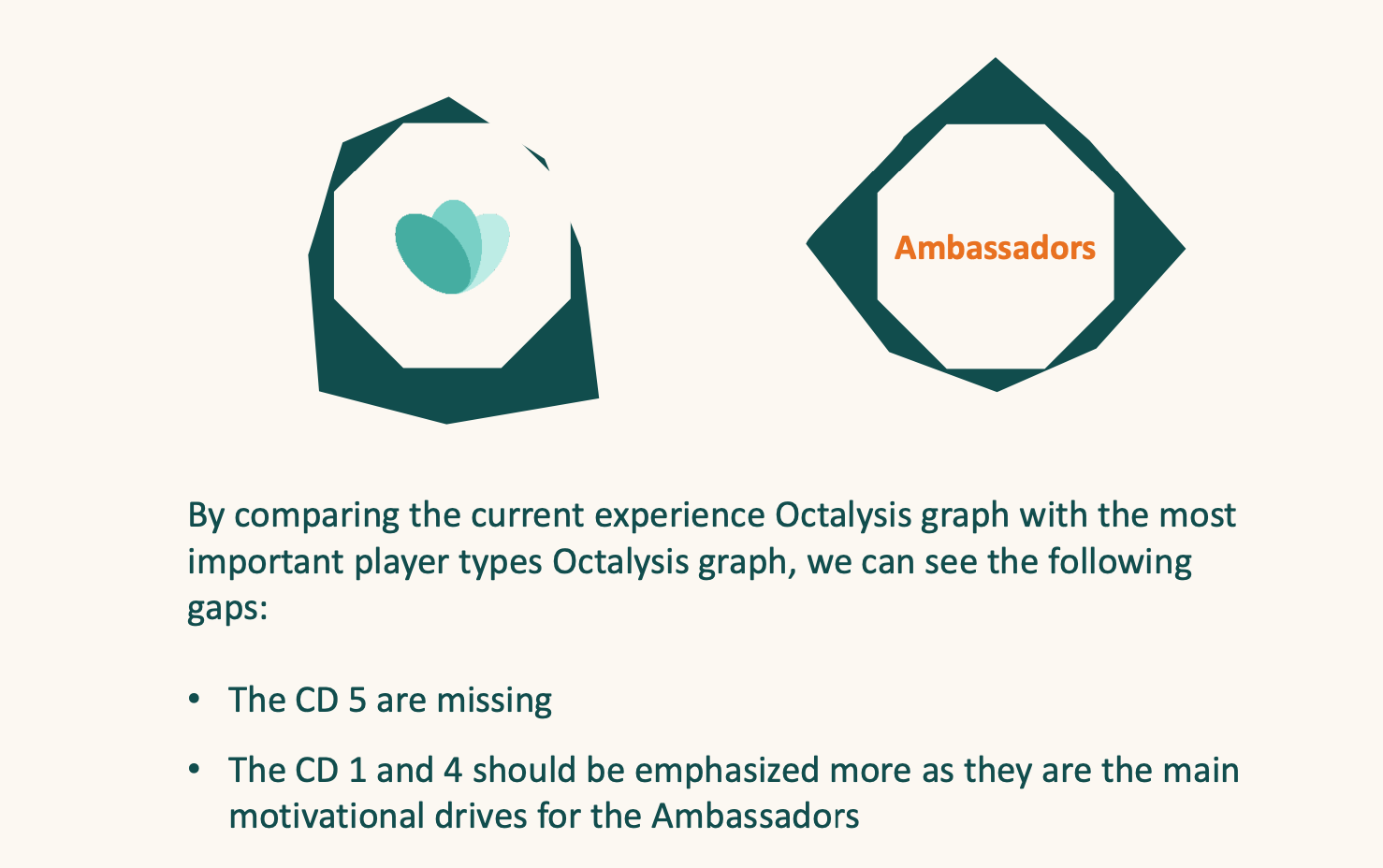
Arturo built out the Strategy Dashboard, mapping each touchpoint in the Too Good To Go user journey against all eight Core Drives of the Octalysis Framework. Earning the certificate required demonstrating deep mastery of Core Drive 2: Development & Accomplishment.
He then tied the conclusions from the different steps of the analysis phase to deliver a great brainstorming.
We especially like the “Proximity Bonus” which adds a sense of obligation to help the local stores, together with other users that live nearby — a clear application of Core Drive 5: Social Influence & Relatedness.
And the “Roulette Formula” that motivates to also visit other stores — tapping into Core Drive 7: Unpredictability & Curiosity.
Congratulations, Arturo. Good work!
I’m so excited! It’s a great milestone for me, I’m so happy! Thanks for your precious feedback, I really appreciate it! Yeaaaah!
Arturo Caudullo
Do you want to join a community of learners and bring your knowledge of Human-Focused Design to the next level?
Don’t hesitate to try out Octalysis Prime for free!
Related Reading
- The Octalysis Framework for Gamification & Behavioral Design
- What is Gamification? Definition, Examples & Framework
- Actionable Gamification: Beyond Points, Badges & Leaderboards
- Top 10 Enterprise Gamification Examples
- 90+ Gamification Examples & Cases with ROI Stats
- The $1.06 Billion Octalysis Gamification Case Study