

We are strict when reviewing submissions for the Octalysis Certificates. The bar we have set is high, even for the Level 1. This means that most people need one or two re-submissions before meeting all the criteria, if at all.
It also means that those who earned their certificate have really proven that they are worthy!
Robert is one of the few people who managed to obtain the Octalysis Level 1 Certificate with their first submission! Impressive.
⚡ Speed Run Notes
- Each certificate achiever is a proof point that the framework produces practitioners, not just readers. A framework with only readers dies quietly. A framework with practitioners compounds. The quality of the practitioners is the clearest signal of the framework's long-term health.
- The best certificate holders are visible in how they explain the framework to others, not how well they passed the test. Tests measure recall. Teaching measures understanding. Every certified practitioner should be evaluated on their teaching, which is the true measure of mastery.
- CD5 (Social Influence) in a certification community is the retention mechanic for practitioners. A certified practitioner without a community drifts away. A certified practitioner embedded in a community of peers stays for decades. The community, not the certificate, is the long-term bond.
- The strongest certificate programs have post-certification rituals, not just tests. Guest teaching, peer review, case studies. These rituals convert the certificate from an end to a beginning. Programs without these rituals see certification as a graduation; strong ones see it as onboarding.
- The deepest insight: the certificate is a commitment device that shapes the holder's future behavior. Once you're a named Octalysis practitioner, you can't apply the framework sloppily without feeling like a fraud. The external identity disciplines the internal practice. The certificate is the forcing function.
About the Creator of the Octalysis Framework

Yu-kai Chou created the Octalysis Framework after studying gamification since 2003 — years before the term entered mainstream vocabulary. As a Human-Systems Architect & Behavioral Designer, his framework has been applied by LEGO, Microsoft, Porsche, Coca-Cola, Salesforce, and MrBeast, impacting over 1.5 Billion Users.
Chou has taught the Octalysis methodology at Harvard, Stanford, Yale, Tesla, Google, BCG, and IDEO.
His work has been cited by Harvard, Stanford, MIT, Forbes, Wall Street Journal, Wired, US Department of Energy, NIST, NSF, NCBI, US Department of Education, ClinicalTrials.gov, and 3,700+ more academic publications. Explore his books here.
Robert Sherman’s Octalysis Certificate
What Makes Robert’s Analysis Stand Out
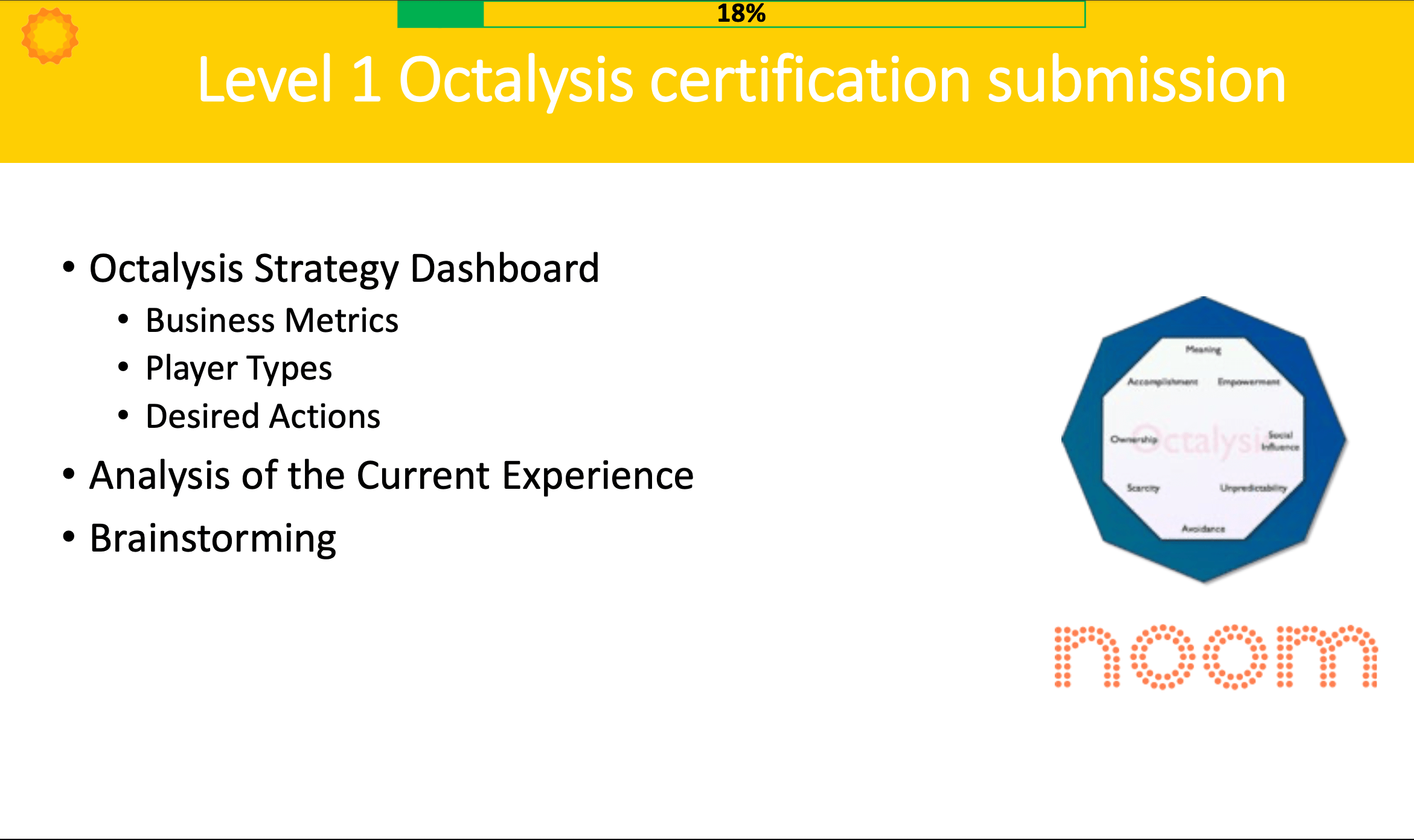
Robert’s analysis of the weight-loss app Noom is steady on all fronts.
He also took into consideration the experience of the reader.
By adding a progress bar on the slides, the reader gains more control over their experience (CD2) and is more likely to keep on reading.
Congratulations, Robert. Well done!
I am so excited to receive my Level 1 Certificate, and even more excited to take part in this amazing community.
Robert Sherman
Do you want to join a community of learners and bring your knowledge of Human-Focused Design to the next level?
Don’t hesitate to try out Octalysis Prime for free!
Related Reading
- The Octalysis Framework for Gamification & Behavioral Design
- Octalysis Certificate Achiever: Adrian Ensner
- Octalysis Certificate Achiever: Colin Hahn
- Books by Yu-kai Chou