
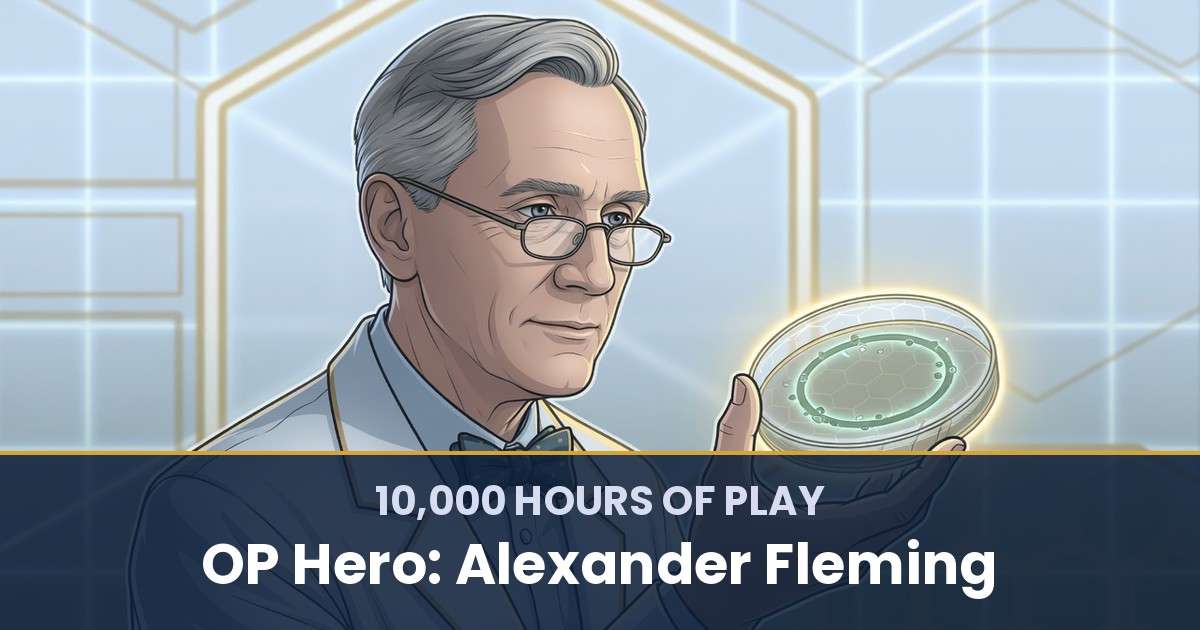


In September 1928, Alexander Fleming came back from a summer holiday to a bench full of dirty Petri dishes he had left stacked before he left. Most of them were ruined. One of them was about to rewrite medicine.
A stray mould had drifted onto a plate of staphylococcus bacteria and started growing. Around that fuzzy green blob, in a clear ring, the bacteria had simply dissolved. A tidy scientist would have seen a contaminated plate and dropped it in the disinfectant tray. Fleming saw something eating the bacteria and stopped to look closer.
That pause is the whole story. The mould was Penicillium notatum, the substance it released he named penicillin, and it became the first true antibiotic, the drug that turned a scratched knee or a battlefield wound from a possible death sentence into a minor inconvenience.
Here is the part people forget. Fleming could not finish what he started. He published the discovery in 1929, failed to turn it into a usable drug, and watched it sit ignored for over a decade. If you treat your life as a game worth playing on purpose, his run is a case study in a rare, uncomfortable truth: seeing the treasure and cashing it in are two completely different skills, and the greatest players know which one they are built for.
⚡ Speed Run Notes
- Fleming played one long game for forty years: find substances nature already uses to kill bacteria, and turn them into medicine that heals people instead of harming them.
- His superpower was observation, not chemistry. The 1928 penicillin plate and the 1921 lysozyme discovery both came from him noticing a clear ring where bacteria had died, and refusing to throw the “ruined” plate away.
- He could not purify penicillin himself. He lacked the chemistry, tried, gave up around 1931, and the discovery languished for a decade until a team at Oxford revived it.
- His allies finished his quest. Howard Florey, Ernst Chain, and Norman Heatley turned Fleming’s observation into a mass-produced drug that reached its first patients in 1941.
- He knew his own weakness and never faked past it. Fleming kept the mould alive, shared the strain freely, and let better-equipped players cast the spell he had only discovered.
Table of Contents
- Step 1: The Game Alexander Fleming Was Actually Playing
- Step 2: Attributes, the Innate Stats
- Step 3: Role(s) Across Chapters
- Step 4: Skills He Mastered
- Step 5: Allies Who Multiplied Him
- Step 6: Quests That Shaped the Saga
- What You Can Steal From Alexander Fleming’s Build
- Where This Framework Comes From
- Related Reading
About Yu-kai Chou

Yu-kai Chou is the author of 10,000 Hours of Play — the book that treats your life as the most important game you’ll ever build a character in, and gives you the 6-Step framework (Game · Attributes · Role · Skills · Allies · Quests) to play it on purpose. He has spent two decades developing the system through which this post analyzes its OP Hero, and applies it to his own life and to the lives of the people he advises around the world.
Chou’s other framework, the Octalysis Framework, has been applied by LEGO, Microsoft, Porsche, Coca-Cola, Salesforce, and MrBeast, impacting over 1.5 Billion Users. He has taught the methodology at Harvard, Stanford, Yale, Tesla, Google, BCG, and IDEO, and has advised governments in eight nations including Ukraine, the United Kingdom, the Kingdom of Bahrain, Singapore, Taiwan, the Netherlands, Kazakhstan, and South Korea.
His work has been cited by Harvard, Stanford, MIT, Forbes, Wall Street Journal, Wired, US Department of Energy, NIST, NSF, NCBI, US Department of Education, ClinicalTrials.gov, and Google Scholar — with 3,700+ more academic publications. Explore his books here.
What pulls me to Fleming is that he is the rare legend who was honest about the edge of his own build. He had the sharpest eyes in the room and shallow chemistry, and instead of clinging to the discovery he could not finish, he handed the strain to players who could. The lesson I lift from him: know exactly which skill you are elite at, and design a team of Allies around the gap you refuse to pretend you can cover.
Step 1: The Game — What Alexander Fleming Was Actually Playing
Fleming was born on August 6, 1881, on a remote farm called Lochfield near Darvel in Ayrshire, Scotland. He came to bacteriology sideways, through a small inheritance and a good rifle: St Mary’s Hospital in London wanted to keep him on its shooting team, so a colleague nudged him into the research lab to hold onto him.
Once he was there, the game locked in and never changed. For the next four decades Fleming chased one question: what substances does nature already use to kill bacteria, and can we borrow them to heal people without poisoning the patient?
That framing mattered because the tools of his era were brutal. The antiseptics used on wounds killed germs, but they also killed the body’s own defensive cells, often doing more harm than good. Fleming wanted a scalpel where medicine only had a flamethrower.
He was playing the same broad game that Louis Pasteur opened a generation earlier, taking the germ theory of disease and pushing it toward a cure. His whole career was a hunt for the one weapon that would target the invader and spare the host. Everything he is remembered for is a move in that single long game.
Step 2: Attributes — The Innate Stats
Some players are built for the discovery and some for the delivery. Fleming’s raw stats point entirely at the first.
His highest attribute was observation. Colleagues noted his habit of actually looking at his culture plates instead of just processing them, and both of his great discoveries hinge on him spotting a small clear ring that a busier scientist would have swept into the bin.
The second was a restless curiosity about odd little details. When his own nose ran during a cold, most people would reach for a handkerchief. Fleming dropped the mucus onto a bacterial plate to see what would happen. That reflex, treating an accident as an experiment, shows up again and again.
The third was a high tolerance for mess. His lab bench was famously cluttered, plates left out, cultures stacked. It reads like sloppiness, but it was really comfort with a loose, uncontrolled environment, and that looseness is exactly what let a random spore land where he would notice what it did.
The last was quiet persistence. He stayed at St Mary’s for almost his entire career, circling back to the same theme for forty years rather than chasing whatever was fashionable. If you want a structured way to find your own top stats, the Talent Triangle Method is a good place to start.
Step 3: Role(s) — The Character Class Across Chapters
Fleming respecced his character several times, but every version kept the same core stat of observation.
He started as a working-class Scot turned reluctant medical student, funding his way through St Mary’s after a stint as a shipping clerk. Around 1906 he joined the Inoculation Department under Sir Almroth Wright and became a hospital bacteriologist, the lab specialist who tests samples and hunts for defenses against infection.
During World War I he took on the role of army medical officer, serving as a captain in the Royal Army Medical Corps from 1914 to 1918. In field hospitals he watched harsh antiseptics fail on deep wounds and saw men die of infections the medicine of the day could not touch. That experience hardened his mission into something personal.
Back at St Mary’s, he settled into his defining class: the experimental observer, the player who finds the invisible power hiding in an organism but leaves the industrial engineering to others. Like Rosalind Franklin, he was the one who saw the crucial thing first, even when finishing it and getting the full credit would fall to other hands.
Step 4: Skills — The Real-Life Game Skills Alexander Fleming Mastered
Fleming’s breakthroughs trace to a tight set of concrete, repeatable skills.
The signature one is True Sight (Ranger): observing keen details that others miss. In September 1928 he returned from holiday, glanced at a discarded staphylococcus plate, and noticed the halo of dead bacteria around a contaminating mould. Seven years earlier the same skill produced his first find, when a drop of his own nasal mucus cleared a patch of bacteria and led him to lysozyme, a natural antibacterial enzyme in tears and saliva, which he reported in 1922. Both discoveries are the same move: see the clear ring, and refuse to look away.
Backing it was Elemental Transposition (Mage): reframing every problem as a puzzle instead of an error. The mould on that plate was, by every normal standard, a ruined experiment. Fleming’s instinct was to treat the contamination as a question worth chasing rather than a mistake to discard. He isolated the mould, identified it as Penicillium notatum, and showed its “juice” could stop bacteria even when diluted 800 times.
He also had Aegis (Paladin): ignoring indifference and naysayers while pushing the quest. His 1929 paper naming penicillin landed with a thud. The medical world shrugged, the chemistry defeated him, and for a decade almost no one cared. Fleming kept the strain alive anyway, and handed samples to anyone who asked, keeping the ember lit for the team that would eventually fan it into fire.
His final skill only showed up once he was famous: Floral Blossom (Druid), educating and mentoring at scale. In his 1945 Nobel lecture he warned the world that misusing penicillin would breed resistant bacteria, decades before “antibiotic resistance” became a headline. None of these are mystical gifts. They sit on a spectrum you can climb deliberately, which is exactly what the Skills Spectrum is for.
Step 5: Allies — The People Who Multiplied Alexander Fleming
Fleming’s story is the clearest proof in the whole OP Hero library that a discovery is a team sport. Left to him alone, penicillin would be a footnote.
The first ally was his mentor, Sir Almroth Wright, who ran the Inoculation Department at St Mary’s and pulled Fleming into serious research around 1906. Wright built the plate-based, infection-focused lab culture inside which both lysozyme and penicillin were found.
The players who actually saved his discovery worked at Oxford more than a decade later. Howard Florey led the team that, using Fleming’s original strain, proved purified penicillin could cure infected mice in 1940 and human patients by February 1941. Ernst Chain, the biochemist, cracked the purification problem that had beaten Fleming, producing extracts stable and potent enough to test.
Norman Heatley supplied the hands-on engineering, inventing a clever back-extraction method to pull scarce penicillin out of the mould broth and grow enough of it to treat the first patients. When a London policeman named Albert Alexander received the drug in February 1941, he improved dramatically before the tiny supply ran out. That partial win is what convinced everyone the game was real. Each of those allies covered a gap Fleming never pretended he could cover himself.
Step 6: Quests — The Milestones That Shaped the Saga
Fleming’s career reads like a quest log with one glorious discovery and one honest, public failure sitting right next to each other.
His first real quest was wartime. From 1914 to 1918 he researched wound infections for the Royal Army Medical Corps and proved that the standard antiseptics were often harming soldiers more than the bacteria were. That set the target for everything after.
The second was lysozyme in 1922, his warm-up discovery, a genuine natural antibacterial that turned out too weak against the germs that actually kill people. The third was the big one: penicillin, spotted in September 1928 and published in June 1929 in the British Journal of Experimental Pathology.
Then came the failure. Fleming tried to concentrate and stabilize penicillin into a real drug and could not do it. He was a bacteriologist, not a chemist, and by around 1931 he had largely set the problem aside. For most of the 1930s his world-changing find sat dormant in journals almost no one acted on.
The revival was the fourth quest, and it belonged to others: the 1940 to 1941 Oxford effort that turned his observation into medicine. Recognition finally caught up. He was knighted in 1944, and in 1945 he shared the Nobel Prize in Physiology or Medicine with Florey and Chain. When he died in 1955, penicillin had already saved millions. You will find that same pattern of a setback becoming the setup all over the OP Hero library.
What You Can Steal From Alexander Fleming’s Build
The first steal is that observation is a trainable weapon, not a lucky accident. Fleming did not get fortunate once. He built a habit of looking hard at the things everyone else discarded, and that habit paid off twice. Slow down at the anomaly instead of sweeping it away.
The second is to know the edge of your own build. Fleming was elite at discovery and mediocre at chemistry, and he never lied to himself about it. Naming your weakness honestly is what lets you recruit the right Allies instead of stalling on a wall you cannot climb.
The third is that keeping the ember alive counts. Fleming could not finish penicillin, but he kept the strain, shared it, and stayed ready. Sometimes your job in a quest is not to win it, but to make sure it survives long enough for the player who can.
The last steal is patience with the long game. His discovery sat ignored for over a decade before it changed the world. Like Thomas Edison, Fleming shows that the gap between the breakthrough and the payoff can be years long, and the players who endure it are the ones who get remembered.
Where this framework comes from

Want the full system this profile is built on?
Every OP Hero piece runs through the same 6-Step framework from 10,000 Hours of Play: Unlock Your Real-Life Legendary Success. The book covers the full system, walks through Yu-kai’s own life run as the first applied case study, and gives you the worksheets to audit your own build.
Related Reading
- The full OP Hero profiles library: every legendary life run through the 6-Step framework.
- The 10,000 Hours of Play framework: the 6 Steps of Game, Attributes, Role, Skills, Allies, and Quests.
- Louis Pasteur: OP Hero: the germ-theory pioneer who set the target Fleming spent his life chasing.
- Rosalind Franklin: OP Hero: the scientist who saw the crucial thing first while others finished the story.
- Thomas Edison: OP Hero: proof that the gap between a breakthrough and its payoff can be brutally long.
- The Talent Triangle Method: how to map your own innate attributes.