
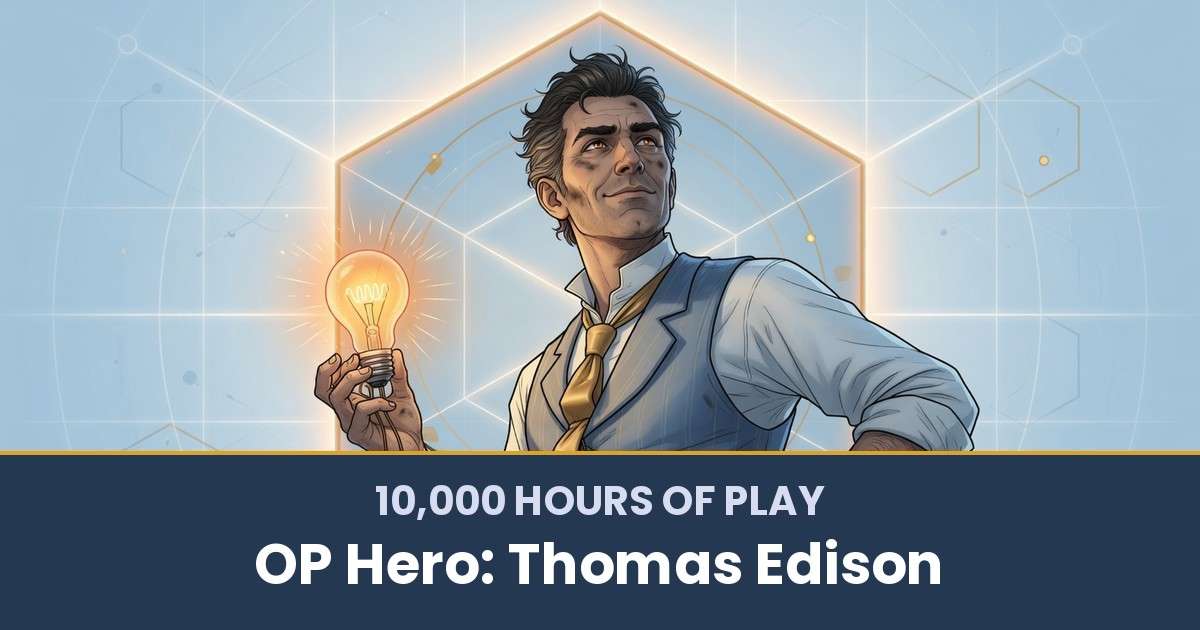


Most people remember Thomas Edison for the lightbulb. That’s like remembering Steve Jobs for the iPod click wheel — technically true and almost completely beside the point.
Edison’s real game wasn’t inventing a thing. It was inventing the invention factory itself. Menlo Park, New Jersey, 1876: a lab purpose-built to grind out a minor patent every ten days and a major one every six months, with a payroll of mechanics, glassblowers, and mathematicians treating discovery as a production line.
That’s the move worth studying. He didn’t out-genius his competitors — he out-systemed them. By the time he died in 1931, he held 1,093 U.S. patents, founded the company that became General Electric, and had built the world’s first commercial electric utility on Pearl Street in Manhattan. He also lost almost his entire phonograph fortune on a failed iron-mining venture and shrugged it off as tuition.
Looked at through the 10,000 Hours of Play framework, Edison is one of the cleanest case studies in the canon: a build that explicitly treats invention as a multi-decade game with attributes, roles, skills, allies, and quests. Here’s how the character sheet reads.
⚡ Speed Run Notes
- Edison’s real invention wasn’t the lightbulb — it was Menlo Park, the first industrialized R&D lab. The thing he built was the thing that built the things.
- His core attribute stack was high risk tolerance plus absurd tolerance for tedium. The teenage printing-press-in-a-baggage-car kid is already the same operator running 6,000 filament tests at 32.
- The 1879 carbon-filament lamp shipped only because Edison had already designed the generators, meters, wiring, and central station around it. He won at the system level, not the part level.
- The 1890s ore-milling fiasco wiped out most of his phonograph fortune. He came back by reinventing the equipment as cement-making machinery and selling it to the team that poured Yankee Stadium.
- He lost the War of the Currents to Tesla and Westinghouse, lost control of his own company to J.P. Morgan, and still ended his life as the most famous inventor on earth. Phoenix Rebirth is the unlock.
Table of Contents
- Step 1: The Game — What Edison Was Actually Playing
- Step 2: Attributes — The Innate Stats
- Step 3: Role(s) — The Character Class Across Chapters
- Step 4: Skills — The Real-Life Game Skills Edison Mastered
- Step 5: Allies — The People Who Multiplied Edison
- Step 6: Quests — The Milestones That Shaped the Saga
- What You Can Steal From Edison’s Build
- Where this framework comes from
- Related Reading
About Yu-kai Chou

Yu-kai Chou is the author of 10,000 Hours of Play — the book that treats your life as the most important game you’ll ever build a character in, and gives you the 6-Step framework (Game · Attributes · Role · Skills · Allies · Quests) to play it on purpose. He has spent two decades developing the system through which this post analyzes its OP Hero, and applies it to his own life and to the lives of the people he advises around the world.
Chou’s other framework, the Octalysis Framework, has been applied by LEGO, Microsoft, Porsche, Coca-Cola, Salesforce, and MrBeast, impacting over 1.5 Billion Users. He has taught the methodology at Harvard, Stanford, Yale, Tesla, Google, BCG, and IDEO, and has advised governments in eight nations including Ukraine, the United Kingdom, the Kingdom of Bahrain, Singapore, Taiwan, the Netherlands, Kazakhstan, and South Korea.
His work has been cited by Harvard, Stanford, MIT, Forbes, Wall Street Journal, Wired, US Department of Energy, NIST, NSF, NCBI, US Department of Education, ClinicalTrials.gov, and Google Scholar — with 3,700+ more academic publications. Explore his books here.
What I find instructive about Edison is that his single best skill wasn’t a skill at all in the traditional sense — it was the discipline of building a system that made his skills compound. Most ambitious people I advise are looking for the right “next thing” to learn. Edison’s life argues the bigger lever is the right next environment to build, because the environment trains the skill in the background while you sleep.
Step 1: The Game — What Edison Was Actually Playing
If you asked Edison what game he was playing, he’d have given you the wrong answer on purpose. “I find out what the world needs. Then I go ahead and try to invent it.” Folksy. Saleable. Half of it.
The other half is what he actually optimized for: turning speculative ideas in telegraphy, electricity, sound, and motion into industrialized, mass-usable systems with patents and businesses bolted on. Library of Congress records show he framed invention as an organized industrial process — not a series of lone strokes of genius — from at least 1869 forward, when he moved from telegraph operator to professional inventor.
By 1876 the game had a board: the Menlo Park laboratory. Edison’s stated quota — “a minor invention every ten days and a big thing every six months” — wasn’t bravado. It was the operating model. Inputs (problems the market would pay to solve) went in one side; outputs (working prototypes, patents, licensable companies) came out the other.
And every breakthrough he’s remembered for is actually a system, not a device. The phonograph was a recording machine plus a manufacturing business plus an entertainment industry. The lightbulb was a filament plus generators plus meters plus wiring plus a central station plus a billing model. Motion pictures were a Kinetoscope plus film stock plus projector plus exhibition venues. He kept winning at the system level because that’s the level he was playing on.
The mistake most ambitious people make is picking a game one altitude below the one that actually decides. Edison picked his at the right altitude on purpose.
Step 2: Attributes — The Innate Stats
Look at Edison at fifteen and you can already see the character sheet.
The first stat is risk tolerance bordering on lunacy. While working as a newsboy on the Grand Trunk Railroad, he set up a small printing press and chemistry lab in a baggage car. The chemicals caught fire. The conductor kicked him and his equipment off the train. Most teenagers learn from that. Edison’s takeaway was, evidently, “build a better lab next time.”
The second is persistence with industrial-grade tolerance for tedium. His own line about the lightbulb — “I have not failed. I’ve just found 10,000 ways that won’t work” — is consistent with contemporaneous accounts that his team tested thousands of filament materials between 1878 and 1879, including, by some claims, over 6,000 plant species. Most people can do that for a week. Edison did it for a year and called it Tuesday.
The third stat is systems thinking. As a teenage telegraph operator, he was already designing a duplex circuit that could send two messages simultaneously down one wire — not because somebody asked him to, but because he saw circuits the way other people see sentences. This is the same brain that, decades later, sketched out a full electric grid before there was such a thing as one.
The fourth is a relentless commercial instinct. In 1869–70 he negotiated a $40,000 buyout of his improved stock ticker from the Gold & Stock Telegraph Company — at age 22, in 1870 dollars. That’s not the action of someone who happens to be making inventions. That’s the action of someone who has decided invention is a business and is auditioning vendors for everything else.
If you map these innate stats against the Talent Triangle Method — your innate strengths, your earned skills, the market that pays for both — Edison’s triangle was almost suspiciously aligned. His risk tolerance and his systems brain were aimed at a market (telegraphy, then electricity) that was, in his lifetime, about to explode from zero to nation-scale infrastructure. That’s the kind of luck that looks like genius from the outside.
Step 3: Role(s) — The Character Class Across Chapters
Edison’s roles ladder up in a way that’s worth tracing chapter by chapter, because almost nobody starts where they end.
Chapter one, roughly 1862 to 1868: itinerant telegraph operator. He worked the night shifts across the American Midwest and Canada, deepening his circuit-design intuition on company time. The job was the school.
Chapter two, 1869 to 1875: independent telegraph inventor and shop owner. He left Western Union in Boston, took the quadruplex payout from Jay Gould in December 1874 — more than $100,000 in cash, bonds, and stock — and ran small manufacturing shops in Newark, New Jersey. Now the school had become the storefront.
Chapter three, 1876 to roughly 1886: laboratory-based invention-factory leader. Menlo Park opens in 1876. The phonograph in 1877. The carbon-filament lamp by late 1879. The Pearl Street Station, Manhattan’s first central power station, in 1882. This is the chapter most history books cover and most ambitious people mistakenly think they have to start in.
Chapter four, roughly 1878 to 1892: industrial entrepreneur and utility founder. The Edison Electric Light Company. The Edison Electric Illuminating Company of New York. Multiple manufacturing arms. By 1892, a merger with Thomson-Houston produces General Electric, and Edison — backed out of management by J.P. Morgan — moves on.
Chapter five, roughly 1892 to 1931: diversified industrialist, late-stage experimentalist, and national mythos. West Orange. Phonograph improvements. Storage batteries for electric vehicles. The motion picture business. Ore milling. Cement. Submarine detection for the U.S. Navy.
The thing to notice is that none of these roles is “inventor” in the dictionary sense. Each is a specific job in a specific market with specific compensation structures, and Edison treats the transition between them the way a careful player treats a class change — only switching when the new build genuinely fits the new content.
Step 4: Skills — The Real-Life Game Skills Edison Mastered
This is where the canon Real-Life Game Skills from the 10K HP framework do the most analytic work. Six skills carry most of Edison’s build.
The first is Lich Grind (Warlock) — intense, secluded work periods that nobody else is awake for. Menlo Park’s all-night sessions are the textbook example. Assistants describe Edison testing variation after variation until dawn, then sleeping on a cot in the lab. The 6,000-filament marathon is Lich Grind in its purest form, and it sits in the same Warlock skill family as the polyphasic sleep pattern Edison was famous for practicing — nap-driven work cycles that recovered him just enough to keep grinding.
The second is Vision Manifestation (Warlock) — visualizing success so vividly it shapes the work. Edison didn’t see a bulb. He saw New York City lit by his bulbs, billed monthly, on a grid he’d designed end to end. The 1879 lamp was almost an afterthought; the central station that switched on at Pearl Street in 1882 was the actual move. He had to see the whole grid before any part of it was real.
The third is Mastermind (Ranger) — creating, adapting, and executing complex plans. Menlo Park is the Mastermind skill at organizational scale. Chemists, machinists, glassblowers, mathematicians, and draftsmen run dozens of experiments in parallel, all coordinated by Edison’s notebooks and daily walkthroughs. You can read the lab logs at the National Park Service archive and watch a Ranger working at full capacity.
The fourth is Cognitive Lens (Mage) — zooming in on detail and zooming out for strategy in the same breath. Edison would obsess over a single filament’s behavior in vacuum, then in the same conversation switch to the economics of a citywide distribution network. Most people can do one of those well. The ones who change industries can do both inside the same hour.
The fifth is Loremaster (Druid) — weaving the inspiring story around the work. “The Wizard of Menlo Park” wasn’t a nickname that happened to Edison; it was a brand he cultivated. He invited reporters to staged demonstrations, made the lab feel like a magic show, and turned every patent into a press event. He understood that the public’s imagination was a battery the lab could run on, and he kept it charged.
The sixth is Phoenix Rebirth (Paladin) — recovering from devastating failure and coming back stronger. The 1890s ore-milling project in Ogdensburg, New Jersey nearly bankrupted him. He’d reinvested most of his phonograph profits into giant magnetic separators that turned out to be uneconomical against newly discovered Minnesota ore. He shut it down, sold the equipment for scrap value, and — in true Phoenix form — repurposed the rock-crushing technology into the Edison Portland Cement Company, which later supplied the cement for the original Yankee Stadium in 1923.
If you read the Skills Spectrum argument — that mastery beats dabbling and specialization beats generalism — Edison is the inversion case worth studying. He looks like a generalist on the surface (telegraphs, light, sound, motion, batteries, cement) but he’s actually a deep specialist in one thing: industrialized iteration. Every chapter applies the same core skill to a new domain.
Step 5: Allies — The People Who Multiplied Edison
Edison is the patron saint of accidental solo-genius mythology, which is funny, because his actual build was built on allies.
Charles Batchelor was his chief experimenter and right hand from the early Newark days. The carbon-filament breakthrough has Batchelor’s fingerprints all over it; he later represented Edison’s interests in Europe and translated the lab’s output into international contracts. If Edison was the chess player, Batchelor was the chess clock.
Francis Robbins Upton, a Princeton-trained physicist who’d studied with Helmholtz in Berlin, brought the mathematics the lab desperately needed. Upton’s calculations on lamp efficiency, wiring resistance, and distribution economics are the reason Pearl Street Station could be designed as a coherent network rather than a hopeful pile of equipment. Edison’s intuition needed an Upton to keep it from drowning in itself.
John Kruesi was the master machinist who turned Edison’s sketches into hardware. The first phonograph — the one Edison shouted “Mary had a little lamb” into in late 1877 — was built by Kruesi from a sketch on a piece of paper, with the famous note “make this from a drawing on the back.”
The Menlo Park “muckers” — the lab’s day-in-day-out staff of mechanics, glassblowers, chemists, and draftsmen — turned a one-genius operation into a parallel-experiments machine. Without them, the 6,000-filament test is a fantasy. With them, it’s a quarterly project plan.
On the capital side, J.P. Morgan, members of the Vanderbilt family, and the financier Spencer Trask backed the Edison Electric Light Company starting in 1878. They gave Edison the money to scale, and the boardroom power, in 1892, to take his own company away from him when they backed Thomson-Houston management over his. Allies are still allies even when they eventually beat you.
Samuel Insull came in as private secretary and grew into a business manager, then a Midwestern utility magnate. Henry Ford, decades later, became the late-life patron who collected and preserved the Menlo Park buildings at Greenfield Village and financed the 1929 “Light’s Golden Jubilee.” Allies came in waves, and Edison’s career has a different shape if any of those waves doesn’t show up.
Step 6: Quests — The Milestones That Shaped the Saga
You can mark Edison’s career with six quests, and each one moves the build forward in a way the previous one didn’t.
Quest one, 1869–1874: the Quadruplex Telegraph. Four messages on a single wire. Sold to Jay Gould in December 1874 for over $100,000. The payout funds the move from wage labor to full-time inventor. This is the quest that bought him the right to play the rest of the game.
Quest two, 1877: the Phonograph. He’s working on a telephone repeater and stumbles on the discovery that sound vibrations can be indented on tinfoil and replayed. Kruesi builds the machine. Edison shouts. It plays back. International fame follows. He becomes “The Wizard of Menlo Park” almost overnight.
Quest three, 1878–1882: the Incandescent Lamp and the Pearl Street Station. The 1879 carbon-filament lamp (U.S. Patent 223,898, issued January 27, 1880) is the headline. The actual win is the September 4, 1882 switch-on at Pearl Street in lower Manhattan — the first commercial central electric station, serving 85 customers in a one-square-mile zone. The age of electricity, as we now understand it, has a date.
Quest four, roughly 1888–1893: the War of the Currents. Edison bets on direct current. Westinghouse and Nikola Tesla bet on alternating current. Edison loses, hard. He resorts to publicity stunts — electrocuting animals to make AC look dangerous — that have aged poorly. By 1893 AC has won the Chicago World’s Fair contract. This is the failure quest, and it’s important: a hero with no losses isn’t a hero, he’s a marketing campaign.
Quest five, roughly 1890–1898: the Ogdensburg Ore-Milling Disaster. Edison sinks something on the order of two million dollars (a colossal sum in 1890s currency) into a magnetic ore-separation plant in northern New Jersey. New iron-ore discoveries in Minnesota make the whole thing economically obsolete before it can scale. He liquidates, eats the loss, and repurposes the equipment for cement — eventually supplying the cement that built Yankee Stadium. Recovery, not avoidance, is the move.
Quest six, 1891 onward: Motion Pictures, Storage Batteries, and the Long Tail. The Kinetoscope (1891–94) seeds the film industry. The nickel-iron alkaline storage battery (perfected by ~1909 after a decade of relentless iteration) becomes one of his most profitable late-career products. He continues experimenting into his eighties. The saga doesn’t end at the peak; it tapers, the way most real lives do, into a long compounding of smaller wins.
What You Can Steal From Edison’s Build
Three things, if you’re auditing your own character sheet.
First, build the lab, not just the invention. If your current 10,000 hours are going entirely into one output — one product, one company, one craft — you’re playing one altitude too low. Edison’s compounding came from owning the machine that produced the outputs, not from any one output. What’s your Menlo Park equivalent? It might be a writing system, a small research team, a portfolio of experiments, or simply a weekly schedule that guarantees ten new attempts at something.
Second, treat failure as tuition you’ve already paid, so spend it. Edison’s Ogdensburg loss didn’t end his career — it bought him cement, which paid for batteries, which paid for the next decade. If you’ve taken a real loss recently, your only job is to figure out what infrastructure or skill the loss left you with that you didn’t have before. That’s the asset. Use it. The same recovery pattern shows up in the build of Bill Gates two generations later: cash the lesson, redeploy the capital, keep playing.
Third, do not confuse losing a battle with losing the game. Edison lost the War of the Currents. He lost control of his own electric company. He still ended his life with 1,093 patents and a national mythology that made him synonymous with American invention. The board kept changing; he kept showing up. If you’re auditing your own losses, the only question worth asking is whether you’re still at the table.
For the rest of the operator’s manual, browse the full OP Hero catalog and find the build whose pattern most closely matches your own.
Where this framework comes from

Want the full system this profile is built on?
Every OP Hero piece runs through the same 6-Step framework from 10,000 Hours of Play: Unlock Your Real-Life Legendary Success. The book covers the full system, walks through Yu-kai’s own life run as the first applied case study, and gives you the worksheets to audit your own build.
Related Reading
- The full OP Hero catalog — every life-as-RPG profile in one place, sorted by build pattern.
- 10,000 Hours of Play by OP Hero: Nikola Tesla — the other side of the War of the Currents.
- 10,000 Hours of Play by OP Hero: Bill Gates — a modern parallel for industrialized iteration.
- 10,000 Hours of Play by OP Hero: Albert Einstein — the contrasting build: theoretical depth instead of industrial breadth.
- The Talent Triangle Method — find the intersection where your stats actually compound.
- The Skills Spectrum: Specialist, Dabbler, Master — pick the right altitude for your 10,000 hours.