
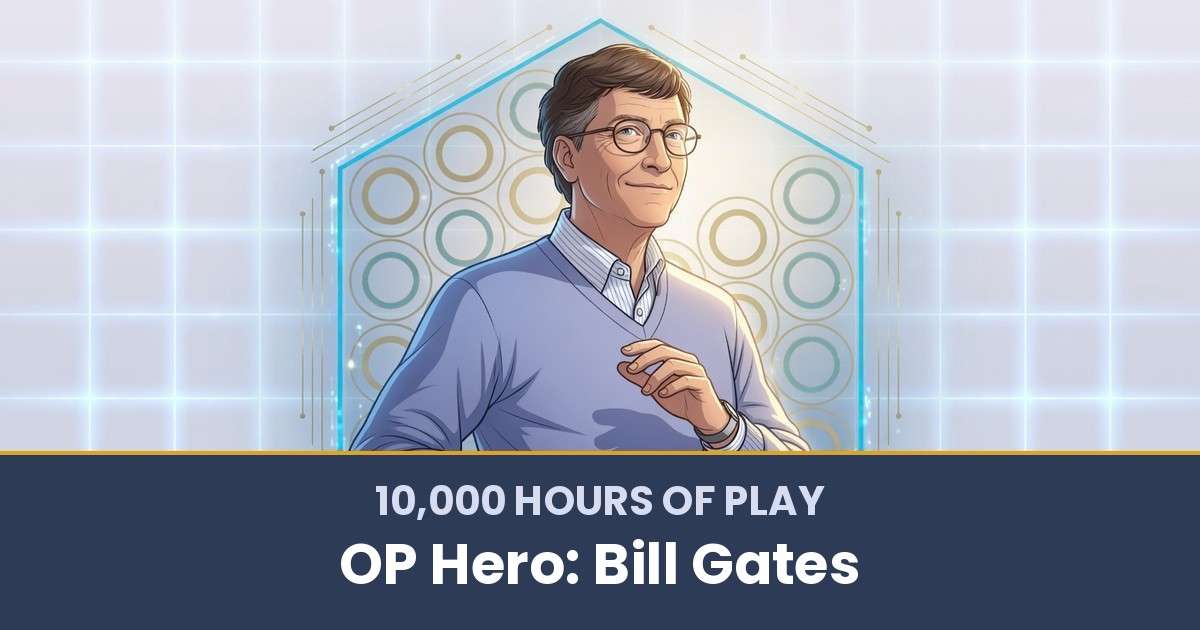


In 1975, a twenty-year-old Harvard sophomore phoned a calculator company in Albuquerque, promised them a BASIC interpreter for a computer he had never seen, and then spent eight weeks writing one with his best friend in a Harvard dorm. The interpreter ran on first try. He dropped out a year later.
That’s the founding scene every Bill Gates biography uses, and it explains less about his life as a build than the forty years that followed.
Gates’s full run looks less like a lucky bet on the Altair and more like a forty-year strategy where the same operating loop — find a system where leverage compounds, write the rules early, then keep compounding the advantage for decades — keeps showing up across software, antitrust, philanthropy, and climate. He didn’t pivot from software to global health. He played the same Game twice, with capital instead of code.
⚡ Speed Run Notes
- Gates’s lifelong Game wasn’t “build Microsoft.” It was using technical and capital leverage to change the baseline outcome for hundreds of millions of people — first via software, then via philanthropy.
- His strongest innate Attribute was extreme sustained focus combined with quantitative pattern recognition — visible at Lakeside School, where he and Paul Allen burned through so much PDP-10 time the company banned them.
- He ran at least five Roles: teen hacker, founder-CEO, Chief Software Architect, full-time philanthropist, and climate-tech investor. Each Role was set up by the credibility of the last.
- The Skill that built Microsoft wasn’t coding. It was negotiating non-exclusive licensing terms — Gravity Flip (Warlock) — in the 1980 IBM deal that quietly preserved Microsoft’s right to license MS-DOS to every PC clone manufacturer.
- His biggest force multipliers were Paul Allen, Steve Ballmer, his mother Mary Maxwell Gates, Warren Buffett, and Melinda French Gates.
- The 1998–2001 antitrust trial that almost broke Microsoft up overlapped with his largest pivot — handing the CEO role to Ballmer in January 2000 and committing the bulk of his fortune to the Gates Foundation. Phoenix Rebirth (Paladin), played in slow motion.
Updated 1 October 2026.
Table of Contents
- Step 1: The Game — What Bill Gates Was Actually Playing
- Step 2: Attributes — The Innate Stats
- Step 3: Role(s) — The Character Class Across Chapters
- Step 4: Skills — The Real-Life Game Skills Bill Gates Mastered
- Step 5: Allies — The People Who Multiplied Bill Gates
- Step 6: Quests — The Milestones That Shaped the Saga
- What You Can Steal From Bill Gates’s Build
- The 10K HP Frame
- Which Core Drives His Arc Activated
- Modern Echo
- Frequently Asked Questions
- Where this framework comes from
- Related Reading
About Yu-kai Chou

Yu-kai Chou is the author of 10,000 Hours of Play — the book that treats your life as the most important game you’ll ever build a character in, and gives you the 6-Step framework (Game · Attributes · Role · Skills · Allies · Quests) to play it on purpose. He has spent two decades developing the system through which this post analyzes its OP Hero, and applies it to his own life and to the lives of the people he advises around the world.
Chou’s other framework, the Octalysis Framework, has been applied by LEGO, Microsoft, Porsche, Coca-Cola, Salesforce, and MrBeast, impacting over 1.5 Billion Users. He has taught the methodology at Harvard, Stanford, Yale, Tesla, Google, BCG, and IDEO, and has advised governments in eight nations including Ukraine, the United Kingdom, the Kingdom of Bahrain, Singapore, Taiwan, the Netherlands, Kazakhstan, and South Korea.
His work has been cited by Harvard, Stanford, MIT, Forbes, Wall Street Journal, Wired, US Department of Energy, NIST, NSF, NCBI, US Department of Education, ClinicalTrials.gov, and Google Scholar — with 3,700+ more academic publications. Explore his books here.
Gates is the build I keep coming back to when founders ask me how to design a second act. Most people who win their first big Game spend the rest of their life defending the trophy. Gates set down the trophy on purpose, used the same operating loop on a harder problem, and made the second run arguably bigger than the first. If you only steal one lesson from his build, steal the way he treats Roles as exits — something you graduate out of when the leverage has shifted somewhere else.
Step 1: The Game — What Bill Gates Was Actually Playing
Many accounts treat Gates’s life as two separate stories — Microsoft, then philanthropy — with a midlife crisis between them.
The dates point to a single Game with two phases. From 1975 through 2000 the Game was “put a computer on every desk and in every home, running Microsoft software.” From 2000 onward the Game became “make sure every person has the chance to live a healthy, productive life,” with the Bill & Melinda Gates Foundation as the vehicle and a December 31, 2045 sunset that Gates announced in May 2025.
That’s why his early bet on software-as-licensed-IP rhymes so closely with his later bet on data-driven philanthropy. In both cases he found a place where the marginal cost of replication was near zero — a piece of code, a vaccine protocol, a measurement framework — and bet that whoever owned the platform layer at that level of replication would have outsized influence on the eventual baseline. Software let him reset what a billion office workers did each morning. Capital plus measurement, deployed through Gavi and the Global Fund, let him push child mortality down across entire regions.
Step 2: Attributes — The Innate Stats
Four Attributes show up in Gates so early they read as wiring, not training.
Extreme sustained focus. At Lakeside School in the late 1960s he and Paul Allen routinely logged all-night sessions on the school’s teletype-linked PDP-10. They were eventually banned from Computer Center Corporation for exploiting bugs to gain free machine time — a punishment that they responded to by negotiating debugging work in exchange for more time.
Quantitative-abstract reasoning. Gates scored 1590 out of 1600 on the SAT and was, by every contemporary account at Lakeside, the kind of student who finished advanced math homework before class started. His teenage Traf-O-Data project with Allen — counting traffic patterns by reading punched-paper tape into an Intel 8008 — was a tiny business and a commercial failure, but it shows a 17-year-old already thinking in terms of “sensor in, analytics out” two decades before that became a phrase.
Combative argumentation. Multiple former Microsoft executives have described his style as confrontation by default — “that’s the stupidest thing I’ve ever heard” was reportedly a real artifact of his code reviews. At Lakeside he was the kid who would argue with teachers about logic problems. The Attribute isn’t pleasant, but it is real, and it shaped the quality bar inside Microsoft’s early product teams. The downside cost shows up later, in his public communication style under the antitrust pressure of 1998–2001.
Risk tolerance on big asymmetric bets. Dropping out of Harvard in 1975 to start Microsoft on the strength of a magazine cover is the famous example. The 26 May 1995 “Internet Tidal Wave” memo, in which he reoriented the entire company around a competitor it had barely noticed two months earlier, is the same Attribute applied at scale. Most leaders hedge. Gates would flip an entire roadmap inside a quarter if the underlying assumption had changed. That risk profile is part of why the Talent Triangle Method matters — risk-tolerant operators are easy to spot in hindsight and brutally hard to identify before they hit.
Step 3: Role(s) — The Character Class Across Chapters
Gates ran at least five distinct Roles across his career.
Teen hacker and freelance programmer (1968–1975). Lakeside, Computer Center Corporation, Traf-O-Data, the early Harvard years writing BASIC. The Role looked like an unfocused prodigy. The skill base was compounding underneath.
Founder-CEO and platform strategist (1975–2000). Microsoft founded April 4, 1975 in Albuquerque. IBM PC deal landed November 1980. MS-DOS 1.0 ships August 1981. Windows 3.0 ships May 1990. Microsoft’s IPO on March 13, 1986 priced his 45% stake at roughly $350 million; by 1995 he was the wealthiest person in the world. This is the Role most people associate with the name, and it lasted exactly 25 years.
Chief Software Architect (2000–2006). He handed the CEO job to Steve Ballmer in January 2000, kept the architect title, and used the change to spend more time on individual product strategy — including the January 15, 2002 “Trustworthy Computing” memo that put security back at the center of the Windows roadmap after a year of high-profile worm outbreaks.
Full-time philanthropist and global-health investor (2008–present). In June 2008 he made the public transition to full-time work at the Bill & Melinda Gates Foundation, keeping only a chairman role at Microsoft until 2014. The Foundation has paid out more than $77 billion in grants as of recent annual reports and committed to spending down all remaining assets by 2045.
Climate-tech investor and policy advocate (mid-2000s–present). Through Breakthrough Energy Ventures (founded 2016) and the 2021 book How to Avoid a Climate Disaster, he turned the same data-driven, big-bet logic toward energy. The Role here looks like the philanthropy Role, but the playbook is closer to his early Microsoft self — funding the unfashionable, technically hard, capital-intensive bet.
Step 4: Skills — The Real-Life Game Skills Bill Gates Mastered
Five canon 10K HP Skills show up in Gates’s run, and most of them can be tied to a specific year.
Vision Manifestation (Warlock). The Skill of holding a future state in your head so vividly that you start acting as if it’s real, which then makes it real. “A computer on every desk and in every home, running Microsoft software” was internal Microsoft language by the early 1980s, at a moment when most homes had no computer at all. The Foundation’s mission — “every person has the opportunity to live a healthy, productive life” — is the same Skill, ported to a different domain. Both are statements you can hold up against any meeting on a Tuesday afternoon and immediately know whether the meeting moves you toward it.
Gravity Flip (Warlock). The negotiation Skill — bending a deal structure so the apparent winner of the negotiation actually loses the long-term leverage. The diagnostic moment is the 1980–1981 IBM PC operating-system deal. Microsoft licensed MS-DOS to IBM non-exclusively, and the U.S. v. Microsoft Findings of Fact (1999) document that Microsoft retained the right to license MS-DOS to other PC manufacturers — the structural lever that built the entire clone industry. IBM thought it had won a procurement. It had actually handed Microsoft the keys to the entire PC clone industry that would emerge over the next decade — Compaq, Dell, HP, and every Taiwanese assembler — all of whom now needed an MS-DOS license to be IBM-compatible. Gates had practiced the same move on the 1975 Altair BASIC contract with MITS, which licensed the interpreter instead of selling it outright.
Cognitive Lens (Mage). Zoom in to the line-of-code detail, zoom out to the platform strategy, and switch between the two without losing context. Gates was famously involved in early Microsoft code reviews — line-by-line critique of MS-DOS internals and Windows kernel paths in the late 1980s — while simultaneously running the meta-strategy that selected which products to ship at all. The 1995 “Internet Tidal Wave” memo is the macro-lens artifact: “the Internet is the most important single development to come along since the IBM PC… I want every product plan to try and go overboard on Internet features.” Twice-yearly “Think Weeks,” where he isolated himself with stacks of internal strategy papers and read for seven days straight, were the deliberate switching mechanism between the two lenses. The same range shows up in the Skills Spectrum — Specialist depth feeding Master synthesis.
Lich Grind (Warlock). Intense, secluded work periods. In Gates’s case the pattern was decades of all-night coding sessions, weekend code-review marathons, and the institutionalized Think Week. The early Microsoft team has multiple stories of finding him asleep under his desk after thirty-six straight hours on a compiler. Without the grind, the IBM negotiation would not have had a product on the other side of it.
Mastermind (Ranger). Create, adapt, and execute complex plans across long time horizons. The Microsoft platform strategy — DOS leads to Windows, Windows leads to Office bundling, Office bundling leads to the Internet Explorer-Netscape collision — was a fifteen-year sequenced plan, and each move set up the next move’s leverage. The Gates Foundation’s grant strategy works the same way: vaccine research feeds delivery infrastructure, delivery infrastructure feeds national health-system capacity, capacity feeds endemic-disease elimination targets.
Step 5: Allies — The People Who Multiplied Bill Gates
Much of Gates’s build was a team build. He’s an introvert who picked operators well, and most of his platform shifts ride on a specific person.
Paul Allen — childhood friend, Microsoft co-founder, and the person who spotted the January 1975 Popular Electronics Altair cover and told Gates they had to call MITS. Allen’s instinct that software should be licensed rather than sold outright shaped Microsoft’s business model from the start.
Steve Ballmer — Harvard classmate, Microsoft’s first business manager in 1980, then CEO from 2000 to 2014. Ballmer is the operator who let Gates stay the strategist. The Office bundling expansion, the international enterprise sales force, and most of the revenue infrastructure that funded everything else were largely built under Ballmer.
Mary Maxwell Gates — his mother, a University of Washington Regent and United Way national board member who sat alongside IBM chairman John Opel on a national charity board. Contemporary accounts credit her connection with Opel as a contributing factor in IBM picking the tiny Microsoft for the PC operating system in 1980.
Warren Buffett — friend since their first meeting on July 5, 1991, and the example that reshaped Gates’s philanthropy. Buffett’s June 2006 commitment to give the bulk of his Berkshire Hathaway stake to the Gates Foundation — eventually exceeding $39 billion in appreciated stock — is the single largest individual gift in philanthropic history. The Giving Pledge, co-launched in 2010, is essentially Gates and Buffett institutionalizing that example.
Melinda French Gates — Microsoft executive, marriage to Gates in 1994, co-founder and co-chair of the Gates Foundation. She is the person most responsible for the Foundation’s focus on women’s health, family planning, and gender equity, and she repeatedly pushed back when Bill’s instinct was to optimize for narrow technical metrics rather than human ones.
Bill Gates Sr. — his father, a Seattle lawyer who co-chaired the Gates Foundation in its earliest years and is the moral counterweight Gates publicly credits with pushing him toward serious philanthropy in the late 1990s. Gates himself has said the Foundation simply does not exist without his father’s involvement.
Step 6: Quests — The Milestones That Shaped the Saga
Six Quests structure Gates’s life as a build.
Quest 1: The Altair BASIC interpreter (January–April 1975). Gates and Allen see the Altair on the cover of Popular Electronics, call MITS in Albuquerque, promise a BASIC interpreter for a CPU they have never used, and ship a working version in roughly eight weeks. The interpreter runs first try on the demo. Microsoft is founded April 4, 1975.
Quest 2: The IBM PC operating-system deal (July 1980–August 1981). Microsoft buys 86-DOS from Seattle Computer Products for $50,000, rebrands it MS-DOS, and licenses it to IBM non-exclusively for the original IBM PC. The deal closes November 1980; MS-DOS 1.0 ships August 1981. This is the leverage that turns Microsoft from a small language-tools company into the platform layer of the PC era.
Quest 3: Windows 95 and the Microsoft IPO arc (1986–1995). March 13, 1986: Microsoft IPOs at $21 a share, valuing Gates’s 45% stake at roughly $350 million. May 22, 1990: Windows 3.0 ships and sells millions of copies. August 24, 1995: Windows 95 ships and reportedly sells 7 million copies in the first five weeks. Microsoft passes a $100 billion market cap by the late 1990s, and Gates is the wealthiest person in the world for most of the decade.
Quest 4 (the setback): The U.S. v. Microsoft antitrust ruling (April 3, 2000–November 1, 2001). Judge Thomas Penfield Jackson’s April 3, 2000 conclusion that Microsoft had violated the Sherman Act, followed by the June 2000 order to break the company in two, is the closest Gates ever came to losing the empire. The remedy was overturned on appeal in June 2001 and replaced with a behavioral consent decree in November 2001.
Quest 5: The handoff and the Foundation pivot (January 2000–June 2008). Gates announces January 13, 2000 that Ballmer is the new CEO. He stays as Chief Software Architect until June 27, 2008, when he transitions to full-time work at the Foundation. Between 2000 and 2008, the Bill & Melinda Gates Foundation receives roughly $36 billion in committed capital from Bill, Melinda, and Warren Buffett combined. This is the Phoenix Rebirth (Paladin) Quest — recovery from a near-catastrophic outcome by deliberately shifting the Game rather than doubling down on the old one.
Quest 6: Climate, AI, and the 2045 sunset (2016–present). Founding Breakthrough Energy Ventures in 2016. Publishing How to Avoid a Climate Disaster in February 2021. The May 2021 divorce from Melinda French Gates, which forced a public re-negotiation of how the Foundation was governed without rupturing its mission. The July 2022 announcement that he intends to give away “virtually all” of his wealth, followed by the May 2025 announcement that the Foundation will close permanently on December 31, 2045. Quest 6 is still in motion.
What You Can Steal From Bill Gates’s Build
Three lessons for anyone running a multi-decade Game.
Check each year where your leverage sits. Most people inherit a Role early and then play it until it plays them. Gates left the CEO chair while Microsoft was still the most valuable company in the world, because the Game had moved to a place where the CEO Role no longer multiplied him. If you find yourself defending a Role’s status rather than its leverage, the Role has expired. The move is to write down what Role would actually produce the highest impact on your underlying Game right now, and to ask why you’re not running that one.
Write contracts like a platform, not a sale. The single most important commercial decision of Gates’s life was retaining the right to license MS-DOS to non-IBM manufacturers in 1980. It cost Microsoft nothing extra at the table and bought them the entire next decade. Whenever you sign a deal — a customer contract, an employment agreement, a publishing deal, a partnership — the question to ask is which clauses you’d want to look back on in fifteen years and which clauses are quietly compounding leverage to the other side.
Build the second Game while the first one is still winning. The Gates Foundation was incorporated in January 2000, the same month Gates stepped down as CEO. He did not wait for the antitrust dust to settle before opening the next chapter — he opened it with overlap.
The 10K HP Frame — Bill Gates Through the 6 Steps Lens
Each Step in Gates’s life fed the next one, and most of the handoffs can be dated.
In the 10,000 Hours of Play framework, Step 1: Choose Your Game is supposed to decide which Skills you grind in Step 4.
In Gates’s case, “A computer on every desk and in every home” told a teenager at Lakeside which hours mattered, and those were the hours he spent on the school’s PDP-10 terminal while other students went home.
Step 2: Know Your Attributes then explains how he sustained that grind for years.
Sustained focus and quantitative reasoning were already visible when he and Paul Allen bargained debugging work in exchange for more machine time at Computer Center Corporation.
Step 3: Select Your Role changed for Gates on two dated days.
When Steve Ballmer became CEO in January 2000, Gates moved to Chief Software Architect while the Game stayed the same.
Eight years later, in June 2008, he moved full time to the Foundation.
Step 4: Enhance Your Skills has room for two more canon Skills beside Gravity Flip and Vision Manifestation.
Reflect Damage (Paladin) is the Skill of turning negative feedback and setbacks into growth. Gates used it in January 2002, when a year of high-profile worm outbreaks pushed him to write the “Trustworthy Computing” memo and move security to the center of the Windows roadmap, which turned a year of public criticism into the product plan.
Arcane Metrics (Mage) is the Skill of harnessing data to measure progress. The Foundation’s closing plan, announced on 8 May 2025, names its goals as outcomes you can count: ending preventable deaths of mothers and babies, protecting the next generation from deadly infectious diseases, and lifting millions of people out of poverty.
Each goal comes with a scoreboard that someone outside the Foundation can check.
Step 5: Build Your Alliances is where the second Game got its scale.
Warren Buffett committed the bulk of his Berkshire Hathaway stake to the Foundation in June 2006, two years before Gates moved there full time. Gates had his largest Ally in place before he entered the new Role.
Step 6: Achieve Your Quests carries a timer in Gates’s case.
The Foundation will close on 31 December 2045, which turns an open-ended mission into a Quest with a known final day. Gates has also started publishing the quest log himself: Source Code: My Beginnings came out in February 2025 as the first of three planned volumes, covering his life through the late 1970s.
Which Octalysis Core Drives Bill Gates’s Arc Activated
Four of the eight Core Drives in the Octalysis Framework show up across both of Gates’s Games: CD1, CD2, CD4 and CD6.
CD1: Epic Meaning & Calling
Epic Meaning & Calling is the drive that makes people act because they believe they are part of something bigger than themselves.
Gates wrote his calling down twice, once for each Game he played. The Microsoft version was a computer on every desk and in every home. The Foundation version is a world where every person has the chance to live a healthy, productive life.
Both statements were large enough to recruit thousands of people who would never meet him, and specific enough to reject projects that did not move toward them.
His explanation for the 2045 plan reads like a CD1 statement in plain language.
“There are too many urgent problems to solve for me to hold onto resources that could be used to help people.” (Bill Gates, May 2025)
CD2: Development & Accomplishment
Development & Accomplishment is the drive behind progress bars, levels and visible scores.
At Microsoft the scoreboard was market share and shipped versions: MS-DOS in 1981, Windows 3.0 in 1990, Windows 95 in 1995.
At the Foundation the scoreboard moved to health outcomes, and the spending moved with it. In January 2026 the Foundation approved a record annual budget of $9 billion as part of the plan to spend its remaining resources before closing.
CD4: Ownership & Possession
Ownership & Possession is the drive to accumulate, protect and improve what is yours.
The first half of Gates’s life shows CD4 at work. Keeping the right to license MS-DOS to other manufacturers in the 1980 IBM deal is an ownership move, and it paid for everything that came after.
The second half runs the same drive in reverse. The May 2025 announcement committed more than $200 billion through the Foundation by 2045, which means giving away almost everything the first Game accumulated.
CD6: Scarcity & Impatience
Scarcity & Impatience is the drive that makes people act because they cannot have something yet, or because time is running out.
The 2045 sunset is a CD6 design. A foundation that exists forever can always fund the hard project next year, while a foundation with a closing date has to choose now.
Gates applied the same pressure to himself in 1975, when he promised MITS a BASIC interpreter for a machine he had never seen and then had about eight weeks to deliver it.
Modern Echo — Who’s Playing This Game Today
Since the Last Time We Told This Story
Gates’s second Game moved quickly through 2025 and 2026.
On 3 April 2025, a day before Microsoft’s 50th anniversary, he published the original Altair BASIC source code that he and Paul Allen wrote in 1975.
On 28 October 2025 he released a memo titled “Three tough truths about climate,” arguing that climate policy should be judged by its effect on human welfare, with disease and poverty in poor countries treated as the larger near-term threat.
On 4 March 2026 the United States Nuclear Regulatory Commission approved the construction permit for TerraPower’s Natrium reactor in Kemmerer, Wyoming. Gates founded TerraPower and chairs it, and the plant is designed as a 345-megawatt sodium fast reactor with molten-salt storage, with completion targeted for 2030.
Two people today are running a version of the build Gates ran: win one Game with technology, then point the proceeds and the playbook at human health.
Demis Hassabis reached chess master standard at 13 and co-designed the 1994 video game Theme Park at Bullfrog Productions when he was 17.
He founded his own games studio, Elixir, in 1998, then co-founded DeepMind in 2010 and sold it to Google in 2014.
In 2024 he shared the Nobel Prize in Chemistry for AI work on protein structure prediction. Isomorphic Labs, the drug discovery company he launched in 2021, raised $600 million in March 2025 and a $2.1 billion Series B in May 2026 to move its drug candidates into clinical testing.
Like Gates, Hassabis built his early Skills inside games and then used them on biology.
Patrick Collison co-founded Stripe and then backed the Arc Institute, which launched in 2021 with an initial endowment of $650 million from Collison and other donors.
Arc gives scientists multi-year funding with no strings attached, a structure that echoes the Gates Foundation’s patient-capital model.
In February 2025 Arc released Evo 2, a biology foundation model built with NVIDIA. In September 2025 Arc researchers reported a generative design of viable bacteriophage genomes that produced 16 working phages.
Collison’s first Game moved money around the internet, and his second uses that money to speed up research on complex diseases.
Frequently Asked Questions
What was Bill Gates’s lifelong Game?
From 1975 to 2000 Gates used software to change what people did at their desks. From 2000 onward he used capital and measurement through the Gates Foundation to change health outcomes for the world’s poorest people.
Which Real-Life Game Skills did Bill Gates use most?
His clearest canon Skills are Vision Manifestation, Gravity Flip and Lich Grind (Warlock), Cognitive Lens and Arcane Metrics (Mage), Mastermind (Ranger), and Reflect Damage (Paladin). Gravity Flip shows up in the 1980 IBM deal, where Microsoft kept the right to license MS-DOS to other PC makers.
Why is the Gates Foundation closing in 2045?
In May 2025 Gates announced that the Foundation would spend more than $200 billion over twenty years and close on 31 December 2045. He said there were too many urgent problems for him to hold onto resources that could help people now.
Which Octalysis Core Drives explain Bill Gates’s motivation?
CD1 Epic Meaning & Calling, CD2 Development & Accomplishment, CD4 Ownership & Possession and CD6 Scarcity & Impatience carry most of his arc. The 2045 closing date is a deliberate CD6 deadline placed on top of a CD1 mission.
How can I apply Bill Gates’s build to my own life?
Pick one of the six Steps and compare it with a dated decision from Gates’s life. For Step 6, give your largest Quest a final day the way the Foundation’s 31 December 2045 closing date does, then work backward to this year’s milestones.
Where this framework comes from

Want the full system this profile is built on?
Every OP Hero piece runs through the same 6-Step framework from 10,000 Hours of Play: Unlock Your Real-Life Legendary Success. The book covers the full system, walks through Yu-kai’s own life run as the first applied case study, and gives you the worksheets to audit your own build.
Related Reading
- All OP Hero Profiles — the full library of 10K HP-framework character studies, updated as new heroes ship.
- 10,000 Hours of Play by OP Hero: Elon Musk — the closest peer build to Gates’s, with a similarly overlapping second-Game pattern.
- 10,000 Hours of Play by OP Hero: Jensen Huang — another modern tech build whose patient hardware bet rhymes with Gates’s platform thinking.
- 10,000 Hours of Play by OP Hero: Phil Knight — a founder-to-elder-statesman arc with the same Mastermind plus Allies pattern.
- The 10,000 Hours of Play framework hub — start here if you want to map your own Game · Attributes · Role · Skills · Allies · Quests.