
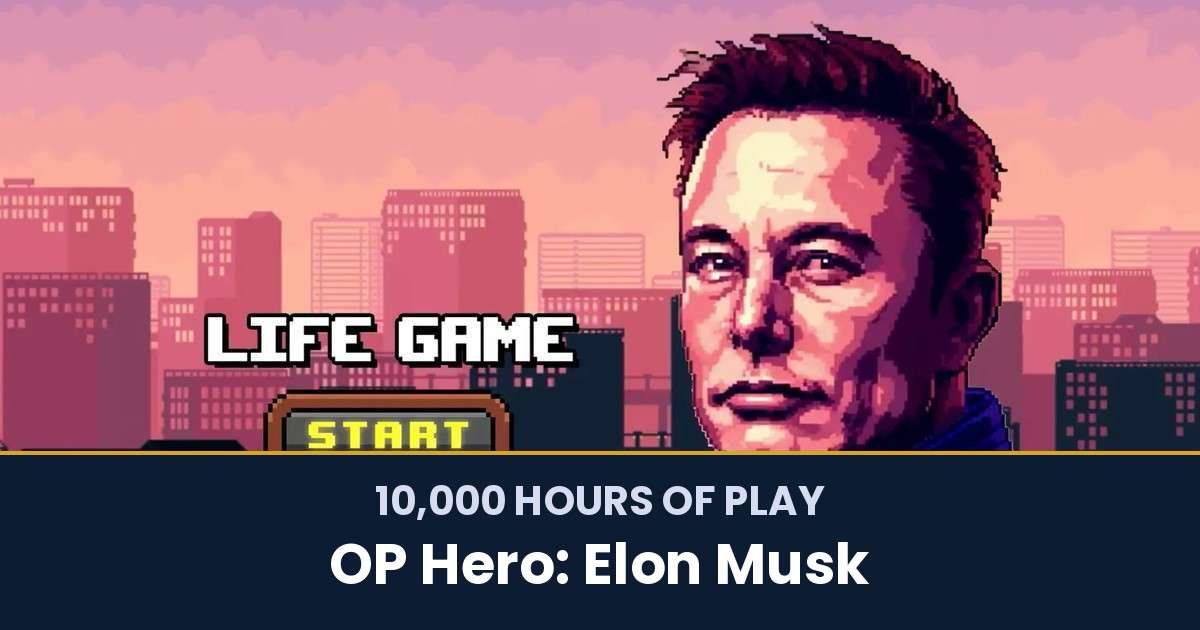



Below is a manuscript snippet of my 2nd book: 10,000 Hours of Play: Unlock Your Real-Life Legendary Success. Due to content length, sizeable portions of the manuscript was removed from the final version, so I wanted to post the “Director’s Cut” here. If you like this post, you’ll love the book!
⚡ Speed Run Notes
- Reading a famous life as a game build reveals which stats were invested and which were dump stats. Everyone has finite points. The interesting question about any outlier is which attributes they starved in order to max others. Most biographies skip this, they write the max stats in praise and pretend there were no dump stats. The game-build frame forces honesty about the trade.
- High-agency players live in the “restart the run” frame instead of the “play it safe” frame. The normal life posture treats each decision as a branch you cannot unwind. The high-agency posture treats each decision as a run you can re-roll. That single reframing unlocks risk tolerances most players cannot access.
- The Ownership stat shows up in almost every outlier build. People who feel they own their outcomes grind more hours, take more risk, and absorb more failure than people who feel outcomes happen to them. Ownership is not an attitude, it is a stat. And every point in it returns multiplicatively across the other stats in the build.
- Every OP hero in real life is carrying a hidden debt the game tracks invisibly. Health, relationships, reputation, the OP build pays for itself with currencies the in-game UI doesn't display. Honest life gamification has to make those hidden ledgers visible, or you end up broke in a currency you forgot was real.
- The point of the exercise is refusing to worship the outlier. A life-as-game frame treats famous builds as studyable, not imitable. The correct takeaway from any OP hero is never “do what they did”, it is “understand the trade-offs they made and decide which trades you actually want in your own run.” That posture lets you respect an outlier without trying to become one.
Elon’s build is one entry in a much longer roster. I keep every breakdown like this in my OP Hero Profiles hub: Michael Jordan’s brutal skill grind, Galileo staking his life on a truth stat nobody wanted him to max, Ada Lovelace playing a game her whole century could not see yet. Over a hundred builds live there now. If reading a famous life as a game build hooks you the way it hooks me, that page is the full library. Now, the manuscript.
Table of Contents
Author Credibility: Yu-kai Chou

Yu-kai Chou created the Octalysis Framework after studying gamification since 2003 — years before the term entered mainstream vocabulary. As a Human-Systems Architect & Behavioral Designer, his framework has been applied by LEGO, Microsoft, Porsche, Coca-Cola, Salesforce, and MrBeast, impacting over 1.5 Billion Users.
Chou has taught the Octalysis methodology at Harvard, Stanford, Yale, Tesla, Google, BCG, and IDEO.
His work has been cited by Harvard, Stanford, MIT, Forbes, Wall Street Journal, Wired, US Department of Energy, NIST, NSF, NCBI, US Department of Education, ClinicalTrials.gov, and Google Scholar — with 3,700+ more academic publications. Explore his books here.

OP Hero Profile: From Bullied and Broke to Top of the World – the Existential Innovator
This OP Hero, an embodiment of Step 4: Enhance Your Abilities, is a widely recognized and respected figure whose impact spans society. He began his life game with a mission (Step 1) that extended naturally from his insatiable curiosity: Uncovering the truth of the universe.
He then built on his unique attributes (Step 2), stacking a vast variety of synergetic abilities (Step 4) across software, payments, rockets, cars, and artificial intelligence.
Let us begin with the captivating story of a young boy from Pretoria, South Africa – a tale often misconstrued by popular media. From the tender years of his childhood, our OP Hero was quite introverted and preferred to spend time alone reading books. His world was one of science fiction novels and comic books, where a future among the galactic stars was an inevitability.
His first quest (Step 6) was to read as many books from the library as possible. By the age of nine, his insatiable thirst for knowledge outpaced both his school’s and his community’s library resources, leading him to petition the school to add new books.
The 10K HP Frame — Elon Musk Through the 6 Steps Lens
The manuscript stops with a nine-year-old petitioning his school for more library books. The rest of his life can be walked through the 6-Step framework one Step at a time.
Start with the Game, because it has barely moved in fifty years. The boy who lived inside science fiction about a future among the stars grew into the founder of a rocket company whose stated purpose is making life multiplanetary.
Two Attributes appeared before he turned thirteen. The first was a reading appetite large enough to exhaust two libraries. The second was the urge to turn what he read into something that runs: at twelve he wrote a space shooter called Blastar, and a computer magazine published the code in 1984 and paid him about $500. Absorb a domain, then ship a working artifact in it. That loop repeats for the next four decades.
His Roles changed roughly once per chapter, and each one bought a resource the next one needed. Zip2, the online city-guide company he built with his brother Kimbal, sold to Compaq in 1999 for $307 million and turned the coder into an investor. X.com became PayPal, and eBay bought PayPal in 2002 for $1.5 billion, which turned the investor into someone who could fund a rocket company out of his own pocket. Then came the long run as SpaceX’s chief engineer and Tesla’s chief executive, a 2025 detour of about 130 days as a special government employee leading the cost-cutting effort known as DOGE, and in 2026 a return to artificial intelligence when SpaceX absorbed his AI company, xAI.
Every company he built worked as a side quest that funded the main quest he started reading about as a boy.
The evidence clusters around five canon Real-Life Game Skills.
Ley Line Infusion (Mage) is the ability to absorb a large amount of knowledge quickly. With degrees in physics and economics and no aerospace training, he taught himself rocketry from textbooks and long interrogations of the engineers he hired, then took the chief engineer title at his own launch company.
Sacrificial Cycle (Warlock) is reinvesting everything back into the project. He received roughly $175.8 million from the PayPal sale and fed most of it into SpaceX and Tesla, which is why both companies could pull him to the edge of personal ruin in 2008.
Phoenix Rebirth (Paladin) is coming back stronger from devastating failure. Falcon 1 failed in 2006, failed in 2007, and failed again in August 2008. The fourth attempt, on September 28, 2008, made it the first privately developed liquid-fuel rocket to reach orbit.
Devour (Warlock) is stripping steps and components out of a system until it runs lean. His engineering rule is to question every requirement and delete every part or process you can, because the cheapest, most reliable part is the one that was never built.
Animate (Warlock) is moving human labor into computing and robotics. Tesla began building the Cybercab, a two-seat robotaxi with no steering wheel or pedals, at its Texas factory in 2026.
His Allies show up at the moments the build nearly broke, and NASA is the clearest case. Its cargo contract, worth up to $1.6 billion, arrived in December 2008 while SpaceX was nearly out of money.
There is a cost side too. A build running this many simultaneous quests spends currencies the scoreboard never displays, and public feuds and a polarizing turn in government in 2025 sit on that hidden ledger alongside the rockets.
Which Octalysis Core Drives Elon Musk’s Arc Activated
The 6 Steps describe what he built. To see what kept him building through three exploded rockets and a near-bankrupt car company, look at the motivation underneath through the Octalysis Framework.
CD1: Epic Meaning & Calling
Epic Meaning & Calling is the drive to serve something larger than yourself. Musk describes SpaceX as a backup plan for civilization, a way to keep humanity alive if something goes badly wrong on one planet.
The evidence is in what he tolerated. Rational investors walk away after a third failed launch. A mission framed as species insurance makes a third failure an expensive lesson, so he funded a fourth.
CD7: Unpredictability & Curiosity
Curiosity sits at the root of the build. A mission framed as uncovering the truth of the universe is Unpredictability & Curiosity in its purest form. The same phrase reappears as the stated goal of xAI, the company he founded to understand the true nature of the universe.
A boy who emptied two libraries chasing that question grew into a man who funds a frontier AI lab to chase it at scale. Curiosity also explains the breadth of the build. Payments, electric cars, batteries, rockets, tunnels, brain implants, and AI make a strange business plan, and they make sense as one question followed down every corridor it opens.
CD8: Loss & Avoidance
Loss & Avoidance is the drive to act before something you value disappears. December 2008 is its textbook case. On December 23, NASA awarded SpaceX the resupply contract. On December 24 at 6 p.m., Tesla closed the funding round that kept it alive, which Musk later called the last hour of the last day possible.
Both companies survived 2008 by a margin measured in hours.
Loss Avoidance produces enormous short-term effort, and it also burns. A player who keeps the stakes at company-or-nothing for years pays for it in health, relationships, and judgment.
CD3: Empowerment of Creativity & Feedback
Empowerment of Creativity & Feedback is the drive to try, see the result, and try again. The Starship program runs on it: build a vehicle, fly it, watch what breaks, and fold the lesson into the next one.
On September 28, 2026, Starship reached orbit for the first time even though one of the ship’s six engines failed on ascent. On November 14, the tower’s mechanical arms caught Ship 42 as it returned from orbit, the first recovery of a Starship upper stage. On that same flight the booster aborted its own tower catch, diverted to the Gulf of Mexico, and exploded. One flight produced a record and a failure, and both went straight into the next design.
Modern Echo — Who’s Playing This Game Today
Since the Last Time We Told This Story
The run kept moving in 2026. On February 2, SpaceX absorbed xAI in an all-share deal that valued the combined company at $1.25 trillion. Because xAI had absorbed the social network X in 2025, the deal also put X under the SpaceX roof. On June 12, SpaceX began trading on Nasdaq under the ticker SPCX after raising $86 billion at a $1.77 trillion valuation.
At Tesla, shareholders approved a performance award worth up to roughly $1 trillion on November 6, 2025, with about 75 percent of votes in favor, tying his payout to targets such as a vastly larger market value and one million humanoid robots delivered. Cybercab production followed in early 2026. Through all of it he has kept the chief executive role at both Tesla and SpaceX.
Two players running a similar pattern today are easy to name: largely self-taught builders who stake everything on hardware missions most experts called unrealistic.
Peter Beck never went to university. He started as a tool-and-die apprentice at the New Zealand appliance maker Fisher & Paykel in 1995, spent his spare time building rocket-powered machines, and founded Rocket Lab in 2006. His Electron rocket failed on its first attempt in 2017 and reached orbit on January 21, 2018. Its Rutherford engines use 3D-printed parts and battery-driven electric pumps, which Rocket Lab bills as the world’s first 3D-printed, electric-pump-fed rocket engine. In 2025 Electron flew 21 times with every mission successful, a company record.
His next quest is Neutron, a larger, partly reusable rocket. In October 2026 Rocket Lab pushed its first launch into 2027 after finding voids in a carbon-fiber dome on the first stage.
Palmer Luckey built his first virtual reality headset prototypes as a teenager in his parents’ garage, founded Oculus at nineteen, sold it to Facebook in 2014 in a deal reported at about $2 billion, was pushed out of the company in 2017, and founded the defense company Anduril that same year. In 2025 Anduril took over the Army’s mixed-reality headset program from Microsoft, and its Fury drone fighter made its first flight on October 31. On July 27, 2026, the first Fury built at Anduril’s new Arsenal-1 factory in Ohio rolled off the line. Like Musk with NASA, he paired a fortune from consumer technology with a bet on a government customer that most startups avoid.
Frequently Asked Questions
What video game did Elon Musk make as a kid?
At twelve, Elon Musk wrote a space shooter called Blastar. A computer magazine published the code in 1984 and paid him about $500 for it. It was his first shipped product.
What did Elon Musk study in college?
He moved from South Africa to Canada in 1989, studied at Queen’s University, and transferred to the University of Pennsylvania two years later. Penn awarded him a bachelor’s degree in physics and a bachelor’s degree in economics from the Wharton School in 1997.
How did Elon Musk survive 2008?
Both of his companies nearly died that year. After three failed Falcon 1 launches, the fourth reached orbit on September 28, 2008. NASA then awarded SpaceX a resupply contract worth up to $1.6 billion on December 23, and Tesla closed an emergency funding round on the evening of December 24.
What happened on SpaceX’s Starship flights in 2026?
Starship reached orbit for the first time on September 28, 2026. On the next flight, the launch tower’s arms caught Ship 42 on November 14 as it returned from orbit, the first recovery of a Starship upper stage, while that flight’s booster aborted its own catch and was lost in the Gulf of Mexico.
Is SpaceX a public company?
Yes. SpaceX listed on Nasdaq under the ticker SPCX on June 12, 2026, after raising $86 billion at a $1.77 trillion valuation. Earlier that year it had absorbed xAI, Musk’s artificial intelligence company, in an all-share deal.
Related Reading
- OP Hero Profiles: the full library of life-as-a-game breakdowns.
- Henry Ford, OP Hero: an earlier builder who rebuilt an industry around the factory itself.
- Nikola Tesla, OP Hero: the inventor whose name Musk’s car company carries.
- 10,000 Hours of Play: the book this manuscript snippet comes from.