
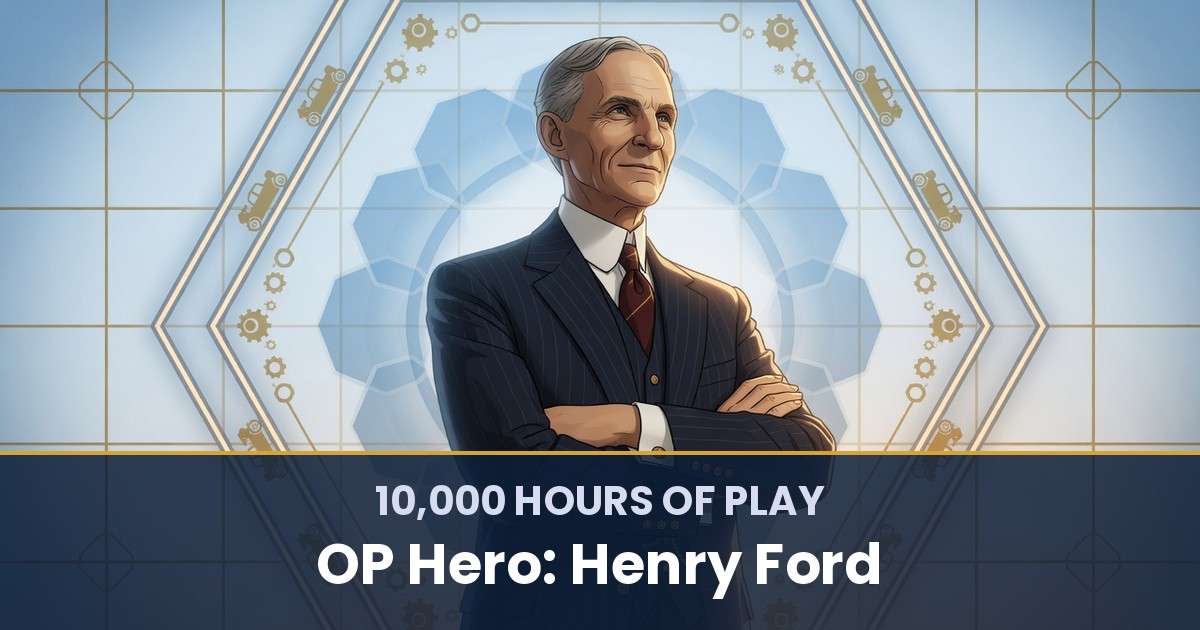


On January 5, 1914, Henry Ford walked his managers into a room and told them he was about to pay assembly-line workers five dollars a day. That was more than double the going rate. His own board thought he had lost his mind, and much of the business press agreed.
He was not being generous. He was being a systems engineer. Ford had just spent a year turning car-building into a moving river of standardized steps, and the last broken part in that machine was the human being who kept quitting because the work was so monotonous. The $5 day was the fix.
That is the thing most people miss about Ford. He was not a great inventor. He did not invent the car, the assembly line, or interchangeable parts. What he did was rarer: he saw a giant, expensive, artisanal object and asked how to make it boring, cheap, and infinite. He treated the whole of industry as a puzzle with a solvable answer.
If you read his run through the 6-Step framework of a life played on purpose, Ford stops being a statue and becomes something more useful: a case study in what happens when one relentless attribute meets one enormous game.
⚡ Speed Run Notes
- Ford’s real invention was not the car. It was a system for making cars: the moving assembly line at Highland Park, which cut chassis build time from over 12 hours to about 90 minutes.
- His breakthrough skill was theft. He borrowed the moving line from Chicago meatpackers and the standardization idea from watches and bicycles, then aimed it all at one product.
- Before Ford Motor Company, he failed. The Detroit Automobile Company went bankrupt inside 18 months. The second attempt is the one you’ve heard of.
- The $5-a-day wage in 1914 was not charity. It was a retention hack that stabilized a workforce quitting from boredom, and it let workers afford the very cars they built.
- His fatal flaw was the same as his superpower: he loved one answer so much he clung to the Model T for almost 20 years while rivals passed him.
Table of Contents
About Yu-kai Chou

Yu-kai Chou is the author of 10,000 Hours of Play — the book that treats your life as the most important game you’ll ever build a character in, and gives you the 6-Step framework (Game · Attributes · Role · Skills · Allies · Quests) to play it on purpose. He has spent two decades developing the system through which this post analyzes its OP Hero, and applies it to his own life and to the lives of the people he advises around the world.
Chou’s other framework, the Octalysis Framework, has been applied by LEGO, Microsoft, Porsche, Coca-Cola, Salesforce, and MrBeast, impacting over 1.5 Billion Users. He has taught the methodology at Harvard, Stanford, Yale, Tesla, Google, BCG, and IDEO, and has advised governments in eight nations including Ukraine, the United Kingdom, the Kingdom of Bahrain, Singapore, Taiwan, the Netherlands, Kazakhstan, and South Korea.
His work has been cited by Harvard, Stanford, MIT, Forbes, Wall Street Journal, Wired, US Department of Energy, NIST, NSF, NCBI, US Department of Education, ClinicalTrials.gov, and Google Scholar — with 3,700+ more academic publications. Explore his books here.
What I keep coming back to with Ford is that he won by working on the how, not the what. Anyone in 1908 could see that cheap cars were a good idea. Ford was the one who broke that dream into 45 numbered operations and a moving belt. The lesson I lift from his build: when a goal feels impossibly big, stop staring at the goal and start decomposing the process. The person who systematizes the boring middle usually wins the whole game.
Step 1: The Game — What Ford Was Actually Playing
Every OP Hero is chasing one long game across decades. Ford’s game was almost embarrassingly simple to state and brutally hard to win: make a reliable automobile cheap enough for ordinary people, and redesign work itself so industry could produce it at scale.
In his own words in My Life and Work, he wanted a car for “the great multitude,” the 95% of people who could never dream of affording the hand-built machines of 1900. In that era, a car was a rich man’s toy, assembled one at a time by skilled craftsmen. Ford looked at that and saw a design failure.
Notice the shape of the game. It was not “invent a better engine.” It was “collapse the cost of an entire category until a farmer in Nebraska can own one.” That reframing changed every downstream decision he ever made: the single model, the single color, the wages, the factory layout. The game defined the moves.
When you turn your own life into a game you can play deliberately, this is the first move that matters: naming the actual objective. Ford’s objective was never “get rich.” Wealth was a side effect. The objective was democratized mobility, and he pointed 40 years at it.
Step 2: Attributes — The Innate Stats
Attributes are the stats you roll at the start: the traits visible early, before anyone teaches you anything. Ford’s showed up on the farm near Dearborn, Michigan, where he was born on July 30, 1863.
His first attribute was mechanical intuition. As a boy he took apart watches and fixed machinery for neighbors while dodging farm chores. Machines spoke to him in a way soil never did. In 1879, at sixteen, he left the farm for Detroit to become an apprentice machinist. That was not a career plan; it was gravity.
His second attribute was a systems reflex: an instinct to break any messy process into simple, repeatable steps. Where others saw a car, Ford saw a sequence of operations that could each be simplified. This is the raw stat that later became the assembly line.
The third, and the rarest, was a mass-market vision, the trait we might call Foresight (Ranger) in its innate form: the pull toward the 95% instead of the elite. Most builders of his day chased status buyers and fat margins. Ford’s gaze went the opposite way, toward volume and the ordinary person, from his earliest designs onward. If you want to understand how a single dominant attribute compounds across a life, it’s worth studying the Talent Triangle Method, which maps exactly this kind of innate-trait leverage.
Step 3: Role(s) — The Character Class Across Chapters
No hero plays one class for a whole life. Ford re-specced several times.
He began as a tinkerer and apprentice machinist (1863–1880s), absorbing raw mechanical craft. Then he leveled into corporate engineer, rising to chief engineer at the Edison Illuminating Company in Detroit in the 1890s. That role gave him a steady salary and, crucially, a lab bench: in 1896 he built his first gasoline vehicle, the Quadricycle, in a shed behind his house.
Next came the riskiest class of all, startup founder and race driver (1899–1903). And here is the part the statues leave out: his first company failed. The Detroit Automobile Company, organized on August 19, 1899, went bankrupt within about 18 months. Ford walked away with nothing but a lesson.
His recovery is a textbook Phoenix Rebirth (Paladin): coming back from a devastating failure stronger than before. Instead of hiding, he built race cars to prove his engineering in public, then used the attention to raise capital. On June 16, 1903, Ford Motor Company was incorporated with $28,000 from thirteen investors. His final class was the one history remembers: industrial architect, the man who rebuilt how the world makes things. Plenty of OP Heroes share this arc of a public failure that becomes fuel; the way Thomas Edison treated dead ends as data is a close cousin to how Ford treated his bankruptcy.
Step 4: Skills — The Real-Life Game Skills Ford Mastered
Attributes are innate. Skills are learned. In the 10K HP system, this is where a hero’s edge actually gets built, and Ford’s skill tree is one of the most concentrated in history.
The first is Siphoning (Warlock): extracting a skill or idea rapidly from someone else and making it yours. Ford did not dream up the moving line from a blank page. In My Life and Work (1922) he admits the idea came in part from “the overhead trolley that the Chicago packers use in dressing beef,” and that his team borrowed from the watch, sewing-machine, and bicycle industries. He watched a disassembly line take animals apart and imagined running it in reverse to put cars together.
The second is Devour (Warlock): reducing steps and components until a process becomes lean. Ford’s team broke the work into tiny, numbered operations. Magneto assembly, once one long job, was split into 29 separate operations. Full car assembly was divided into 45. This obsessive decomposition is what let unskilled workers hit expert speed, and it’s the practical face of the specialist-versus-generalist tension mapped in the Skills Spectrum.
The third is Animate (Warlock): automating human labor into a flowing system. When Ford installed the moving assembly line at Highland Park in 1913 and 1914, the chassis build time collapsed from over 12 hours to about 90 minutes. He later extended this into full vertical integration at the River Rouge plant, where, as he put it in Today and Tomorrow (1926), raw materials came in one end and finished cars rolled out the other.
The fourth is Beacon Flare (Ranger): PR that cuts through noise. Ford raced to get famous, not to win trophies. On October 10, 1901, his Sweepstakes car beat the established champion Alexander Winton at Grosse Pointe, and on January 12, 1904, his stripped-down 999 tore a mile across the frozen Lake St. Clair in 39.4 seconds. Each spectacle bought him headlines and backers when he had little else.
Step 5: Allies — The People Who Multiplied Ford
No solo run reaches this scale. Ford’s allies each unlocked a level he could not clear alone.
The first was a mentor’s blessing. At an Edison company dinner in the late 1890s, the great inventor Thomas Edison heard Ford describe his gasoline engine and reportedly banged the table and told him it was “the thing.” For a young engineer betting against electric and steam, that endorsement was rocket fuel.
The money and parts came from Alexander Malcomson, a Detroit coal dealer who put up the principal early capital, and from the Dodge brothers, John and Horace, who supplied Ford’s first engines and chassis in exchange for stock and kept the young company alive through 1903 and 1904.
The business brain was James Couzens, who ran accounting, distribution, and dealer relations, turning Ford’s engineering wins into a profitable, well-managed company. The engineering deputy was C. Harold Wills, chief designer of the durable one-piece Model T engine block. And late in the story, his son Edsel Ford, who became company president in 1919, was the ally who pushed for modernization when his father would not, eventually forcing the shift off the aging Model T.
Step 6: Quests — The Milestones That Shaped the Saga
Quests are the concrete missions that move the story. Ford’s headline quests still define modern industry.
The failed quest came first: the Detroit Automobile Company (1899–1901), bankrupt inside 18 months. Then the proof-of-skill quests, the Sweepstakes win in 1901 and the 999 record in 1904, that rebuilt his credibility. Then the founding quest: Ford Motor Company, incorporated June 16, 1903.
The masterpiece quest was the Model T, launched in 1908: a rugged, simple, repairable car aimed squarely at the multitude. Its companion quest was the process itself: the moving assembly line of 1913–14. Together they did what Ford set out to do. Over its run to 1927, the Model T sold roughly 15 million units and put a nation on wheels.
Then came the quest he lost. Ford loved the Model T so completely that he refused to change it for almost two decades while General Motors offered color, comfort, and yearly models. By 1927 he was finally forced to shut down production for months to retool for the Model A. His greatest strength, total commitment to one winning answer, had become the weakness that nearly cost him the market. It’s a pattern you’ll see again and again across the OP Hero profiles: the very attribute that wins the early game can lose the late one if it never adapts.
What You Can Steal From Ford’s Build
You are never going to build a Model T. But Ford’s build hands you three moves you can run in your own game this year.
First, work on the process, not just the goal. Ford’s rivals wanted cheap cars too. He won because he decomposed the how into 45 operations while they argued about the what. Whatever your big ambition is, the leverage is almost always in redesigning the boring middle steps.
Second, steal shamelessly across domains. His single most valuable idea came from a slaughterhouse, not a car factory. Your next breakthrough is probably sitting in an industry that has nothing to do with yours. The same cross-pollination shows up in builders like Ray Kroc, who turned a burger stand into a system.
Third, know when your winning answer has expired. Ford’s refusal to evolve the Model T is the cautionary half of his legend. Commitment is a superpower until the world moves and you don’t. Audit your own “Model T,” the thing that made you successful, and ask whether you’re still riding it out of conviction or out of fear.
Where this framework comes from

Want the full system this profile is built on?
Every OP Hero piece runs through the same 6-Step framework from 10,000 Hours of Play: Unlock Your Real-Life Legendary Success. The book covers the full system, walks through Yu-kai’s own life run as the first applied case study, and gives you the worksheets to audit your own build.
Related Reading
- The Full OP Hero Profiles Hub: every legendary build analyzed through the 10K HP framework.
- The 10,000 Hours of Play Framework: the 6 Steps behind every OP Hero profile.
- OP Hero: Thomas Edison: the mentor who told Ford his engine was “the thing.”
- OP Hero: Andrew Carnegie: another builder who won by re-engineering an entire industry’s cost structure.
- OP Hero: Sam Walton: mass-market obsession applied to retail.
- The Skills Spectrum: how to choose what to master versus dabble in.