
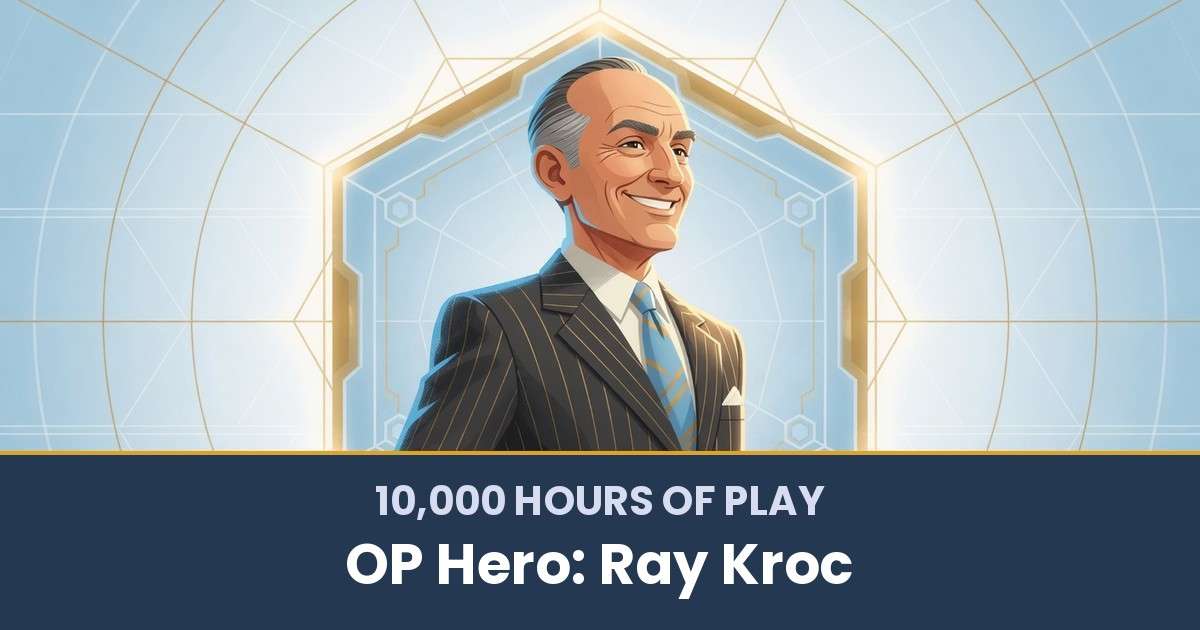


In 1954, a 52-year-old salesman drove into San Bernardino, California, to look at a hamburger stand.
He sold milkshake machines for a living, and he had been doing it for years. This trip was detective work. One small drive-in had ordered eight of his Multimixers, enough to spin forty milkshakes at the same time, and the order made no sense for a single restaurant. He wanted to see the kitchen that could possibly need that much.
What he found in that parking lot rearranged the rest of his life. The salesman was Ray Kroc, and the kitchen belonged to two brothers, Richard and Maurice McDonald.
Kroc did not invent that restaurant. He did not invent the assembly line behind its counter. What he did over the next thirty years is one of the cleanest case studies in the 10,000 Hours of Play framework you will ever read: a man who found his real game late, then played it harder than anyone half his age.
⚡ Speed Run Notes
- Ray Kroc did not invent the McDonald’s restaurant or its kitchen. He invented the system that let one good restaurant become thousands of identical ones, run by other people’s hands.
- He found his real game at 52. Three decades of selling paper cups and milkshake machines were not lost time. They built every Attribute the McDonald’s bet would need.
- His edge was reading an outlier. A single drive-in ordering eight milkshake machines was a data point everyone else ignored. Kroc drove across the country to find out why.
- The franchise model barely made money for years. It only worked once Harry Sonneborn rebuilt it around real estate. A great idea can still need a second engine.
- The honest stain on the build: Kroc bought the McDonald brothers out for $2.7 million, and they always said a promised handshake royalty was never paid.
- The move you can copy: stop waiting to feel ready. Readiness is just the skills you have already been grinding, finally meeting the right game.
Table of Contents
About Yu-kai Chou

Yu-kai Chou is the author of 10,000 Hours of Play — the book that treats your life as the most important game you’ll ever build a character in, and gives you the 6-Step framework (Game · Attributes · Role · Skills · Allies · Quests) to play it on purpose. He has spent two decades developing the system through which this post analyzes its OP Hero, and applies it to his own life and to the lives of the people he advises around the world.
Chou’s other framework, the Octalysis Framework, has been applied by LEGO, Microsoft, Porsche, Coca-Cola, Salesforce, and MrBeast, impacting over 1.5 Billion Users. He has taught the methodology at Harvard, Stanford, Yale, Tesla, Google, BCG, and IDEO, and has advised governments in eight nations including Ukraine, the United Kingdom, the Kingdom of Bahrain, Singapore, Taiwan, the Netherlands, Kazakhstan, and South Korea.
His work has been cited by Harvard, Stanford, MIT, Forbes, Wall Street Journal, Wired, US Department of Energy, NIST, NSF, NCBI, US Department of Education, ClinicalTrials.gov, and Google Scholar — with 3,700+ more academic publications. Explore his books here.

What I take from Ray Kroc’s build is that timing is not the same thing as readiness. Kroc spent three decades selling other people’s products before he found the one game worth all of him, and he did not waste those decades. Every sales route, every cold call, every rejection had quietly built the exact Attribute set the McDonald’s bet would require. If you feel late, study Kroc closely. He did not start at 52. He arrived at 52, carrying everything the earlier chapters had handed him.
Step 1: The Game — What Ray Kroc Was Actually Playing
Every OP Hero is playing one core game across decades, whether or not they could name it out loud. Ray Kroc’s game was not “sell hamburgers.” It was something colder and more interesting: build a system so consistent that it produces the exact same result anywhere in the world, in hands that are not your own.
Look at what he sold before McDonald’s and the pattern is already there. Paper cups for the Lily-Tulip Cup Company. Then the Multimixer, a single machine that spun five milkshakes at once. Kroc spent decades selling standardized objects that did one job the same way every time. He was drawn to consistency long before he had a restaurant to apply it to.
When he walked into the McDonald brothers’ drive-in in 1954, he did not see lunch. He saw a process. Richard and Maurice McDonald had stripped their kitchen down to a few items and arranged it like an assembly line, a setup they called the Speedee Service System. A burger came out fast, cheap, and identical every time. The brothers were content running one excellent restaurant. Kroc looked at the same counter and saw a blueprint that could be copied a thousand times.
That gap is the whole story. The McDonald brothers had built a great game. Kroc wanted to build the game that built great games.
This is exactly what Step 1 of the 10,000 Hours of Play framework asks you to do first: name the real game, not the job title. Kroc’s title read “salesman” for thirty years. His game was always system-building. He had simply never found a board big enough to play it on.
Step 2: Attributes — The Innate Stats
Attributes are the stats you are mostly born with. Kroc rolled a specific and unusual set.
Relentless salesmanship. As a teenager he played piano in bars and on radio stations, working a room for a living before he was twenty. The instinct to read people and move them showed up that early. It carried him through paper cups and then through milkshake machines, where he became one of the country’s top sellers.
High risk tolerance. Kroc made the McDonald’s bet in 1954, at 52 years old. He mortgaged his home and tied his finances to a franchise idea with no track record. Most people spend their fifties protecting what they have already built. Kroc treated security as fuel, something to spend on a bigger run.
Pattern recognition. The order for eight Multimixers was, to everyone else, one routine line on a sales sheet. To Kroc it was a signal. A single restaurant that needed to make forty milkshakes at once was doing something no ordinary restaurant could do. He noticed the outlier, and then he acted on it.
A builder’s restlessness. Kroc was never settled by a finished thing. The McDonald brothers had reached the size that made them comfortable, and they liked it there. Kroc could not feel comfortable. A working restaurant just looked like a prototype he had not scaled yet.
If you want to find your own innate stats, Yu-kai built a tool for exactly that: the OP Talent Triangle Method, which maps where your natural strengths overlap. Kroc’s triangle pointed at one thing from the start. It just took him five decades to stand on the right corner of it.
Step 3: Role(s) — The Character Class Across Chapters
A Role is the character class you play in a given chapter of life. Kroc re-classed several times, and each Role handed something to the next.
He started as a teenage musician and hustler, playing piano for money in the 1910s and 1920s. That was the low-capital class: charm and performance traded for cash, with nothing to fall back on.
Then came his long stretch as a traveling salesman. Paper cups first, for the Lily-Tulip Cup Company, then the Multimixer milkshake machine. For roughly three decades his livelihood depended on persuading one buyer at a time, route after route, city after city. It looked like a plateau. It was actually a thirty-year course in reading customers and surviving rejection.
In 1954 he re-classed to franchise agent. He signed on to sell McDonald’s franchises on the brothers’ behalf, incorporated McDonald’s System, Inc. in 1955, and opened his own first restaurant in Des Plaines, Illinois. He was still working inside someone else’s concept, an evangelist for a brand he did not own.
The decisive re-class came in 1961, when he became the owner and corporate builder of McDonald’s. From there the game had no ceiling and no co-owner whose permission he had to ask.
His final Role, from 1974, was chairman of the board and public figure. He stepped back from running the company day to day and bought the San Diego Padres baseball team that same year.
The lesson in this Step is that the “wasted” thirty years were not wasted at all. The salesman class is what made the builder class possible. The same is true of Phil Knight, who sold running shoes out of his car before he built Nike. The early Role is the tuition for the later one.
Step 4: Skills — The Real-Life Game Skills Ray Kroc Mastered
Attributes are what you are born with. Skills are what you grind. In 10,000 Hours of Play, Skills are named like RPG abilities, each tied to a Class. Kroc built five of them to a high tier.
Track Treasure (Ranger): spotting an opportunity hidden inside ordinary data. The eight-Multimixer order was Kroc’s treasure map. He read a number nobody else bothered to question and understood it meant something rare was happening in San Bernardino.
Power Leap (Warrior): closing the distance to someone in person to make the meeting happen. Kroc did not phone the McDonald brothers or mail them a brochure. He got in a car and drove to their parking lot to watch the kitchen with his own eyes. The breakthrough needed physical presence, and he supplied it.
Iron Skin (Warrior): becoming unaffected by rejection after constant outreach. Three decades of route selling is three decades of hearing the word “no.” By 1954 Kroc had a hide thick enough that the long, lean, unprofitable early years of franchising could not talk him out of the bet.
Cosmic Alignment (Mage): optimizing how many moving parts come together into one smooth system. This was Kroc’s signature Skill. He turned a single good kitchen into a repeatable standard, codified as Quality, Service, Cleanliness, and Value, and in 1961 he and his team founded Hamburger University to drill that standard into every operator. A burger in one city had to behave like a burger in another.
Phoenix Rebirth (Paladin): coming back stronger after a run already looks finished. At 52, with an unremarkable sales career behind him, Kroc did not drift toward retirement. He started the most demanding quest of his life.
None of these are exotic powers. The lesson of the Skills Spectrum is that mastery is ordinary Skills pushed to an extraordinary tier. Kroc did that with plain salesmanship and plain organization.
Step 5: Allies — The People Who Multiplied Ray Kroc
No OP Hero levels up alone. Kroc’s build ran on a small group of Allies, each one solving a problem he could not solve himself.
Richard and Maurice McDonald were the first Allies, and the most complicated. The brothers built the Speedee Service System that Kroc spent his life scaling. Without their kitchen, there was nothing to franchise. Their story with Kroc does not end well, and that honest detail belongs in Step 6.
Harry Sonneborn rebuilt the business model. In the early years, selling franchises barely made money; the margins were too thin to fund real growth. Sonneborn, who joined in 1956, restructured McDonald’s around real estate: the company would secure the land and the buildings, then lease them to franchisees. That move turned a marginally profitable franchisor into a company with reliable cash flow and the capital to expand. The idea was Sonneborn’s. Kroc’s Skill was recognizing it and backing it without flinching.
Fred Turner made the system teachable. Turner started as a young grill cook in the 1950s and rose, over the following decades, all the way to chief executive. Along the way he wrote the detailed operating manuals and helped build Hamburger University, converting Kroc’s standards into something a brand-new operator could actually learn.
June Martino held the early company together. Hired as Kroc’s bookkeeper and secretary in 1955, she kept the chaotic young finances under control, often working for deferred pay and stock, and rose to become a corporate officer and director.
The pattern is worth copying. Kroc did not assemble a huge network. He found a few people whose strengths covered his blind spots, finance and operations and administration, and he handed them real ownership. Howard Schultz built Starbucks on the same principle: the founder sets the standard, but Allies are what let it scale past one room.
Step 6: Quests — The Milestones That Shaped the Saga
Quests are the concrete missions that move a saga forward. Kroc’s headline Quests:
The first restaurant (1955). Kroc opened his McDonald’s in Des Plaines, Illinois, on April 15, 1955. It was the proof of concept: a franchised unit running the brothers’ system under his own company.
The lean years. This is the setback the highlight reels skip. For years after 1955, the franchise business barely paid. The early contracts were not generous enough to fund fast growth, and Kroc carried real financial strain before Sonneborn’s real-estate model fixed the engine. The idea was always good. For a long stretch it simply did not pay the bills.
The buyout (1961). Kroc bought the McDonald brothers out for $2.7 million, borrowed, which worked out to roughly a million dollars before taxes for each brother. It gave him full control of the name and the system. It is also the stain on the build. The brothers later said a handshake promise of a small ongoing royalty was never written into the deal and never paid. Kroc’s own account does not mention it. A legendary run can still carry a chapter the hero would rather not defend.
Hamburger University (1961). In the same year, Kroc and his team opened Hamburger University in Elk Grove Village, Illinois, in the basement of a restaurant. Training stopped being a hope and became infrastructure.
Going public (1965). McDonald’s listed on the New York Stock Exchange on April 21, 1965. The system now had public capital behind it.
The Padres (1974). Kroc stepped back as chief executive and bought the San Diego Padres, closing his run as an owner and a public figure rather than a daily operator.
Browse the full roster of OP Hero profiles and the same truth shows up everywhere: real builds include lean years, hard buyouts, and chapters the hero would rather skip.
What You Can Steal From Ray Kroc’s Build
You are probably not going to franchise a hamburger empire. That is not the point. The build logic is, and three pieces of it transfer to almost anyone.
First: you are not late, you are loading. Kroc found his real game at 52, and the thirty “ordinary” years before it were the training montage. Every sales route taught him to read a customer. Every rejection thickened his hide. When the McDonald’s chance appeared, he was not a beginner taking a wild swing. He was a specialist who had finally found the game his specialty was built for. If you feel behind, audit what those years actually built before you call them lost.
Second: scale the system, not the effort. Kroc’s real talent was not working harder inside one restaurant. It was designing a standard that let thousands of restaurants run well without him in the room. Ask the same question of your own work: what would let this run without you?
Third: respect the second engine. The McDonald’s idea was strong from day one, and it still nearly stalled until Sonneborn rebuilt the money model around real estate. A good idea often needs a second, unglamorous engine before it can really move. That same systems instinct drove Ingvar Kamprad at IKEA: the visible product is never the whole machine.
And the quiet last lesson: a legendary build is not a clean one. Kroc’s includes lean years and a buyout the McDonald brothers never forgave. The honest scoreboard counts all of it. Yours will too.
Where this framework comes from

Want the full system this profile is built on?
Every OP Hero piece runs through the same 6-Step framework from 10,000 Hours of Play: Unlock Your Real-Life Legendary Success. The book covers the full system, walks through Yu-kai’s own life run as the first applied case study, and gives you the worksheets to audit your own build.
Related Reading
- The full library of OP Hero profiles. Every figure in this series, analyzed through the same six-step framework.
- 10,000 Hours of Play by OP Hero: Howard Schultz. Another builder who scaled one good room into a global chain.
- 10,000 Hours of Play by OP Hero: Phil Knight. A salesman who re-classed into the founder of Nike.
- 10,000 Hours of Play by OP Hero: Ingvar Kamprad. The IKEA build, won on systems and relentless cost discipline.
- 10,000 Hours of Play by OP Hero: Estée Lauder. A build powered by face-to-face selling taken to mastery.
- The 10,000 Hours of Play framework. The full six-step system behind every OP Hero profile.