
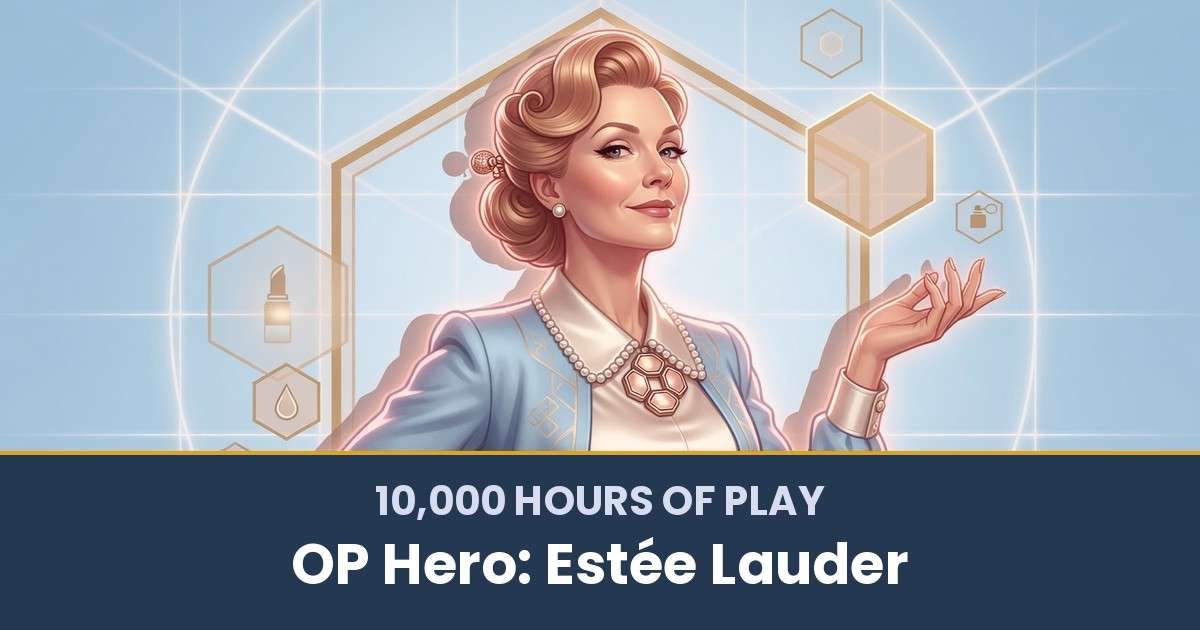


Long before the company, before the counters at Saks Fifth Avenue, before her name was on a single bottle, a young woman in Queens had one move. She would not describe a face cream to you. She would reach over, put it on your skin, and let you feel the difference for yourself.
That move, getting the product onto the customer with her own hands and getting it there now, is the whole story. Josephine Esther Mentzer was born in New York in 1908, started selling her uncle’s skin creams as a teenager, and died in 2004 as Estée Lauder: the name on a global beauty empire, and the only woman Time would name to its 1998 list of the twentieth century’s twenty most influential business geniuses.
Most profiles of Lauder reach straight for the word glamour. Run her life through the 10,000 Hours of Play framework instead, and something far more useful surfaces: one relentless, repeatable play, run for sixty years until it built an empire.
⚡ Speed Run Notes
- Lauder’s Game never changed: get a real product onto a real customer’s skin, today. Every counter, sample, and gift-with-purchase was a version of that one move.
- Her Attributes showed up before the company existed. She was a born salesperson, obsessed with how a cream felt, and able to read a customer’s face in seconds.
- Her signature Skill is Charm (Druid): she never pitched at arm’s length. She applied the product to your face and watched for the moment your expression changed.
- Youth-Dew, in 1953, was Elemental Transposition (Mage): women would not buy themselves perfume, so she sold the identical fragrance as a bath oil instead.
- The copyable part is not the empire or the fortune. It is the rule: stop describing your value, and find a way to put it directly into the other person’s hands.
Table of Contents
- Step 1: The Game — What Estée Lauder Was Actually Playing
- Step 2: Attributes — The Innate Stats
- Step 3: Role(s) — The Character Class Across Chapters
- Step 4: Skills — The Real-Life Game Skills Estée Lauder Mastered
- Step 5: Allies — The People Who Multiplied Estée Lauder
- Step 6: Quests — The Milestones That Shaped the Saga
- What You Can Steal From Estée Lauder’s Build
- Where this framework comes from
- Related Reading
About Yu-kai Chou

Yu-kai Chou is the author of 10,000 Hours of Play — the book that treats your life as the most important game you’ll ever build a character in, and gives you the 6-Step framework (Game · Attributes · Role · Skills · Allies · Quests) to play it on purpose. He has spent two decades developing the system through which this post analyzes its OP Hero, and applies it to his own life and to the lives of the people he advises around the world.
Chou’s other framework, the Octalysis Framework, has been applied by LEGO, Microsoft, Porsche, Coca-Cola, Salesforce, and MrBeast, impacting over 1.5 Billion Users. He has taught the methodology at Harvard, Stanford, Yale, Tesla, Google, BCG, and IDEO, and has advised governments in eight nations including Ukraine, the United Kingdom, the Kingdom of Bahrain, Singapore, Taiwan, the Netherlands, Kazakhstan, and South Korea.
His work has been cited by Harvard, Stanford, MIT, Forbes, Wall Street Journal, Wired, US Department of Energy, NIST, NSF, NCBI, US Department of Education, ClinicalTrials.gov, and Google Scholar — with 3,700+ more academic publications. Explore his books here.
What makes Lauder worth running through this framework is how little of her success was talent in the conventional sense. She was not the finest chemist in cosmetics, and she did not invent the products that made her fortune. What she owned was a Skill, the refusal to let a sale happen at arm’s length, and she ran it with more discipline than anyone around her. The lesson I would lift for your own build is from Step 4: your real edge is rarely the thing itself. It is the specific, repeatable way you get that thing into the hands of the person who needs it.
Step 1: The Game — What Estée Lauder Was Actually Playing
Strip away the perfume bottles and the department-store lighting, and Lauder spent six decades playing one Game: get a high-quality beauty product into the hands of as many women as possible, by the most personal means available, with her own name on the jar as the guarantee.
That last part matters. She was not chasing “be rich” or “be famous.” Plenty of people in cosmetics wanted those. Her Game was specific enough to make decisions for her. When she put her name on the company in 1946, she was doing what Coco Chanel had done in fashion: turning a personal name into a promise a customer could hold.
She described the engine plainly. “I never dreamed about success. I worked for it,” she said, and the work was always the same loop. Make a product she believed in. Get it physically onto a woman’s skin. Convert that first trial into loyalty through personal contact. Then turn the whole pattern into a system other people could run.
A vague goal cannot drive a sixty-year career. “Sell cosmetics” would not have told her to walk into a salon uninvited, or to disguise a perfume as a bath oil, or to give away product for free on purpose. Her Game told her to do all three, because every one of them did the same thing: it shortened the distance between her product and a customer’s hand.
Step 2: Attributes — The Innate Stats
The traits underneath the Game were visible long before there was a company, and most of them read as temperament rather than training. Map Lauder on the Talent Triangle Method and three innate stats sit well above the line.
A born salesperson. As a teenager she was already selling her uncle’s skin creams to her classmates, to local beauty shops, and to women at beach clubs, and she insisted on demonstrating every one of them on the spot. She later called herself a born salesperson without irony. Most people have to be taught to ask for the close. She seems to have arrived knowing.
An obsession with how things feel. As a child she was, by her own account, hypnotized by the creams in her uncle’s small laboratory: the smoothness of them, the faint and specific scent. That was not a passing interest. For the rest of her life she reformulated products until they felt expensive on the skin, refusing to ship a texture or a fragrance that was merely acceptable.
A fast read on people. Lauder could size up a customer, or a store executive, within minutes, and adjust her ask before the other person had finished talking. During a demonstration she watched the customer’s eyes, waiting for the exact moment they widened. That flicker of real desire was her signal that the sale was already made. It is not a learnable trick. It is an antenna.
Step 3: Role(s) — The Character Class Across Chapters
Lauder wore at least four Roles across her life, and the costumes changed so completely that they can look like four separate careers. The player inside them never moved.
She started as the apprentice: learning to formulate creams in the laboratory of her uncle, John Schotz, then carrying them through salons, hotels, and resorts. This was the decade where the craft and the nerve were built.
Then the counter-demo founder. In 1946 she co-founded Estée Lauder, Inc. with her husband, Joseph, on a line of just four products, and she personally stood behind the counter at stores like Saks Fifth Avenue, doing free makeovers one face at a time.
Next, the brand architect. Through the 1950s and 1960s she stopped selling only product and started designing a system: a department-store counter strategy, exclusive launches, uniformed beauty advisers trained to do exactly what she did, and the gift promotions that pulled women to the counter. This is the same move you see in Madam C.J. Walker’s build: a personal demonstration turned into a trained sales force.
Finally, the empire builder, opening the first overseas counter at Harrods in London in 1960 and adding new brands across the next two decades, before handing daily control to her son Leonard while keeping her hand on product and image into the 1980s.
Four Roles, one constant. In every chapter she was still the woman putting a product on a customer’s skin. The scale changed; the move did not. A Role is a costume. Swap it whenever the Game requires, but stay very clear about which part is the costume and which part is you.
Step 4: Skills — The Real-Life Game Skills Estée Lauder Mastered
Read Lauder’s career through the canon skill set and five moves keep recurring. They are not vague “business sense.” They are specific Real-Life Game Skills, the same named techniques the Skills Spectrum uses to grade every OP Hero on this site.
Power Leap (Warrior). This is the skill of traveling to someone uninvited to make the meeting happen. Lauder walked into salons and department stores without an appointment, set up an impromptu demonstration, and sometimes kept going after a manager told her to stop. She did not wait for permission to reach the customer. She removed the gap herself.
Charm (Druid). This is the skill of making a person genuinely affectionate toward you, and it was her core weapon. She did not pitch from behind a counter. She touched the customer’s face, applied the cream herself, and made the encounter feel like care rather than commerce. By the time price came up, the customer was not being sold to. She was being looked after.
Elemental Transposition (Mage). This is the skill of reframing a problem as a puzzle. In 1953 Lauder faced a real one. American women of that era mostly received perfume as a gift from a man and rarely bought it for themselves. Her answer was Youth-Dew, a heavily scented bath oil. The fragrance was perfume-strength, but sold as a bath product it became something a woman could buy for herself without hesitation. She did not argue with the social rule. She moved the product into a category the rule already allowed.
Enchant (Druid). This is the gamification skill: making an activity more enjoyable so people prefer it. Lauder is widely credited with institutionalizing “gift with purchase” in prestige beauty during the 1950s, handing the customer a free and desirable extra in exchange for a purchase. An ordinary transaction became a small reward loop. The same instinct shows up in Sara Blakely’s build: a founder who had sold face to face long enough to know that the buying experience itself is part of the product.
Mastermind (Ranger). This is the skill of creating and executing a complex plan. Lauder’s real masterwork was not any single cream. It was the repeatable counter system: prime store locations, trained advisers, scheduled gift events, exclusive launches. She took a move that only worked when she ran it personally and built a machine that ran it thousands of times a day without her.
Step 5: Allies — The People Who Multiplied Estée Lauder
Lauder’s name carries the legend, but the build leaned on a small group of Allies whose work is hard to separate from her own.
John Schotz, her uncle. Schotz was a chemist who ran a small business called New Way Laboratories, and he taught his niece how creams were actually made. He handed her two things at once: the first products she ever sold, and the formulating knowledge that let her keep improving them. The empire started in his laboratory.
Joseph Lauder, her husband. They married in 1930, and he supplied the half of the company Estée was not built to run. She led product and selling; he organized the finances and the operations. The partnership co-founded Estée Lauder, Inc. in 1946 and held the business together as it grew.
Leonard Lauder, her elder son. Leonard joined the company in 1958 and became its chief executive in 1982, and he is a large part of why the brand became a global corporation rather than a celebrated American one. He pushed the company overseas and championed new brands, including the launch that became Clinique.
Ronald Lauder, her younger son. Ronald joined the company in 1964 and ran its international division out of Belgium for nearly two decades, building the operational machine behind the overseas expansion that took the brand global. He later chaired Clinique Laboratories from 1994. Clinique itself, the company’s allergy-tested, dermatologist-guided line, launched in 1968 — championed by Leonard and his wife Evelyn after Evelyn brought home a Vogue article that became the brand’s blueprint. Estée herself was initially cool on the idea. Her family saw an opening she did not, and a good Ally is often the person who turns out to be right when you are not.
Step 6: Quests — The Milestones That Shaped the Saga
A handful of Quests bracket the run. Listed in order, they show the same player getting steadily harder to stop.
1930 to 1942: the marriage that broke and was rebuilt. Estée married Joseph Lauder in 1930. The couple divorced in 1939, and for a few years the partnership that would later build the company simply did not exist. Then, in 1942, they remarried. This setback belongs at the front of the Quest list, because the company that followed was built by two people who had already lost each other once and chosen to begin again.
1946: the company. Estée Lauder, Inc. was founded on a line of four products. After years of selling other people’s creams, the name on the jar was finally her own.
The late 1940s: the Saks counter. Landing the line in Saks Fifth Avenue moved Lauder from a personal seller into a department-store brand, and she worked that counter herself, proving the model one face at a time.
1953: Youth-Dew. The scented bath oil turned a small, respected seller into a national one, and reset how American women bought fragrance.
1960: Harrods. The first overseas counter, in London, started the long climb from an American success into a global one.
1968: Clinique. An allergy-tested, dermatologist-guided brand, sold alongside the original line, proved the company could build a second hit and become a portfolio rather than a single name.
By 1998, Time would name Lauder to its list of the twentieth century’s twenty most influential business geniuses, the only woman on it. The other OP Hero profiles are full of people who turned one repeated move into a body of work. Lauder’s move just happened to fit in the palm of a hand.
What You Can Steal From Estée Lauder’s Build
The lazy lesson from a Lauder profile is “believe in your product and work hard.” True, and useless, because it describes thousands of people in cosmetics who never built what she built.
The first real lesson is the Game. Lauder picked one thing she would not delegate and one thing she would not fake: the moment a real product met a real customer. Her whole career was the defense and the scaling of that moment. Most goals are too vague to do that work. “Grow the business” cannot tell you what to do on a slow Tuesday. “Get the product onto one more customer’s skin” can.
The second lesson is the reframe. When the rules of the era said women would not buy themselves perfume, Lauder did not lecture the era or wait it out. She moved the product into a category the rules already allowed, and let women buy what they had always wanted. When a wall will not move, check whether you are required to climb it, or only to walk around it.
The third lesson is the quietest. Her business partnership had already collapsed once, in a divorce, before it ever built anything. She did not file that under failure. She remarried, restarted, and co-founded the company anyway. A setback only ends the story if your response to it is an explanation instead of a next move.
So audit your own build. Is there a moment in your work as specific, and as defended, as hers? Are you arguing with a wall you could simply walk around? The strongest builds in these profiles tend to run on one small move, repeated with absurd discipline, until the world decides to call it genius.
Where this framework comes from

Want the full system this profile is built on?
Every OP Hero piece runs through the same 6-Step framework from 10,000 Hours of Play: Unlock Your Real-Life Legendary Success. The book covers the full system, walks through Yu-kai’s own life run as the first applied case study, and gives you the worksheets to audit your own build.
Related Reading
- All OP Hero Profiles — the full catalog of life-as-RPG breakdowns, organized by Class and Skill.
- 10,000 Hours of Play by OP Hero: Madam C.J. Walker — another beauty empire built on personal demonstration and a trained sales force.
- 10,000 Hours of Play by OP Hero: Coco Chanel — a contemporary who also turned her own name into a promise of quality.
- 10,000 Hours of Play by OP Hero: Sara Blakely — a founder who sold face to face before building a product empire.
- The 10,000 Hours of Play framework — the hub for the full 6-Step system.