
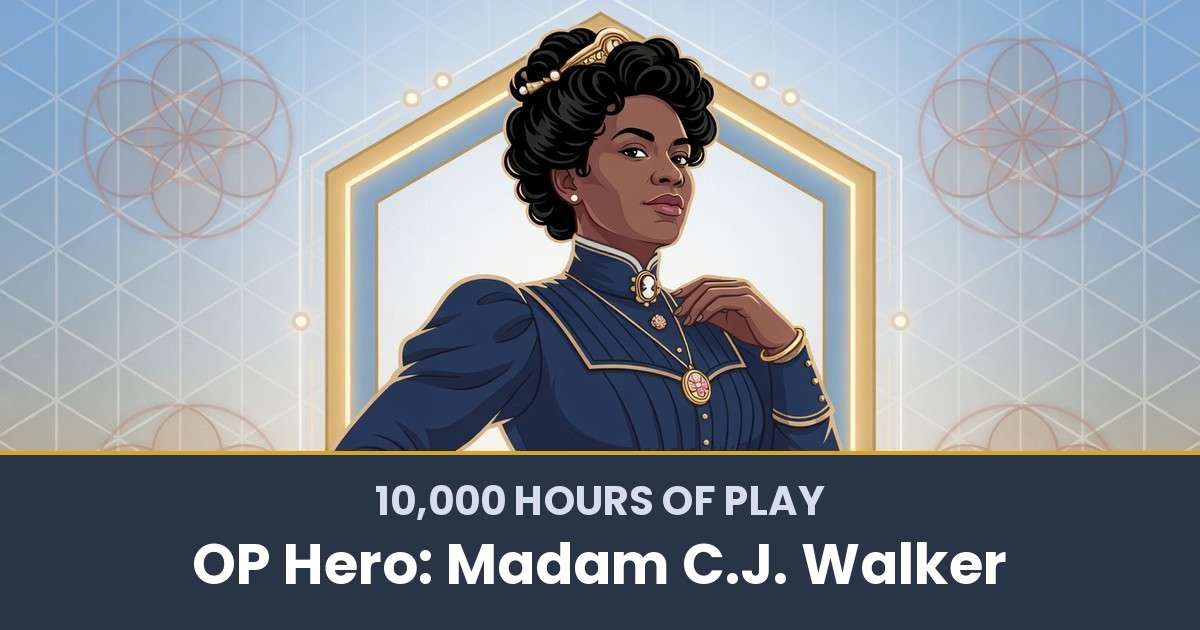


Sarah Breedlove was orphaned at seven, married at fourteen, and widowed at twenty. By the time she was fifty she was the first self-made millionaire woman in American history, of any race, and her own description of the run was four sentences long.
“I am a woman who came from the cotton fields of the South. From there I was promoted to the washtub. From there I was promoted to the cook kitchen. And from there I promoted myself into the business of manufacturing hair goods and preparations.” She said that on July 19, 1912, at the National Negro Business League convention in Chicago, after the chairman tried to deny her the floor. By the end of her speech the room belonged to her.
That arc — washerwoman to industrialist to anti-lynching delegate at the White House in roughly fifteen years — is what the 10,000 Hours of Play framework was built to make legible. Madam C.J. Walker did not “have a good run.” She built a build.
⚡ Speed Run Notes
- Walker’s Game was never “sell hair products.” It was “use a beauty-based engine to fund Black women’s economic independence and to bankroll the anti-lynching fight.” The product was the lever, not the point.
- The breakthrough Attribute was opportunity recognition in social networks — as a St. Louis washerwoman she planted herself inside the AME church, the National Association of Colored Women, and Annie Malone’s Poro sales force before she had a product of her own.
- The Walker System wasn’t a product, it was a curriculum. By 1908 she had opened Lelia College of Hair Culture in Pittsburgh; by 1917 she was running national conventions for Walker Agents and tying bonuses to community giving.
- In 1917 she led a delegation to the Wilson White House to push for federal anti-lynching legislation — using the same convening Skill she had used to recruit thousands of sales agents. Same Skill, scaled up.
- The lesson for your own life run: if your Game is bigger than your product, the product can change three times and the Game still holds. Walker switched cities, formulas, husbands, and missions. The through-line never moved.
Table of Contents
- Step 1: The Game — What Madam C.J. Walker Was Actually Playing
- Step 2: Attributes — The Innate Stats
- Step 3: Role(s) — The Character Class Across Chapters
- Step 4: Skills — The Real-Life Game Skills Madam C.J. Walker Mastered
- Step 5: Allies — The People Who Multiplied Madam C.J. Walker
- Step 6: Quests — The Milestones That Shaped the Saga
- What You Can Steal From Madam C.J. Walker’s Build
- Where this framework comes from
- Related Reading
About Yu-kai Chou

Yu-kai Chou is the author of 10,000 Hours of Play — the book that treats your life as the most important game you’ll ever build a character in, and gives you the 6-Step framework (Game · Attributes · Role · Skills · Allies · Quests) to play it on purpose. He has spent two decades developing the system through which this post analyzes its OP Hero, and applies it to his own life and to the lives of the people he advises around the world.
Chou’s other framework, the Octalysis Framework, has been applied by LEGO, Microsoft, Porsche, Coca-Cola, Salesforce, and MrBeast, impacting over 1.5 Billion Users. He has taught the methodology at Harvard, Stanford, Yale, Tesla, Google, BCG, and IDEO, and has advised governments in eight nations including Ukraine, the United Kingdom, the Kingdom of Bahrain, Singapore, Taiwan, the Netherlands, Kazakhstan, and South Korea.
His work has been cited by Harvard, Stanford, MIT, Forbes, Wall Street Journal, Wired, US Department of Energy, NIST, NSF, NCBI, US Department of Education, ClinicalTrials.gov, and Google Scholar — with 3,700+ more academic publications. Explore his books here.
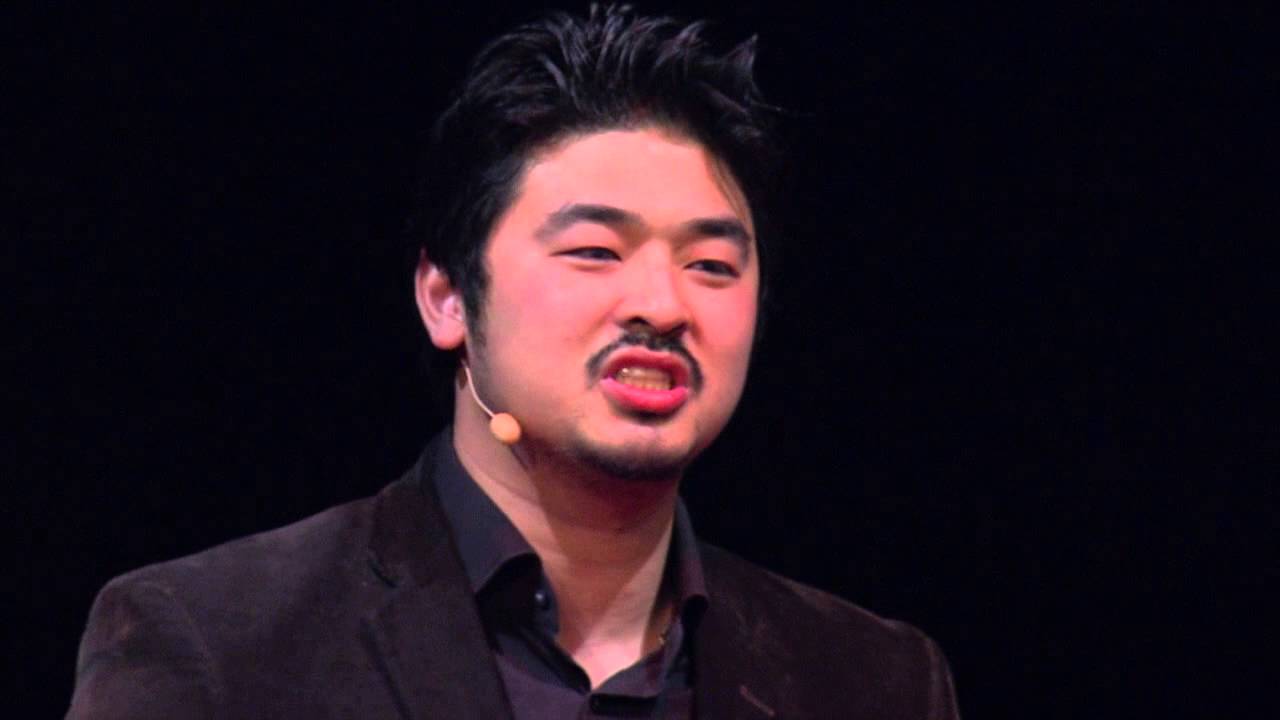
What I find instructive about Madam C.J. Walker’s build is how she treated her product as a lever and never as the Game. Most entrepreneurs let the thing they sell become the identity, and then they have to retire when the product does. She kept doing the opposite — Sarah Breedlove the washerwoman, Madam Walker the hair culturist, Madam Walker the philanthropist, Madam Walker the anti-lynching delegate, all powered by the same underlying mission. The lesson I’d lift from her run is at Step 1: pick a Game your product can graduate into, not a Game your product is.
Step 1: The Game — What Madam C.J. Walker Was Actually Playing
Reduce her run to one sentence and you get this: build a beauty-based economic engine that funds Black women’s independence at scale and bankrolls the public fight against racial violence.
The first half of that mission was personal before it was strategic. Sarah Breedlove had been a washerwoman in St. Louis for fifteen years, earning around $1.50 a day in the late 1890s. When she said later that her business was about giving Black women a path out of laundry and domestic work, she was describing the path she had just walked. Walker Agents earned a percentage of every sale, kept their own books, set their own hours, and at the network’s peak in the late 1910s there were tens of thousands of them across the United States, the Caribbean, and Central America. That was the Game — not selling hair grower, but transferring economic agency.
The second half emerged as the money showed up. From roughly 1912 onward she became one of the largest individual donors to the NAACP, the YMCA, Tuskegee, and Black secondary schools. By 1917 she had pulled together a delegation that traveled to Washington to ask President Wilson to support federal anti-lynching legislation. The product was always a delivery vehicle for that wider mission, never the destination.
If you are choosing your own Game right now, the test is whether it survives a product pivot. Walker pivoted formulas, cities, husbands, and even the central claim of her marketing — and the Game never moved. When you frame your own Talent Triangle around something larger than the SKU, a market shock stops being capable of ending the whole build.
Step 2: Attributes — The Innate Stats
Five Attributes show up so early in her life that they read as innate stats, not learned moves.
Extreme hardship tolerance. Sarah Breedlove was born on December 23, 1867, in Delta, Louisiana, to Owen and Minerva Breedlove, who had been enslaved on the same plantation until emancipation two years earlier. She was orphaned at seven, worked in the cotton fields alongside her sister Louvenia, married Moses McWilliams at fourteen — by her own later accounts partly to escape an abusive brother-in-law — and was a widow with a two-year-old daughter by twenty. She did not collapse under any of that. The absorbing-of-hardship capacity is visible long before any business education.
Pattern recognition inside social networks. When she moved to St. Louis in 1888 to join her four brothers — all of whom were barbers — she did not simply work. She attached herself to St. Paul African Methodist Episcopal Church, where the Women’s Mite Society took her in, and where she met educated Black professionals, women’s-club organizers, and small-business owners. That was the social capital she would later compound. The Attribute is the ability to find the hub of a network without anyone teaching you it is a hub.
Risk tolerance through environment change. Mississippi to St. Louis around 1888. St. Louis to Denver in 1905, against medical advice (she had told friends she went west for her health). Denver to Pittsburgh in 1908. Pittsburgh to Indianapolis in 1910. Indianapolis to Irvington-on-Hudson, New York, in 1917. Each move required her to rebuild her client base from zero. Most people make one move like that in a lifetime. She made five.
Charismatic persuasion. The 1912 NNBL speech is the famous evidence — she walked uninvited to the floor after being passed over by chairman Booker T. Washington, told her story in four sentences, and turned a room full of skeptical men into a standing ovation. But the same Attribute is visible earlier, in the speed at which she built personal trust with each Walker Agent she recruited. A scripted sales process can take you a long way, but it cannot manufacture the magnetism behind 40,000 women voluntarily aligning their financial future with yours.
Justice orientation. The instant her income exceeded subsistence she started giving it away. The contemporary description “the greatest colored philanthropist of her time” was earned in cash. The intensity and consistency of that orientation — anti-lynching donations, scholarships, settlement-house support — reads as a value system she walked in with, not one she developed once she could afford to.
Step 3: Role(s) — The Character Class Across Chapters
Six Roles in roughly fifty years.
From 1867 to 1888, she ran the Sharecropper’s Daughter Role. Cotton-field labor in Delta and Vicksburg, orphaned at seven, raised by an older sister inside a household she had to leave for her own safety. Survival is the whole job description.
From 1888 to 1904, she shifted into the Washerwoman and Church Networker Role in St. Louis. Twelve to fourteen hours a day over boiling laundry kettles, then evenings and Sundays inside the AME church, the women’s clubs, and the National Association of Colored Women’s reading circles. This was the long apprentice phase — she was learning organizational behavior before she had an organization.
From 1904 to 1905, she took on the Apprentice Sales Agent Role under Annie Turnbo Malone’s Poro Company. Door-to-door selling, scalp-treatment demonstrations, and the discovery that her own hair regrowth made her the best living advertisement her product line had. That role lasted barely eighteen months, but it taught her the entire mechanics of direct sales as a learnable specialist craft.
From 1905 to 1910, she ran the Founder-Operator Role out of Denver and then Pittsburgh. Married newspaperman Charles Joseph Walker in 1906, adopted the name “Madam C.J. Walker,” developed her own formula in partnership with a Denver pharmacist, and ran the early business out of mail order plus her own door-to-door demonstrations. Opened Lelia College of Hair Culture in Pittsburgh in 1908.
From 1910 to 1916, she ran the Industrialist Role in Indianapolis. Built a factory, an attached salon, and a training school. Hired F.B. Ransom as general manager. Recruited and organized agents into the Madam C.J. Walker Hair Culturists Union of America. Held national Walker Agent conventions where bonuses were tied to community contribution, not just sales.
From 1916 to her death in 1919, she layered on a Philanthropist-Activist Role on top of the still-active Industrialist Role. The 1917 anti-lynching delegation to the White House, the move to Villa Lewaro in Irvington-on-Hudson designed by Black architect Vertner Tandy, and the will that directed two-thirds of her future estate to charity. She never retired any of the earlier Roles. She stacked them.
Step 4: Skills — The Real-Life Game Skills Madam C.J. Walker Mastered
Six canon Real-Life Game Skills do the heavy lifting in her build. Each one has a moment.
Vision Manifestation (Warlock). Mental rehearsal so vivid it shapes reality is the canon definition, and she described her own version of it directly. She said the formula for her Wonderful Hair Grower came to her in a dream — “a big black man appeared to me and told me what to mix up for my hair.” Whether the dream was literal or rhetorical, the public claim is that she rehearsed the product and the persona in her head so completely that by the time she had the cash to manufacture it, the brand already existed. Her own marketing literature picked that thread up: she did not sell hair products, she sold “hair culture,” a culture she had visualized into existence. The same canon Skill drives the long-haul builds in the rest of the OP Hero catalog.
Courageous Heart (Paladin). Charging into uncomfortable, hostile environments. Door-to-door selling as a Black woman in the Jim Crow South in 1905 is already a courage-of-the-Quest move. The 1912 NNBL convention raised the difficulty: chairman Booker T. Washington had refused to put her on the program because he did not believe a “hair grower” was respectable enough for the league, so she walked up to the floor uninvited and forced the introduction. The 1917 anti-lynching delegation to Wilson is the same Skill at a third stake — bring the question into the room nobody wants you in. The same canon Skill that drove Malala Yousafzai’s public stand shows up in Walker forty years earlier.
Loremaster (Druid). Weaving compelling, inspiring stories. The 1912 speech is the textbook example — five and a half sentences that compressed her entire life into a usable narrative arc, and lived as the public version of her story for the next century. Her marketing copy is the everyday version. She insisted in print that “I claim to be a hair culturist. I grow hair,” which reframed the entire product category from cosmetics to wellness. Print ads in The Indianapolis Recorder used her own before-and-after testimony as the central evidence. The Loremaster Skill is the one that turned a household formula into a movement.
Floral Blossom (Druid). Educate and mentor others. In 1908 she opened Lelia College of Hair Culture in Pittsburgh, named for her daughter A’Lelia. The curriculum surviving in the Madam C.J. Walker Collection at the Indiana Historical Society covers scalp anatomy, the step-by-step Walker System, business etiquette, bookkeeping, and “uplift” comportment. By 1917 the same teaching engine was running national Walker Agent conventions in Philadelphia with thousands of attendees and a structured bonus system that rewarded contribution to local Black institutions. She did not just create jobs; she created a school that minted self-employed Black women at industrial scale. This is exactly what the canon Skill describes — instruction as a force multiplier on the rest of the build.
Sacrificial Cycle (Warlock). Reinvest all resources back into the project. The pattern is consistent from the moment her income passed survival. She personally funded the largest single donation the Indianapolis YMCA had ever received for a Black community center ($1,000 in 1911). She underwrote scholarships at Tuskegee. She gave to anti-lynching funds, settlement houses, and Black hospitals. Her 1919 will directed roughly two-thirds of her future estate to be paid out as charitable bequests. The pattern is the same one Sara Blakely later named the Spanx Pay-It-Forward principle — capital is fuel, not score.
Phoenix Rebirth (Paladin). Recover from devastating failure and come back stronger. The “failure” here is not one event; it is the starting hand. Born to formerly enslaved parents on a plantation. Orphaned at seven. Married at fourteen to escape abuse. Widowed at twenty with a child. By any actuarial reading of 1887 America, she should have ended her life as a domestic worker in a stranger’s kitchen. Instead she rebuilt the identity itself — Sarah Breedlove the washerwoman became Madam C.J. Walker the industrialist. That is the canon Skill at its largest possible stake: not coming back from a single fall, but rebirthing the entire character.
Step 5: Allies — The People Who Multiplied Madam C.J. Walker
Annie Turnbo Malone. Founder of the Poro Company and Walker’s first employer in 1904, before either of them was famous. Malone trained Walker in door-to-door scalp-treatment selling, agent recruitment, and the basic Poro formulary. The two later fell out — Malone publicly accused Walker of stealing the formula — but Walker’s own admiration on the record is durable; the early apprentice phase under Malone was the doorway through which everything that followed walked.
Charles Joseph Walker. Married Sarah Breedlove in Denver in 1906. As a newspaperman he ran the early mail-order advertising campaigns and named the brand “Madam C.J. Walker,” giving her the title and the marketing vehicle in one move. The marriage ended in 1912 and she kept the name. Allies do not have to be permanent to be load-bearing.
A’Lelia Walker (born Lelia McWilliams). Her daughter, born 1885. Ran the Walker Company’s New York operations from 1913 onward, including the Harlem townhouse that doubled as a beauty salon and an intellectual salon for the Harlem Renaissance. Inherited the company in 1919 and held it together through the 1920s. The Walker enterprise outliving the founder is A’Lelia’s work as much as Madam’s.
F.B. Ransom. Walker’s general manager and personal attorney from 1910 onward, based in Indianapolis. Ran the factory, handled litigation, managed the agent contracts, and after Walker’s death served as a trustee of the estate. The pattern of pairing a magnetic founder with a quiet operations head shows up in build after build in this profile series — Coco Chanel with Pierre Wertheimer is the same shape. The home base is not an accessory.
The Walker Agents network. Not an individual ally but the most important one. Tens of thousands of Black women, organized by territory, trained at Lelia College or by correspondence course, bonded into the Madam C.J. Walker Hair Culturists Union of America (and later the National Negro Cosmetics Manufacturers Association). They were her sales force, her brand evangelists, and her political constituency. The 1917 anti-lynching push had institutional weight because the agents were already a coordinated network.
Mary McLeod Bethune and the National Association of Colored Women. NACW leadership were among Walker’s earliest professional Allies in St. Louis and remained donors-and-allies pairs throughout her life. Bethune later wrote that Walker had taught a generation of Black women that economic independence and political activism were the same Quest.
Step 6: Quests — The Milestones That Shaped the Saga
1867 — born Sarah Breedlove in Delta, Louisiana. Owen and Minerva Breedlove had been enslaved on the same plantation until 1865; Sarah was the first child in the family born free. The starting position. Nothing before this date is a stable platform.
1888 — widowed, moves to St. Louis. Moses McWilliams died (cause uncertain in the historical record). Twenty-year-old Sarah arrives in St. Louis with two-year-old Lelia, joins her four brothers, takes work as a washerwoman, and joins St. Paul AME Church. The Game is selected here — get out of laundry — even though the strategy is still empty.
1904–1905 — Poro apprenticeship, the Denver pivot. Begins selling Annie Malone’s Poro hair products in St. Louis around 1904. Moves to Denver in July 1905, partly for health, partly to break clear of Malone’s territory. Develops her own formula in partnership with a local pharmacist, Edmund Scholtz. Within six months she is selling under her own name.
1906–1908 — marries C.J. Walker, opens Lelia College in Pittsburgh. The brand name “Madam C.J. Walker” is adopted in 1906. By 1908 she has moved the operating base to Pittsburgh and opened Lelia College of Hair Culture, the first training school for Walker Agents. The curriculum is the lever that turns one charismatic seller into thousands.
1910 — Indianapolis factory and headquarters. Moves the company to Indianapolis to take advantage of central rail access. Builds a factory, salon, and expanded training school. Hires F.B. Ransom. The business becomes an actual industrial concern, not a personal franchise.
1912 — the NNBL speech. July 19, 1912, Chicago. Booker T. Washington has refused to put her on the National Negro Business League program. She rises from the floor on the second day and delivers the four-sentence autobiography that becomes one of the most-quoted speeches in Black business history. By 1913 she is on the NNBL program by invitation. The speech is the inflection where the public recognizes the build the agents have already known about for years.
1917 — the Wilson delegation; the setback. Walker is part of a delegation of prominent Black leaders that travels to the White House in August 1917 to urge President Wilson to support federal anti-lynching legislation, following the East St. Louis race riots in July. Wilson refuses to meet them in person. They leave a written petition with his staff. The federal anti-lynching legislation she pushed for does not pass in her lifetime — the Dyer Anti-Lynching Bill clears the House in 1922 but dies in the Senate. The failure is real, and it is the kind of failure her Game was always large enough to absorb.
1918 — Villa Lewaro. The 34-room mansion in Irvington-on-Hudson, New York, designed by Vertner Tandy (the first Black architect licensed in New York State), opens in 1918. Walker uses it as a salon for Black intellectuals and activists. Architectural proof, in plain stone, that the Game has been won at one altitude even as it continues at another.
1919 — death and the will. Walker dies May 25, 1919, at Villa Lewaro, age fifty-one, of hypertension and kidney failure. Her will, executed earlier that year, directs roughly two-thirds of her future estate to charitable causes — schools, settlement houses, the NAACP, individual Black women in need. The estate is one of the largest a Black woman has ever held in American history.
What You Can Steal From Madam C.J. Walker’s Build
If you take only one move from her run, take this one. Pick a Game your product can graduate into, not a Game your product is. Hair grower was the product. Black women’s economic independence and the anti-lynching fight were the Game. When the formula evolved, when the cities changed, when the marriage ended, the Game absorbed every pivot without breaking. That is what a real Step 1 buys you.
If you take two moves, take a second one. Build a school, not a sales team. Walker Agents were not gig workers; they were Lelia College graduates with a curriculum, a uniform, a union, and a convention every year. The curriculum was the multiplier. If your Game requires more people than you can personally convince, your real product becomes the training material that makes them as good as you. Most founders never make this turn. The ones who do compound differently — and the rest of the OP Hero catalog is full of the proof.
Where this framework comes from

Want the full system this profile is built on?
Every OP Hero piece runs through the same 6-Step framework from 10,000 Hours of Play: Unlock Your Real-Life Legendary Success. The book covers the full system, walks through Yu-kai’s own life run as the first applied case study, and gives you the worksheets to audit your own build.
Related Reading
- All OP Hero Profiles — the running hub of every 10K HP hero we’ve audited so far.
- 10,000 Hours of Play by OP Hero: Sara Blakely — the closest modern parallel to Walker’s “self-funded women’s-product empire that pays it forward” arc.
- 10,000 Hours of Play by OP Hero: Coco Chanel — another founder whose product was the lever and the personal brand was the Game.
- 10,000 Hours of Play by OP Hero: Maya Angelou — same era of justice work, different craft, same Loremaster engine.
- Real Life Game Skill (Warlock): The Lich Pact — a worked example of how a single canon Skill changes a builder’s trajectory.
- Turning Life Into a Game — the framework’s first principles, in case you want to apply the 6 Steps to your own build right now.