
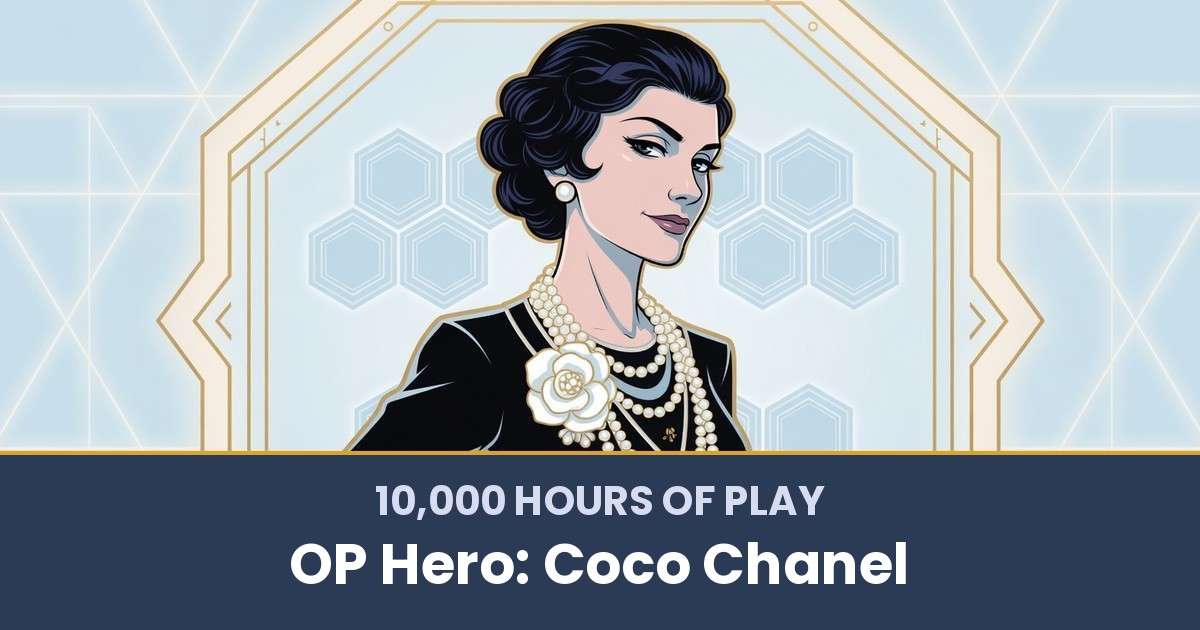


Coco Chanel started life in an orphanage and ended it dictating world fashion from a suite at the Ritz. The arc looks impossible. But once you lay her run out on the 10,000 Hours of Play 6-Step framework, the impossibility resolves into a build. A very specific build.
She did not become legendary because she was talented at sewing. Plenty of women in 1910 were better seamstresses than Gabrielle Chanel. She became legendary because she ran the same game for sixty years and kept compounding the same advantages: stripping fashion down to comfort, scripting her own myth, and treating every wealthy lover as a launchpad rather than a destination.
When she walked back into 31 rue Cambon at age 71 to show her comeback collection on February 5, 1954, the French press tore her apart. American buyers placed orders anyway. Within two years she owned the silhouette of mid-century womenswear again. That is what a fully optimized OP Hero build looks like on its second life.
⚡ Speed Run Notes
- Coco Chanel’s lifelong game was simple: escape her origin by reinventing both herself and how women looked, and bank the freedom that bought.
- Her unfair innate attributes were a stark aesthetic radar, narrative-control instinct, and willingness to bet her reputation on radical reduction.
- She class-changed five times — orphan, courtesan-companion, milliner, couturière, comeback queen — and kept the same core mission across all five.
- The 1954 comeback at age 71 is one of the cleanest Phoenix Rebirth stories in business history. The Paris press hated it; American buyers shipped it.
- The Wertheimer deal on Chanel No. 5 cost her 70% of the perfume but bought her the only brand name she actually wanted: her own.
- Steal one thing from her build: when the room tells you the new silhouette is wrong, check whether you’re early or actually wrong. She was almost always early.
Table of Contents
- Step 1: The Game — What Coco Chanel Was Actually Playing
- Step 2: Attributes — The Innate Stats
- Step 3: Role(s) — The Character Class Across Chapters
- Step 4: Skills — The Real-Life Game Skills Coco Chanel Mastered
- Step 5: Allies — The People Who Multiplied Coco Chanel
- Step 6: Quests — The Milestones That Shaped the Saga
- What You Can Steal From Coco Chanel’s Build
- Where this framework comes from
- Related Reading
About Yu-kai Chou

Yu-kai Chou is the author of 10,000 Hours of Play — the book that treats your life as the most important game you’ll ever build a character in, and gives you the 6-Step framework (Game · Attributes · Role · Skills · Allies · Quests) to play it on purpose. He has spent two decades developing the system through which this post analyzes its OP Hero, and applies it to his own life and to the lives of the people he advises around the world.
Chou’s other framework, the Octalysis Framework, has been applied by LEGO, Microsoft, Porsche, Coca-Cola, Salesforce, and MrBeast, impacting over 1.5 Billion Users. He has taught the methodology at Harvard, Stanford, Yale, Tesla, Google, BCG, and IDEO, and has advised governments in eight nations including Ukraine, the United Kingdom, the Kingdom of Bahrain, Singapore, Taiwan, the Netherlands, Kazakhstan, and South Korea.
His work has been cited by Harvard, Stanford, MIT, Forbes, Wall Street Journal, Wired, US Department of Energy, NIST, NSF, NCBI, US Department of Education, ClinicalTrials.gov, and Google Scholar — with 3,700+ more academic publications. Explore his books here.
The thing I keep coming back to with Chanel is how relentlessly she ran her own myth. Most people accept the starting hand the world dealt them and try to win on those cards. She kept rewriting the cards. That is a Skill — not an attitude — and it is one of the most underrated moves in any real-life game build.
Step 1: The Game — What Coco Chanel Was Actually Playing
Most people read Chanel’s life as “she invented modern fashion.” That’s the output, not the game.
The game she was actually playing was status reclamation through aesthetic dictation. She started at the bottom of the French class system — an illegitimate child of a market trader, placed in the Aubazine convent orphanage in 1895, at eleven, after her mother died — and decided very early that she would not stay there. The only available exit door for a girl with no family money in 1900s France was either marriage or a craft. She chose craft and refused marriage at every turn.
The clothes were not the point. The clothes were the lever. By imposing her taste on the women who paid her, she pulled herself up the social ladder she had not been born on. Then she pulled women in general up another ladder — out of corsets, out of the costume requirements of pre-war femininity, into something that let them work, drive, sweat, and move.
You can see how consistent the game was by how stable her aesthetic stayed across sixty years. Black, white, navy, gold. Jersey, tweed, simple lines, real pockets. Comfort first, ornament last. The 1916 jersey dress and the 1957 tweed suit are clearly cousins. She was not chasing trends. She was building a moat made of her own taste, and every collection deepened it. That is one of the cleanest “Game” definitions in the entire 10K HP catalog — a single coherent objective the player kept compounding into across multiple class changes.
Step 2: Attributes — The Innate Stats
Attributes are the traits you can see in a player before any training. Chanel’s were unusually legible from childhood.
First, an absurdly sharp aesthetic radar. Before she had taste, she had pattern recognition. The Aubazine convent’s stained-glass interlocking C’s — running the length of the corridor that led to the dormitory — later show up in her brand mark. The nuns’ black-and-white habits become her palette. She told Paul Morand in 1946 that “the austerity of the convent has stayed with me” — she did not mean it as trauma, she meant it as taste. Most children leave their childhood behind. She mined hers for design assets.
Second, narrative-control instinct. She lied about her age. She lied about her father. She moved the date of her birth and rewrote the orphanage years out of her own biography. Justine Picardie’s 2010 reconstruction using civil records shows how thoroughly her own version contradicted the paper trail. This is not a flaw in the player. It is the same instinct that lets her dictate what women look like — applied to her own self instead of her customers. The Talent Triangle Method calls this kind of trait a primary edge strength, the one you keep pulling on no matter what role you are playing.
Third, risk tolerance. She left a secure apprenticeship as a seamstress to live as Etienne Balsan’s mistress at Royallieu around 1906. She opened a hat shop at 21 rue Cambon in 1910 without the legal right to sell anything beyond millinery. She bet her entire business in 1916 on jersey fabric — a material previously associated with men’s underwear — at a time when other couturiers were doubling down on silk and trim. None of those moves were safe. All of them paid.
Fourth, instrumental social charm. She did not have charm the way charming people do. She had charm the way operators do — directed, targeted, and cold underneath. She used it to convert wealthy men into vehicles for her career without ever depending on any one of them.
Step 3: Role(s) — The Character Class Across Chapters
Chanel ran at least five distinct class changes. Each one preserved her core mission while adding capability.
The first role was orphan-apprentice. From 1895 to roughly 1906, she absorbed sewing technique under the nuns at Aubazine and then as a seamstress at Maison Grampayre in Moulins. Low status, high absorption. The hands learn before the brand exists.
The second role was cabaret performer and companion. In Moulins and Vichy around 1904 to 1908, she sang in cafés-concerts for cavalry officers — including the song Qui qu’a vu Coco, the source of her nickname. This is when she met Balsan, who installed her at his estate at Royallieu. This was the cheapest available financing for a woman of her background in that era. She took it without ever pretending it was love.
The third role was milliner. The 1910 Cambon shop, funded by Boy Capel, sold hats. Just hats. She was still legally restricted from selling other clothing. Within five years she had outgrown the constraint by force of demand.
The fourth role was couturière, which is where she became Coco Chanel. From the Deauville and Biarritz boutiques in 1913 and 1915 onward, she designed jersey sportswear that women in resort towns actually wanted to wear. By the 1920s she was running a house, a perfume brand, and a couture salon at scale. This is the peak of her first career arc — and where she stopped in 1939 when she closed the couture house at the start of World War II, firing roughly 3,000 employees in one stroke.
The fifth role was comeback queen. From February 5, 1954, at age 71, she relaunched the house against Dior’s New Look and rebuilt her global cultural position over the next sixteen years. Most legendary builds end at the peak. Hers had a second peak that arrived in her seventies. That is a class-change most heroes never get to make.
Step 4: Skills — The Real-Life Game Skills Coco Chanel Mastered
Out of the canon set of Real-Life Game Skills in 10,000 Hours of Play, six show up over and over in Chanel’s life. If you want the full Skill spectrum, the Skills Spectrum framework is the reference; for what a single canon Skill looks like applied at obsession depth, look at how Yu-kai used the Lich Pact polyphasic sleep schedule for two years to multiply output. Chanel ran her own Warlock-heavy build.
The first Skill is Vision Manifestation (Warlock) — visualizing a future state so vividly it shapes reality. From the 1910s on, Chanel could describe the woman she was designing for as a coherent character before that woman actually existed in society. She designed for a woman who drove cars, played sport, worked. That woman became real in part because Chanel kept dressing the early version of her, and the rest of women’s wardrobes followed the gravity.
The second Skill is Bind Fate (Warlock) — leveraging someone else’s brand or resource to become powerful yourself. Etienne Balsan gave her the social access to French cavalry circles. Boy Capel signed the lease at 21 rue Cambon and put up the capital for the first shop. Grand Duke Dmitri Pavlovich introduced her to the perfumer Ernest Beaux, which produced Chanel No. 5. The Duke of Westminster gave her tweed and a near-decade of cross-Channel aristocratic exposure. Each relationship was a fate-bind to someone else’s resource graph, and she never let any single one become a marriage.
The third Skill is Masquerade (Rogue) — pretending to be someone else and performing their soft skills at similar level, the alter-ego move. “Coco” was Gabrielle’s alter ego. The orphan child of a market trader could not walk into Paris salons in 1912 and tell wealthy women how to dress. The Parisian chic woman who somehow knew everyone could. Chanel built that second character deliberately, scrubbed the paper trail, and inhabited her so completely that the press eventually believed it too.
The fourth Skill is Devour (Warlock) — reduce steps, components, and processes until the thing is lean. This was her single most important design move. Pre-Chanel couture in 1910 was bones, structure, ornament. She removed the corset, removed the layered petticoats, removed the trim, removed the formal cut, and what was left she made out of jersey. The Little Black Dress that American Vogue compared to the Model T in 1926 was Devour applied to evening wear — every component a designer in 1920 would have added, she subtracted. The Wertheimer perfume deal worked the same way: she did not want to manage manufacturing and distribution, so she devoured it down to a name license and let Pierre and Paul Wertheimer carry the operations.
The fifth Skill is Aegis (Paladin) — ignore public criticism and naysayers while pushing the Quest. The February 1954 comeback collection got savaged in Paris. French critics called it tired, cold, a nostalgic mistake. She did not change a thread. Life magazine’s coverage in November 1954 plus the American department store orders that followed proved her right within a year. She had run this exact play in 1916, when she launched jersey sportswear against an establishment that thought she was selling underpants as dresses. She would run it again on every comeback collection through 1969.
The sixth Skill is Phoenix Rebirth (Paladin) — recover from devastating failure and come back stronger. Chanel’s 1939 to 1953 period contains a closed business, a war, a documented Nazi-era affair with Hans Günther von Dincklage, the Operation Modellhut episode where she allegedly attempted to broker between Britain and Germany, and a self-exile to Switzerland through most of the late 1940s. By any normal measure that arc ends a career. Instead, at age 70, she funded her own return out of her Wertheimer perfume royalties and opened a comeback collection cold. The Phoenix Rebirth playbook does not say the recovery has to be morally clean — it says it has to be real, evidenced, and complete. Hers was.
Step 5: Allies — The People Who Multiplied Coco Chanel
Chanel is often painted as a self-made figure because of how aggressively she scripted her own myth. The actual record is the opposite. Almost every breakthrough has a specific Ally behind it.
Etienne Balsan was the launchpad. From around 1906 to 1908 he installed her at Royallieu and gave her access to the French social world that taught her how the wealthy actually lived. She used that access; she did not stay. Frida Kahlo ran a similar pattern with Diego Rivera — proximity to power as accelerant, not destination.
Arthur “Boy” Capel was the founding partner. He financed the 1910 Cambon shop, signed the lease, and stayed with her through the Deauville and Biarritz expansion. She told Morand “C’est Capel qui m’a lancée” — Capel launched me. His death in a 1919 car accident is the most cited grief of her life. The fact that she would not sell out his memory by marrying anyone afterward, including the Duke of Westminster, is itself a strategic data point.
Grand Duke Dmitri Pavlovich, Romanov exile and her companion from roughly 1920 to 1922, opened the perfumer door. He introduced her to Ernest Beaux, who had worked at the Russian court perfumery Rallet. Beaux presented two series of samples numbered 1–5 and 20–24 around 1920. She picked the fifth. Chanel No. 5 launched commercially in 1921 and was, by any measure, the most important consumer product launched by any couturière of the twentieth century.
Pierre and Paul Wertheimer were the unwilling partnership that made her rich. The 1924 Parfums Chanel contract gave them 70 percent, Chanel 10 percent, and businessman Théophile Bader 20 percent of the perfume business. She spent decades trying to renegotiate, including a wartime attempt to use Nazi Aryanization laws against them. They survived, kept the business, and after the war signed a final settlement that paid her perfume royalties for life — the cash that funded the 1954 comeback. They were never her friends. They were the most important Ally she ever had.
Misia Sert, the salon hostess and Polish-born muse to Diaghilev’s circle, was the cultural-network ally. She gave Chanel access to Picasso, Cocteau, Stravinsky, the Ballets Russes, and the entire 1920s Paris avant-garde, which moved Chanel from “fashionable dressmaker” to “cultural figure” in less than a decade.
The Duke of Westminster, Hugh Grosvenor, was the British wedge. Through their 1924 to 1931 relationship she absorbed Scottish tweed, English tailoring, and the country-house aesthetic that became the Chanel tweed jacket in the 1950s. When he proposed, she famously refused — “There have been several Duchesses of Westminster; there is only one Chanel” — and walked away from the title without walking away from the wardrobe.
Step 6: Quests — The Milestones That Shaped the Saga
Six Quests structure her run. Three are wins. Two are setbacks. One is the comeback that retroactively reframes everything.
The first Quest is the 1910 millinery opening at 21 rue Cambon. With Capel’s capital and her own taste, she registered “Chanel Modes” and started selling hats in a city that already had hundreds of milliners. By 1913 she had a Deauville boutique. By 1915 a Biarritz one. The site address never changed. Chanel is still designed and sold out of 31 rue Cambon more than a century later. Few founders pick a single physical address as their permanent home base; she did, and the building became part of the brand.
The second Quest is the 1916 jersey breakthrough. Wartime fabric shortages plus her insistence on comfort pushed her to use jersey — a material the textile industry made for men’s underwear — for women’s day and resort wear. The trade press laughed. Her customers, mostly women who needed to actually move during World War I, bought it faster than she could ship it. By 1917 jersey was the fabric defining her house. This is where Devour and Vision Manifestation met in a single garment line.
The third Quest is the 1921 launch of Chanel No. 5 and the 1924 Wertheimer deal. The perfume hit hard enough that she lost control of it almost immediately, traded ownership for distribution scale, and accepted 10 percent of an asset that would later fund the rest of her life. This is a clean example of the trade most founders refuse to make and live to regret. She made it and built around it.
The fourth Quest is the 1939 closure and the wartime collapse. When France entered World War II in September 1939, she fired roughly 3,000 employees and shuttered the couture house, keeping only the perfume and accessories shops at Cambon. The decade that followed includes the Dincklage affair, the Modellhut episode, a brief postwar arrest and release, and a long Swiss exile. By 1953 she was a relic. This is the failure. She did not paper it over later, and neither should her readers.
The fifth Quest is the February 5, 1954 comeback collection. At 71, after fifteen years out, she relaunched with the cardigan suit and the chain-weighted jacket; the 2.55 quilted bag followed in February 1955. Le Figaro and the rest of the French press tore it apart. Life magazine’s November 1, 1954 piece treated her as still relevant. American buyers — Bergdorf Goodman, Neiman Marcus, Saks — placed orders. Two years later her silhouette dominated Western womenswear again. The author of J.K. Rowling’s profile calls a comeback at that age a Phoenix Rebirth; this is the version dressed in tweed.
The sixth Quest is the run from 1954 to her death at the Ritz on January 10, 1971, age 87. She worked through that last morning. She designed, fit, corrected, and ate dinner with Jacques Chazot. She died in the suite she had lived in since the 1930s. Few OP Heroes get to choose the location of their final scene. She chose hers.
What You Can Steal From Coco Chanel’s Build
The most transferable move in her build is not the design. It is the alter ego. “Coco” was a constructed character that gave Gabrielle Chanel social permission to operate at the level she wanted to operate at. Most ambitious players spend a decade waiting for the world to give them that permission. She manufactured hers.
The second move is the patron-as-launchpad pattern. Every wealthy man in her life was a node in a graph, not an endpoint. She extracted what she needed — capital, access, distribution, fabric, network — and kept her business. Whatever the modern equivalent is for your build (early employers, first investors, mentors with reach), the move is the same: treat the relationship as fuel, not as destination.
The third move is radical reduction. When you find yourself adding features, ornament, hedges, qualifiers, options, ask whether you are doing the opposite of what the situation needs. Chanel’s most-copied designs over a century are also her simplest. There is a reason.
If you want more of these builds broken down the same way, the OP Hero profile hub is where the rest of them live. Pick one whose game looks like yours and steal a move.
Where this framework comes from

Want the full system this profile is built on?
Every OP Hero piece runs through the same 6-Step framework from 10,000 Hours of Play: Unlock Your Real-Life Legendary Success. The book covers the full system, walks through Yu-kai’s own life run as the first applied case study, and gives you the worksheets to audit your own build.
Related Reading
- All OP Hero Profiles — the full hub of builds analyzed through the 10,000 Hours of Play framework.
- Frida Kahlo — OP Hero in 10,000 Hours of Play
- Maya Angelou — OP Hero in 10,000 Hours of Play
- Yvon Chouinard — OP Hero in 10,000 Hours of Play
- Hedy Lamarr — OP Hero in 10,000 Hours of Play
- The Talent Triangle Method — What’s Your Edge Strength?