
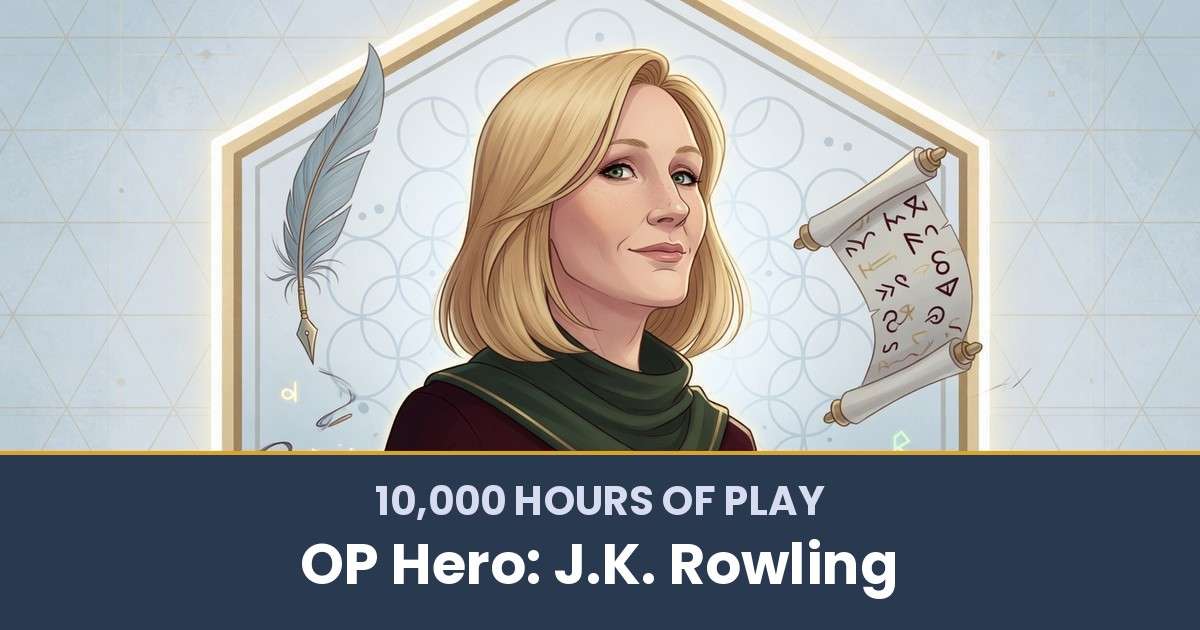


A 25-year-old woman sits on a delayed train from Manchester to King’s Cross in the summer of 1990. She has no pen. She does not write a word for four hours. By the time the train pulls in, she has the entire architecture of a seven-book series in her head — a boy who learns at eleven that he’s a wizard, a school of magic with a dark history, and an ending she will not put on paper for seventeen more years.
Six years later, that woman is on welfare in Edinburgh. Twelve publishers have rejected her manuscript. Her mother has been dead for six years. Her marriage has ended. She is typing the final draft on a manual typewriter because she cannot afford a photocopier, then paying for individual chapters to be copied at the local stationer so she can keep submitting to the thirteenth publisher.
The thirteenth publisher is Bloomsbury. The acquiring editor’s name is Barry Cunningham. The chairman’s eight-year-old daughter, Alice Newton, reads the first chapter and demands the next one. The advance is £1,500.
That is the most-rehearsed origin story in modern publishing, and it is still under-read as a build. J.K. Rowling did not get lucky. She ran a particular configuration of Skills, Attributes, and Allies through a particular sequence of Quests — including the one where the body and the bank account both broke — and her 6-Step run is one of the cleanest case studies in the 10,000 Hours of Play framework the OP Hero series is built on.
⚡ Speed Run Notes
- Rowling’s “Game” wasn’t selling 600 million books. It was building emotionally exact narrative worlds and defending their integrity — the commercial scoreboard was a byproduct of the craft scoreboard.
- Her innate Attribute stack was unusual: compulsive imagination, long-arc pattern recognition, an ear for Latinate wordplay, stubbornness under adverse conditions, and emotional attunement to grief — visible by the time she was six.
- The Role arc went bookish child → language student → office drifter → expat teacher → single mother on welfare → debut children’s author → franchise creator → reinvented crime novelist. She kept the build and changed the map.
- Canon Skills cited: Vision Manifestation (Warlock), Astral Projection (Mage), Lich Grind (Warlock), Aegis (Paladin), Phoenix Rebirth (Paladin), Masquerade (Rogue).
- The 1993–1996 Edinburgh welfare chapter is the Phoenix Rebirth precondition — the part everyone references and almost nobody reads as a deliberate skill stack rather than as luck rewarded.
Table of Contents
- Step 1: The Game — What J.K. Rowling Was Actually Playing
- Step 2: Attributes — The Innate Stats
- Step 3: Role(s) — The Character Class Across Chapters
- Step 4: Skills — The Real-Life Game Skills J.K. Rowling Mastered
- Step 5: Allies — The People Who Multiplied J.K. Rowling
- Step 6: Quests — The Milestones That Shaped the Saga
- What You Can Steal From J.K. Rowling’s Build
- Where this framework comes from
- Related Reading
About Yu-kai Chou

Yu-kai Chou is the author of 10,000 Hours of Play — the book that treats your life as the most important game you’ll ever build a character in, and gives you the 6-Step framework (Game · Attributes · Role · Skills · Allies · Quests) to play it on purpose. He has spent two decades developing the system through which this post analyzes its OP Hero, and applies it to his own life and to the lives of the people he advises around the world.
Chou’s other framework, the Octalysis Framework, has been applied by LEGO, Microsoft, Porsche, Coca-Cola, Salesforce, and MrBeast, impacting over 1.5 Billion Users. He has taught the methodology at Harvard, Stanford, Yale, Tesla, Google, BCG, and IDEO, and has advised governments in eight nations including Ukraine, the United Kingdom, the Kingdom of Bahrain, Singapore, Taiwan, the Netherlands, Kazakhstan, and South Korea.
His work has been cited by Harvard, Stanford, MIT, Forbes, Wall Street Journal, Wired, US Department of Energy, NIST, NSF, NCBI, US Department of Education, ClinicalTrials.gov, and Google Scholar — with 3,700+ more academic publications. Explore his books here.
What I personally take from J.K. Rowling’s build is the Lich Grind / Phoenix Rebirth pairing — a writer who chose to grind a single seven-book vision on benefits in an Edinburgh café through her mother’s death, an ended marriage, and a year of clinical depression that became the source material for dementors. The lesson I lift from her sheet is that the Skills that look most painful in the run are the same Skills that look inevitable in the highlight reel. Don’t wait for the highlight reel to start respecting them.
Step 1: The Game — What J.K. Rowling Was Actually Playing
It is easy to define Rowling’s game as “write a bestselling children’s series.” She wrote seven novels that have sold an estimated 600 million copies, spawned an eight-film franchise, a stage play, a theme park, and a streaming reboot in production. The scoreboard reading isn’t wrong. It’s just shallow.
Her actual game was something narrower and more durable: build emotionally exact narrative worlds with rule-bound internal logic, and defend their integrity at every layer — manuscript, contract, adaptation, canon. The 600 million copies are what the world paid for the privilege of watching her play that game inside her own head for thirty years.
You can see the through-line in three places. As a six-year-old in Yate, she wrote a story about a rabbit called Rabbit and read it aloud to her younger sister Dianne — the pattern of “make the world, perform it for one person who needs to hear it” was already locked in. As a single mother in Edinburgh in 1995, she was filling notebooks with a hand-drawn grid that mapped chapters across columns and subplots across rows, before she had a publisher or any reason to believe the book would ever sell. As a global franchise creator in 2011, she launched Pottermore partly so she could keep authorship of the canon out of the hands of fan sites, film studios, and licensees who wanted to dilute it.
If you compress the saga into a one-sentence quest, it is this: tell a single story about love, death, and prejudice so meticulously that no one — not the publishers who rejected it, not the adaptations that came later, not the marketplace itself — can dilute what the story is. The same compression pattern shows up across Hayao Miyazaki’s run through a different medium, and across most of the heroes in this series. The surface game funds the meta-game.
Step 2: Attributes — The Innate Stats
Attributes are the stats visible early, before training. With Rowling, four were obvious before she finished school.
Compulsive narrative imagination. She has described herself as a child who “lived for books” and was “constantly” writing stories and reading them to her sister. By eleven she had finished a manuscript about seven cursed diamonds. That isn’t a skill installed by an MFA — it’s a kid whose default state was building worlds in her head.
Long-arc pattern recognition. By the time she had drafted Philosopher’s Stone, she had already mapped the broad arc of seven books, including the horcrux mechanic that would not pay off until book six and Snape’s full allegiance, which wouldn’t resolve until book seven. The mid-1990s plot grid she has shown publicly — rows for chapters, columns for subplots, marginalia for character beats — is a temperamental Attribute, not a learned planning technique. Most novelists don’t think in grids; she did before anyone taught her to. The Talent Triangle Method calls this kind of trait an Attribute precisely because no coach installs it.
Ear for Latinate wordplay. She earned A-levels in English, French, and German and went on to study French and Classics at the University of Exeter, with a year of study in Paris. The spell names — “Expelliarmus,” “Lumos,” “Expecto Patronum,” “Wingardium Leviosa” — are not Classics-degree exercises; they’re a kid who liked the shape of Latin roots before anyone made her care about Latin. The Classics degree just supplied the raw material her ear already wanted.
Stubbornness under adverse conditions. She has described herself, with characteristic flatness, as the most determined person she knows. The evidence is the years from 1990 to 1996 — she kept writing through her mother’s death, through a difficult expat marriage in Portugal, through divorce, through clinical depression, through single parenthood on welfare. Most prodigies survive one of those at a time. She survived all of them while still moving the same manuscript forward.
Where you place yourself on the Skills Spectrum often depends on which Attributes you accept as fixed and which you try to overwrite. Rowling’s life is a long argument for accepting your stack and overbuilding the rest of the build around it.
Step 3: Role(s) — The Character Class Across Chapters
Seven distinct Roles across her saga, each one inherited the equipment of the last.
1) Bookish child storyteller (1965–early 1980s). Yate and later Tutshill, England. Reads everything, writes constantly, performs stories for her sister Dianne. The Role here is apprentice — the public scoreboard doesn’t exist yet.
2) University language student (1983–1986). BA in French and Classics at Exeter, with a year in Paris. Absorbs the Latin and Romance-language raw material that will later power the spell system and naming conventions.
3) Office drifter and frustrated novelist (1986–1991). Researcher and bilingual secretary at Amnesty International in London, plus other office jobs. Writes fiction in spare time. Role: under-employed writer.
4) Expatriate teacher and new mother (1991–1993). Moves to Porto, Portugal, in 1991 to teach English as a foreign language. Marries Portuguese journalist Jorge Arantes in 1992. Daughter Jessica born in 1993. Marriage ends the same year. She drafts much of the early Philosopher’s Stone material here.
5) Single mother on benefits / emerging novelist (1993–1997). Returns to Edinburgh in late 1993 with her infant daughter and the first three chapters of a manuscript. Lives on income support. Writes in cafés — Nicolson’s, The Elephant House — while Jessica sleeps. Twelve publishers reject the manuscript. Bloomsbury accepts in 1996. Philosopher’s Stone publishes June 26, 1997.
6) Global franchise creator (1997–2007). Seven books across ten years. Warner Bros. film rights sold 1998. First film 2001. By the publication of Deathly Hallows in July 2007, the series has sold an estimated 400 million copies and the Role has shifted to franchise architect.
7) Post-Potter novelist and philanthropist (2010s–present). Co-founds the Children’s High Level Group with Emma Nicholson in 2005 (renamed Lumos in 2010) — against institutional childcare. Publishes The Casual Vacancy in 2012. Reinvents under the pseudonym Robert Galbraith with The Cuckoo’s Calling in 2013. Continues the Cormoran Strike crime series. Role: capital-A Author, deliberately fragmenting her brand to keep writing.
The Role to study is #5. Most aspiring novelists either survive that chapter and quit, or skip it by being born into a different financial situation. Rowling lived in it for four years, used the time to revise the manuscript into the shape that would actually sell, and treated the welfare cheque as scaffolding around the build rather than as the build itself.
Step 4: Skills — The Real-Life Game Skills J.K. Rowling Mastered
Six canon Skills she demonstrably ran. The full sheet is longer; these are the ones with the cleanest evidence.
Vision Manifestation (Warlock) — mental rehearsal so vivid it shapes reality. In her 1998 ITN interview filmed in Edinburgh — and in repeated interviews since — Rowling has described her writing process as seeing things before she writes them, visualizing them clearly first, then trying to express what she is seeing. The Harry Potter character did not arrive as a plot outline. He arrived as a fully formed image on a delayed train in 1990 — a black-haired boy who didn’t know he was a wizard — and the rest of the saga was the seventeen-year project of getting that image onto the page. Same Skill that powered Kobe Bryant’s pre-game ritual and Miyazaki’s frame-perfect storyboards. Warlock Skills bend the world to fit the mental image, not the other way around.
Astral Projection (Mage) — seeing all possible outcomes. Astral Projection is the Skill that lets you hold seven books of plot in a single mental model and check each scene against payoffs three volumes away. The hand-drawn plot grid she has shown publicly — rows for chapters, columns for subplots, with character beats and clue placement in the margins — is the externalized version of a Mage already running this Skill in her head. It is why “Regulus Black” can be mentioned offhand in book five and pay off as the locket horcrux in book seven without feeling shoehorned in.
Lich Grind (Warlock) — intense, secluded work periods. The Edinburgh cafés from 1993 to 1996 are the canonical Lich Grind chapter. She wrote in long, isolated, low-grade-discomfort sessions — coat on, infant in pram, single coffee nursed for hours — for years before there was any reason to believe the manuscript would sell. The cost is real; the rate of compounding is also real. Compare to the Lich Pact at the more extreme end of the Warlock toolkit — the same class of Skill at a different intensity setting.
Aegis (Paladin) — ignore public criticism and naysayers while pushing the Quest. Twelve rejections is a famous number because it sounds like a movie beat. The relevant thing isn’t the number. It’s that her agent Christopher Little kept submitting and she kept revising while the rejection letters came in, instead of either taking the rejections as data and pivoting to a different manuscript or quitting. Aegis is the Skill that absorbs that level of feedback without breaking the run. She would later run the same Skill at a much larger scale across every cultural controversy of the franchise’s life.
Phoenix Rebirth (Paladin) — recover from devastating failure and come back stronger. The clinical-depression year in Edinburgh in 1995, on benefits, recently divorced, six months after her mother’s death — that is, on any honest reading, a devastating-failure chapter. She has said the dementors in Prisoner of Azkaban were a direct portrait of clinical depression she had lived through. Phoenix Rebirth is the Skill that doesn’t merely survive that chapter; it puts the chapter to work, converts the lived experience of grief and depression into the emotional palette the entire series would run on. Serena Williams’ 2018 pulmonary embolism return is the same Skill in a different domain.
Masquerade (Rogue) — pretend to be someone else and perform their soft skills at similar level. In April 2013 she published The Cuckoo’s Calling under the pseudonym Robert Galbraith — described in the jacket copy as a retired military police officer turned debut crime novelist. The book sold modestly until the leak in July 2013, then exploded. The point of the experiment wasn’t sales. It was learning, without the Potter halo, whether the crime-writing craft she had quietly built since 2010 could stand alone. The pre-leak reviews said yes. That’s the Masquerade test passed at the highest level.
Step 5: Allies — The People Who Multiplied J.K. Rowling
Five Allies carried weight she could not have generated alone.
Anne Volant Rowling, her mother, died of multiple sclerosis on December 30, 1990 — six months after Rowling first conceived Harry Potter on the Manchester train. Rowling has said that from that moment on, death became a central — if not the central — theme of the seven books, and that the books are what they are because of her mother’s death. The pervasive treatment of death and love in the series — Lily Potter’s sacrifice, Harry’s lifelong orphan grief, the Mirror of Erised — is not metaphor; it is the bereavement done as fiction. Anne is the posthumous Ally whose absence carved the shape of the books.
Bryony Evens and Christopher Little. Evens was the assistant at the Christopher Little Literary Agency who pulled the sample chapters out of the slush pile and recommended them. Little then took on the manuscript, kept submitting through the twelve rejections without dropping the project, and ran the U.S. auction in 1997 that closed with Scholastic’s Arthur Levine paying a then-unheard-of $105,000 for an unknown children’s writer. Without Little, the manuscript stays unsolicited.
Barry Cunningham, the editor at Bloomsbury Children’s Books, championed the manuscript internally after it cleared the chairman’s-daughter test, oversaw the editorial shaping of the debut, and famously warned Rowling that she should get a day job because children’s authors rarely make money. The book published June 26, 1997 under his imprint. Without Cunningham’s internal advocacy, the thirteenth submission is also a no.
Alice Newton, the eight-year-old daughter of Bloomsbury chairman Nigel Newton, read the first chapter at her father’s request, came back demanding the next, and gave Bloomsbury its single most-replayed founding moment. One eight-year-old, one weekend, one chapter — that is what unlocked the £1,500 advance. Sometimes the multiplier Ally is not a powerful adult; sometimes it is exactly the target reader.
Arthur Levine at Scholastic won the 1997 U.S. auction. The advance, reported at $105,000, was so far outside the norm for a debut children’s author that Rowling has said her first reaction was utter terror — she had nearly finished book two and suddenly could not write. That advance bought the financial runway for books two and three. Without Levine’s bid, the Edinburgh chapter doesn’t end when it ended.
Step 6: Quests — The Milestones That Shaped the Saga
Six Quests carry the run.
Quest 1: The Manchester train, summer 1990. She conceived the entire seven-book architecture on a four-hour delayed train. No pen. No notes. By King’s Cross, she had Harry, Hogwarts, a school of magic, the boy-doesn’t-know-he’s-a-wizard premise, and a long-arc structure. The proof-of-concept Quest in pure form — an idea so complete it survived four hours of train ride without a single mark on paper.
Quest 2: The setback — December 1990 to 1995. Her mother’s death on December 30, 1990. Marriage in Portugal, daughter Jessica’s birth in 1993, divorce the same year. Edinburgh on welfare from late 1993. The 1995 clinical-depression chapter that became the dementor source material. The hardest single stretch of any modern author’s life-as-RPG run.
Quest 3: The 12 rejections + Bloomsbury yes, 1996. Christopher Little submits the manuscript to twelve publishers. Twelve nos. Bloomsbury says yes after Alice Newton’s verdict. The advance is £1,500. The first print run is 500 hardbacks, most of which go to libraries. By the time Rowling sees the contract, she has been working on the manuscript for six years.
Quest 4: The Scholastic auction, 1997. Arthur Levine bids $105,000 for U.S. rights to a book by an unknown author. The auction price changes what is possible — it converts a hobbyist’s manuscript into a career. Philosopher’s Stone publishes in the U.K. June 26, 1997; Sorcerer’s Stone publishes in the U.S. September 1998.
Quest 5: Deathly Hallows, 2007. Book seven publishes July 21, 2007. The midnight release sells eleven million copies in the first 24 hours. The seven-book arc she had outlined on the 1990 train is finally fully on paper, including the horcrux mechanic she planted in book six and the Lily-sacrifice payoff she planted in book one.
Quest 6: Robert Galbraith and The Cuckoo’s Calling, 2013. She publishes a crime novel under a pseudonym on April 18, 2013. The leak comes in July. By then, the unmediated critic reaction has already confirmed the craft. The capstone Quest is not another billion-dollar children’s series; it is the experiment that proves the writer is still a writer when the brand halo is taken away.
If you scan the full catalog of OP Hero profiles, you’ll see the same structural pattern across heroes from different domains — four to six build Quests, one identity-breaking setback, one capstone where the hero changes the game’s terms instead of just running the same level harder.
What You Can Steal From J.K. Rowling’s Build
Two transferable lessons, both load-bearing.
First: put your devastating chapter to work. The 1995 Edinburgh year — welfare, recent divorce, recent grief, clinical depression — is the part of Rowling’s life every retelling treats as the obstacle the books overcame. That reading misses the build. The dementors that scared a generation of children weren’t an obstacle she got around to write; they were the obstacle she wrote with. Most builds either avoid the painful chapter or merely survive it. The ones that compound put the chapter directly into the deliverable.
Second: master the unsexy Skill before you need the famous one. Vision Manifestation gets the publicity in Rowling’s career — the train-ride origin story is the one everyone retells. The Skill that actually shipped the books was Lich Grind. Four years of café shifts on benefits, manuscript drafts on a manual typewriter, photocopied chapters paid for at the local stationer because she couldn’t afford her own copier. The famous Skill is the one in the highlight reel. The load-bearing Skill is the one in the unglamorous middle that nobody films.
The 600 million copies are the part of her story you’ll see in retrospectives. The Edinburgh café and the photocopier are the part you should actually steal.
Where this framework comes from

Want the full system this profile is built on?
Every OP Hero piece runs through the same 6-Step framework from 10,000 Hours of Play: Unlock Your Real-Life Legendary Success. The book covers the full system, walks through Yu-kai’s own life run as the first applied case study, and gives you the worksheets to audit your own build.
Related Reading
- All OP Hero Profiles — the full 10K HP hub
- 10,000 Hours of Play by OP Hero: Hayao Miyazaki — same Vision Manifestation Skill, a different medium.
- 10,000 Hours of Play by OP Hero: Serena Williams — Phoenix Rebirth taught from inside the body.
- 10,000 Hours of Play by OP Hero: Martin Luther King Jr. — Aegis at civic scale.
- Real Life Game Skill (Warlock): The Lich Pact — the Warlock toolkit at its most extreme setting.
- Turning Life Into a Game: the 6-Step framework explained