
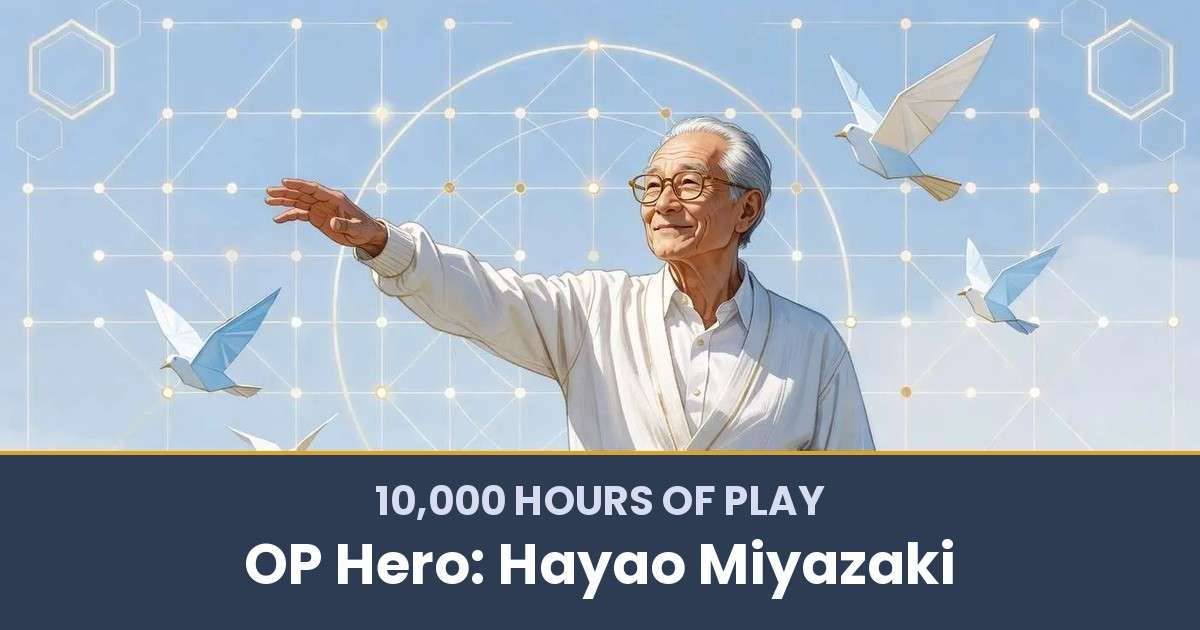


Most directors would have stopped after Spirited Away won the Academy Award for Best Animated Feature. Hayao Miyazaki was 62, the film had broken every box-office record in Japan, and he had already been threatening to retire for a decade. He kept going.
Twenty-one years later, in 2024, he was on the Academy stage again for The Boy and the Heron, his fourth or fifth “retirement” film depending on how you count. He still draws by hand. He still storyboards every shot. He still walks the halls of Studio Ghibli most days, well into his 80s.
Look at his life through the 10,000 Hours of Play 6-Step lens (Game, Attributes, Role, Skills, Allies, Quests) and what you see is not a genius gifted with effortless inspiration. You see a player who picked one game very young, kept choosing it through five decades of failures and frustration, and turned a small studio in suburban Tokyo into the most revered animation house on the planet.
This is the build sheet on how he did it.
⚡ Speed Run Notes
- Miyazaki’s life-game was never just “make animated films.” It was build worlds children deserve, and refuse to compromise the craft to ship them.
- His core innate attributes were visual imagination, mechanical curiosity, and a stubborn moral independence visible from his earliest manga work.
- His most underrated learned skill is Vision Manifestation (Warlock): his storyboards are so detailed they function as the finished film’s blueprint.
- Studio Ghibli only exists because of three Allies who multiplied each other: Miyazaki, Isao Takahata, and producer Toshio Suzuki.
- He has “retired” at least four times. Each Phoenix Rebirth produced a better film, and The Boy and the Heron won Best Animated Feature in 2024.
- The lesson for your own build: pick one game young, refuse the shortcuts, and let the same craft compound for fifty years.
Table of Contents
- Step 1: The Game — What Miyazaki Was Actually Playing
- Step 2: Attributes — The Innate Stats
- Step 3: Role(s) — The Character Class Across Chapters
- Step 4: Skills — The Real-Life Game Skills Miyazaki Mastered
- Step 5: Allies — The People Who Multiplied Miyazaki
- Step 6: Quests — The Milestones That Shaped the Saga
- What You Can Steal From Miyazaki’s Build
- Where this framework comes from
- Related Reading
About Yu-kai Chou

Yu-kai Chou is the author of 10,000 Hours of Play — the book that treats your life as the most important game you’ll ever build a character in, and gives you the 6-Step framework (Game · Attributes · Role · Skills · Allies · Quests) to play it on purpose. He has spent two decades developing the system through which this post analyzes its OP Hero, and applies it to his own life and to the lives of the people he advises around the world.
Chou’s other framework, the Octalysis Framework, has been applied by LEGO, Microsoft, Porsche, Coca-Cola, Salesforce, and MrBeast, impacting over 1.5 Billion Users. He has taught the methodology at Harvard, Stanford, Yale, Tesla, Google, BCG, and IDEO, and has advised governments in eight nations including Ukraine, the United Kingdom, the Kingdom of Bahrain, Singapore, Taiwan, the Netherlands, Kazakhstan, and South Korea.
His work has been cited by Harvard, Stanford, MIT, Forbes, Wall Street Journal, Wired, US Department of Energy, NIST, NSF, NCBI, US Department of Education, ClinicalTrials.gov, and Google Scholar — with 3,700+ more academic publications. Explore his books here.
Miyazaki is one of the cleanest case studies in the 10K HP book of what happens when a single Role gets played for fifty years without abandonment. Most people switch games every decade. He switched Roles within one game (animator, then director, then studio-builder, then mentor) but kept the underlying Quest constant. The attribute I’d lift from his build for your own life is moral independence on the work: the willingness to ship a film you’d be proud of and absorb the box-office risk that comes with it.
Step 1: The Game — What Miyazaki Was Actually Playing
Most people think Miyazaki’s game was “make beautiful animated movies.” That’s not specific enough to explain his choices.
His actual game, traceable across five decades of public statements and the films themselves, was something closer to: build animated worlds that take children seriously, never compromise the craft to ship them, and use the medium to push back against the parts of modern life that crush human spirit. That’s why his villains are usually industrial systems and not individuals, why his protagonists are usually children doing labor, and why he refuses to let anyone else write his scripts.
The clearest evidence of the game is the consistency of the themes (flight, work, nature, war, childhood) from his 1984 breakthrough Nausicaä of the Valley of the Wind all the way through 2013’s The Wind Rises and 2023’s The Boy and the Heron. The themes don’t drift. The technology around them changed; the question he was answering didn’t.
This is what the 10K HP framework calls a well-defined Game of Life: a single overarching mission specific enough to make decisions against. When Miyazaki turned down opportunities for live-action, for foreign production deals, for sequels that would have printed money, you can see him playing his game and refusing other people’s.
The lesson here is uncomfortable for most adults. Most of us have never named the game we’re playing this precisely. We’re playing “do well at work” or “have a good life” and then wondering why our days feel directionless. Miyazaki had a sentence-length game by his thirties. He’s been compounding against it ever since.
Step 2: Attributes — The Innate Stats
Attributes in the 10K HP system are the traits you showed up to life with: the dice roll, not the build. For Miyazaki, four attributes stand out, visible early and consistent across his entire career.
Visual imagination. Miyazaki was drawing constantly as a child, filling notebooks with planes, trains, and imagined worlds, the same kinds of machines and settings that would later populate his films. By his teens he was already producing manga work.
Mechanical curiosity. Aircraft, engines, gliders, and clockwork show up in nearly every Miyazaki film, and they’re rendered with the affection of someone who actually loves how things work. His father ran an aviation parts factory during the war, and that early proximity to flight mechanics shows up directly in Porco Rosso, Castle in the Sky, and The Wind Rises.
Pattern recognition and observational attention. The reason Ghibli films feel different from American animation is that Miyazaki spends an enormous amount of attention on how the real world moves: weather, hair, fabric, hands, the way a kettle steams. He doesn’t invent these from imagination; he watches and then encodes what he saw.
Moral independence. Miyazaki has been politically and creatively contrarian his entire career, refusing easy ideological labels and openly criticizing the industry he works in. This is not a learned posture; everyone who has worked with him describes it as constitutional.
If you want to map your own attributes the same way (what you actually showed up with vs. what you’ve trained), the Talent Triangle Method is the diagnostic. Miyazaki’s triangle points heavily at the visual-craft corner; he built his Role around that strength rather than trying to round himself out into a generalist.
Step 3: Role(s) — The Character Class Across Chapters
Miyazaki has played four distinct Roles across his career, each one building on the last instead of replacing it.
Role 1: Animator (1963–1971). After graduating from Gakushuin University with a political-science degree, he joined Toei Animation as a junior in-betweener. The Toei years gave him the production discipline that would later define Ghibli: the daily craft of drawing frame after frame, learning to hit deadlines, learning whose feedback to trust.
Role 2: Director (from 1979). His first feature as director was Lupin the Third: The Castle of Cagliostro in 1979. The film flopped at the box office. He kept directing anyway, because the previous Role gave him enough craft equity to keep getting hired.
Role 3: Studio co-founder and world-builder (from 1985). With Isao Takahata and Toshio Suzuki, he co-founded Studio Ghibli in 1985 after Nausicaä‘s success made it viable. The Role transfer here is what most people miss: he didn’t stop being a director. He added an institutional Role on top.
Role 4: Mentor and culture-keeper (ongoing). In the last 20 years, much of Miyazaki’s actual day-to-day work has been training younger Ghibli staff: sketching corrections on their key frames, drilling them on the values of the studio, fighting to keep hand-drawn animation alive against a global industry shift to CGI.
What’s instructive is the order. He didn’t try to be a studio-builder first or a mentor first. Each Role unlocked the next, and the foundational animator Role never went away. He still does the actual drawing on his own films. Joris Beerda’s Role Transfer case study is another worked example of the same compounding-Roles pattern in a very different domain.
Step 4: Skills — The Real-Life Game Skills Miyazaki Mastered
Within the Roles, here are the canon 10K HP Skills Miyazaki demonstrably built. Each one has a specific moment in his career where it cracked open a result.
Vision Manifestation (Warlock): visualize a result so vividly it shapes reality. Miyazaki’s storyboards are famously detailed, often functioning as the finished film’s blueprint rather than a rough planning document. On Princess Mononoke (1997) and Spirited Away (2001), he produced storyboards so complete that animators could execute against them with very little ambiguity. He sees the film before it exists; the production team renders what he already saw.
Elemental Ensemble (Mage): mentally visualize complex compositions and execute with precision. This is the engine behind Miyazaki’s signature flight sequences. The wind in Castle in the Sky, the dive in Porco Rosso, the dream-flight sequences in The Wind Rises: none of these are improvised. He composes the physics of each shot mentally first, then translates it to paper. The same Skill in a different domain is what we explore in the Skills Spectrum as deep specialist mastery.
Lich Grind (Warlock): intense, secluded work periods. Miyazaki is famous for the punishing hours he keeps at Studio Ghibli, well into his 80s, often eating at his desk and drawing late into the night. The Warlock class is full of these high-output, high-cost Skills. Lich Pact‘s polyphasic sleep is the same family of bargain, paid in personal toll for output other people can’t match.
Aegis (Paladin): ignore public criticism and naysayers while pushing the Quest. Miyazaki has spent his whole career fending off pressure to be more commercial, more international, more digital, more sequel-friendly. He absorbs the criticism and ships the film he wanted to ship. The Wind Rises drew political attacks from multiple directions in 2013; he released the film he had storyboarded anyway.
Tactical Command (Ranger): make people of different talents work harmoniously. Ghibli is a production environment with animators, art directors, sound designers, composers, and writers operating at the highest tier of craft. Holding that team together for forty years and producing consistent output is itself a Skill, and Miyazaki shares it with Takahata and Suzuki.
Phoenix Rebirth (Paladin): recover from devastating failure and come back stronger. Miyazaki has announced “retirement” multiple times since the early 1990s. Each time, he eventually returned with a more ambitious project. The Boy and the Heron in 2023, his most recent “comeback,” won the Academy Award for Best Animated Feature in 2024, more than two decades after Spirited Away won the same prize.
Step 5: Allies — The People Who Multiplied Miyazaki
No one has ever built a Studio Ghibli alone. Miyazaki’s three load-bearing Allies show up in nearly every biography.
Isao Takahata was Miyazaki’s senior at Toei Animation in the 1960s, his first real creative collaborator, and his co-founder at Ghibli. The two had radically different artistic temperaments. Takahata was the more austere, intellectual director behind Grave of the Fireflies and The Tale of the Princess Kaguya, and that friction sharpened both of them. When Takahata died in 2018, Miyazaki delivered the eulogy.
Toshio Suzuki, the producer and editor who originally championed the Nausicaä manga in Animage magazine, became the third leg of the Ghibli stool. Suzuki is the reason the studio survived as a business. He negotiated the distribution deals, kept the financial side stable, and was the public-facing partner Miyazaki could afford not to be.
The Ghibli animation team. Miyazaki’s storyboards are blueprints, but they’re useless without the senior key-frame animators who have trained in his style for decades. The studio’s continuity through How Do You Live? / The Boy and the Heron depended on a team that had been internalizing his craft since the 1980s.
The pattern across OP Hero profiles is consistent: lone-genius narratives almost always hide an Ally network. The Hedy Lamarr profile shows the same thing with George Antheil. See how Hedy Lamarr’s frequency-hopping patent depended on her composer partner. The 10K HP framing on this is direct: you cannot solo this game. The question is whether you’re deliberate about who’s at your table.
Step 6: Quests — The Milestones That Shaped the Saga
Miyazaki’s Quests trace a clean progression from beginner Quest to legendary Quest, with at least one significant failure along the way.
1963: Joins Toei Animation. The starter Quest. He’s 22, fresh out of university, working as an in-betweener on the bottom-tier salary scale.
1979: Directs Lupin the Third: The Castle of Cagliostro. His first directed feature. The film underperformed at the box office in Japan. This is the failure he absorbed and learned from. It would be five years before his next feature.
1982: Begins the Nausicaä manga. A side Quest that ran for twelve years (until 1994) and gave him the IP that launched everything else.
1984: Releases Nausicaä of the Valley of the Wind. The breakthrough. The film succeeded well enough to make Ghibli possible.
1985: Co-founds Studio Ghibli with Takahata and Suzuki. The institutional Quest that gave him a home for every Quest after it.
1997–2001: Princess Mononoke and Spirited Away. Back-to-back legendary Quests. Spirited Away won the Academy Award for Best Animated Feature in 2003 and remained the highest-grossing Japanese film for nearly two decades.
2023: The Boy and the Heron. The Quest he had retired from. It won Best Animated Feature at the 2024 Academy Awards. He was 83.
You’ll find more of these long-arc Quest profiles at the OP Hero Profiles hub, where each hero is broken down into the same six categories so you can compare builds side-by-side.
What You Can Steal From Miyazaki’s Build
Three takeaways for your own life-as-RPG.
First, pick your Game young and stop drifting. Most people switch games every five to ten years and wonder why nothing compounds. Miyazaki picked his by 30 and is still playing the same one at 83. Compounding is the most underrated force in a life.
Second, build the Roles in order. Don’t try to be a studio-builder before you can draw, and don’t try to be a mentor before you’ve shipped your own work. Each Role you take on should sit on top of the last one, not replace it. The compounding above only works if the underlying craft Role never gets abandoned.
Third, treat Phoenix Rebirth as a feature, not a failure. Miyazaki has “retired” four or five times. Each retirement was the rest period before a more ambitious Quest. If you’re in a low season, that’s the setup for a return, not the end of your saga.
The build sheet is portable. The Game is yours to pick.
Where this framework comes from

Want the full system this profile is built on?
Every OP Hero piece runs through the same 6-Step framework from 10,000 Hours of Play: Unlock Your Real-Life Legendary Success. The book covers the full system, walks through Yu-kai’s own life run as the first applied case study, and gives you the worksheets to audit your own build.
Related Reading
- All OP Hero Profiles — the full hub
- OP Hero: Hedy Lamarr — The Trophy Wife Who Built the Antennas of the 21st Century
- OP Hero: Elon Musk’s Life as a Game (10K HP Book Snippet)
- Joris Beerda: A Legendary Role Transfer Case Study
- What’s Your Edge Strength? The Talent Triangle Method
- The Skills Spectrum: Specialist, Dabbler, or Master?