
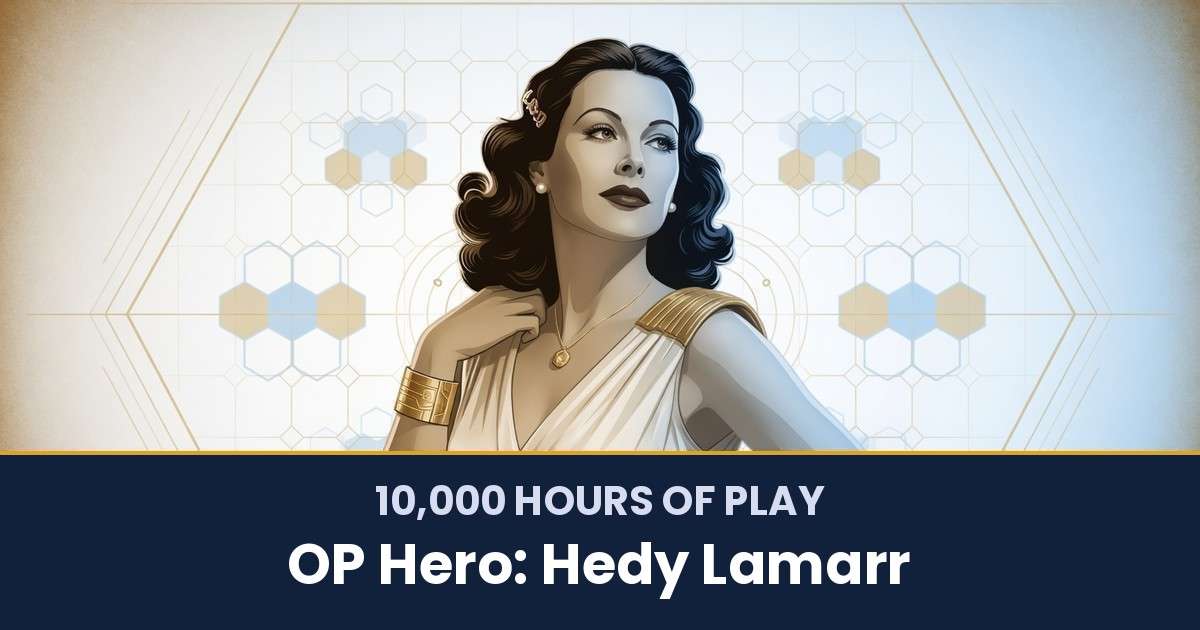


If you grade a life by the row in the Hollywood gossip column it ended up in, Hedy Lamarr was a 1940s starlet whose face sold tickets to Algiers and Samson and Delilah. If you grade it by what carries your phone signal in 2026, she is one of the most consequential engineers of the last century, and most of the world only learned that after she was dead.
This is the build that fascinates me. Lamarr is the case study for what happens when a player is mis-typed by their server. She got slotted into a class — “beautiful, no further questions” — that hard-capped four or five of her best stats for fifty years. The patents survived. The reputation took until 1997 to catch up.
Run her life through the 10,000 Hours of Play framework and the structure underneath becomes obvious. There is a clear Game. There are five innate Attributes she was carrying that her contemporaries refused to score. There are at least four distinct Roles she ran across one lifetime. And the Skills she leveled — some of them you can name out of the Real-Life Game Skills canon — are the kind that compound across decades, not weeks. Here is the read.
⚡ Speed Run Notes
- Lamarr’s Game was autonomy through invention, not stardom. Every chapter of her life is the same loop: a constraint hems her in, she designs an escape. The Hollywood career was a means, not the end.
- Her standout Attributes were mechanical intuition, observational intelligence, and ambient charisma — not “beauty.” The first two were visible at age 5 (disassembling music boxes); the world only ever scored the third.
- Her best Skill was Cloak (Rogue) at Fritz Mandl’s arms-trade dinners. Trophy wife was the cover story. Reconnaissance was the actual mission. The radio-jamming problem she would later solve was an arms-industry technical concern she absorbed at 22.
- Her Fulcrum Strike (Rogue) was a single 1942 patent — a specialist-tier drop, in 10K HP terms. The U.S. Navy filed it away. Fifty years later, frequency-hopping spread spectrum became the foundation of Wi-Fi, Bluetooth, and CDMA cellular — a quiet, multi-decade compounding return on one filed page.
- Her Phoenix Rebirth (Paladin) was posthumous. Pioneer Award in 1997. National Inventors Hall of Fame in 2014. The lesson: a build can be undervalued for its entire active run and still beat the leaderboard in the late game.
- The takeaway is not “be like Hedy.” It is “make sure the world’s wrong scoring of you doesn’t become your own.”
Table of Contents
- About Yu-kai Chou
- Step 1: The Game — What Hedy Was Actually Playing
- Step 2: Attributes — The Innate Stats Hollywood Refused to Score
- Step 3: Roles — Six Character Classes in One Lifetime
- Step 4: Skills — The Real-Life Game Skills She Mastered
- Step 5: Allies — The People Who Multiplied Her
- Step 6: Quests — The Milestones That Shaped the Saga
- What You Can Steal From Hedy’s Build
- Where this framework comes from
- Related Reading
About Yu-kai Chou

Yu-kai Chou is the author of 10,000 Hours of Play — the book that treats your life as the most important game you’ll ever build a character in, and gives you the 6-Step framework (Game · Attributes · Role · Skills · Allies · Quests) to play it on purpose. He has spent two decades developing the system through which this post analyzes its OP Hero, and applies it to his own life and to the lives of the people he advises around the world.
Chou’s other framework, the Octalysis Framework, has been applied by LEGO, Microsoft, Porsche, Coca-Cola, Salesforce, and MrBeast, impacting over 1.5 Billion Users. He has taught the methodology at Harvard, Stanford, Yale, Tesla, Google, BCG, and IDEO, and has advised governments in eight nations including Ukraine, the United Kingdom, the Kingdom of Bahrain, Singapore, Taiwan, the Netherlands, Kazakhstan, and South Korea.
His work has been cited by Harvard, Stanford, MIT, Forbes, Wall Street Journal, Wired, US Department of Energy, NIST, NSF, NCBI, US Department of Education, ClinicalTrials.gov, and Google Scholar — with 3,700+ more academic publications. Explore his books here.
Hedy Lamarr is one of the most useful examples in the 10K HP curriculum because her build was perfectly clear and her server still mis-rated it for fifty years. The lesson I keep pulling out of her arc isn’t “be undiscovered for a long time” — nobody wants that. It’s that your job is to make sure the world’s wrong score of you doesn’t end up being how you score yourself. The patent kept its truth no matter who failed to read it.
Step 1: The Game — What Hedy Was Actually Playing
The surface read of Lamarr’s life is “Hollywood star, six marriages, late-life inventor recognition.” That is the gossip-column build. It does not explain anything about her decisions.
The deeper read — the one her biographer Richard Rhodes lands on in Hedy’s Folly — is that she was playing a single Game across decades: autonomy and control through invention and reinvention. Every time a constraint closed in, she responded by designing an escape mechanism. Sometimes literally (her 1937 escape from her first husband Friedrich “Fritz” Mandl, the Austrian munitions tycoon who had her watched at home), sometimes technically (her 1942 frequency-hopping patent, which began as a literal “how do you build a jam-proof torpedo guidance system” problem and ended as the foundation of half the wireless technology in your pocket).
Read that way, the six marriages aren’t a sign of instability; they’re a sign of a player who could not tolerate the loss-of-autonomy condition and re-rolled the moment she found it. The acting was a job. The inventing was the actual quest line.
What makes her case so clean for a 10K HP analysis is that she stated the Game out loud. Her own version of it shows up in interviews and in her ghostwritten memoir: she repeatedly said that the work she was most proud of had nothing to do with movies. The world simply had no slot for “actress who is also an engineer,” so the engineering half of the build was ruled non-canonical until decades after she stopped playing.
Step 2: Attributes — The Innate Stats Hollywood Refused to Score
If you build the talent triangle Hedy’s career deserved, four or five Attributes immediately separate from the pack — and only one of them is what made it to her IMDb page.
Mechanical Pattern Recognition. She is documented (Rhodes; family corroboration) disassembling and reassembling music boxes and other mechanical objects as a child in Vienna. The same instinct, twenty years later, became the engineering metaphor that solved the radio-jamming problem: she mapped musical-piano-roll synchronization onto the timing of frequency hops on both transmitter and receiver. Most engineers in 1940 would have approached the problem orthodox-radio-first. Lamarr approached it player-piano-first. That is a stat, not a study habit.
Observational Intelligence. As Mandl’s wife from 1933 to 1937, she sat through hundreds of arms-industry meetings where her presence was treated as decorative. She came out the other side carrying enough specific technical context about analog torpedo control and its vulnerabilities to define a real engineering problem statement. That is the same Attribute that lets a junior employee five years into the wrong role suddenly become an industry expert when they switch sides.
Risk-Seeking with low downside-aversion. At eighteen she filmed one of the most-discussed nude scenes in commercial cinema history (Ecstasy, 1933). Whatever you think of the artistic merit, the calibration is identifiable: she traded scandal for international name recognition and got the deal she wanted. Four years later, she drugged her own maid, smuggled herself out of Mandl’s house, fled across two countries, and negotiated an MGM contract on the boat to America — with no studio offer in hand when she boarded.
Ambient Charisma. Yes, this one made it to her IMDb page. The point isn’t that she had it — it’s that she could convert it: a Vienna-scandal-tier reputation into an MGM contract, an MGM contract into War Bond fundraising (reportedly $7 million in a single 1941 New Orleans evening), and an MGM contract into the room access she needed for the later inventor work.
Persistent Curiosity. Friends interviewed by Rhodes describe a woman who spent her evenings drafting at a homemade drafting table while her contemporaries went to parties. After Samson and Delilah made her financially secure in 1949, she kept inventing — a fluorescent dog collar, a tablet for fizzy drinks, a reshaped traffic-light shape. The drive was intrinsic, not economic.
Four of those five are exactly the kind of stat that becomes a superpower in the right Role and a liability in the wrong one. Hedy’s Role was wrong for thirty years.
Step 3: Roles — Six Character Classes in One Lifetime
One lifetime, six recognizable Roles, in roughly this order:
- Viennese ingénue (1929–1933). Stage bit parts in Vienna and Berlin, then Ecstasy. Class: charisma-focused performer.
- Captive intelligence asset inside an arms court (1933–1937). The Mandl marriage. Class: covert observer disguised as trophy.
- Hollywood leading lady, MGM contract player (1938–mid-1940s). Algiers, Boom Town, Ziegfeld Girl, White Cargo. Class: high-charisma front-liner traded as a studio commodity.
- Wartime inventor (1940–1945). Patent file with George Antheil, June 1941; granted August 1942. Class: artificer with high creativity, low institutional standing.
- Independent producer (late 1940s). Mars Film Corporation; produced The Strange Woman (1946) and Dishonored Lady (1947). Class: self-directed project owner.
- Posthumously-recognized engineer (1997 onward). EFF Pioneer Award 1997; National Inventors Hall of Fame 2014. Class: legendary artifact whose drops finally get re-rated as epic-tier.
The leverage move in her life was Role 4. Everyone remembers Role 3. Almost no one in her lifetime knew Role 4 was even being played. The fact that you can read about it now is downstream of Role 6 happening.
Step 4: Skills — The Real-Life Game Skills She Mastered
Five Skills from the canon Real-Life Game Skills list show up explicitly in her build.
Cloak (Rogue) — gather information or execute without being noticed. From 1933 to 1937, every meeting Mandl held in his house was a Cloak proc. The arms-industry technical specifics that later became her patent were gathered while her presence was being read as “ornamental wife.” This is the most important Skill in her early build and almost nobody who scored her at the time could see her using it.
Adaptive Foraging (Ranger) — find the right resources to solve the problem you have. Lamarr had no formal engineering training. She did not have a lab. She borrowed George Antheil’s player-piano synchronization patent as a metaphor for radio frequency-hop coordination because that was the resource she had in front of her, and the metaphor turned out to be load-bearing. The 88-key piano became the 88 radio frequencies in the patent diagram. Foraging is exactly what that move is.
Astral Projection (Mage) — see possible outcomes. The hardest part of designing frequency-hopping in 1940 was not the chemistry of the components — it was holding the entire moving system in your head: transmitter and receiver synchronized, jumping in lockstep across dozens of frequencies, while a jammer chased them in vain. That is a mental simulation of a system that did not yet exist. The patent diagram is the artifact of that simulation.
Courageous Heart (Paladin) — charge into uncomfortable or hostile zones. The Ecstasy scandal. The Mandl escape. The transatlantic negotiation with Louis B. Mayer with no offer in hand. The decision to walk into the National Inventors Council in 1942 and try to actually build the device. Every single one of those is the same Skill firing under different conditions.
Phoenix Rebirth (Paladin) — recover from devastating failure and come back stronger. This is the late-game move. After her Hollywood career stalled in the late 1950s, she spent decades being known mostly for shoplifting arrests, lawsuits, and a memoir she said was fabricated. Then the cellular-tech industry woke up to what her patent actually meant. The EFF gave her the Pioneer Award in 1997. The National Inventors Hall of Fame inducted her in 2014. The rebirth was real, it just happened on a timescale most players don’t have the lifespan to see.
If you want the bonus sixth: Fulcrum Strike (Rogue) — execute high-leverage activities that obtain transformative results that turn the tide. U.S. Patent 2,292,387 is a Fulcrum Strike that took fifty years to land. One filed page. Wi-Fi, Bluetooth, GPS, CDMA cellular. Multi-trillion-dollar industries downstream of a wartime artifact the Navy filed away. That is the cleanest Fulcrum Strike in the canon.
Step 5: Allies — The People Who Multiplied Her
George Antheil was the indispensable one. Avant-garde composer, technically literate, willing to talk seriously to a movie star about radio engineering at a 1940 dinner party. Their player-piano analogy was a co-invention. Without Antheil, the patent does not exist in the form that survives. He is the Lamarr build’s clearest case of 1 + 1 = 3.
Howard Hughes gave her lab space and put his own staff engineers on call to her when she had inventing ideas during the war. Most billionaires of the era would have laughed her out of the room. Hughes built her a small drafting setup inside his operation. The signal in Hughes’s behavior is that he believed her stats. That belief is what an Ally provides.
Louis B. Mayer is the awkward Ally — he locked her into MGM’s contract system and was the architect of the “actress, no further questions” mis-typing. But he is also the reason she landed in America with a paycheck and a name on a marquee. Without the Mayer deal she negotiated on the boat in 1937, the rest of the build does not get its starting capital.
The Electronic Frontier Foundation and the inventors’ community that gave her the Pioneer Award in 1997 are the late-game Allies. They are the players who finally re-rated her drops. The lesson there is that some Allies show up forty years late and still matter.
Step 6: Quests — The Milestones That Shaped the Saga
- 1933 — Ecstasy released. Calibrated trade of scandal for international name recognition.
- 1937 — the escape from Mandl. Drugs her maid, flees through Paris and London, lands in America with an MGM offer. One of the cleanest single-night life-pivot Quests in 20th-century biography.
- 1938 — Algiers, her American film debut. American audiences see her for the first time (on loan from MGM to Walter Wanger / United Artists). The Hollywood Quest line begins.
- 1941–1942 — U.S. Patent 2,292,387 with George Antheil. Filed June 10, 1941. Granted August 11, 1942. The artifact that the rest of the build now hangs on.
- 1942 — the Navy passes on it. The most consequential setback in her life. The patent goes into a drawer for almost a quarter-century. This is the moment most players quit. Hedy logged it as a failure but kept building.
- 1949 — Samson and Delilah. Career peak. Financial security. The point at which most players would have stopped questing and started maintaining. She didn’t.
- 1957–1962 — the patent quietly re-enters the conversation. Sylvania-built spread-spectrum sonobuoys re-enter U.S. Navy use in the early 1960s, after Lamarr’s patent has expired. She is still alive and never paid for it.
- 1997 — EFF Pioneer Award + Bulbie Gnass Spirit of Achievement Award. Phoenix Rebirth fires. She is 82.
- 2014 — National Inventors Hall of Fame induction (posthumous). The final scoring.
What You Can Steal From Hedy’s Build
Three concrete pieces you can lift into your own 10K HP run.
Build for the Game your stats actually fit, even when your Role doesn’t. Hedy’s Role for thirty years didn’t have a slot for “engineer.” She built engineering anyway, on her own time, with the resources she could forage. The patent didn’t care that her studio bio called her a glamour girl. If you have a stat your current Role won’t pay for, the answer isn’t to suppress the stat — it’s to find an off-the-books quest where the stat compounds.
Cloak is a real Skill and you are probably under-using it. Hedy gathered everything she needed for her best work while the people around her thought she was decorative. You probably have meetings in your life where you are read as the junior person, the consultant, the foreign hire, the spouse-of-the-other-guest. Those meetings are intelligence-gathering opportunities. Stop trying to be the loud one in them. Cloak proc.
Phoenix Rebirth is on a longer timescale than you are budgeting for. Hedy’s patent vindicated her fifty years after she filed it. Most players underweight late-game payoffs because their own loss-aversion clock runs in months and quarters. The Yu-kai principle here is that the right Quests don’t always reward inside your visible runway, but the build still works. Keep filing the patent even if the Navy this year doesn’t read it.
The final caveat is the one I keep returning to. The takeaway from any OP Hero is never “do what they did.” Hedy’s life included a long stretch of being painfully misunderstood, two arrests, multiple lawsuits over her own image, and a late life that her son and daughter both describe as lonely. The trade-offs were real. The frame here is: study her build, take the moves that fit your Game, and pass on the ones that don’t. Respect without worship is the posture that makes the chapter land.
Where this framework comes from

Want the full system this profile is built on?
Every OP Hero piece runs through the same 6-Step framework from 10,000 Hours of Play: Unlock Your Real-Life Legendary Success. The book covers the full system, walks through Yu-kai’s own life run as the first applied case study, and gives you the worksheets to audit your own build.
Related Reading
- All OP Hero Profiles (hub)
- Turning Life Into a Game: Lessons from Yu-kai Chou and the Octalysis Framework
- OP Hero: Elon Musk’s Life as a Game (10K HP Book Snippet)
- Joris Beerda: A Legendary Role Transfer Case Study
- What’s Your Edge Strength? The Talent Triangle Method
- 10,000 Hours of Play (the book)