
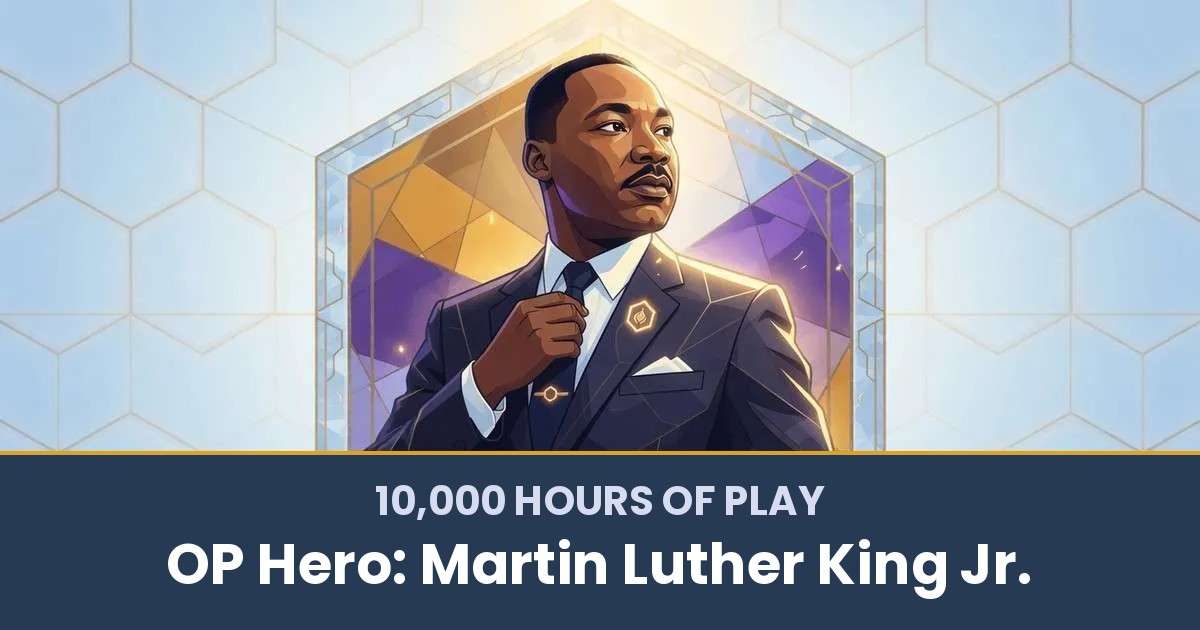


On December 1, 1955, a 26-year-old Baptist pastor in Montgomery, Alabama got a phone call about a tired seamstress who had refused to give up her seat on a bus. Four days later, he stood on a pulpit at Holt Street Baptist Church with twenty minutes to write the most important speech of his life. He spoke for sixteen of those minutes from notes scribbled on the way to the church. When he finished, every Black bus rider in Montgomery was committed to not riding a bus for as long as it took. It took 381 days.
Thirteen years later he was dead at 39, with a Nobel Peace Prize, a federal civil rights act, a federal voting rights act, and a sentence — “I have a dream” — that has outlived almost every other piece of twentieth-century rhetoric. He never held office. He never owned a company. He died with about $5,000 in his name. By any conventional scoreboard, he should not be one of the most consequential lives in modern American history.
Through the 10,000 Hours of Play lens, Martin Luther King Jr.’s character sheet is the cleanest example we have of moral leverage compounding over thirteen years. He was not the most gifted preacher in Atlanta when he started. He was not the most experienced organizer in the room. What he had was a Game long enough that an entire nation eventually moved through it with him.
⚡ Speed Run Notes
- King’s Game was never “civil rights legislation.” It was the Beloved Community — a long moral horizon that made every defeat just a level in a much bigger campaign.
- His core Attribute stack is moral courage, empathy across groups, visionary abstraction, systems pattern recognition, and rhetorical force. Four of the five were visible by his teens.
- His Skill stack is heavy Paladin — Thunder Clap, Courageous Heart, Aegis, Phoenix Rebirth — anchored by a Ranger Tactical Command and a Druid Loremaster. That combination is why the movement didn’t fracture every time it got attacked.
- Albany in 1961 was a strategic failure. He learned from it, picked Birmingham as a better arena in 1963, and shipped Phoenix Rebirth at national scale. Most operators never recover from one Albany.
- The lesson worth stealing: pick a Game whose horizon is longer than any single defeat. Then build an Ally party diverse enough that no single arrest can shut you down.
Table of Contents
- About Yu-kai Chou
- Step 1: The Game — What MLK Was Actually Playing
- Step 2: Attributes — The Innate Stats
- Step 3: Role(s) — The Character Class Across Chapters
- Step 4: Skills — The Real-Life Game Skills MLK Mastered
- Step 5: Allies — The People Who Multiplied MLK
- Step 6: Quests — The Milestones That Shaped the Saga
- What You Can Steal From MLK’s Build
- Where this framework comes from
- Related Reading
About Yu-kai Chou

Yu-kai Chou is the author of 10,000 Hours of Play — the book that treats your life as the most important game you’ll ever build a character in, and gives you the 6-Step framework (Game · Attributes · Role · Skills · Allies · Quests) to play it on purpose. He has spent two decades developing the system through which this post analyzes its OP Hero, and applies it to his own life and to the lives of the people he advises around the world.
Chou’s other framework, the Octalysis Framework, has been applied by LEGO, Microsoft, Porsche, Coca-Cola, Salesforce, and MrBeast, impacting over 1.5 Billion Users. He has taught the methodology at Harvard, Stanford, Yale, Tesla, Google, BCG, and IDEO, and has advised governments in eight nations including Ukraine, the United Kingdom, the Kingdom of Bahrain, Singapore, Taiwan, the Netherlands, Kazakhstan, and South Korea.
His work has been cited by Harvard, Stanford, MIT, Forbes, Wall Street Journal, Wired, US Department of Energy, NIST, NSF, NCBI, US Department of Education, ClinicalTrials.gov, and Google Scholar — with 3,700+ more academic publications. Explore his books here.
What I find most instructive about Martin Luther King Jr.’s build is that his Game horizon was longer than his lifetime. He was not optimizing for a personal win. He was optimizing for a moral arc that could absorb every individual loss along the way — including his own death. If you ever feel your project is too small, your defeats too final, or your Allies too few, study his Phoenix Rebirth between Albany and Birmingham. That two-year stretch is the cleanest worked example of bouncing back stronger that exists in the modern record.
Step 1: The Game — What MLK Was Actually Playing
Most retellings of King’s life will tell you the Game was “end segregation.” That is one mid-game boss, not the Game.
The actual Game, in his own words from the 1957 founding of the Southern Christian Leadership Conference (SCLC) and repeated through every major speech and book afterward, was the Beloved Community — a society reorganized around dignity, nonviolence, and economic justice strong enough that nobody had to fight for the floor of their humanity anymore. By the end of his life he had named the three intertwined enemies of that Game out loud: racism, poverty, and militarism. He framed them as a single system, not three separate causes.
Read that twice. The objective function is not “pass the Civil Rights Act of 1964.” It is “build a society where the conditions that made the Civil Rights Act necessary no longer exist.” A 13-year arc cannot be sustained by a goal that completes in one congressional session. It needs a horizon you can keep walking toward even after you win.
This is why the 1963 March on Washington was not the climax of his work. He moved straight from that speech into Birmingham’s economic boycotts, then Selma, then Chicago, then the Poor People’s Campaign, then Memphis sanitation workers. Every “victory” was a checkpoint, not the final boss. Compare this to the way most modern operators define their Game — quarterly OKRs, a funding round, a launch — and you start to see why most ambitious lives lose momentum after one big win. Their Game ended; King’s didn’t.
For a deeper read on choosing a Game with the right horizon, the canonical entry point is What Do You Want to Want? — the question King appears to have answered before he was twenty-five.
Step 2: Attributes — The Innate Stats
King rolled five Attributes that were visible long before Montgomery. They are temperament, not training.
Moral courage / risk tolerance. By age 15 he had taken a public transit bus from Dublin, Georgia to Atlanta and been forced to give up his seat to white passengers. He cried with humiliation and never forgot it. From that moment on, fear of bodily harm did not function as a stop signal for him. He took beatings, jail, stabbings, and bombings of his own home. He kept showing up. This Attribute is the one most often mislabeled as “faith.” It is closer to a calibration of what counts as a worse outcome than physical danger.
Empathy across groups. He could imagine the inner life of a Birmingham sheriff and a Vietnamese rice farmer in the same sermon. “Injustice anywhere is a threat to justice everywhere” was not a slogan — it was the operating principle that let him keep his coalition wide. The same Attribute is the one your build needs if you are trying to lead a team across functions where each function thinks the others are the problem.
Visionary abstraction. He could hold a long-term moral endpoint — integrated democracy, economic justice, nonviolence — while also campaigning on a concrete immediate task like seating a Black diner at a lunch counter. Most operators are good at one altitude or the other. King could oscillate between them in a single paragraph, which is what made his speeches feel like both prayer and policy at the same time.
Pattern recognition / systems thinking. By 1967 he had named racism, poverty, and militarism as the same machine running on three sets of victims. The “Beyond Vietnam” speech at Riverside Church on April 4, 1967 — exactly one year before his death — is the clearest single demonstration of this Attribute. It cost him friends, donors, and his Newsweek favorability. He did it anyway because the pattern was real.
Rhetorical force. Even his teenage oratory contest entries used antiphony, refrain, and biblical cadence. By Boston University he was reading Reinhold Niebuhr, Walter Rauschenbusch, and Mahatma Gandhi and braiding their language into his own. He could compress a complex political and moral claim into a sentence that traveled through newspapers, radios, and now — sixty years later — algorithms. That kind of compression is wiring you either have early or you don’t. The flip side of your Talent Triangle’s edge strength is the temperament that makes the gift usable under pressure. King’s edge was that he could deliver his strongest material when he was tired, threatened, and ten minutes from a deadline.
Step 3: Role(s) — The Character Class Across Chapters
King respec’d his Role roughly every three to five years, each transition forced by the size of the Quest in front of him.
1948–1954. The Seminary Student and Young Pastor. Morehouse undergrad at 15, Crozer Theological Seminary, then a Boston University doctorate. Married Coretta Scott in 1953. This Role was about absorbing every philosophical tradition he could reach — personalism, social gospel, Gandhi’s satyagraha, Niebuhr’s realism. The intake phase. He had not yet been forced to apply any of it.
1954–1957. The Local Pastor Who Got Picked. Took the pulpit at Dexter Avenue Baptist in Montgomery in September 1954, fifteen months before the bus boycott began. The Montgomery Improvement Association needed a leader untainted by old factional feuds. King was the outsider candidate. He did not seek the Role; the Role was handed to him because he was new, articulate, and credentialed. He almost said no.
1957–1963. The National Movement Strategist. Co-founded the SCLC in 1957 and became its first president. This is the Role where he moved from speaking on behalf of a single city to designing a multi-city campaign architecture. The shape echoes other operators who took the leap from local hero to national operator — read Elon Musk’s role transfer from PayPal founder to industry-level operator for a non-political analog of the same Role-shift mechanic.
1963–1968. The National Moral Conscience. After “I Have a Dream” and the 1964 Nobel Peace Prize, his audience was no longer the movement — it was the country. By 1967 he was using that platform to argue that the Vietnam War, the slums of Chicago, and Jim Crow in the South were the same machine. This was the Role with the highest personal cost. Many of his old Allies wanted him to stay in the lane that had won. He refused, and his approval ratings collapsed in his last year of life. He was killed at 39, before he could finish the Role transfer to economic-justice strategist that the Poor People’s Campaign would have completed.
Step 4: Skills — The Real-Life Game Skills MLK Mastered
If you are new to the canon Real-Life Game Skills, the short version is that each Skill belongs to one of seven Classes — Warrior, Ranger, Mage, Rogue, Druid, Paladin, Warlock — and most operators only get truly fluent in three or four across a lifetime. King’s stack is concentrated in Paladin (resilience under public exposure, idealism that bends institutions) with a Ranger anchor for coalition logistics and a Druid anchor for narrative. For a deeper look at how to read this Skills map across a career, see the Skills Spectrum primer — King is the textbook Specialist who beat almost every Generalist political operator of his era.
Thunder Clap (Paladin). “Public speaking that charges up and inspires people.” The “I Have a Dream” speech at the March on Washington on August 28, 1963 is one of the cleanest demonstrations on tape. He had a prepared text. Mahalia Jackson called from behind him on the platform — “Tell them about the dream, Martin” — and he set the script aside and improvised the closing twelve paragraphs that became the most quoted English-language oration of the twentieth century. The Skill is not the cadence. The Skill is being prepared enough that you can abandon the prepared text safely.
Courageous Heart (Paladin). “Charge into uncomfortable zones, uncharted territory, hostile environments.” On April 12, 1963 — Good Friday — King walked into Birmingham knowing he was about to be arrested in a city where Bull Connor would use dogs and fire hoses on children. He had been advised by SCLC counsel not to court arrest that day because there was no bail money in the fund. He went anyway. The Letter from Birmingham Jail was written from inside that exact decision. Most operators will not walk into a room when the law is on their side and the worst outcome is a tough conversation. King walked into rooms where the worst outcome was death.
Tactical Command (Ranger). “Make people of different talents work harmoniously.” Bayard Rustin was a gay former-Communist pacifist. A. Philip Randolph was a labor patriarch in his seventies. James Bevel was a fiery young SCLC strategist who pushed for using schoolchildren in the Birmingham marches. John Lewis was 23, running SNCC, and angry. White union leaders, Jewish rabbis, Catholic priests, and Black Baptist preachers had to march under one logistical plan in August 1963. King did not invent the coalition — Rustin’s logistical genius did. But King was the trusted node every faction would speak through, which is what made the Tactical Command function. Pick the leadership pattern most similar to your own out of the 7 Leadership Personas and you will see why this Skill is rarer than it looks.
Loremaster (Druid). “Weave compelling, inspiring stories.” “Beloved Community” was a narrative frame, not a policy. So was “the arc of the moral universe is long but it bends toward justice.” So was the dream itself. King’s Loremaster move was to give the movement a story that absorbed defeats as part of the plot, not refutations of it. Every time a march got attacked, the story got bigger, not smaller. If you want to feel how this Skill compares to other forms of self-leverage in the canon, the Lich Pact case study is the canon Warlock companion piece — a different way of compounding output that King would never have chosen, by temperament.
Aegis (Paladin). “Ignore public criticism and naysayers while pushing the Quest.” In April 1963 eight white moderate Birmingham clergy published a letter calling the campaign “unwise and untimely” and asking Black citizens to be patient. King wrote his reply in the margins of newspapers and on scraps of paper smuggled in by his lawyer. The Letter from Birmingham Jail did not just answer the eight clergy. It permanently reframed “wait” as itself a form of injustice. Aegis is not pretending you do not hear the criticism. It is hearing it, taking it seriously, and refusing to slow down the Quest.
Phoenix Rebirth (Paladin). “Recover from devastating failure and come back stronger.” The Albany Movement in 1961–62 was a strategic loss. Police Chief Laurie Pritchett refused to do anything photographable, integrated the jail intake, and absorbed the protests without producing the federal pressure King needed. King left Albany with no clear win and a chastened movement. He could have lost the SCLC right there. Instead he sat down with his strategists and rebuilt the playbook: pick an arena with a visibly violent opponent (Birmingham, Bull Connor), focus on economic pressure plus child-led marches, and aim for federal television cameras. He came back in spring 1963 and shipped a campaign so successful it forced the Civil Rights Act onto the national agenda. That is Phoenix Rebirth at national scale — and most operators never recover from one Albany.
Step 5: Allies — The People Who Multiplied MLK
The single most underrated thing about King is that he was never the smartest person in any one room. He was the trusted center of a party of specialists who each carried him through a different terrain.
Coretta Scott King. Not the soft-focus version. She was a trained musician, a peace activist who got there before he did, and the person who kept the home and the movement running through 29 arrests and a stabbing. She raised four children with a husband who was on the road for most of their marriage and was the one who held the Poor People’s Campaign together for years after his death. Without her, the Role never works.
Bayard Rustin. The chief logistical and strategic architect of the 1963 March on Washington. He had organized for A. Philip Randolph since the 1940s and had brought Gandhi’s nonviolent direct action methodology to the American civil rights movement before King knew his name. King’s coalitions worked because Rustin had spent twenty years building the muscle that made them possible.
Ralph Abernathy. Co-pastor of the entire arc. He was with King in Montgomery, in Birmingham, in Selma, and in the Memphis motel room. The Skill that Abernathy carried was Steadfast Presence — the Ally who never asks “should we?” but always asks “how?”
Ella Baker. The SCLC’s first executive director, and the senior organizer who taught the Student Nonviolent Coordinating Committee (SNCC) to operate without King’s hierarchical model. She was not a member of King’s party in the romantic sense — she pushed back on his top-down style — and that friction is exactly why she belongs on the list. Every long-running Quest needs at least one Ally who will tell the protagonist they are wrong.
The Big Six. John Lewis (SNCC), James Farmer (CORE — Congress of Racial Equality), Roy Wilkins (NAACP), Whitney Young (Urban League), A. Philip Randolph (BSCP — Brotherhood of Sleeping Car Porters), and King (SCLC). The 1963 March on Washington existed because these six organizations agreed to march under one tent without anyone winning the credit war. That is rare in any movement, in any decade, on any cause. It happened because King was a node every faction trusted.
Mahatma Gandhi (indirect mentor). King traveled to India in 1959 to study satyagraha on the ground. The trip is where he stopped quoting Gandhi as a literary figure and started using nonviolent direct action as a deliberate technical method. Some of your most important Allies are people you will never meet.
Step 6: Quests — The Milestones That Shaped the Saga
Quest 1 — Montgomery Bus Boycott (1955–1956). 381 days. Triggered by Rosa Parks’ arrest on December 1, 1955. King was elected president of the new Montgomery Improvement Association on December 5 and gave the Holt Street Baptist Church speech that night with twenty minutes of preparation. The boycott ended after Browder v. Gayle, decided by the Supreme Court in November 1956, affirmed bus desegregation. The boycott was also where King’s home was firebombed (January 30, 1956) and he stood on the porch and told the armed crowd not to retaliate. Quest 1 set the entire arc.
Quest 2 — Founding SCLC (1957). Co-founded with Ralph Abernathy, Joseph Lowery, Fred Shuttlesworth, and others in January 1957. This was the institution build, not a campaign. King became its first president. Most operators skip this Quest and stay in their first hero moment forever. SCLC is what turned Montgomery from a one-off into a method that could be exported to Birmingham, Selma, Chicago, and Memphis.
Quest 3 — Albany Movement (1961–1962). [The Setback.] King’s first major campaign loss. Police Chief Laurie Pritchett studied King’s nonviolent playbook in advance and neutralized it by refusing to do anything photographable. King left town with no win, no federal action, and a movement that briefly looked unsure of itself. This Quest is the one most retellings skip. Every honest study of King has to include Albany because Phoenix Rebirth between 1962 and 1963 is the most important Skill development of his life.
Quest 4 — Birmingham Campaign and the March on Washington (1963). Birmingham started in April with Project C — confrontation. King was arrested on April 12 and wrote the Letter from Birmingham Jail. Children marched in early May. The fire hoses and dogs ran on national television. On August 28, the March on Washington drew roughly 250,000 people and King delivered “I Have a Dream.” This is the Quest that produced the political pressure for the Civil Rights Act of 1964. The Nobel Peace Prize followed in October 1964.
Quest 5 — Selma to Montgomery (1965). Three attempted marches between March 7 and March 25, 1965. Bloody Sunday on March 7 saw John Lewis and 600 marchers attacked by state troopers on the Edmund Pettus Bridge. King led the second symbolic march on March 9 and the full march to Montgomery from March 21–25 under federal protection. The Voting Rights Act was signed on August 6, 1965. This Quest is the cleanest example of King’s campaign design as a strategic engine: pick an arena, create photographable injustice, force federal intervention, lock the win into legislation.
Quest 6 — Chicago Campaign, Beyond Vietnam, and the Poor People’s Campaign (1966–1968). King moved into a Chicago apartment in 1966 to lead the open-housing campaign. He delivered “Beyond Vietnam” at Riverside Church on April 4, 1967, breaking with President Johnson over the war. He launched the Poor People’s Campaign in late 1967 to bring a multiracial coalition to Washington demanding economic justice. He was assassinated in Memphis on April 4, 1968 — supporting the sanitation workers’ strike — exactly one year after the Riverside speech. The Quest he died inside of was the multi-front war he believed his life’s work had to expand into.
What You Can Steal From MLK’s Build
Three transferable patterns for your own character sheet.
First, pick a Game with a horizon longer than any single defeat. King’s “end segregation” boss fight was won in 1964. His Game — the Beloved Community — was still running when he died and is still running now. The horizon is what kept Albany from breaking him. If your Game can be completed in two years, two years of bad luck will end it.
Second, build an Ally party diverse enough that no single arrest can shut you down. King’s coalition included a gay strategist, a labor patriarch, a 23-year-old militant, four other national organization presidents, a network of Black Baptist preachers, white moderate clergy, Jewish rabbis, and a stable home. Any one of those nodes could have been removed and the movement would have kept moving. Most modern operators build a single-point-of-failure team and call it focus.
Third, train Phoenix Rebirth before you need it. Most people only get to practice Phoenix Rebirth once because most people stop after their first major loss. King practiced it deliberately between Albany and Birmingham, with the same strategists, in the same room, over months — diagnosing what had failed and rebuilding the playbook before the next campaign. The pattern is portable. Sit down after a real loss, identify the one structural reason it happened, and re-architect before the next attempt. For a sibling profile where the same Skill shows up under very different circumstances, read Phil Knight’s OP Hero build — and then go see every other entry in the catalog at the OP Hero Profiles hub.
Where this framework comes from

Want the full system this profile is built on?
Every OP Hero piece runs through the same 6-Step framework from 10,000 Hours of Play: Unlock Your Real-Life Legendary Success. The book covers the full system, walks through Yu-kai’s own life run as the first applied case study, and gives you the worksheets to audit your own build.
Related Reading
- The full OP Hero Profiles hub — every life-as-RPG character sheet in one place.
- Albert Einstein — OP Hero — another life run that compounded one Game for decades.
- Hayao Miyazaki — OP Hero — a fellow Loremaster whose narrative work shaped a generation.
- Joris Beerda — Legendary Role Transfer — how respec-ing your Role mid-life actually works.
- Frederick Douglass — OP Hero — the civil-rights pillar peer whose Game was the same long horizon.
- Abraham Lincoln — OP Hero — the historical predecessor whose Phoenix Rebirth between 1858 and 1860 is the closest structural sibling to MLK’s Albany→Birmingham arc.
- Turning Life Into a Game — the 6-Step framework, applied to your own life from scratch.
- The Two-Quest Rule — the move from preparing for life to actually playing it.