
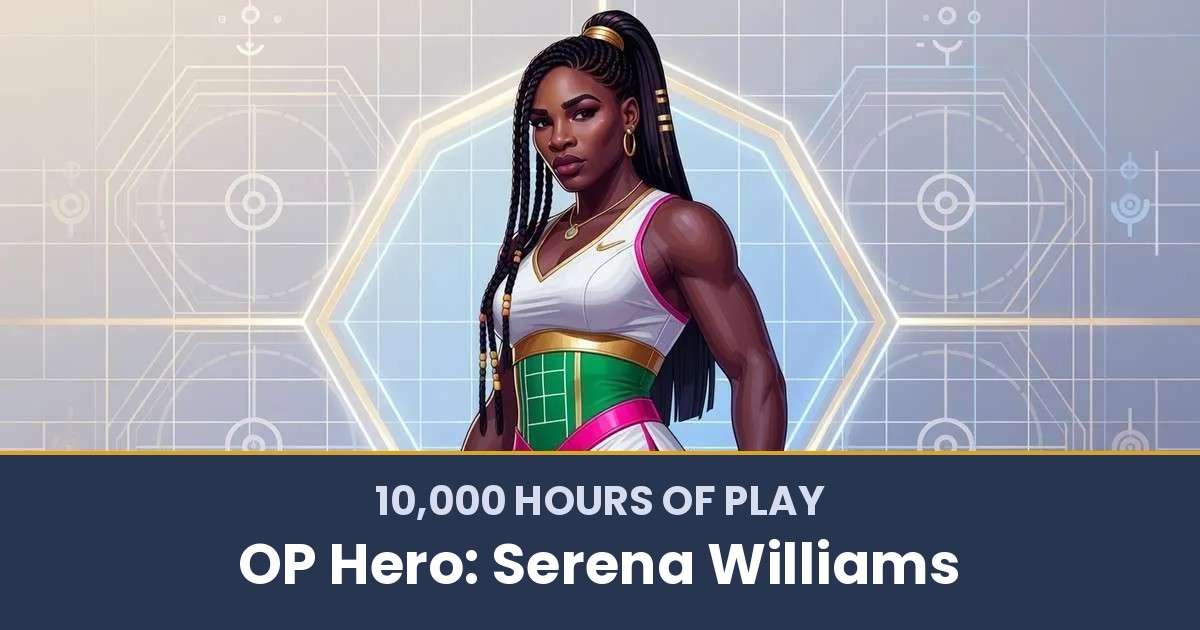


A four-year-old hits a tennis ball on a Compton public court while her father films practice and writes a 78-page plan describing the No. 1 player she will become. Thirty years later, she is holding 23 Grand Slam singles trophies and a check from her own venture fund.
If you watched Serena Williams over those three decades and thought you were watching talent, you missed the point. You were watching a system. A particular kind of system — one that converts hostile environments into proof of concept, that treats every “you can’t” as a missing input, that turns physical power into business power into cultural power without ever resetting the player.
The Serena Williams game wasn’t tennis. Tennis was the level she ran first because it was hers. The bigger game was authorship — over her body, her voice, her economics, and the ceiling on what a Black woman in a country-club sport was allowed to be. The 23 majors were how she paid for the rest of the build.
Here is her run through the 6 Steps of the 10,000 Hours of Play framework — and the canon Real-Life Game Skills you can lift from it.
⚡ Speed Run Notes
- Serena’s real “game” wasn’t tennis trophies — it was authorship over her body, voice, economics, and what a Black woman in tennis was allowed to be. The 23 majors funded the bigger build.
- Her innate Attribute stack was unusual: hyper-competitive drive, mental aggression under pressure, raw physical explosiveness, and defiance toward perceived ceilings — visible by age 10 (46–3 USTA junior record).
- The Role arc went prodigy-in-training → disruptor → apex champion → wounded veteran → reasserted monarch → founder-investor. She didn’t retire from each phase. She kept the gear and changed the map.
- Canon Skills cited: Ninja Focus (Rogue), Heroic Strike (Warrior), Vision Manifestation (Warlock), Aegis (Paladin), Phoenix Rebirth (Paladin), Mastermind (Ranger).
- The 2018 near-death pulmonary embolism after Olympia’s birth, followed by four Slam finals before retirement — that’s the Phoenix Rebirth arc, taught at a global scale.
Table of Contents
- Step 1: The Game — What Serena Was Actually Playing
- Step 2: Attributes — The Innate Stats
- Step 3: Role(s) — The Character Class Across Chapters
- Step 4: Skills — The Real-Life Game Skills Serena Mastered
- Step 5: Allies — The People Who Multiplied Serena
- Step 6: Quests — The Milestones That Shaped the Saga
- What You Can Steal From Serena’s Build
- Where this framework comes from
- Related Reading
About Yu-kai Chou

Yu-kai Chou is the author of 10,000 Hours of Play — the book that treats your life as the most important game you’ll ever build a character in, and gives you the 6-Step framework (Game · Attributes · Role · Skills · Allies · Quests) to play it on purpose. He has spent two decades developing the system through which this post analyzes its OP Hero, and applies it to his own life and to the lives of the people he advises around the world.
Chou’s other framework, the Octalysis Framework, has been applied by LEGO, Microsoft, Porsche, Coca-Cola, Salesforce, and MrBeast, impacting over 1.5 Billion Users. He has taught the methodology at Harvard, Stanford, Yale, Tesla, Google, BCG, and IDEO, and has advised governments in eight nations including Ukraine, the United Kingdom, the Kingdom of Bahrain, Singapore, Taiwan, the Netherlands, Kazakhstan, and South Korea.
His work has been cited by Harvard, Stanford, MIT, Forbes, Wall Street Journal, Wired, US Department of Energy, NIST, NSF, NCBI, US Department of Education, ClinicalTrials.gov, and Google Scholar — with 3,700+ more academic publications. Explore his books here.
What I personally take from Serena’s build is the Phoenix Rebirth lesson — that the most important Skill on the sheet isn’t the one that wins the title, it’s the one that boots you back up after the body breaks. The 2018 near-death pulmonary embolism would have ended most careers; she came back to four Slam finals. If you ever doubt whether a setback ended your run, watch what she did between September 2017 and July 2018 and recalibrate.
Step 1: The Game — What Serena Was Actually Playing
It’s tempting to define Serena’s game as “win the most Grand Slams.” She finished with 23 — the Open Era record, one shy of Margaret Court’s 24 — so the scoreboard reading isn’t wrong. It’s just shallow.
Her actual game was authorship at every layer of her life. Authorship over how she trained (no junior-tour grind — her father pulled her and Venus off the circuit). Authorship over how she dressed on court (catsuit at the 2002 US Open, black compression suit at Roland Garros 2018, beaded braids in 1998 that earned a code violation). Authorship over what a Black woman from Compton was permitted to look like, sound like, and earn while playing in a country-club sport.
The 23 majors are best understood as the price of entry for the bigger game. They bought her the seat at a table where she could launch Serena Ventures in 2014, take an ownership stake in the Miami Dolphins, sit on the boards she chose, and direct capital toward founders who looked nothing like the tennis establishment that spent two decades policing her body and demeanor.
If you compress her decades into a one-sentence quest, it’s this: build a player so undeniable on the court that the court can’t dictate the rest of the life. The same compression works on Elon Musk’s life-as-RPG arc and on many other heroes I profile — the surface game funds the meta-game.
Step 2: Attributes — The Innate Stats
Attributes are the stats visible early — before coaching, before reps. With Serena, four of them were obvious by the time she was a junior.
Hyper-competitive drive. By age 10, she had a 46–3 record on the USTA junior circuit. That isn’t a developed skill. That’s a child who already hated losing more than she liked anything else. The Talent Triangle method calls this kind of trait an Attribute precisely because no coach installs it.
Mental aggression under pressure. Most players tighten on match points. Serena escalated. The 2012 Wimbledon semifinal against Victoria Azarenka and the 2013 French Open quarterfinal against Svetlana Kuznetsova are both filed under “saved match points by hitting harder, not safer.” That’s temperament, not technique.
Physical explosiveness. By the late 1990s, WTA coverage was already calling her raw power the trait that separated her from peers. Same body type as a lot of athletes, but the explosive recruitment behind it was unusually wired-in.
Defiance toward perceived ceilings. The catsuit. The braids. The catwalk at the 2002 US Open. Most prodigies absorb the sport’s culture as the cost of admission. Serena treated it as an opening bid she could counter. Her sister Venus shared the trait; their father had selected for it, but the way Serena ran with it across decades — into fashion, motherhood, business — was hers.
Where you place yourself on the Skills Spectrum usually depends on which Attributes you accept as a given and which you try to fight. Serena’s life is a long argument for accepting your Attribute stack and overbuilding around it, not flattening it.
Step 3: Role(s) — The Character Class Across Chapters
Five distinct Roles, in order, across her saga.
1) Prodigy-in-training (1981–1997). Homeschooled, coached by Richard Williams and Oracene Price, mostly on public courts. Turned pro at 14 in October 1995 and lost her first WTA match in Quebec City. The Role here is disciple — accept the apprenticeship, accept that the public scoreboard isn’t ready yet.
2) Rising disruptor (1998–2001). First Grand Slam singles title at the 1999 US Open, age 17, beating Martina Hingis 6–3, 7–6. With Venus, begins racking up doubles majors and Olympic doubles golds. The Role is dual: rising solo star and one half of the most dominant sister tandem in tennis history.
3) Apex champion / “Serena Slam” (2002–2003). Holds all four majors concurrently from the 2002 French Open through the 2003 Australian Open. Reaches WTA No. 1 for the first time on 8 July 2002. Role: frontline closer.
4) Wounded veteran (2004–2007). Knee and ankle injuries, fashion-school detours, and a media narrative that she was distracted or past her peak. She won the 2005 Australian Open but oscillated otherwise. The Role here matters because most heroes hate this chapter and try to skip it — Serena lived inside it for years and used the time to widen her game beyond tennis.
5) Reasserted monarch + founder-investor (2008–present). Regains year-end No. 1 in 2009. Wins singles gold at the 2012 London Olympics, completing a Career Golden Slam — in women’s tennis, only Steffi Graf had done it before her. Launches Serena Ventures in 2014 and shifts the Role from athlete to capital allocator while still playing at Slam level. The 2017 Australian Open is won while eight weeks pregnant.
The Role to study is #4. Apex players who survive their wounded-veteran chapter without quitting are the ones who get a second dynasty. The ones who try to power through it without changing anything are the ones who don’t.
Step 4: Skills — The Real-Life Game Skills Serena Mastered
Six canon Skills she demonstrably ran. I’m cherry-picking the ones with the cleanest evidence; the full sheet is longer.
Ninja Focus (Rogue) — sustained discipline and focus over years. The Compton-to-West-Palm-Beach training arc, Richard’s 78-page plan, the early-morning court hours starting at age four. Same Skill that underwrote Kobe Bryant’s Mamba decade — see how it played out for him in the Kobe profile. The thing to notice is that Ninja Focus isn’t intensity in a single session; it’s the willingness to stack the same boring sessions for a decade before the trophy.
Heroic Strike (Warrior) — bold confident statements that force a binary choice. On court, her serve was the literal Heroic Strike — she hit aces at the highest rate in women’s tennis history during her peak, and the second-serve speed alone forced opponents to either commit to a return position or get blown off the baseline. Off court, her quotes work the same way. “I love making history” is not a defensive sentence. It dares the room to disagree.
Vision Manifestation (Warlock) — mental rehearsal so vivid it shapes reality. She has talked publicly for years about visualizing wins, dates, scorelines, opponents. The 2002–2003 Serena Slam wasn’t a surprise to her; she had rehearsed the arc. The same Skill ran through Kobe’s pre-game routine and through how Hayao Miyazaki built finished films in his head before drawing frame one. It’s a Warlock Skill because it bends the world to fit the mental image, not the other way around.
Aegis (Paladin) — ignore public criticism and naysayers while pushing the Quest. The 2018 black compression suit at Roland Garros was banned by the French Tennis Federation; Serena had worn it post-childbirth to manage blood clots, the same condition that had nearly killed her. She kept playing. The 1998 beads incident, the 2002 catsuit, the constant policing of her body and demeanor — Aegis is the Skill that absorbs all of that without slowing the run.
Phoenix Rebirth (Paladin) — recover from devastating failure and come back stronger. September 2017, she gives birth to Olympia via emergency C-section and develops a pulmonary embolism that nearly kills her. Six surgeries follow. Ten months later, she is in the Wimbledon final. Over the next four years she reaches three more Slam finals. Most athletes who survive what she survived don’t come back to elite competition at all, let alone four finals. This is the Skill the title-winners don’t think about until the body breaks.
Mastermind (Ranger) — create, adapt, and execute complex plans. Serena Ventures, launched in 2014, reports that ~78% of its founders are women and people of color. Operating a top-five-of-all-time singles career, a doubles dynasty with Venus, a fashion line, a fund, an NFL ownership stake, and a global brand simultaneously — that’s not multitasking. That’s a multi-track plan with checkpoints, where the on-court phase deliberately funds the off-court phase.
Step 5: Allies — The People Who Multiplied Serena
Five Allies carried weight she could not have generated alone.
Richard Williams wrote the original 78-page plan when his daughters were children, structured their training away from the junior-tour grind, and accepted the cost of looking eccentric in exchange for the freedom to build the player he had in mind. Without that early plan, the Ninja Focus reps go to the wrong fundamentals.
Oracene Price, her mother, was the second coach and the emotional load-bearer. Tennis history tends to flatten her contribution into “Richard’s plan,” which is wrong — Oracene was on every court and made the technical adjustments Richard couldn’t.
Venus Williams is the rarest Ally type: the one who is also the rival. Fourteen women’s doubles majors and three Olympic doubles golds (Sydney 2000, Beijing 2008, London 2012). More importantly, Venus reached the WTA finals first and absorbed the early cultural impact, which gave Serena cover to escalate faster.
Patrick Mouratoglou, her coach from 2012 to 2022, engineered the second dynasty. He rebuilt her serve mechanics, restructured her footwork, and rebuilt her confidence after the 2012 French Open first-round loss. The 2012 Olympics gold and the next decade of Slams sit on top of his work.
Alexis Ohanian, her husband and Reddit co-founder, multiplied her on the venture side. Serena Ventures’ infrastructure, deal flow, and Silicon Valley access came partly through his network — a clean example of the kind of Ally who unlocks a completely different game board than the one you originally trained on.
Step 6: Quests — The Milestones That Shaped the Saga
Six Quests carry the saga.
Quest 1: 1999 US Open — first Grand Slam singles title at 17, beating Hingis. The proof-of-concept Quest. Everything else in the saga gets to point back to this one.
Quest 2: 2002–2003 Serena Slam — four consecutive majors held simultaneously, the closest thing to a calendar-year Slam without the calendar. Reaches WTA No. 1 on 8 July 2002.
Quest 3: 2012 London Olympics singles gold — completes the Career Golden Slam (all four majors plus Olympic gold), in women’s tennis a feat previously held only by Steffi Graf.
Quest 4: 2017 Australian Open while pregnant — wins the title eight weeks pregnant, beating Venus in the final. Most athletes would treat this as the closing-credits moment. She didn’t.
Quest 5 (the setback): 2017–2018 birth and near-death pulmonary embolism — emergency C-section, multiple surgeries, six weeks bedridden. The setback that should have ended the career. Comes back to the Wimbledon 2018 final ten months later.
Quest 6: Serena Ventures + retirement on her own terms (2014 onward, capstone 2022 US Open). Builds the fund, builds the portfolio, and decides her own retirement timing rather than letting injury or rankings decide for her. The final match was a third-round US Open loss in September 2022. The closing scene was the one she scripted.
Look at the catalog of OP Hero profiles and you’ll see the same structural pattern across heroes from different domains: 3 to 5 build Quests, one body-or-soul-breaking setback, one capstone where the hero changes the game’s terms.
What You Can Steal From Serena’s Build
Two transferable lessons, both load-bearing.
First: fund the meta-game with the surface game. Serena’s tennis career bought the venture fund. The venture fund bought the cultural authorship. The cultural authorship bought the ownership stakes. If you have a thing you’re already excellent at, the right move is rarely to switch — it’s to keep cashing the chips into a board where the original game is no longer the only game you’re playing.
Second: build Phoenix Rebirth before you need it. Most people read recovery Skills as something you reach for after the crisis. Serena had run small versions of Phoenix Rebirth — the 2004–2007 wounded-veteran chapter, the 2011 pulmonary embolism scare, the 2012 French Open first-round loss — long before the 2018 near-death event made it the title Skill of her saga. By the time she needed it at scale, she had already rehearsed it.
The 23 majors are the part of her story you’ll see in highlight reels. The Phoenix Rebirth Skill is the part of her story you should actually steal.
Where this framework comes from

Want the full system this profile is built on?
Every OP Hero piece runs through the same 6-Step framework from 10,000 Hours of Play: Unlock Your Real-Life Legendary Success. The book covers the full system, walks through Yu-kai’s own life run as the first applied case study, and gives you the worksheets to audit your own build.
Related Reading
- All OP Hero Profiles — the full 10K HP hub
- 10,000 Hours of Play by OP Hero: Kobe Bryant — same Ninja Focus arc, different sport.
- 10,000 Hours of Play by OP Hero: Phil Knight — the founder-investor Role chapter, told from the other side.
- 10,000 Hours of Play by OP Hero: Martin Luther King Jr. — Aegis taught at civic scale.
- Real Life Game Skill (Warlock): The Lich Pact — what Warlock-class Skills actually cost.
- Turning Life Into a Game: the 6-Step framework explained