
10K HP Step 6: Turn Your Goals Into Quests You Can Finish

Your Game, Attributes, Role, Skills and Alliances are your character sheet, and quests are where you take that character out and actually play.
A quest is any purposeful activity that moves you toward your Game, with a clear way to know whether you succeeded.
Without quests, the first five Steps stay as a nice self-portrait you never use.
Most “gamify your life” advice calls everything a quest, from reading a book to becoming a billionaire.
That makes planning impossible, so in 10,000 Hours of Play (10K HP) I separate quests by scope.
Step 6 is how you turn your goals into quests you can finish.
Last updated:
Speed Run Notes
- Step 6 of 10,000 Hours of Play turns your Game, Attributes, Role, Skills and Alliances into quests, so the character you built in the first five Steps gets put to work.
- Separating Sagas, Arcs, Major Quests, Minor Quests and Tasks lets you see which Saga even a small Tuesday afternoon Task belongs to.
- Every quest needs a Win-State and a Fail-State, and the 3-Star Achievement System gives Minor Quests and Tasks partial credit so you keep going.
- The OP (overpowered) Hero for this Step is J.K. Rowling, whose first Harry Potter book took twelve rejections and seven years to get from a delayed train in 1990 to print in 1997.
- Routine maintenance and passive consumption still take hours, and keeping them out of your quest count shows you when a busy week did not move your Game forward.
In This Article
- Quests come in sizes
- What does not count as a quest
- OP Hero: J.K. Rowling’s quest line
- Give every quest a Win-State and a Fail-State
- The 3-Star Achievement System
- Starter exercise: design your next Major Quest
- What you keep even when a quest fails
- Common questions about Step 6
- Take the next step in your 10K HP journey
- Sources
Author Credibility: Yu-kai Chou

Yu-kai Chou is the author of 10,000 Hours of Play — the book that treats your life as the most important game you’ll ever build a character in, and gives you the 6-Step framework (Game · Attributes · Role · Skills · Allies · Quests) to play it on purpose. He has spent two decades developing the system this series teaches, and applies it to his own life and to the lives of the people he advises around the world.
Chou’s other framework, the Octalysis Framework, has been applied by LEGO, Microsoft, Porsche, Coca-Cola, Salesforce, and MrBeast, impacting over 1.5 Billion Users. He has taught the methodology at Harvard, Stanford, Yale, Tesla, Google, BCG, and IDEO, and has advised governments in eight nations including Ukraine, the United Kingdom, the Kingdom of Bahrain, Singapore, Taiwan, the Netherlands, Kazakhstan, and South Korea.
His work has been cited by Harvard, Stanford, MIT, Forbes, Wall Street Journal, Wired, US Department of Energy, NIST, NSF, NCBI, US Department of Education, ClinicalTrials.gov, and Google Scholar — with 3,700+ more academic publications. Explore his books here.

Quests are where my own Game, making important activities enjoyable and enjoyable activities productive, meets an ordinary to-do list. This Step helps you rebuild yours as a quest log.
Quests come in sizes
- Saga: a major era of your life, often five to fifteen years.
- Arc: a series of quests aimed at one big objective inside a Saga, such as building one company or one body of work.
- Major Quest: a commitment that takes months or years, such as finishing a degree, launching a product or moving countries.
- Minor Quest: a shorter commitment that feeds a Major Quest, such as a course, a chapter, or one partnership.
- Task: the small actions on your daily to-do list.
Tasks add up to Minor Quests, Minor Quests add up to Major Quests, and a string of Major Quests becomes an Arc.
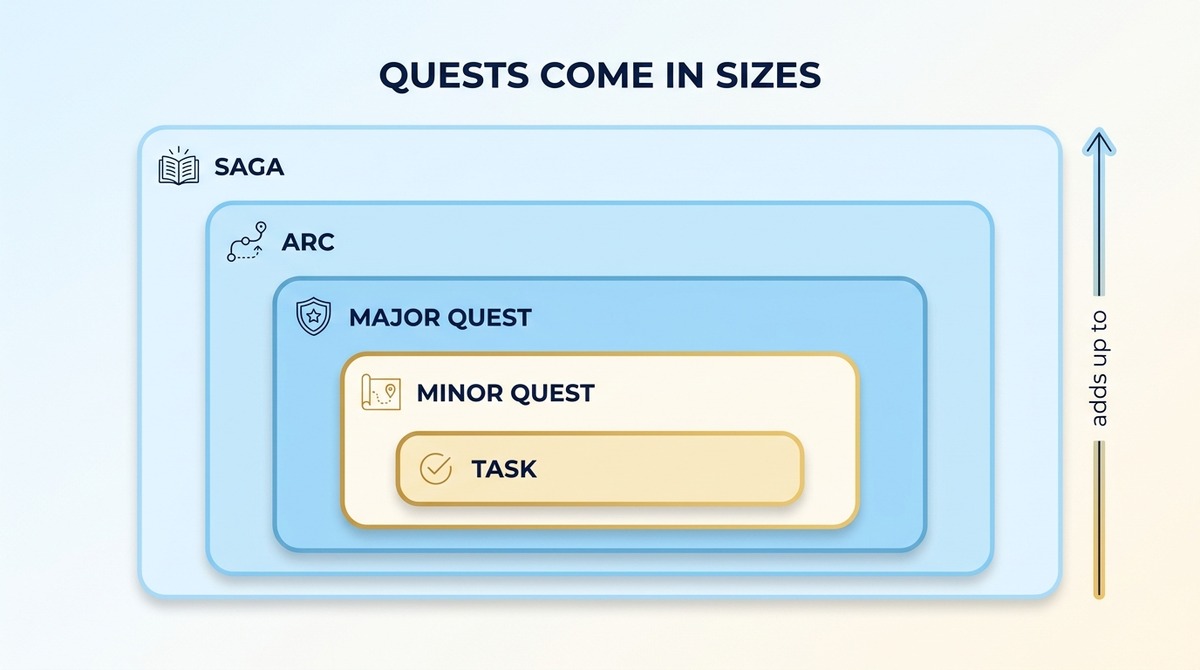
When you can see that structure, a boring Task on a Tuesday afternoon stops feeling random, because you know exactly which Saga it belongs to.
What does not count as a quest
Routine maintenance does not count: groceries, laundry and email inbox cleanup keep your life running without moving your Game forward.
Passive consumption does not count either: scrolling and binge-watching have no win condition.
Neither does anything you do purely out of habit with no intent behind it.
You will still spend plenty of hours on these activities, and that is fine as long as you do not count them as progress on your Game.
Keeping that line clear makes it obvious when a week was busy without moving you forward.
OP Hero: J.K. Rowling’s quest line
In 1990, J.K. Rowling was stuck on a delayed train from Manchester to London when the idea for a boy wizard came to her.

That was the start of a Saga, and what followed was a long series of quests, many of them under difficult conditions.
Her mother died at the end of that same year.
She moved to Portugal to teach English, then returned to the UK and settled in Edinburgh as a single mother, living on very little money while she kept writing.
Her Major Quest was finishing the first manuscript, and she completed it in 1995.
The next Major Quest was getting it published, and twelve publishers rejected it before Bloomsbury accepted it.
Harry Potter and the Philosopher’s Stone came out in June 1997 with a hardback first printing of just 500 copies, most of which went to libraries.
Even then, her editor, Barry Cunningham, reportedly told her to get a day job, because children’s books rarely paid.
Seen as a quest line, her story has a clear shape: one Saga planned as seven books, Arcs for each book, and Major and Minor Quests that kept moving forward through grief, poverty and rejection.
She kept playing, and the Saga eventually became one of the best-selling book series in history.
Her full six-Step run is in her OP Hero profile.
Give every quest a Win-State and a Fail-State
A quest needs a clear definition of success and a deadline.
“Write a book” gives you nothing to measure, while “finish a 60,000-word draft of my fantasy novel by June 30” gives you a finish line and a date.
The deadline is your Fail-State, and it gives every work session a reason to matter.
Aim for difficulty that is hard enough that you have to stretch and possible enough that you believe you can do it, which creates what game designer Jane McGonigal calls urgent optimism.
The 3-Star Achievement System
Mobile games score levels with one, two or three stars, and I use the same idea for my own Minor Quests and Tasks.
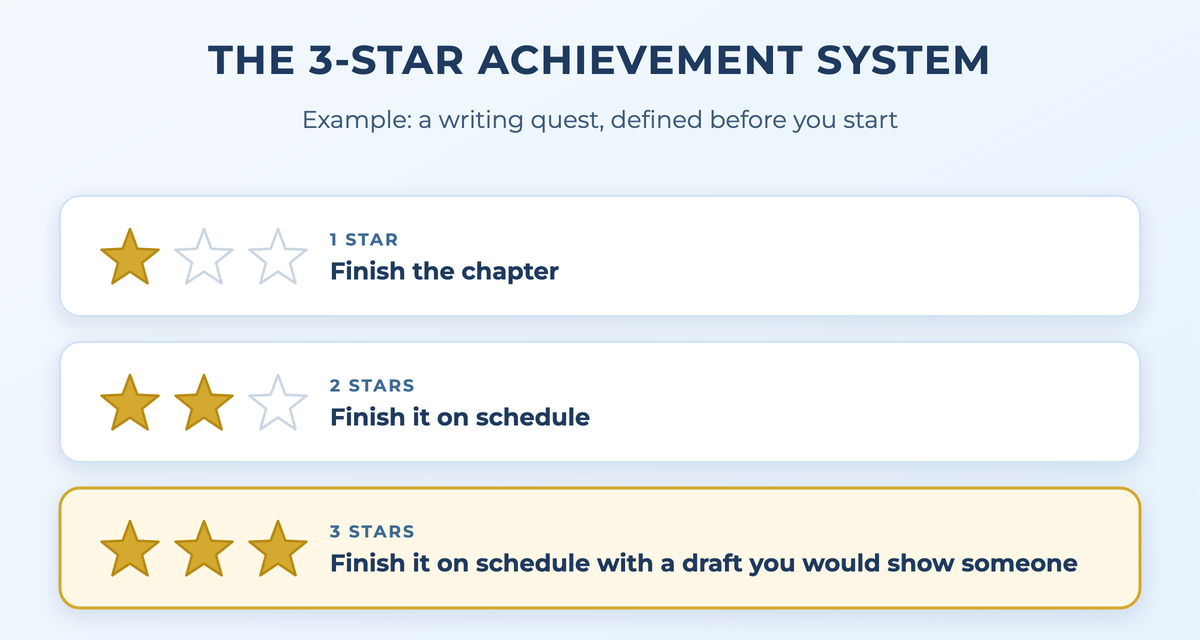
For each quest, define what one star, two stars and three stars mean before you start.
For a writing quest, one star could be finishing the chapter, two stars finishing it on schedule, and three stars finishing it on schedule with a draft you would show someone.
This removes the all-or-nothing feeling that makes people quit, because even a one-star result still counts as progress you can see.
It works best for Tasks and Minor Quests, where feedback comes quickly.
Major Quests take too long for stars to feel motivating, so break them down first.
In the book: The Quests chapter covers the ten Quest Types (Career, Learning, Resource, Health, Spiritual, Relationship, Alliance, Discovery, Service and Adventure), how to tell Main Quests from Side Quests and Pivotal Quests, the full Quest Journey Map for analyzing your own past Sagas, a step-by-step quest for finding a mentor, and how Marie Curie’s quests made her one of the greatest scientists in history. It closes with how all six Steps come together into OP Mode.
Get 10,000 Hours of Play and register your order at 10KHP.com to claim the 10K HP Academy, which comes free with the book.
Starter exercise: design your next Major Quest
Give yourself 20 minutes and a blank page.
- Name the Saga you are in right now. Give it a title, like a season of a TV show. Examples: “the startup years” or “the new-parent Saga.”
- Pick one Major Quest for the next three to twelve months. It should move you toward the Game you chose in Step 1 and use the Role from Step 3.
- Write down its Win-State and its Fail-State. What does done look like, and by what date?
- Break it into three to five Minor Quests. Each should take a few weeks at most.
- Give the first Minor Quest a one-, two- and three-star definition. Then put its first Task on tomorrow’s calendar.
What you keep even when a quest fails
You will not finish every quest you start, and some of your Sagas will end differently from how you planned them.
That is fine, because the skills you gain, the allies you meet and the person you become along the way stay with you into the next Saga.
So pick your next quest today and keep playing.
Common questions about Step 6
How do you turn your goals into quests?
Pick one Major Quest for the next three to twelve months that moves you toward your Game, and write down its Win-State and its Fail-State.
Break it into three to five Minor Quests, give the first one a 3-Star definition, and schedule its first Task.
This is Step 6 of 10,000 Hours of Play (10K HP), and the book adds the ten Quest Types and the full Quest Journey Map.
What is the difference between a Saga, an Arc and a quest?
A Saga is a major era of your life, often five to fifteen years, and an Arc is a series of quests aimed at one big objective inside it.
Major Quests take months or years, Minor Quests feed them, and Tasks are the small actions on your daily to-do list.
What is the 3-Star Achievement System?
The 3-Star Achievement System gives each Minor Quest or Task a one-star, two-star and three-star definition before you start, the way mobile games score levels.
Because a partial result still earns a star, you keep seeing progress and are less likely to quit.
Take the next step in your 10K HP journey

This post gives you the starting move for Step 6, and you now have a starter version of all six Steps.
The book shows how they come together, with seven OP Hero profiles, the complete tools for every Step, and the path to living in OP Mode.
- Get the book. 10,000 Hours of Play is available on Kindle, paperback, hardcover and audiobook.
- Register your order at 10KHP.com to claim the 10K HP Academy: the workbook, the Play Life Like an RPG (role-playing game) video course, two months of live Mastermind calls with my co-author Mark Diaz, the Level Up In Real Life Sheet for logging your quests and earning experience points (XP), and a guide to setting up your own 10K HP AI coach.
The Academy comes free with any format of the book. If you already bought it on Amazon, you can register today with the order number from your receipt.
Sources
The hero facts on this page come from these sources, each checked in October 2026.
- J.K. Rowling: About, for the delayed train in 1990, her mother’s death, Edinburgh and the seven-book plan.
- Wikipedia: J. K. Rowling, for the Manchester to London train and her years in Portugal.
- The Guardian (2015): JK Rowling on her rejections, for the 12 publishers before Bloomsbury.
- Sotheby’s: one of only 500 copies of the first hardback, for the first printing.
- The Guardian (2022): an oral history of Harry Potter at 25, for Barry Cunningham’s day-job advice.
- Jane McGonigal: Games can make a better world (transcript), for her definition of urgent optimism.
Keep exploring: see the six Steps applied to real lives in more than 200 OP Hero Profiles.