

10K HP Step 1: Find Your Life Mission and Choose Your Game

When I was a teenager, I put more than a thousand hours into Diablo 2 to build the strongest Paladin my friends had ever seen.
The day I finished the set, I walked over to show them, and they had already moved on to Warcraft 3.
All of that effort had gone into a game nobody around me was playing anymore, including, a few months later, me.
That moment taught me the first rule of 10,000 Hours of Play, which is to decide what you are working toward before you start putting in the hours.
Your life mission is what I call your Game, and choosing it is Step 1.
In real life, most people skip this step completely.
They pick a major because it sounds employable, take the job that calls back first, and chase the next promotion because it is the next rung in front of them.
Twenty years later they are very good at a game they never chose and never cared about.
Last updated:
Speed Run Notes
- Step 1 of 10,000 Hours of Play (10K HP) is choosing your Game, the long-term mission that decides where your hours go before you start putting them in.
- Your Game sits underneath your roles and quests, which is why the same law student can end up on different paths depending on the Game behind the degree.
- A clear Game works as a filter, because most decisions become simple once you ask whether a choice moves you forward in it.
- The OP (overpowered) Hero for this Step is Ingvar Kamprad, whose written Game of a better everyday life for the many people explains flat packs and his refusal to go premium.
- You can start today with the 20-minute Decision Test, and then commit to your Game for three to eight years so your skills and relationships have time to compound.
In This Article
- Your Game is the mission behind everything else
- A Game works as a filter for every decision
- OP Hero: Ingvar Kamprad and the Game of “the many people”
- Starter exercise: the Decision Test
- How long should you commit to a Game?
- Common questions about Step 1
- Take the next step in your 10K HP journey
- Sources
Author Credibility: Yu-kai Chou

Yu-kai Chou is the author of 10,000 Hours of Play — the book that treats your life as the most important game you’ll ever build a character in, and gives you the 6-Step framework (Game · Attributes · Role · Skills · Allies · Quests) to play it on purpose. He has spent two decades developing the system this series teaches, and applies it to his own life and to the lives of the people he advises around the world.
Chou’s other framework, the Octalysis Framework, has been applied by LEGO, Microsoft, Porsche, Coca-Cola, Salesforce, and MrBeast, impacting over 1.5 Billion Users. He has taught the methodology at Harvard, Stanford, Yale, Tesla, Google, BCG, and IDEO, and has advised governments in eight nations including Ukraine, the United Kingdom, the Kingdom of Bahrain, Singapore, Taiwan, the Netherlands, Kazakhstan, and South Korea.
His work has been cited by Harvard, Stanford, MIT, Forbes, Wall Street Journal, Wired, US Department of Energy, NIST, NSF, NCBI, US Department of Education, ClinicalTrials.gov, and Google Scholar — with 3,700+ more academic publications. Explore his books here.

My own Game is to make important activities enjoyable and enjoyable activities productive. Every later Step in the framework builds on the Game you choose here.
Your Game is the mission behind everything else
Your life mission is the long-term purpose that gives your effort a direction.
It is the reason behind your choices, which is why it comes before your talents, your role, your skills, your allies, and your quests.
Some examples of Games people play: raising children who grow up confident and kind, making clean energy cheap, getting great music into more homes, or living a quiet, healthy life close to the people they love.
Your Game can be as small or as personal as you like.
It has to be true for you, and it has to be big enough that you would happily spend years on it.
A useful test is to separate the Game from the activities inside it.
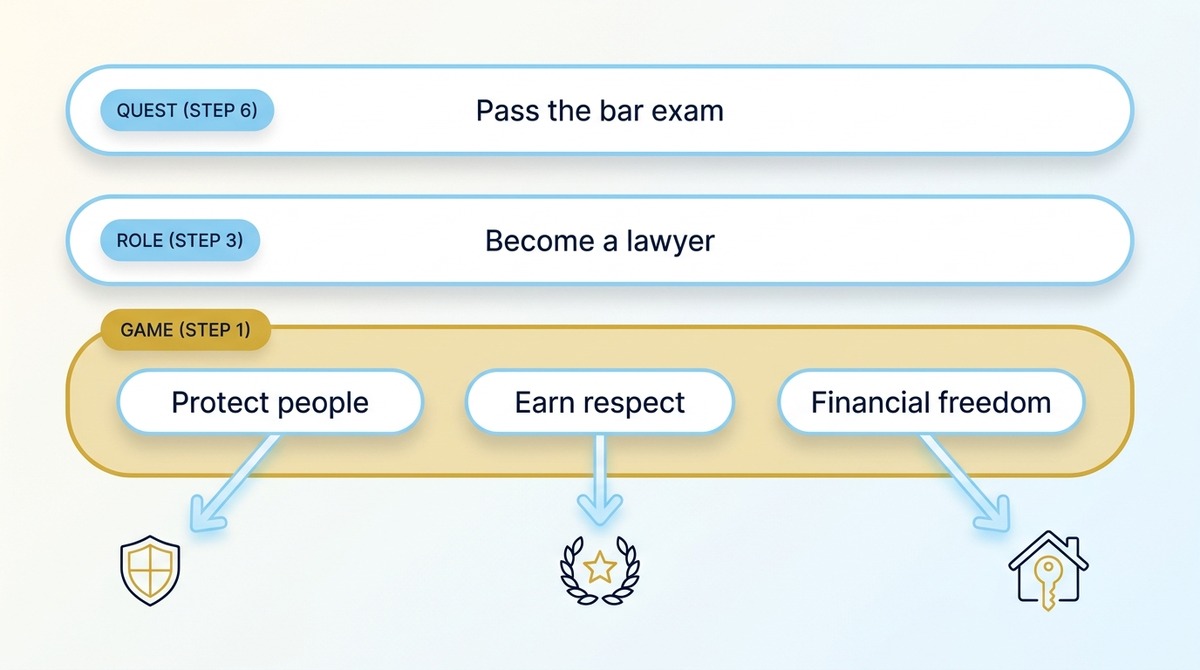
“Pass the bar exam” is a quest you might take on in Step 6.
“Become a lawyer” is a role you might select in Step 3.
The Game is the reason underneath both of them: protecting people who cannot protect themselves, earning respect, or building financial freedom for your family.
Each of those Games would send the same law student down a different path after graduation.
In the book: The Game chapter walks through four different ways to discover your Game when you have no idea where to start, and breaks down how Gandhi changed his Game from a comfortable legal career to the liberation of India.
Get 10,000 Hours of Play and register your order at 10KHP.com to claim the 10K HP Academy, which comes free with the book.
A Game works as a filter for every decision
The most practical benefit of choosing a Game is that it gives you a clear reason to turn down opportunities that do not serve it.
Without one, every opportunity looks equally attractive, so you end up saying yes to whatever is loudest or most flattering.
With one, most decisions become obvious because you can ask a single question: does this move me forward in my Game?
OP Hero: Ingvar Kamprad and the Game of “the many people”
Ingvar Kamprad registered IKEA in 1943, when he was 17 years old, selling pens, wallets and other small goods by mail from a farming area in southern Sweden.
Years later he wrote his Game down in a document he called The Testament of a Furniture Dealer (1976): “To create a better everyday life for the many people.”
That one sentence explains decisions that would otherwise look random.
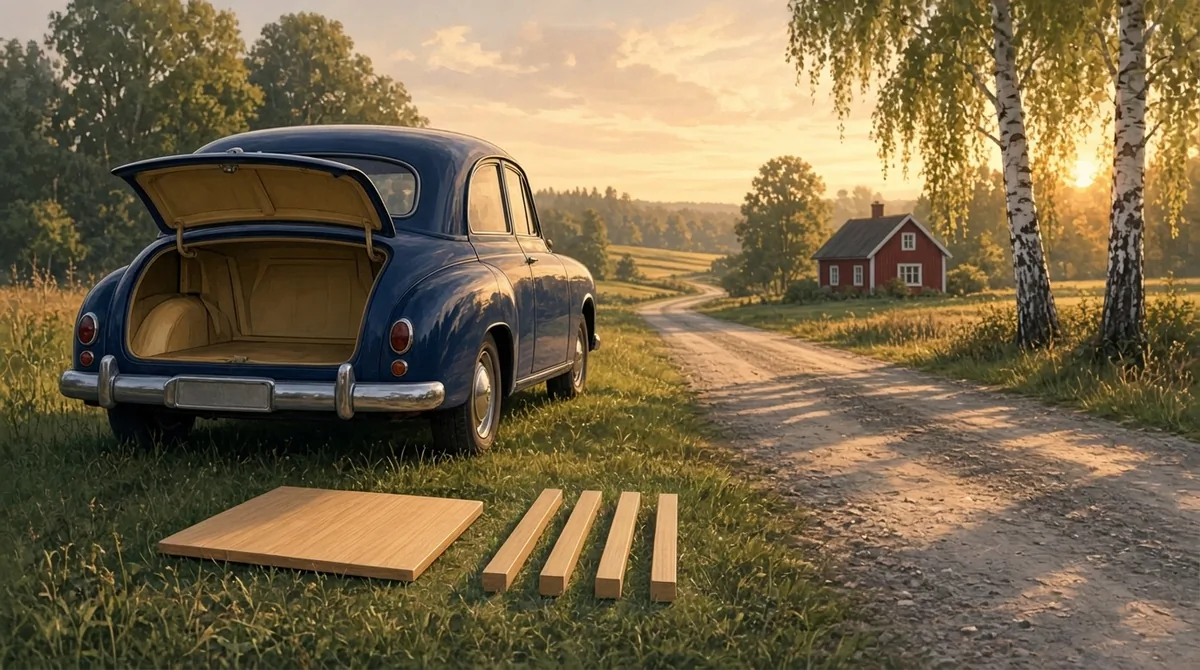
In 1953, IKEA began selling tables that customers assembled at home. A well-known IKEA story has designer Gillis Lundgren taking the legs off a table so it would fit in a car.
Flat packs made furniture cheaper to ship and store, which made it affordable for more households, which served the Game directly.
When established Swedish furniture dealers pushed suppliers to boycott IKEA and got it barred from Stockholm’s main furniture fair, Kamprad stayed in the low-price market and worked around the block.
He kept turning up at the fair under other company names, rented his own showroom in central Stockholm, and found manufacturers outside Sweden, first in Denmark and then in Poland from 1961, because a premium IKEA would have been a different Game entirely.
His Game also told him what to give up: luxury ranges, high margins, and the prestige that comes with them.
Kamprad wrote his decision down once, and it kept shaping IKEA long after he stepped back from running the company.
You can read his full run through all six Steps in his OP Hero profile.
Starter exercise: the Decision Test
You do not need to know your lifelong mission today to make real progress on Step 1.
Here is a 20-minute exercise for anyone who feels stuck.
- Write a first draft of your Game sentence. Use the format “I play to ___ for ___.” For example: “I play to make learning feel like play for kids who hate school.” It will be wrong in some way, and that is fine because a draft gives you something to test.
- List the five biggest decisions you made in the last three years. Job changes, moves, relationships, money, how you spend your evenings.
- Run each of those decisions through your draft. Mark each one as “moved me forward,” “neutral,” or “pulled me away.”
- Look at the pattern. If most decisions are neutral, your sentence is too vague to act on, so sharpen it. If most pulled you away, either the sentence describes someone else’s Game, or you have been living as a non-player character (NPC) in someone else’s story. Both of those are worth knowing before you go any further.
- Tell three people you trust this week. Say the sentence out loud and watch how they react. Saying it publicly turns a private wish into a commitment, and it starts attracting the allies you will need in Step 5.
Repeat the test every few months as your sentence improves.
Most people need several drafts before the sentence feels like theirs.
How long should you commit to a Game?
Your Game can change, and it probably will at least once in your life.
Still, I recommend committing to a Game for at least three to eight years before reconsidering it.
The 10,000-hour idea only works if the hours stack up in the same direction, and a Game you swap every year never gives your skills or your relationships time to compound.
If you realize you picked the wrong Game, do not treat the years as wasted.
Carry your skills, your allies and your experience into the next one, which is exactly what I wish teenage me had been able to do with that Paladin.
Common questions about Step 1
What is a life mission?
A life mission is the long-term purpose you choose to spend your years on, and in 10,000 Hours of Play (10K HP) I call it your Game.
Choosing it is Step 1, because every later Step, from your Attributes to your quests, depends on knowing what you are playing for.
How do I find my life mission if I have no idea where to start?
Write a rough first draft in the form “I play to ___ for ___,” and test it against the five biggest decisions you made in the last three years.
If most of those decisions come out neutral, the sentence is too vague, and if most of them pulled you away, it may describe someone else’s Game.
The book walks through four different ways to discover your Game when you have nothing to start from.
What is the difference between a life mission, a role and a goal?
Your Game is the reason underneath everything you do, your Role (Step 3) is the part you play in it, and a goal becomes a quest (Step 6) once it has a clear finish line.
Becoming a lawyer is a Role and passing the bar exam is a quest, while the Game behind both might be protecting people who cannot protect themselves.
Take the next step in your 10K HP journey

This post gives you the starting move for Step 1.
The book gives you the complete Step, plus the five that follow: Attributes, Role, Skills, Alliances and Quests, each with its own OP Hero and tools.
- Get the book. 10,000 Hours of Play is available on Kindle, paperback, hardcover and audiobook.
- Register your order at 10KHP.com to claim the 10K HP Academy: the workbook, the Play Life Like an RPG (role-playing game) video course, two months of live Mastermind calls with my co-author Mark Diaz, the Level Up In Real Life Sheet, and a guide to setting up your own 10K HP AI coach.
The Academy comes free with any format of the book. If you already bought it on Amazon, you can register today with the order number from your receipt.
Sources
The hero facts on this page come from these sources, each checked in October 2026.
- IKEA Museum: The birth of IKEA, for Kamprad registering IKEA in 1943 and its first mail-order goods.
- IKEA Museum: The Testament of a Furniture Dealer, for the 1976 document and its vision of a better everyday life for the many people.
- IKEA Museum: Flatpacks, for the tables customers assembled at home in the 1953 catalogue.
- IKEA Museum: Price wars, for the boycott and the Stockholm furniture fair.
- IKEA Museum: Boycott makes IKEA turn to Poland, for the move to Danish and then Polish suppliers.
- The Independent: Gillis Lundgren obituary, for the table whose legs came off so it would fit in a car.
Next in the series: Step 2: Know Your Attributes (Talents)