

10K HP Step 3: Select Your Role and Find the Right Career

In World of Warcraft, the first big decision is your class: Warrior, Priest, Rogue, Mage and so on.
Once you are in a group, every class collapses into one of three jobs: the tank who absorbs the damage, the healer who keeps everyone alive, and the damage dealer who finishes the fight.
A Priest who insists on tanking can technically survive for a while, and the whole party pays for it.
Real careers work the same way, because a Role that fights your Attributes costs you and everyone who depends on you.
The question in Step 3 is which job you play in your Game, and whether it fits the Attributes you uncovered in Step 2.
To select your Role well, you look at your Game, your Attributes and your Skills together.
Last updated:
Speed Run Notes
- Step 3 of 10,000 Hours of Play (10K HP) is selecting your Role, the part you play inside your Game, the way a tank, a healer and a damage dealer each play a different part in the same party.
- A job title is only the part of a Role that other people can see, and getting clear on the inner layers of Aspiration and Identity makes the outer layers much easier to choose.
- Where your Game, Attributes and Skills overlap tells you which of five Career Zones you are in, and the OP (overpowered) Zone is where all three meet.
- The OP Hero for this Step is Julia Child, who entered the Adventure Zone in her late thirties and spent about a decade turning her Attributes into a Specialization.
- The starter exercise asks you to introduce yourself from the inside out and then pick one 90-day move toward the OP Zone.
In This Article
- Your job title is only the visible shell
- Identity can be put on before you have earned it
- The five Career Zones
- OP Hero: Julia Child and the late move into the Adventure Zone
- Starter exercise: introduce yourself from the inside out
- Common questions about Step 3
- Take the next step in your 10K HP journey
- Sources
Author Credibility: Yu-kai Chou

Yu-kai Chou is the author of 10,000 Hours of Play — the book that treats your life as the most important game you’ll ever build a character in, and gives you the 6-Step framework (Game · Attributes · Role · Skills · Allies · Quests) to play it on purpose. He has spent two decades developing the system this series teaches, and applies it to his own life and to the lives of the people he advises around the world.
Chou’s other framework, the Octalysis Framework, has been applied by LEGO, Microsoft, Porsche, Coca-Cola, Salesforce, and MrBeast, impacting over 1.5 Billion Users. He has taught the methodology at Harvard, Stanford, Yale, Tesla, Google, BCG, and IDEO, and has advised governments in eight nations including Ukraine, the United Kingdom, the Kingdom of Bahrain, Singapore, Taiwan, the Netherlands, Kazakhstan, and South Korea.
His work has been cited by Harvard, Stanford, MIT, Forbes, Wall Street Journal, Wired, US Department of Energy, NIST, NSF, NCBI, US Department of Education, ClinicalTrials.gov, and Google Scholar — with 3,700+ more academic publications. Explore his books here.

Part of the Role I play today began as a character I acted out before I was ready for it. This Step helps you choose your own Role from the inside out.
Your job title is only the visible shell
A Role is the position you play within your Game, and in 10,000 Hours of Play it runs much deeper than the title on your business card.
Ask people what they do, and almost everyone answers with a job title: accountant, engineer, full-time parent.
That answer describes the most visible part of a Role, which also happens to be the least fundamental part.
It is the main reason so many successful people feel hollow: they optimized their job title and never examined the layers underneath.
In 10K HP, I describe a Role as a sphere with four layers, from the core outward.

- Aspiration: who you are trying to become. Your trajectory says more about you than your current position.
- Identity: who you believe you are, such as “someone who never quits” or “someone who protects people.”
- Occupation: the value you provide to the people around you, paid or unpaid.
- Specialization: what you have become unusually good at, where your Attributes and Skills meet.
When the inner two layers are clear, the outer two become much easier to choose.
When they are missing, people pick occupations based on what their parents wanted, what pays the most, or what their friends did.
Identity can be put on before you have earned it
One of my favorite tricks in this Step is roleplaying, which is exactly what it sounds like.
Before college, I was terrified of public speaking.
What helped me most was acting as if I were already an experienced speaker: standing the way I imagined one would stand, preparing the way one would prepare, and walking on stage in that character.
Over time, the character I was playing became an accurate description of me.
Today I speak to audiences around the world, and I describe myself with a Hero Name, “Human-Systems Architect,” which keeps reminding me what kind of work I should say yes to.
In the book: The Role chapter goes much deeper into the Role Sphere, how to build your own Hero Name and Hero Code, Nir Eyal’s Identity Pacts, and the story of how Oprah Winfrey’s demotion from news anchor led her to the Role that fit her Attributes.
Get 10,000 Hours of Play and register your order at 10KHP.com to claim the 10K HP Academy, which comes free with the book.
The five Career Zones
When you choose a Role, three circles matter: your Game (Step 1), your Attributes (Step 2), and your current Skills (Step 4).
Skills is the smallest circle, because you can build skills in months while your Game and Attributes take years to change.
Where those circles overlap tells you which zone you are in.
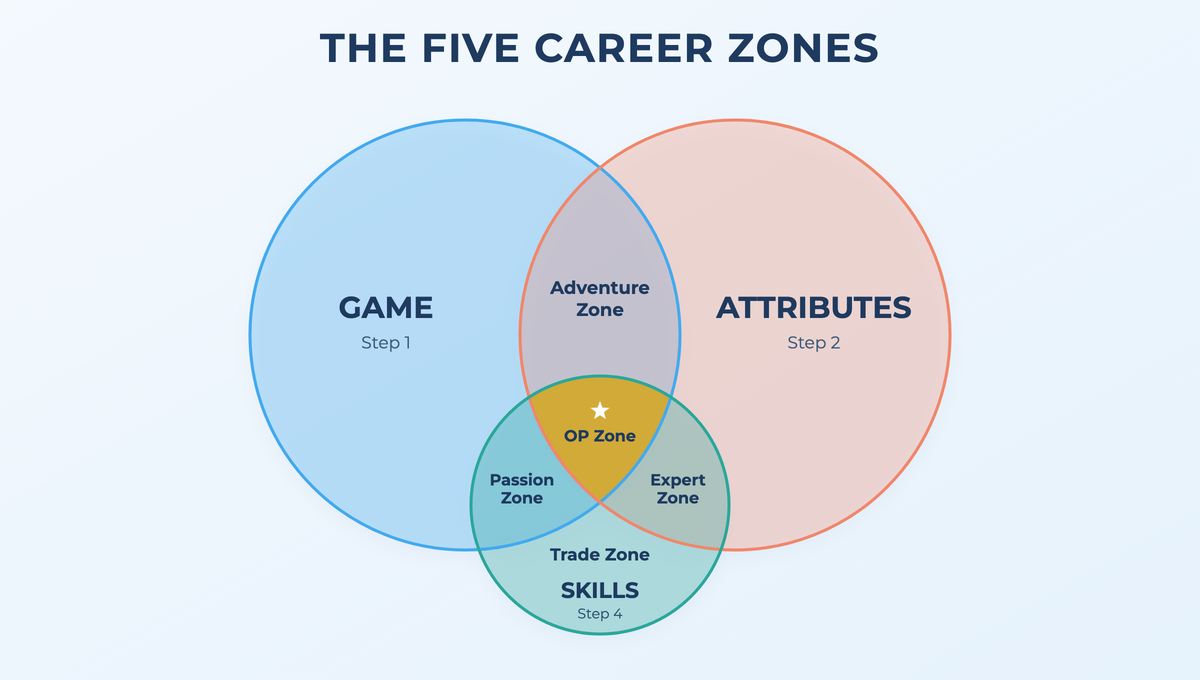
| Zone | What overlaps | How it feels |
|---|---|---|
| Trade Zone | Skills only | “This pays the bills, but is this really it?” |
| Expert Zone | Skills + Attributes | “I’m very good at this, so why do I feel empty?” |
| Passion Zone | Skills + Game | “I love this, even if I’ll never be the best at it.” |
| Adventure Zone | Game + Attributes | “I have no idea what I’m doing, and I’ve never felt more alive.” |
| OP Zone | Game + Attributes + Skills | “The work energizes me, I improve every day, and it matters.” |
Two moves are worth knowing even before you read the full chapter.
If you are in the Expert Zone, you can often jump straight to the OP Zone by pointing your existing skills at a Game you care about.
An accountant who loves music can become the finance lead at a music education nonprofit, keeping all of her expertise while gaining a Game she cares about.
If you are in the Trade Zone, the Adventure Zone is usually the better next step, even though it feels riskier, because, like the OP Zone, it lines up your Game and Attributes from day one.
OP Hero: Julia Child and the late move into the Adventure Zone
Julia Child did not take her first serious cooking class until her late thirties.
She had worked for the Office of Strategic Services (OSS) during World War II, moved to Paris with her husband after the war, and enrolled at Le Cordon Bleu in 1949.
Her Attributes were already there: curiosity, stamina, a big theatrical personality, and an unusual patience for testing the same recipe again and again.

What she lacked was the skill, which put her squarely in the Adventure Zone.
She spent about a decade turning that into a Specialization, co-writing Mastering the Art of French Cooking with Simone Beck and Louisette Bertholle, published in 1961.
Then her Role widened into teaching on television with The French Chef, which began in 1963 when she was 50.
On paper she was a “TV cook,” but her Occupation, the value she gave the people around her, was teaching ordinary Americans that serious cooking was something they could do at home.
Her full six-Step run is in her OP Hero profile.
Starter exercise: introduce yourself from the inside out
Spend 15 minutes on this, and write the answers down.
- Answer “What do you do?” in four lines, starting from the core. Who am I becoming? Who do I believe I am? What value do I provide? What am I unusually good at?
- Compare it with how you normally introduce yourself. If your usual answer is only a job title, you have been describing the shell of your Role.
- Place yourself in a Career Zone using the table above. Be honest with yourself here, because most people discover they are in the Trade Zone or the Expert Zone.
- Pick one move toward the OP Zone for the next 90 days. For example, take one project inside your current job that serves your Game, or start a side quest that uses your Edge, your strongest Attribute from Step 2.
- If you know neither your Game nor your Attributes yet, pick a role model. Study one person whose Role you would want in ten years and copy their first few moves. SpaceX President Gwynne Shotwell chose mechanical engineering after hearing a mechanical engineer speak on a Society of Women Engineers panel in high school, long before she knew her life mission.
Common questions about Step 3
What does it mean to select your Role?
Selecting your Role is Step 3 of 10,000 Hours of Play (10K HP), where you choose the position you play within your Game so it fits the Attributes you uncovered in Step 2.
A job title is only the visible shell of a Role, which runs from who you are becoming at the core out to what you are unusually good at.
What are the five Career Zones?
The five Career Zones show where your Game, your Attributes and your Skills overlap: the Trade Zone, the Expert Zone, the Passion Zone, the Adventure Zone and the OP Zone.
The OP Zone is where all three meet, and the book teaches the full Career Circles method for moving toward it.
How do I choose the right career?
Start from the inside of your Role, with who you are trying to become, before you look at job titles.
Then place yourself in a Career Zone and pick one move toward the OP Zone for the next 90 days, such as a project in your current job that serves your Game.
Can you change your Role later in life?
You can, and Julia Child is the OP Hero I use to show it in Step 3 of 10K HP.
She did not take her first serious cooking class until her late thirties and spent about a decade turning her Attributes into a Specialization. The French Chef began in 1963, when she was 50.
Take the next step in your 10K HP journey

This post gives you the starting move for Step 3.
The book gives you the complete Role Sphere and Career Circles method, Hero Names and Hero Codes, the Oprah Winfrey story, and the rest of the six Steps.
- Get the book. 10,000 Hours of Play is available on Kindle, paperback, hardcover and audiobook.
- Register your order at 10KHP.com to claim the 10K HP Academy: the workbook, the Play Life Like an RPG (role-playing game) video course, two months of live Mastermind calls with my co-author Mark Diaz, the Level Up In Real Life Sheet, and a guide to setting up your own 10K HP AI coach.
The Academy comes free with any format of the book. If you already bought it on Amazon, you can register today with the order number from your receipt.
Sources
The hero facts on this page come from these sources, each checked in October 2026.
- National Women’s History Museum: Julia Child, for her OSS service, Le Cordon Bleu, the 1961 cookbook with Simone Beck and Louisette Bertholle, and The French Chef.
- Smithsonian National Museum of American History: Diploma from Le Cordon Bleu, 1951, for her 1949 enrollment.
- History.com: Julia Child’s The French Chef debuts, for the 1963 premiere.
- Wikipedia: Gwynne Shotwell, for the Society of Women Engineers panel.
Next in the series: Step 4: Enhance Your Skills (Craft)