
10K HP Step 2: Find Your Hidden Talents and Strengths

Imagine dropping Mega Man X into Super Mario 64.
He has an arm cannon, a dash and a wall jump, which are perfect for beating Sigma in his own game.
In Mario’s world, he would fail over and over, because the levels were designed for long jumps, swimming and a wing cap he will never have.
Mega Man X would struggle in that world through no fault of his own.
He is simply playing a game that was designed for somebody else’s Attributes.
Most people who feel stuck in their careers are in exactly this position, and they blame themselves for it.
Step 2 is how you find your strengths, including the hidden talents you assume everyone has.
Last updated:
Speed Run Notes
- Step 2 of 10,000 Hours of Play (10K HP) is naming your Attributes, the built-in traits that develop over years and set how fast you can grow in any Role.
- Your strongest Attribute is often the hardest one to see, because anything that comes naturally feels like something everyone can do.
- I map Attributes into an Edge, a Ring and a Base, and the strongest careers put the Edge to work every day while the other two support it.
- The OP (overpowered) Hero for this Step is Temple Grandin, whose visual thinking turned into an Edge when she took it into the livestock industry.
- The starter exercise is a five-person audit that surfaces the strengths you are blind to and turns one criticized weakness into a setting where it helps you.
In This Article
- Attributes are what you were built with
- Why your hidden talents are hard to see
- Edge, Ring and Base
- OP Hero: Temple Grandin and the Attribute everyone called a problem
- Starter exercise: the “Everyone Can Do This” audit
- Your Attributes point to your Role
- Common questions about Step 2
- Take the next step in your 10K HP journey
- Sources
Author Credibility: Yu-kai Chou

Yu-kai Chou is the author of 10,000 Hours of Play — the book that treats your life as the most important game you’ll ever build a character in, and gives you the 6-Step framework (Game · Attributes · Role · Skills · Allies · Quests) to play it on purpose. He has spent two decades developing the system this series teaches, and applies it to his own life and to the lives of the people he advises around the world.
Chou’s other framework, the Octalysis Framework, has been applied by LEGO, Microsoft, Porsche, Coca-Cola, Salesforce, and MrBeast, impacting over 1.5 Billion Users. He has taught the methodology at Harvard, Stanford, Yale, Tesla, Google, BCG, and IDEO, and has advised governments in eight nations including Ukraine, the United Kingdom, the Kingdom of Bahrain, Singapore, Taiwan, the Netherlands, Kazakhstan, and South Korea.
His work has been cited by Harvard, Stanford, MIT, Forbes, Wall Street Journal, Wired, US Department of Energy, NIST, NSF, NCBI, US Department of Education, ClinicalTrials.gov, and Google Scholar — with 3,700+ more academic publications. Explore his books here.

My own Attributes come with weaknesses as well as an Edge, such as a slow thought-to-action cycle that I cover by working with allies who execute fast. This Step helps you name both sides of your own build.
Attributes are what you were built with
In 10K HP, Attributes are your built-in traits: physical abilities, personality, the way your mind processes information, and how you read people.
They develop slowly over years or decades, which is the main difference from Skills (Step 4), which you can learn in months.
Two rules matter more than anything else here.
First, Attributes do not make you a better or worse person than anyone else, so do not rank human worth by them.
Second, Attributes alone do not win the Game you chose in Step 1.
Plenty of people have musical talent, and very few of them play for a world-class orchestra, because talent still needs years of practice, the right role and the right allies.
Why your hidden talents are hard to see
Your hidden talents are the Attributes that come so naturally to you that you assume everyone has them, so you never think to call them strengths.
Real life does not hand you a character sheet.
Some Attributes show up early because school measures them: you run faster than everyone, or math comes easily.
Most of the important ones stay hidden because they feel normal from the inside.
It took me more than a decade to name my own top Attribute accurately.
For years I described myself as “creative,” which was vague and did not help me make any decisions.
Eventually I noticed what was really happening: my brain automatically connects ideas that look unrelated to most people.
I now call that Attribute Associative Thinking, and it explains why I am good at analogies, at naming things, and at turning messy ideas into frameworks like Octalysis.
Once I had the precise name, I could deliberately choose roles and quests that used it.
Edge, Ring and Base
In the book, I map Attributes into three tiers I call the OP Talent Triangle.
Your Edge is the one Attribute where you are better than most of the world.
Your Ring is a small set of strong Attributes that support your Edge.
Your Base is a wider group of above-average traits that make your Edge and Ring work better, even if none of them would set you apart by itself.
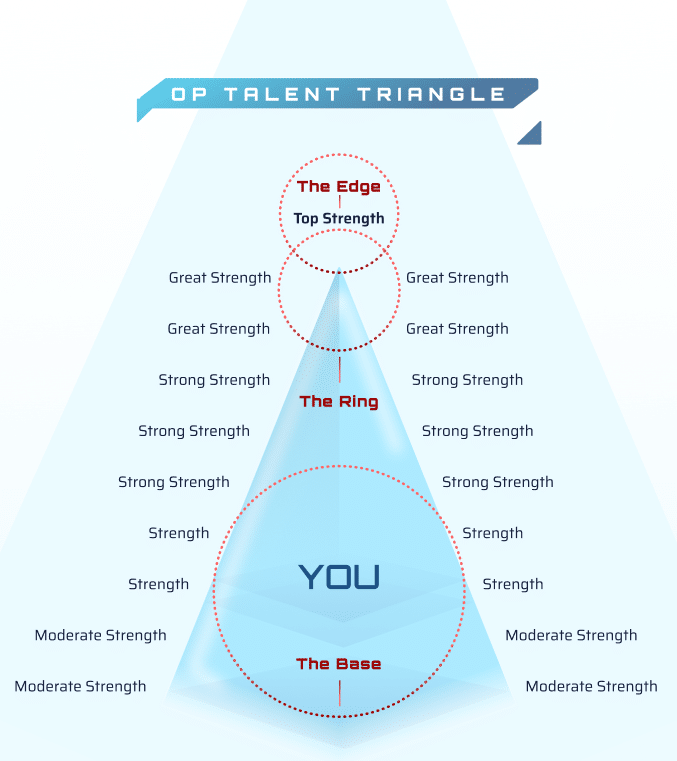
The order matters because the strongest careers are built on the Edge, with the Ring and Base supporting it.
In the book: The Attributes chapter shows the full method for building your Talent Triangle and its opposite, the Weakness Triangle, with my own complete triangles as worked examples. It also covers Chou’s 7 Leadership Personas and how Walt Disney’s Attributes shaped his Role.
Get 10,000 Hours of Play and register your order at 10KHP.com to claim the 10K HP Academy, which comes free with the book.
OP Hero: Temple Grandin and the Attribute everyone called a problem
Temple Grandin is autistic, and for much of her early life the way her mind worked was treated as something to fix.
She describes herself as a visual thinker: she thinks in detailed pictures, the subject of her book Thinking in Pictures.
In the livestock industry, that Attribute turned into an Edge.
When cattle balked in a chute, many handlers pushed harder.
Grandin got down to the animals’ eye level and noticed what they were reacting to: shadows, reflections, a dangling chain, a sudden change in the floor.
She designed curved chutes and handling systems that removed those triggers, and the center track restrainer system she designed is now used to handle close to half of the cattle in North America.

Once she found an industry and a Role that needed her way of thinking, it became one of her greatest assets.
That is the point of Step 2: understand your Attributes so you can stop forcing them into games built for someone else.
Her full six-Step run is in her OP Hero profile.
Starter exercise: the “Everyone Can Do This” audit
This exercise surfaces the Attributes you are blind to because they feel normal.
- Ask five people the same two questions. Pick people who have seen you work or handle pressure. Ask them: “If you ran a company, what would you hire me to do?” and “If I gave a TED talk next month, what would the title be?”
- Write down every answer, even the ones that surprise you. The surprising ones are usually the most useful.
- Circle anything that made you think “but anyone can do that.” That reaction is a strong sign of a hidden Attribute.
- Break each circled item down one level deeper. “Good with people” is too vague, so ask whether it means reading emotions quickly, earning trust fast, or making a room laugh. Each of those leads to different roles.
- Flip one weakness by changing the setting. Write the trait people criticize most, then describe a setting where it would be an advantage. Impatience, for example, is a weakness in long administrative work and an asset when a project needs someone to move fast.
For a quick first read before you ask anyone, take the free Main Stat quiz.
It runs you through 12 quick scenarios, scores you on the seven Momentum Attributes, and shows which stat your build is centered on.
Your Attributes point to your Role
Once you can name your Edge, the next question becomes obvious: which Role in your Game would use it every day?
That is Step 3, and it is where Attributes start paying off in your career.
Common questions about Step 2
What are hidden talents?
Hidden talents are strengths you have had for so long that they feel normal, so you assume anyone could do the same thing.
In 10,000 Hours of Play (10K HP), finding them is part of Step 2, Know Your Attributes, and the most important ones are often the hardest for you to see.
How do I find my hidden talents?
Ask five people who have seen you work what they would hire you to do and what the title of your TED talk would be.
Circle every answer that made you think “but anyone can do that,” because those answers usually point to the talents you have stopped noticing.
The free Main Stat quiz gives you a quick first read, and the book shows the full method for building your Talent Triangle.
What are some examples of hidden talents?
Examples include reading emotions quickly and earning trust fast, which feel too ordinary to list until someone else points them out.
My own is Associative Thinking, which I spent years calling being “creative” before I could name it precisely.
Temple Grandin’s visual thinking is another, and it helped her notice what cattle were reacting to in a chute.
What is the difference between talents and skills?
In 10K HP, talents are Attributes, the built-in traits that develop slowly over years or decades.
Skills are what you learn through practice, usually in months, and Step 4 is about building them on top of the Attributes you name in Step 2.
Take the next step in your 10K HP journey

This post gives you the starting move for Step 2.
The book gives you the full Talent and Weakness Triangle method, the 7 Leadership Personas, and the rest of the six Steps, each with its own OP Hero.
- Get the book. 10,000 Hours of Play is available on Kindle, paperback, hardcover and audiobook.
- Register your order at 10KHP.com to claim the 10K HP Academy: the workbook, the Play Life Like an RPG (role-playing game) video course, two months of live Mastermind calls with my co-author Mark Diaz, the Level Up In Real Life Sheet, and a guide to setting up your own 10K HP AI coach.
The Academy comes free with any format of the book. If you already bought it on Amazon, you can register today with the order number from your receipt.
Sources
The hero facts on this page come from these sources, each checked in October 2026.
- Lemelson-MIT: Temple Grandin, for the center-track restrainer system and the share of North American cattle it handles.
- Texas Trail of Fame: Temple Grandin, for her curved chute designs.
- Temple Grandin: distractions that cause livestock to balk, for shadows, reflections and dangling chains.
- PBS NewsHour: A conversation with Temple Grandin, for her autism diagnosis and early life.
- Wikipedia: Thinking in Pictures, for her book on visual thinking.
Next in the series: Step 3: Select Your Role (Specialty)