
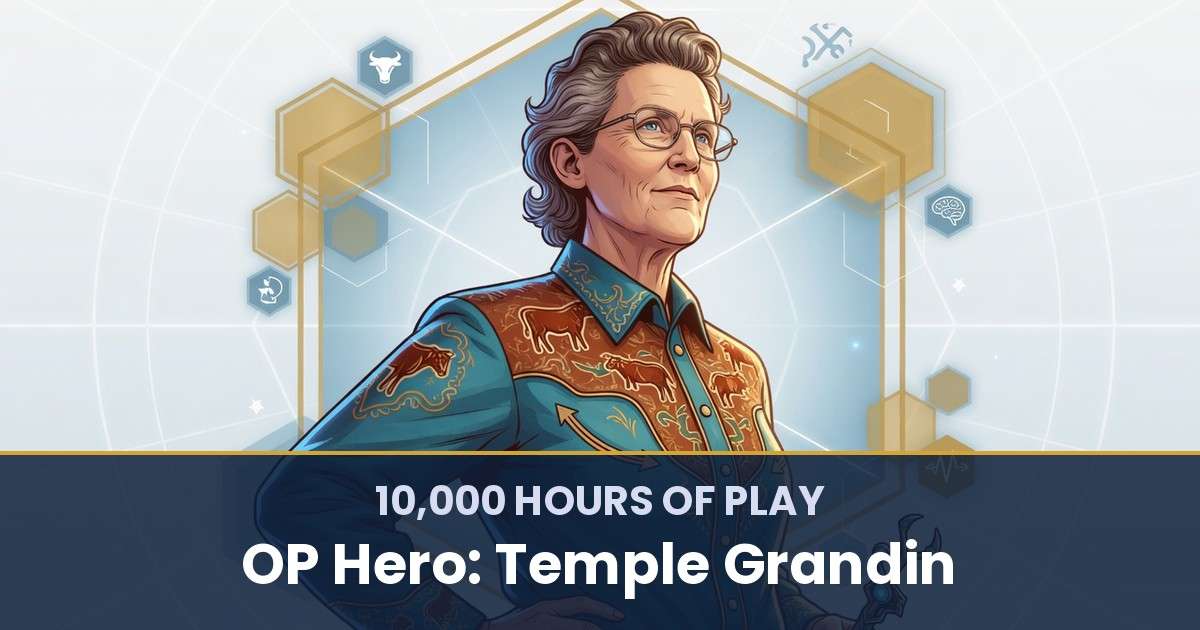


In the early 1970s, a young woman climbed into a cattle squeeze chute at a feedlot and asked it to hold her. The steel walls pressed in on both sides, and for the first time in her life the panic that had followed her since she was a nonverbal toddler went quiet. Ranch hands thought she was strange. She thought she had found data.
That woman was Temple Grandin, and the thing most people missed is that she was never running from her autistic brain. She was reading it like a spec sheet.
Grandin thinks in pictures. Where a typical engineer reasons in words and equations, she runs full-color simulations in her head, rotating a cattle chute she hasn’t built yet and watching where an animal would balk. That single wiring difference, treated by her teachers as a deficit, turned out to be the exact instrument the livestock industry needed. If you want the operating system behind reading a life this way, it lives in the 10,000 Hours of Play framework, and Grandin is one of its cleanest case studies.
⚡ Speed Run Notes
- Grandin’s “disability,” extreme visual thinking, was the precise attribute that let her design cattle-handling systems no word-based engineer could see.
- She played one game for six decades: make the world workable for minds and creatures whose experience is atypical, from livestock in feedlots to autistic kids.
- Her breakthrough move was empathy as measurement: walking the chute as if she were the animal, then turning what she saw into a countable welfare score.
- Setbacks were structural: mockery as a child, and a male-dominated feedlot industry that dismissed her for years before her designs won on results.
- The lesson to steal: your weirdest trait is often your rarest tool. Audit it before you try to sand it off.
Table of Contents
About Yu-kai Chou

Yu-kai Chou is the author of 10,000 Hours of Play — the book that treats your life as the most important game you’ll ever build a character in, and gives you the 6-Step framework (Game · Attributes · Role · Skills · Allies · Quests) to play it on purpose. He has spent two decades developing the system through which this post analyzes its OP Hero, and applies it to his own life and to the lives of the people he advises around the world.
Chou’s other framework, the Octalysis Framework, has been applied by LEGO, Microsoft, Porsche, Coca-Cola, Salesforce, and MrBeast, impacting over 1.5 Billion Users. He has taught the methodology at Harvard, Stanford, Yale, Tesla, Google, BCG, and IDEO, and has advised governments in eight nations including Ukraine, the United Kingdom, the Kingdom of Bahrain, Singapore, Taiwan, the Netherlands, Kazakhstan, and South Korea.
His work has been cited by Harvard, Stanford, MIT, Forbes, Wall Street Journal, Wired, US Department of Energy, NIST, NSF, NCBI, US Department of Education, ClinicalTrials.gov, and Google Scholar — with 3,700+ more academic publications. Explore his books here.
What I keep coming back to with Grandin is that she never tried to become a different kind of thinker. She industrialized the thinker she already was. That is the whole game. Her build proves that an Attribute the world calls a flaw can be the exact stat your Quest requires, if you have the honesty to name it and the discipline to aim it.
Step 1: The Game — What Temple Grandin Was Actually Playing
Every OP Hero is playing one long game underneath all the smaller ones. Grandin’s game was this: make the world safer and more understandable for beings whose inner experience is atypical, and prove that different minds are not defects but instruments.
It started with livestock. Grandin spent her career designing handling systems so that animals moving through feedlots and processing plants experience less fear and less pain. But the same game ran on a second board. In 1986 she published Emergence: Labeled Autistic, widely regarded as the first book-length account of autism written from the inside, recasting the autistic person from silent subject to expert witness.
Both boards are the same move: translate between a sensory world nobody in charge understands and the systems of power that keep ignoring it. That is what makes her a textbook 10K HP hero. She did not chase a job title; she chased a mission and let the roles rearrange themselves around it.
The engine underneath was Spirit of Nature (Druid): the skill of meaning-making under stress, where you take private suffering and convert it into a value-driven purpose. Grandin’s sensory overwhelm could have been a lifelong wound. She turned it into the reason for the work. Like Helen Keller’s refusal to let a silent, dark world define her ceiling, Grandin treated her condition as the starting terrain of the game, not the final score.
Step 2: Attributes — The Innate Stats
Attributes are the stats you are born with, the ones you can aim but cannot install. Grandin’s sheet is unusual, and the unusual part is the point.
Her headline stat is extreme visual thinking. She describes her mind as running in pictures rather than words, closer to full-color movies than to inner narration. Ask her to consider a piece of equipment and she does not reason about it abstractly; she sees it, from every angle, in motion.
Her second stat is high sensory sensitivity. Nonverbal until roughly age four, she experienced sounds and textures at an intensity that overwhelmed her as a child. That same sensitivity later let her feel the fear cues in a herd that seasoned handlers had trained themselves to ignore.
The third is relentless, focused fixation. What her teachers first saw as an obsessive streak became the capacity to spend decades on one narrow domain of cattle behavior and facility design, refining the same blueprints across hundreds of site visits. If you want to map your own raw stats before you spend a career fighting them, the Talent Triangle Method is the fastest audit I know. Grandin’s genius was refusing to trade her rare stats for common ones.
Step 3: Role(s) — The Character Class Across Chapters
Heroes multi-class. The role that wins Chapter One is rarely the role that wins Chapter Four, and Grandin cycled through several distinct classes without ever changing her mission.
She began as the autistic child learning to speak and take turns: an apprentice figuring out the basic controls most people get for free. In college she leveled into a behavior scientist and junior livestock engineer, earning a B.A. in psychology from Franklin Pierce College in 1970 and an M.S. in animal science from Arizona State University in 1975.
Then came the role that defined her: what Oliver Sacks would famously call an “anthropologist” among cattle: a scientist-engineer who studied a species from the outside so carefully she could redesign the world around it. She completed her Ph.D. in animal science at the University of Illinois in 1989 and became a professor at Colorado State University in 1990, a post she still holds.
Her final class is the one most people know: public explainer of minds. This is the same character arc that makes Jane Goodall’s shift from field observer to global advocate so instructive: the deep specialist who earns the right to speak for something that cannot speak for itself.
Step 4: Skills — The Real-Life Game Skills Temple Grandin Mastered
Attributes are potential; Skills are what you drill until they fire on command. Grandin’s breakthroughs each trace to a specific, nameable technique.
The first is Elemental Ensemble (Mage): the skill of mentally visualizing a complex composition and executing it with precision. Grandin designs entire cattle-handling facilities in her head before a single line is drawn, running the animal through the imagined chute and watching where it hesitates. This is the same in-the-head engineering that let Nikola Tesla test his machines mentally before building them, except Grandin’s simulations are of fear and motion, not voltage.
The second is True Sight (Ranger): observing the keen details others miss. Grandin walked the chutes on foot, crouched at the animal’s eye level, and saw what the industry had never registered: cattle balked at shadows, at shiny reflections, at a dangling chain or a puddle. The problem was almost never the animal. It was a detail no human had bothered to see.
The third is Arcane Metrics (Mage): harnessing data to measure progress. Grandin’s most durable contribution was not a single chute but a scoring system: a small, countable set of behavioral outcomes that turned “the animals seem calmer” into an auditable number. Major buyers, including McDonald’s, adopted outcome-based welfare audits built on that logic, and it reshaped how the meat industry measures humane handling. Understanding where a skill like this sits, specialist depth versus generalist breadth, is exactly what the Skills Spectrum is built to help you decide.
Step 5: Allies — The People Who Multiplied Temple Grandin
No hero solos the final boss. Grandin’s build was multiplied by a handful of people who saw the stat before the world did.
Her mother, Eustacia Cutler, refused the era’s standard advice to institutionalize her nonverbal daughter and fought for education and speech therapy instead, the single decision that kept the entire run alive. Her aunt Ann, who ran a cattle ranch in Arizona, gave the teenage Grandin the summer that changed everything, and the squeeze chute that became the seed of her first invention.
Her high-school science teacher, William Carlock, took a mocked, struggling student and pointed her fixations at real scientific problems, giving her intense interests a legitimate channel. Decades later, the neurologist Oliver Sacks profiled her in 1993, lending her experience the weight of mainstream scientific attention and turning a livestock consultant into a public authority on the autistic mind.
The pattern is worth stealing. None of these allies gave Grandin a new personality. Each one handed her a better arena for the person she already was.
Step 6: Quests — The Milestones That Shaped the Saga
Quests are the concrete milestones where the build gets tested. Grandin’s saga has a clear questline, setbacks included.
The first quest was personal: building the squeeze machine as a teenager, a device modeled on the cattle chute that let her regulate her own overwhelming nervous system. It was proof of concept that a machine could be designed around a sensory reality rather than against it.
The second was professional and slow: breaking into a male-dominated feedlot industry in the 1970s that dismissed a woman with an unusual manner telling them their expensive facilities were built wrong. This is the failure most retellings skip. For years she was mocked and shut out, and her designs won not through persuasion but through results: calmer animals, fewer injuries, better throughput.
The third quest was systemic: rewriting the rules themselves through Terraform (Warlock), the skill of influencing rule-makers and regulators to change an entire landscape. By turning her audits into standards that major corporate buyers required, Grandin changed industry practice at a scale no single facility ever could. The fourth ran in parallel: the books, from Thinking in Pictures (1995) to Animals in Translation (2005), and the 2010 film that carried her ideas to millions. You can see how her questline sits among other legendary builds on the OP Hero Profiles hub.
What You Can Steal From Temple Grandin’s Build
The temptation, looking at your own character sheet, is to spend your life sanding down the stat that makes you strange so you can blend into the party. Grandin’s run is the argument against that instinct.
Her rarest Attribute was the one the world labeled a disorder. She did not overcome it; she aimed it. The visual mind that made small talk hard was the exact instrument a blind spot in an entire industry required, and the sensory wiring that made childhood painful was the sensor that let her feel what a frightened animal feels.
So audit the trait you have been apologizing for. Ask what game it would be a superpower in, then go find that game, echoing the same conviction that “the world needs all kinds of minds” runs through builds like Maria Montessori’s insistence that different minds learn in different ways. Grandin’s whole life is one sentence of advice: stop trying to be normal, and start being useful in a way only you can be.
Where this framework comes from

Want the full system this profile is built on?
Every OP Hero piece runs through the same 6-Step framework from 10,000 Hours of Play: Unlock Your Real-Life Legendary Success. The book covers the full system, walks through Yu-kai’s own life run as the first applied case study, and gives you the worksheets to audit your own build.
Related Reading
- OP Hero Profiles: the full roster of legendary real-life builds
- The 10K HP Framework: 6 Steps to Gamify Your Life
- Jane Goodall, OP Hero: the field observer who spoke for the voiceless
- Nikola Tesla, OP Hero: the man who built his machines in his mind
- Helen Keller, OP Hero: turning a silent world into a mission
- Maria Montessori, OP Hero: designing a world for different minds