
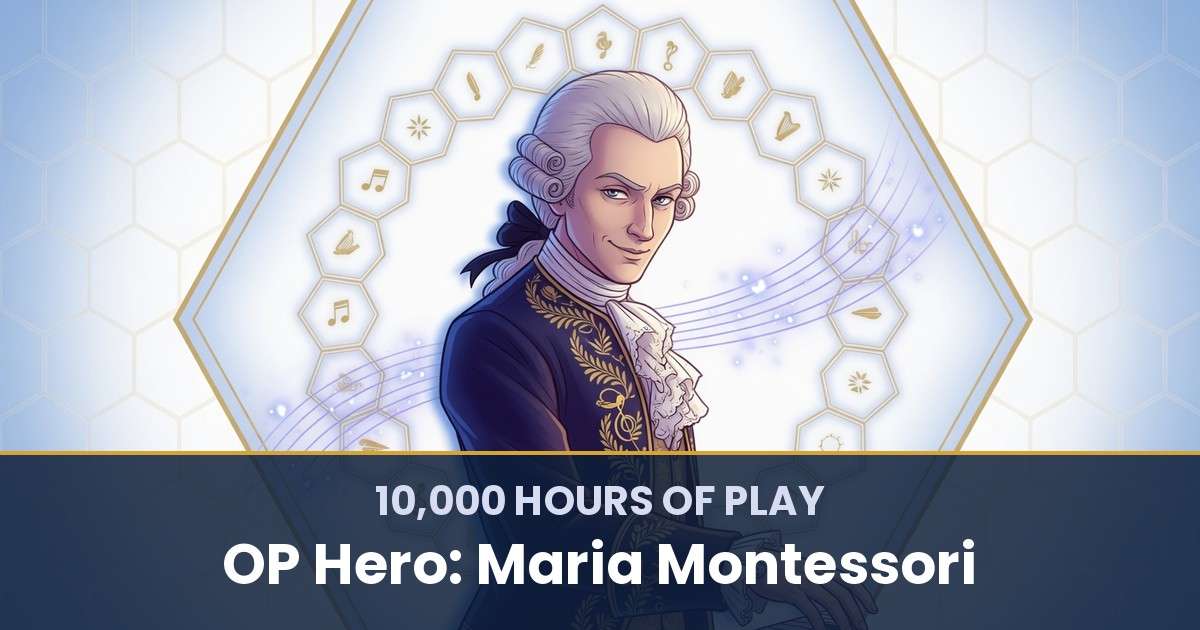


In January 1907, a 36-year-old Italian physician opened a daycare for the children of San Lorenzo, one of Rome’s roughest tenement districts. She had no teaching credential, no textbooks, and a budget so small the furniture had to be improvised. The Casa dei Bambini opened on 6 January 1907 at Via dei Marsi 58, and inside it Maria Montessori began running an experiment most adults of her era thought absurd. She would give three- and four-year-olds freedom inside a carefully prepared room, then watch what they did with it.
What she watched was something nobody had described in print. The children chose their own work and stayed with it for hours. They cleaned. They taught each other. They corrected their own mistakes because she had built the materials to let them. By 1909 she had published the method as a book. By 1911 the first Montessori school in the United States opened in Tarrytown, New York. By 1929 she had founded the Association Montessori Internationale. By her death in 1952, the system she designed had outrun her, and it has been spreading ever since.
The pop framing of Maria Montessori is “a famous educator who designed cute toddler classrooms.” That framing makes her smaller than she was. The interesting question is what build she was actually running across the 50 years on either side of the Casa, and what the rest of us can lift from it. Read through the 6-Step 10K HP framework and her life starts to look less like a curriculum chapter and more like the cleanest case study we have of a builder-class career that survived two world wars, two dictatorships, and three exiles, and still finished with the system intact.
⚡ Speed Run Notes
- Montessori’s “game” was never running a school. It was proving children would self-educate inside a carefully prepared environment, given long enough. She ran that game for 54 years.
- Casa dei Bambini opened 6 January 1907 in San Lorenzo, Rome. She had been a physician for 11 years before she opened a single classroom. The medicine came first, the method second.
- Mussolini endorsed her work and founded the Opera Nazionale Montessori in 1924. He closed every Montessori school in Italy in 1934 after she refused to make children swear allegiance to the Fascist state.
- She lost Spain to the Civil War in 1936 and Italy to the Fascists in 1934. She still trained teachers and wrote books across both losses, and in India from 1939 to 1946 ran the longest single chapter of her career.
- Three consecutive Nobel Peace Prize nominations followed in 1949, 1950, and 1951. She did not win. Most of her actual legacy was not the prize anyway.
- She published The Absorbent Mind at 78 and died at 81 in Noordwijk, the Netherlands. More than 3,000 Montessori schools in the United States alone now run on her system.
Table of Contents
- Step 1: The Game (What Montessori Was Actually Playing)
- Step 2: Attributes (The Innate Stats)
- Step 3: Role(s) (The Character Class Across Chapters)
- Step 4: Skills (The Real-Life Game Skills Montessori Mastered)
- Step 5: Allies (The People Who Multiplied Montessori)
- Step 6: Quests (The Milestones That Shaped the Saga)
- What You Can Steal From Montessori’s Build
- Where this framework comes from
- Related Reading
About Yu-kai Chou

Yu-kai Chou is the author of 10,000 Hours of Play — the book that treats your life as the most important game you’ll ever build a character in, and gives you the 6-Step framework (Game · Attributes · Role · Skills · Allies · Quests) to play it on purpose. He has spent two decades developing the system through which this post analyzes its OP Hero, and applies it to his own life and to the lives of the people he advises around the world.
Chou’s other framework, the Octalysis Framework, has been applied by LEGO, Microsoft, Porsche, Coca-Cola, Salesforce, and MrBeast, impacting over 1.5 Billion Users. He has taught the methodology at Harvard, Stanford, Yale, Tesla, Google, BCG, and IDEO, and has advised governments in eight nations including Ukraine, the United Kingdom, the Kingdom of Bahrain, Singapore, Taiwan, the Netherlands, Kazakhstan, and South Korea.
His work has been cited by Harvard, Stanford, MIT, Forbes, Wall Street Journal, Wired, US Department of Energy, NIST, NSF, NCBI, US Department of Education, ClinicalTrials.gov, and Google Scholar — with 3,700+ more academic publications. Explore his books here.
Maria Montessori is the OP Hero I find most instructive on the question of how to keep a system intact when the politics around it keeps trying to kill it. She lost her schools in Italy in 1934, her base in Spain in 1936, and was effectively confined in India from 1940 onward, and across all of it she kept training teachers, writing the books, and refining the materials. If you want the one lesson to lift, it is this: when the world burns down a chapter of your build, the move is not to grieve the chapter, it is to take the framework with you into the next room and keep teaching.
Step 1: The Game — What Montessori Was Actually Playing
The pop framing of Montessori is “she invented preschool with the wooden trays and the pink tower.” That is true and unhelpful. The actual game she was playing across half a century was much sharper, and she stated it openly long before the schools started spreading.
Montessori believed children would educate themselves if you stopped getting in the way and built the right environment around them. The Association Montessori Internationale, which she founded in 1929, summarizes her view as “the child is the constructor of the adult” and frames her vision of education as a “help to life.” Not “instruction.” Not “discipline.” Help to life, where the child does the actual work of becoming a person, and the adult is the gardener of the conditions.
You can read that mission line in the moves. She trained as a physician at the University of Rome and graduated in 1896, then went straight into clinical work at a psychiatric clinic, where she encountered children with intellectual disabilities and started asking what the schools were doing wrong. From 1898 to 1900 she ran the Orthophrenic School in Rome, redesigning materials from the ground up. By 1907, when she opened the Casa dei Bambini in San Lorenzo, the question had already shifted from “how do we treat these specific children” to “what does any child do when you remove the obstacles.” Across every chapter that followed, the work was prove-the-child-can-build-itself first and run-a-school second. The order never flipped.
That ordering is why she could survive the political wreckage of the 1930s. After Mussolini closed every Montessori school in Italy in 1934 and the Spanish Civil War shut down her Barcelona center in 1936, a younger builder without her framing would have read those losses as the end of the project. Montessori did not. The schools were never the project. The schools were a proof. The proof had already arrived in 1907. Everything after was about teaching enough adults to run the prepared environment so the proof could keep reaching new children.
Step 2: Attributes — The Innate Stats
Attributes are the unfair gifts you walk in with. You did not earn them and you cannot fake them. In 10K HP, Attributes are the raw stats your character class build is allowed to lean on, and they show up early enough that biographers usually find them in childhood anecdotes.
Montessori’s most visible Attribute was observation acuity. From the Orthophrenic School in 1898 forward, her breakthroughs were never theoretical. They came from sustained attention to what specific children actually did in a real room, then re-engineering the room until they could do more of it. She used the same eye she had trained in medicine. Most pedagogues of her era reasoned from philosophy down. She reasoned from the child up. If you want a deep dive on the trait, Jane Goodall’s observation-first build at Gombe is the closest direct analog — same Attribute, different species under the lens.
Her second Attribute was risk tolerance. To enter the University of Rome medical faculty in the early 1890s as a woman in Catholic Italy required ignoring a wall of professional and social pressure that had stopped almost everyone else. She did it anyway, graduated in 1896, and then doubled the bet by treating disability and intellectual development as a respectable medical specialty when both were considered unserious. The independence shows up everywhere in her timeline. She named her son Mario in 1898 outside of marriage and kept her career. She broke with Mussolini in 1934 and lost her country rather than compromise the method. The same Attribute, used at every decision point.
The third Attribute is pattern recognition. “Sensitive periods,” “planes of development,” “the absorbent mind” are not slogans. They are pattern claims about how children change in describable stages, and they came from watching enough children long enough to see the recurrence. Yu-kai’s writeup on the Talent Triangle Method walks through how to triangulate your own stat ceiling against passion and market need; Montessori is a textbook case of all three corners locking into place once she found the children.
Step 3: Role(s) — The Character Class Across Chapters
OP Heroes almost always change character class as the saga moves. Reading Montessori as one fixed role flattens her. Watch how the class shifts.
From roughly 1890 to 1896 she was a Medical Student, the rare woman in the University of Rome’s medical faculty. From 1896 to 1900 she became a Clinician, working with developmentally disabled children at the psychiatric clinic and then directing the Orthophrenic School from 1898 to 1900. That class transition is where she stopped trying to cure the children and started suspecting the problem lived in the teaching method.
From 1900 to 1907 she ran as a Researcher-Lecturer, teaching pedagogical anthropology at the University of Rome and visibly reading her way into the educational tradition before she dared to ship a method of her own. From 1907 forward she was an Educator-Designer, building the Casa dei Bambini, then writing Il metodo della pedagogia scientifica in 1909 and its English version The Montessori Method in 1912. The first American Montessori school opened in 1911 in Tarrytown, New York. By 1916 she had relocated her base to Barcelona at the city council’s invitation and added a Teacher-Trainer layer to the class.
From 1929 forward she was a Movement Founder, having stood up the Association Montessori Internationale that year to hold the method together across borders. From 1939 to 1946 she was an Exile-Builder. The Theosophical Society’s George Arundale had invited her to India to lecture, she arrived in October 1939 with her son Mario, and when Italy entered the war in June 1940 the British colonial government classified her family as enemy aliens and effectively grounded them. She kept training Indian teachers until she could leave in 1946. Florence Nightingale’s medical-pioneering build shows the same class progression from physician to system-designer to author-trainer, almost beat for beat, fifty years earlier.
Step 4: Skills — The Real-Life Game Skills Montessori Mastered
Attributes are the raw stats, but Skills are the moves you actually run inside a fight. Yu-kai’s canon Real-Life Game Skills sit inside seven Classes, and the discipline is to name the Skill, name the Class, and cite the exact moment the Skill cracked a result. The Skills Spectrum is the companion read for how deep to go on any one Skill; Montessori is a Specialist on a handful of moves, not a dabbler across many, and that’s a feature.
Cognitive Lens (Mage) is the skill of zooming in on micro detail and back out to the macro pattern. Her clinical training gave her the zoom-in. The Casa dei Bambini gave her the zoom-out. She would watch a single child fail to button a sleeve, redesign a fabric frame to let the child practice it independently, and then ask what the success of that one frame implied about the next ten years of the child’s life. That round-trip from particle to population is the move, and she ran it for fifty years.
Floral Blossom (Druid) is the skill of educating and mentoring others so they go on to do the same. This is her core craft. The Casa dei Bambini wasn’t the legacy. The teacher-training pipelines were. From 1916 in Barcelona, then through AMI from 1929, then across India from 1939 to 1946, the unit she actually produced was certified adults who could run a prepared environment without her supervision. The 3,000-plus Montessori schools currently operating in the United States alone exist because the Skill compounded across multiple human generations.
Loremaster (Druid) is the skill of weaving compelling, inspiring stories that survive the storyteller. Her writing did this. Il metodo (1909, in Italian), The Montessori Method (1912, in English), Pedagogical Anthropology (1913), L’autoeducazione nelle scuole elementari (1916), The Secret of Childhood (1936), Education for a New World (1946), and The Absorbent Mind (1949) form a 40-year publishing arc. When the schools were closed and the borders shut, the books kept the method portable. Lose the buildings, keep the books, rebuild the buildings later.
Vision Manifestation (Warlock) is the skill of seeing a future so vividly the present rearranges around it. She insisted, in 1898, that children labelled “deficient” could learn to read and write at standard age levels with the right materials. That was a vivid claim, contradicted by every contemporary authority. She proved it. By 1907 she was claiming healthy three-year-olds could choose their own work, run multi-hour concentration cycles, and teach each other. Also contradicted, also proved. The Skill is not optimism. It is treating the unbuilt result as an existing object and then doing the boring work of carving away the rest of reality until the object can be seen.
Courageous Heart (Paladin) is the skill of charging into uncomfortable zones, uncharted territory, and hostile environments. The University of Rome’s medical faculty in the early 1890s was a hostile environment. So was the San Lorenzo tenement in 1907, which the Roman bourgeoisie considered unsafe. So was the meeting room in 1934 where she told the Italian Ministry of Education she would not put her children in Fascist uniforms. So was the Theosophical Society compound in Adyar in 1940 when she became a watched enemy alien. She walked into every one of those rooms anyway. The Skill is not the absence of fear, it is the move that runs while the fear is in the body.
Phoenix Rebirth (Paladin) is the skill of recovering from devastating failure and coming back stronger. In 1934 Mussolini closed every Montessori school in Italy, ending the official Italian chapter of her career. In 1936 the Spanish Civil War shut down her Barcelona center after twenty years of work there. By any normal metric, two consecutive ground-zero losses inside three years should have ended the project. Instead, she rebuilt the operation from the Netherlands and then from India, where she ran the 1939 to 1946 chapter that produced both the elementary “Cosmic Education” curriculum and the AMI India lineage that still operates today. Viktor Frankl’s Phoenix Rebirth out of the concentration camps ran on the same Class. Different fire, same move.
Step 5: Allies — The People Who Multiplied Montessori
The OP Hero rule is that the build never works alone. Allies multiply the hero, and if you ignore them you misread the saga.
Her mother, Renilde Montessori, is the first ally. Family biographers consistently credit her with backing Maria’s medical ambition when the social cost of doing so was high. That backing showed up as practical, daily support during the medical school years in the early 1890s, when there was no peer group of female physicians to pull her forward. Without Renilde, the Medical Student class never gets unlocked, and the rest of the saga does not happen.
Giuseppe Montesano, her clinical collaborator at the Orthophrenic School in 1898, is the second. He was the co-director and the father of her son Mario, born 31 March 1898. The relationship dissolved shortly after, and Mario was placed with a wet-nurse’s family in the Roman countryside to protect Maria’s career. Montesano is the most painful ally entry on her sheet. Without him, she does not see disability work clinically. With him, she also pays the cost of a son she could not publicly claim for most of his childhood. Both halves are true.
The children of San Lorenzo are the third ally, and they are the strangest entry. They were not her colleagues, they were her dataset and her teachers. The Casa dei Bambini in 1907 worked because they did things she had not predicted. They cleaned, they chose, they concentrated, and the method bent to what they revealed instead of what she had assumed. The Skill of Cognitive Lens needs targets to read; San Lorenzo gave her three years of high-resolution targets that no theoretical seminar could have produced.
George Arundale, president of the Theosophical Society in Adyar, Madras, is the fourth. His 1939 invitation to lecture in India brought her and Mario to the subcontinent right before Europe burned, and his organization sheltered them for the seven years that followed. Without that invitation, the war catches her in Europe and the elementary chapter of the method probably never gets written.
Mario Montessori, her son, is the final and decisive ally. Once they were openly reunited in adulthood, he became her closest collaborator, her chief lieutenant inside AMI, and after 1952 her successor running the international organization. Most of what is now considered “Montessori” beyond ages 0–6 was developed jointly with Mario, especially the 6–12 elementary curriculum in India. The mother-son arc is also a Phoenix Rebirth in its own right. The relationship that started as the most expensive secret of her career ended as her most important professional partnership.
Step 6: Quests — The Milestones That Shaped the Saga
Five Quests carry the saga; the sixth is the failure quest, and it matters as much as the others.
Quest 1 is the 1896 medical degree at the University of Rome. The credentialing fight is what gave her standing for everything after. Without “Doctor” in front of the name, the 1907 claims about three-year-olds get dismissed as governess opinions. With it, they get printed.
Quest 2 is the 1907 opening of the Casa dei Bambini at Via dei Marsi 58 in San Lorenzo. This is the proof. From this single classroom, in three years, she had enough data to write Il metodo della pedagogia scientifica, which appeared in Italian in 1909 and in English as The Montessori Method in 1912. The book turned a single tenement experiment into a portable system.
Quest 3 is the international spread between 1911 and 1916. The first American Casa dei Bambini opened in Tarrytown, New York in 1911. By 1916 she had moved her main base to Barcelona at the city council’s invitation, where she would stay for 20 years. The method left her hands and entered other people’s classrooms, in other languages, on other continents. That is the moment Floral Blossom and Loremaster locked in as a compound system.
Quest 4 is the failure quest. In 1924 Mussolini publicly endorsed her method and founded the Opera Nazionale Montessori. She accepted the partnership in good faith for ten years, and in 1934 he closed every Montessori school in Italy after she refused to make children swear allegiance to the Fascist state and wear youth uniforms in the classroom. The lesson is not “do not work with regimes,” it is more specific. When the regime’s demands cross the design line of the method, the right move is to lose the country and keep the method. She did. Two years later the Spanish Civil War ran the same trade against her Barcelona base, and she made the same call.
Quest 5 is the India chapter from 1939 to 1946. The Theosophical Society’s invitation brought her in October 1939. Italy entered the war against Britain in June 1940 and the colonial government classified her family as enemy aliens. Mario was interned more strictly at first and later released to her work. They used the seven years to develop the 6–12 elementary curriculum, train Indian teachers, and seed what is now AMI India. It is the longest single-chapter run of her career, and it happened under house-arrest conditions on a continent she had never lived on before.
Quest 6 is the legacy crystallization. She returned to Europe in 1946 and settled in the Netherlands. Education for a New World came out in 1946. The Absorbent Mind, published in 1949 when she was 78, is the late-career restatement of the system. She was nominated for the Nobel Peace Prize in 1949, 1950, and 1951. She died at 81, on 6 May 1952, in Noordwijk aan Zee. The Association Montessori Internationale she had founded in 1929 ran on without her. The method is now on every continent. The OP Hero hub has fewer builders who finished cleaner.
What You Can Steal From Montessori’s Build
Three lifts to take out of this profile.
First, the Skill of separating the proof from the schools. Most builders die emotionally attached to the specific instance of their work. Montessori let the Italian schools die, then let the Spanish center die, and kept the method. If your current company, course, channel, or chapter were taken from you tomorrow, what would survive in transferable form? Build that thing on purpose.
Second, the Class of Educator-Designer is a real and underrated character class. The world has lots of teachers and lots of designers; the multipliers are the few people who design the environment so the teaching becomes self-sustaining without them in the room. The 3,000-plus US Montessori schools running today do not need her to function. That is the actual win condition.
Third, the meta-move is observation. She did not theorize her way into the method. She watched specific children long enough to see the patterns, then engineered the room until the patterns could scale. If you are stuck on a hard build problem, the most under-applied move is more careful attention to what your actual users, students, or readers are doing on the surface, before you reach for the next framework.
Where this framework comes from

Want the full system this profile is built on?
Every OP Hero piece runs through the same 6-Step framework from 10,000 Hours of Play: Unlock Your Real-Life Legendary Success. The book covers the full system, walks through Yu-kai’s own life run as the first applied case study, and gives you the worksheets to audit your own build.
Related Reading
- All OP Hero Profiles — the 10K HP roster
- The 10K HP Framework: 6 Steps to Gamify Your Life
- What’s Your Edge Strength? The Talent Triangle Method
- The Skills Spectrum: Specialist, Dabbler, or Master?
- 10,000 Hours of Play by OP Hero: Jane Goodall
- 10,000 Hours of Play by OP Hero: Florence Nightingale
- 10,000 Hours of Play by OP Hero: Viktor Frankl