
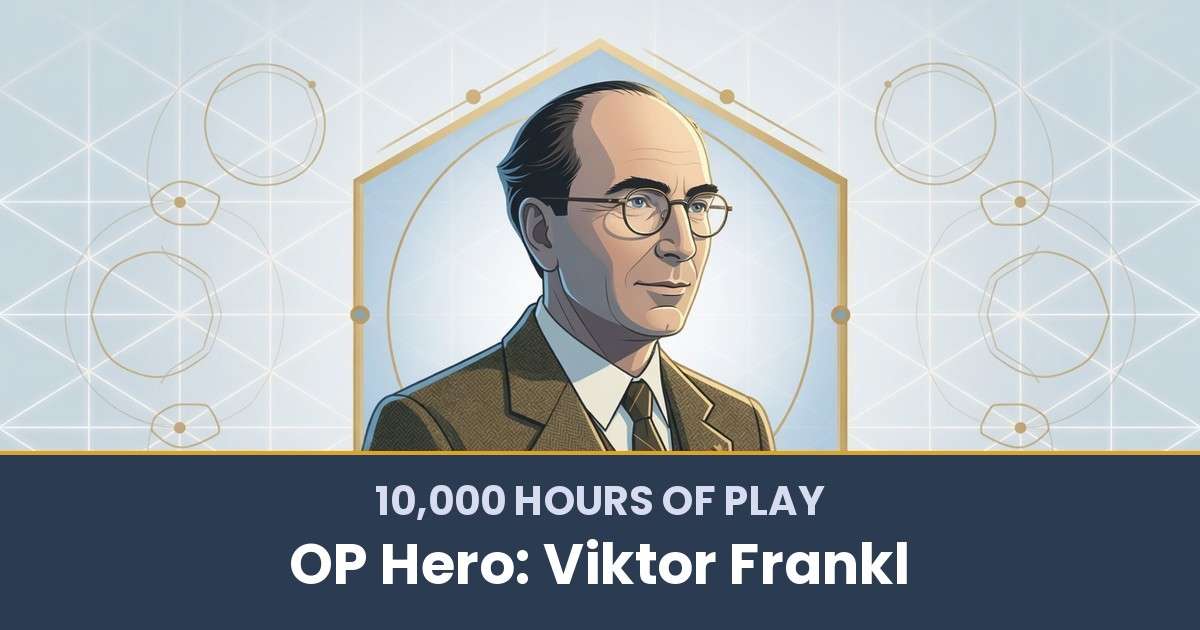


Most people, handed Viktor Frankl’s life, would have stopped playing.
By 1945 he had been stripped of his profession, his country, his manuscript, his parents, his brother, and the wife he had married a year before deportation. He survived four camps. He weighed 81 pounds at liberation. Whatever “build” he had spent twenty years constructing as a young Viennese psychiatrist — published, mentored by Freud and Adler, founder of suicide-prevention programs that reportedly hit zero student suicides in 1931 — had been disassembled by Nazi Germany piece by piece.
Nine months later, he dictated Man’s Search for Meaning in nine days. That book has now sold more than sixteen million copies in fifty-plus languages, and the therapy it carried — logotherapy, the Third Viennese School — is taught in clinics, hospices, and graduate programs on every continent. Frankl did not return to his old game. He returned to a deeper version of it.
That is the move I want to examine here, run through the 10,000 Hours of Play framework. Not the suffering part. Anyone can read that in his own words. The build part — the six layers that let one specific human being keep playing on hard mode after his entire character sheet had been burned.
⚡ Speed Run Notes
- Frankl’s “game” was meaning under suffering. He picked it as a gymnasium student around 1923 and never switched, even when the board was Auschwitz.
- His innate attributes show up at sixteen: existential curiosity, didactic clarity, contrarian independence, observer’s detachment, and a moral seriousness that refused to optimize for self.
- His class changed four times: apprentice psychoanalyst, clinical psychiatrist, theorist of logotherapy, and prisoner-observer in the camps. The same mission carried across all four.
- He cracked extreme situations with named real-life game Skills: Spirit of Nature, Locked Heart, Astral Projection, Vision Manifestation, Phoenix Rebirth, Loremaster.
- His pivotal quest is not a project. It is a decision: in 1942 he tore up an American visa to stay with his elderly parents in Vienna. Every subsequent quest sits downstream of that single choice.
Table of Contents
- Step 1: The Game — What Viktor Frankl Was Actually Playing
- Step 2: Attributes — The Innate Stats
- Step 3: Role(s) — The Character Class Across Chapters
- Step 4: Skills — The Real-Life Game Skills Viktor Frankl Mastered
- Step 5: Allies — The People Who Multiplied Viktor Frankl
- Step 6: Quests — The Milestones That Shaped the Saga
- What You Can Steal From Viktor Frankl’s Build
- Where this framework comes from
- Related Reading
About Yu-kai Chou

Yu-kai Chou is the author of 10,000 Hours of Play — the book that treats your life as the most important game you’ll ever build a character in, and gives you the 6-Step framework (Game · Attributes · Role · Skills · Allies · Quests) to play it on purpose. He has spent two decades developing the system through which this post analyzes its OP Hero, and applies it to his own life and to the lives of the people he advises around the world.
Chou’s other framework, the Octalysis Framework, has been applied by LEGO, Microsoft, Porsche, Coca-Cola, Salesforce, and MrBeast, impacting over 1.5 Billion Users. He has taught the methodology at Harvard, Stanford, Yale, Tesla, Google, BCG, and IDEO, and has advised governments in eight nations including Ukraine, the United Kingdom, the Kingdom of Bahrain, Singapore, Taiwan, the Netherlands, Kazakhstan, and South Korea.
His work has been cited by Harvard, Stanford, MIT, Forbes, Wall Street Journal, Wired, US Department of Energy, NIST, NSF, NCBI, US Department of Education, ClinicalTrials.gov, and Google Scholar — with 3,700+ more academic publications. Explore his books here.
What I find instructive about Frankl’s build is the inversion he runs on Step 1. Most of us choose a game by what we want to win. He chose a game by what he refused to let suffering invalidate. The Skill I’d lift from him is the one that has nothing to do with the camps: a teenager giving public lectures on the meaning of life because, at sixteen, he had already noticed that nobody else was going to ask the question for him.
Step 1: The Game — What Viktor Frankl Was Actually Playing
Most people pick a game from the menu the world hands them. Frankl picked his off-menu and never traded it in.
The game he played for seven decades has one sentence: understand how human beings find meaning under suffering, and turn that understanding into a teachable therapy. He named the discipline logotherapy — the Third Viennese School of Psychotherapy, after Freud’s psychoanalysis and Adler’s individual psychology. The mission was visible by age sixteen, when he gave his first public lecture on “the meaning of life” to a Vienna youth group around 1921. The 1924 paper Freud forwarded to the Internationale Zeitschrift für Psychoanalyse without Frankl’s prior knowledge, the 1928 youth suicide-prevention program, the manuscript of Ärztliche Seelsorge (later The Doctor and the Soul, in progress through the late 1930s and reconstructed in 1945) — every milestone is the same thesis, refined.
What makes the Game choice unusual is its direction. Most great builds chase a positive: more reach, more capability, more impact. Frankl’s chases an absence: what survives when the world removes everything you would normally optimize for? That framing made his game uniquely portable. He could keep playing it in a private practice in Vienna, in a hospital ward at the Steinhof, in a barracks at Theresienstadt, and in a quarry at Kaufering III. The board changed. The objective did not.
The lesson here is not “find your passion.” It is sharper than that. Frankl’s Game was chosen so that no external collapse could destroy it. If your current Game depends on a particular industry, employer, country, or set of conditions, it’s worth asking whether you’re playing the game or the conditions are playing you.
Step 2: Attributes — The Innate Stats
Attributes are the parts of your character sheet that show up early and don’t change much. They are the raw stats your Skills are built on top of. Yu-kai writes about this on the Talent Triangle Method — Attributes sit at one corner because most people misread their own.
Frankl’s Attributes are unusually legible because he was visible in print by his late teens. Four show up consistently, traceable to specific moments before logotherapy existed as a word.
Existential seriousness. At sixteen he was lecturing on the meaning of life. At eighteen he was corresponding with Sigmund Freud, who published one of his early manuscripts in 1924 in the Internationale Zeitschrift für Psychoanalyse. Most teenagers don’t write Freud letters. The trait isn’t “smart” — it’s that the questions other people treat as adolescent affectations, Frankl treated as the actual job.
Didactic clarity. He could explain things in a way that didn’t lose anything in translation. The proof is Man’s Search for Meaning itself: dictated in nine days, written for a general reader, and still pinned to the curriculum of psychology, philosophy, and theology departments seventy years later.
Contrarian independence. He apprenticed under Freud, then Adler, then broke with both — Adler’s circle expelled him for “heresy” because he insisted meaning, not inferiority, was the primary human drive. He kept saying the unfashionable thing in the room. The 1930s Viennese psychoanalytic world is hard to be a heretic inside if your stats don’t include real independence.
Observer’s detachment under pressure. Even as a young suicide-ward physician in his twenties, he could maintain clinical distance from extreme distress. In Man’s Search for Meaning he describes watching his own psychological reactions in the camps with a “curious detachment” — the same Attribute, scaled up to the worst circumstances a human being can be placed in.
The Attribute that did the most load-bearing work, though, is the fifth: a moral seriousness that overrode self-interest reflexively. It’s the one that decides Step 6.
Step 3: Role(s) — The Character Class Across Chapters
Most people stay in one Role. Frankl rotated four, and the rotation is the story.
Apprentice psychoanalyst (1920–1927). Vienna medical student in correspondence with Freud and Adler. Publishing in their journals before he was a doctor. Already differentiating his position from theirs.
Clinical psychiatrist and suicide-prevention specialist (1928–1938). Built a counseling network for Vienna’s high schools and reportedly drove student suicides in his catchment to zero in 1931. Headed the female suicide pavilion at Am Steinhof from 1933. This is the chapter where the theoretical interest in meaning meets the operational realities of preventing despair-driven deaths.
Logotherapy theorist (1933–1942). Drafted Ärztliche Seelsorge, gave lectures, named the school. The intellectual architecture of his life’s work was substantially complete before he was deported.
Prisoner-observer (1942–1945). Theresienstadt, Auschwitz, Kaufering III, Türkheim. He worked as a camp doctor where he could, and he kept observing — sometimes scratching notes on stolen scraps. The Role isn’t “victim.” Frankl insists on the distinction. In his telling he was, even there, a researcher in an unwanted field.
What’s striking is that the Mission did not flex with the Role. Every Role is the same job written in a different dialect: understand and teach how meaning survives suffering. That’s a different pattern than, say, Martin Luther King Jr., whose Role widened in steps from preacher to organizer to global moral figure but stayed within the civil-rights game. Frankl’s Roles ranged farther because his Game was more abstract. The cost of an abstract Game is it can feel disconnected; the benefit is the conditions can’t take it from you.
Step 4: Skills — The Real-Life Game Skills Viktor Frankl Mastered
The 10,000 Hours of Play canon names specific Skills the way an RPG names spells. They’re trained capacities, not personality traits. Frankl’s library leans heavy on Druid and Warlock — the Classes that handle meaning and power — and pulls in Mage and Paladin at the points where his arc bends. Yu-kai writes about how a single named Skill can decide an entire life chapter in the Lich Pact piece; Frankl’s Skill stack has six of those decisive moments.
Spirit of Nature (Druid). Meaning-making under stress — the Skill of turning brute hardship into a value-driven mission. This is Frankl’s signature. The “yes to life in spite of everything” he later titled an essay collection around is the exact mechanic. In Auschwitz, watching prisoners die at the rate one would later be ashamed to describe, he made a decision: he would treat the camp itself as a research site. The stress did not disappear. The Skill metabolized it into something teachable. Logotherapy is the residue.
Locked Heart (Warlock). Pain contrasting — comparing the current pain to a worse hardship to transform suffering into gratitude. Frankl uses this constantly in his memoir. A barracks with a roof becomes a luxury when the alternative is no roof. A piece of bread becomes a feast when the alternative is no bread. The Skill isn’t denial; it’s calibration. He used it on himself in the camps and later taught it as a therapeutic tool for patients whose suffering felt total.
Astral Projection (Mage). Seeing all possible outcomes — the analytical Skill of running futures in your head until you find the one worth aiming for. In the camps Frankl repeatedly described mentally rehearsing himself, post-liberation, lecturing on the psychology of the camps to a warm hall in Vienna. He pictured the lectern, the audience, the slides he didn’t yet have. The visualization wasn’t escapism; it was a Mage’s projection — using a future state as the gravitational anchor for present behavior.
Vision Manifestation (Warlock). Visualize success so vividly it shapes reality. Same mental act as Astral Projection, different posture. Where the Mage maps the future, the Warlock insists on it. Frankl’s post-war life was, in a real sense, the vision rendered: he founded the Vienna Polyclinic of Neurology, ran it from 1946 to 1970, accepted invitations from universities he had never visited, and gave 209 invited lectures around the world by his own count. The world he projected from the barracks became the world he lived in. Vision Manifestation is rarely cheap to deploy; in Frankl’s case the cost was paid before he even cast it.
Phoenix Rebirth (Paladin). Recover from devastating failure and come back stronger. The post-1945 chapter is the canonical case. His pre-war manuscript was confiscated and destroyed at Auschwitz. His wife Tilly died at Bergen-Belsen. His parents perished in Theresienstadt and Auschwitz; his brother in Auschwitz. He was thirty-nine years old and starting again with a body weighing 81 pounds. The output of the rebirth, in nine months, was the book that has carried more grieving people through the next twenty years of their lives than most institutions ever will.
Loremaster (Druid). Weaving compelling, inspiring stories. The decisive demonstration is Man’s Search for Meaning. It is, mechanically, a memoir and a treatise duct-taped together. It should not work as a single book. It works because Frankl is a Loremaster — he tells the stories he saw, in the voice of the man who saw them, and then he turns to the reader and quietly explains the principle. The Skill is what made the therapy travel.
Step 5: Allies — The People Who Multiplied Viktor Frankl
Solo builds romanticize themselves. Frankl had Allies, and naming them changes the story.
Sigmund Freud and Alfred Adler. Mentors he eventually broke from. The break is the proof of the relationship — neither would have invested attention in him if his early thinking weren’t worth pushing back on. Without Freud’s invitation to publish in 1924 there is no canon-grade-young-Frankl. Without Adler’s circle there is no test bed where Frankl learned that he wasn’t going to accept anyone’s primary-drive theory but his own.
Otto Pötzl. Head of the Vienna University psychiatric clinic — and, formally, a Nazi party member after the Anschluss, which meant any working relationship with a Jewish colleague had to be covert. Anschluss pushed Frankl out of the University clinic and over to the Jewish Rothschild Hospital, but Pötzl coordinated with him in private: the two of them sabotaged the Nazi euthanasia program by falsifying diagnoses that would otherwise have sent Jewish mental patients to die. The Ally that risks personal cover to keep your work alive during a regime is worth more than the one that buys you praise during peacetime.
Tilly Grosser. His first wife. They married in 1941 — one of the last Jewish weddings permitted in Vienna — and were separated at Auschwitz the following year. She died at Bergen-Belsen at twenty-four. She is the Ally whose absence shaped the rebirth. Frankl described her image as one of the mental anchors that pulled him through the worst nights in the camps — not the memory of her, the active sense of her presence. Allies don’t have to be alive to multiply you.
Eleonore “Elly” Schwindt. His second wife, married in 1947. She partnered him through the long second half of the build — the lectures, the institute, the 39 honorary doctorates, the late-life mountaineering — and ran the Viktor Frankl Institute with him from its 1992 founding. The post-war life was a duet, not a solo.
The students. Edith Joelson, Joseph Fabry, and the generation who carried logotherapy into the United States and beyond — without their translations and clinics the school stays Viennese. Frankl’s Loremaster Skill traveled because his Allies built the boats. Albert Einstein had Marcel Grossmann and Max Planck doing similar work in physics. The pattern of mid-career allies translating your work into the next generation’s vernacular is one of the most under-appreciated lines on a great character sheet.
Step 6: Quests — The Milestones That Shaped the Saga
A Quest is a specific, dated thing that bent the saga. Frankl has more than six, but six is the right number to study.
Quest 1: The teenage lecture on meaning (~1921). Sixteen years old, in front of a Vienna youth group, on the question that would define seventy more years of work. The Game was chosen here, before he knew it was being chosen.
Quest 2: The youth suicide-prevention program (1928–1931). A counseling network embedded in Vienna’s high schools. In 1931, he reports, no student in his catchment died by suicide. The Quest demonstrated that meaning was not only an abstract therapeutic principle — it was operational. You could deploy it and lives changed.
Quest 3: The visa decision (1942). This is the load-bearing one. He had an American immigration visa. He could have left. His parents were elderly and in Vienna. He decided that the meaning of his life was bound to staying with them. He tore up the option and stayed. Auschwitz, the lost manuscript, the lost family — all of it sits downstream of that decision. The Quest is not a project. It is a refusal to optimize for self. The post-war saga only happens because the visa Quest happened first.
Quest 4: Man’s Search for Meaning (1946). Nine days of dictation. Originally published in German as …trotzdem Ja zum Leben sagen. The English translation in 1959 is the version most readers know. By any reasonable accounting, the most influential popular psychology book of the twentieth century. Note the timing: he wrote it less than a year after liberation, while the wounds were still entirely open. The Loremaster Skill at full power.
Quest 5: The Vienna Polyclinic chapter (1946–1970). Twenty-five years as head of neurology at the Vienna Polyclinic. Most popularizers stop building once the book hits; Frankl kept practicing, kept teaching residents, kept refining the therapy in clinical contact with actual patients. The treatise has weight because the practice never stopped.
Quest 6: The Institute (1992). At eighty-seven he co-founded the Viktor Frankl Institute in Vienna with Elly, his daughter Gabriele, and longtime students, to steward the corpus. He died in 1997 at ninety-two. The final Quest is the one most ambitious builders neglect: structuring the work to outlast you.
Failure note: not every Quest landed. Frankl never quite cracked the English-language academic establishment the way Freud and Adler did; logotherapy is still treated as a fringe school in many psychology departments. His 1960s proposal for a “Statue of Responsibility” on the U.S. West Coast to balance the Statue of Liberty has never been built. The build isn’t perfect. It’s just unusually portable.
What You Can Steal From Viktor Frankl’s Build
Three takeaways, in order of how hard they are to apply.
First, the easy one: train Locked Heart. Pain contrasting is a Skill anybody can practice this week. Next time a setback feels total, force yourself to write down three worse versions of it. The Skill doesn’t change the pain. It changes the calibration. Frankl used it under conditions that should silence any objection that “your problem is too serious for this.” If he could deploy it in Auschwitz, your version works on a missed promotion.
Second, the medium one: build a portable Game. Look at your current Step 1 and ask the Frankl question: if every external condition I’m optimizing for collapsed tomorrow, what would still be left of my game? If the answer is “nothing,” the Game is too dependent on the conditions. Refactor it until at least part of it survives the collapse. You don’t need the camps to test for this. You just need to imagine them honestly.
Third, the hard one: practice Vision Manifestation against your worst plausible week. Frankl rehearsed the post-liberation lecture from inside the barracks. The cost of the practice is that you have to look directly at the bad scenario. The benefit is that when you arrive at the other side of it, the future state has already been so vividly imagined that walking into it feels like coming home, not improvising. Most people refuse to picture the bad week. Frankl refused to look away.
The full library of profiles is at the OP Hero hub — Frankl sits alongside other builds that ran on hard mode, including a fellow Viennese contemporary, Hedy Lamarr, whose displacement from the same city in the same decade produced an entirely different but equally portable Game. Studying both lets you triangulate what “portable” actually looks like.
Where this framework comes from

Want the full system this profile is built on?
Every OP Hero piece runs through the same 6-Step framework from 10,000 Hours of Play: Unlock Your Real-Life Legendary Success. The book covers the full system, walks through Yu-kai’s own life run as the first applied case study, and gives you the worksheets to audit your own build.
Related Reading
- The full OP Hero hub — every profile in the 10K HP series in one place.
- Martin Luther King Jr. — OP Hero profile: a contrasting Game played at the level of a society rather than an individual psychology.
- Albert Einstein — OP Hero profile: another Central European intellectual whose Game survived the displacement of his era.
- Hedy Lamarr — OP Hero profile: a Vienna-rooted build that took a wildly different turn under the same historical pressure.
- The Talent Triangle Method: the diagnostic for Attributes, Roles, and Skills — Frankl’s own build maps cleanly onto it.
- The Skills Spectrum: how to decide which Skills to specialize in versus dabble in across a life run.