
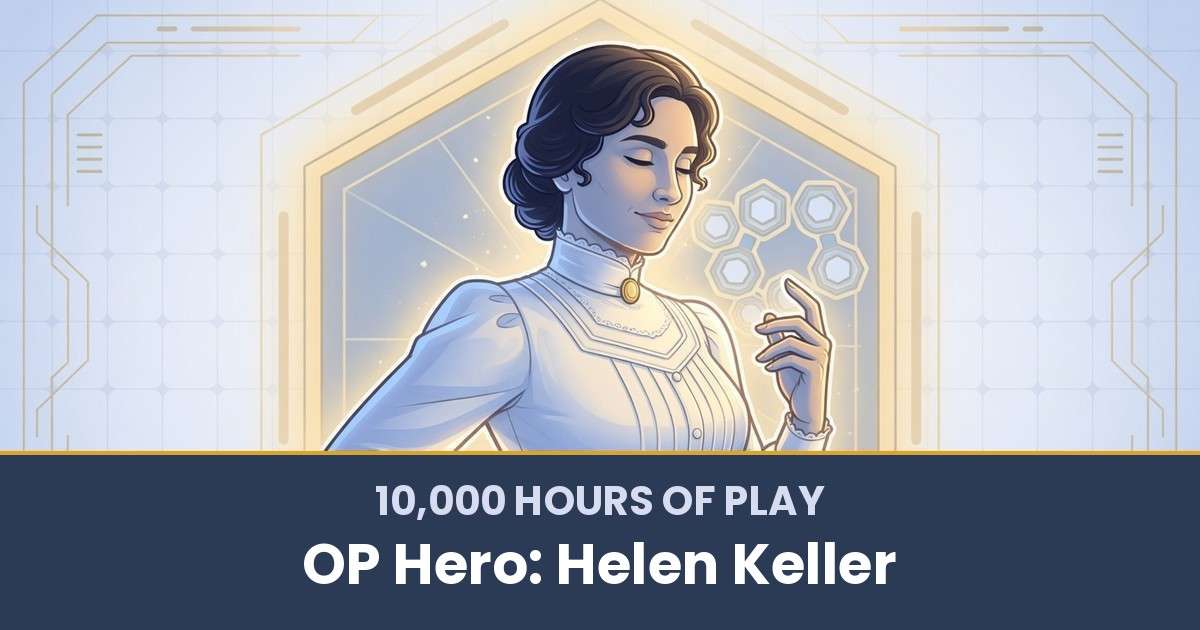


Most retellings of Helen Keller make Anne Sullivan the hero. That’s a beautiful story. It’s also wrong.
The miracle was the build. Helen Keller arrived in Tuscumbia, Alabama, as a deafblind toddler whose own family thought she was unreachable. By twenty-four she had a Harvard-grade college degree. By thirty-two she was attacking the Brooklyn Eagle in print for “social blindness.” By seventy-six she had personally lobbied across thirty-five countries for the rights of disabled people.
You don’t get there on rescue. You get there because the character was already underneath, and someone finally showed her how to spell.
That’s the lesson worth stealing. The right ally doesn’t replace your build — they unlock it.
⚡ Speed Run Notes
- Helen Keller’s life is the textbook case for one rule — the right ally is a stat multiplier, not a substitute. Anne Sullivan didn’t replace Helen’s character; she unlocked the one that was already there.
- Her innate stats were stubborn will, pattern-hungry curiosity, and a freakish verbal memory. Sullivan’s manual alphabet wasn’t a cure — it was the input device the hardware needed.
- The Story of My Life (1903) is the moment her Role shifts from Apprentice to Author. She turned her own biography into the most valuable asset she’d ever own.
- Joining the Socialist Party in 1909 and the Industrial Workers of the World (IWW) in 1912 was a Courageous Heart move that cost her press goodwill. She made it anyway.
- After Anne Sullivan’s death in 1936, she rebuilt the operating system around Polly Thomson and shipped another thirty-two years of work. That’s Phoenix Rebirth on a second life.
Table of Contents
- Step 1: The Game — What Helen Keller Was Actually Playing
- Step 2: Attributes — The Innate Stats
- Step 3: Role(s) — The Character Class Across Chapters
- Step 4: Skills — The Real-Life Game Skills Helen Keller Mastered
- Step 5: Allies — The People Who Multiplied Helen Keller
- Step 6: Quests — The Milestones That Shaped the Saga
- What You Can Steal From Helen Keller’s Build
- Where this framework comes from
- Related Reading
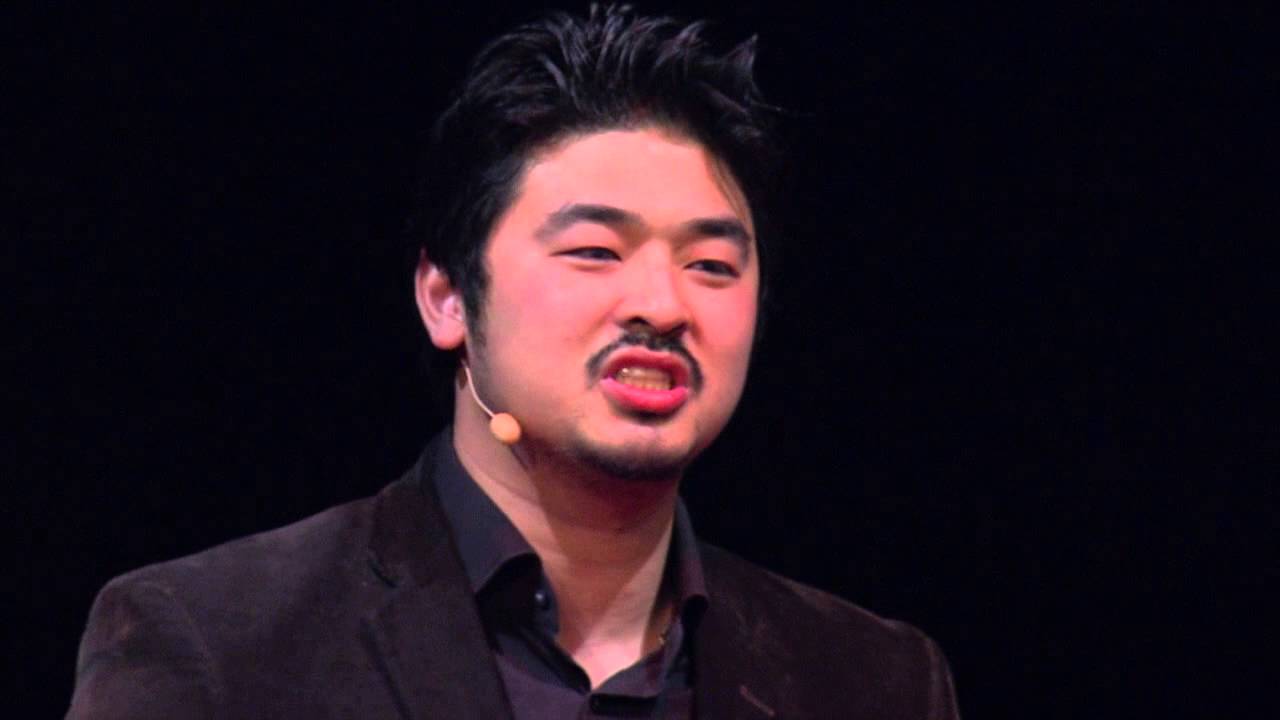
About Yu-kai Chou

Yu-kai Chou is the author of 10,000 Hours of Play — the book that treats your life as the most important game you’ll ever build a character in, and gives you the 6-Step framework (Game · Attributes · Role · Skills · Allies · Quests) to play it on purpose. He has spent two decades developing the system through which this post analyzes its OP Hero, and applies it to his own life and to the lives of the people he advises around the world.
Chou’s other framework, the Octalysis Framework, has been applied by LEGO, Microsoft, Porsche, Coca-Cola, Salesforce, and MrBeast, impacting over 1.5 Billion Users. He has taught the methodology at Harvard, Stanford, Yale, Tesla, Google, BCG, and IDEO, and has advised governments in eight nations including Ukraine, the United Kingdom, the Kingdom of Bahrain, Singapore, Taiwan, the Netherlands, Kazakhstan, and South Korea.
His work has been cited by Harvard, Stanford, MIT, Forbes, Wall Street Journal, Wired, US Department of Energy, NIST, NSF, NCBI, US Department of Education, ClinicalTrials.gov, and Google Scholar — with 3,700+ more academic publications. Explore his books here.
Helen Keller is the OP Hero I keep returning to whenever someone tells me they’re “stuck.” She didn’t lack input — for the first seven years of her life she had almost none. The thing that broke her open wasn’t a better environment. It was one person spelling letters into her palm. If you remember nothing else from this profile, remember that finding the right Ally — not the most famous, the right — is the highest-leverage move in your whole 10,000 Hours of Play.
Step 1: The Game — What Helen Keller Was Actually Playing
The thing Helen Keller chased across seventy-five years was the same thing she’d chased at age six in the family garden. She was trying to translate the world from the inside of her own head outward, and to translate other people’s worlds from the outside inward. Language was never the goal. Language was the API. The Game was: take what is locked inside one person, and make it land — accurately, with feeling — inside another.
In 1887 she was trying to get her family to understand what she wanted for breakfast. In 1912 she was trying to get a country that had crowned her “the miracle child” to understand why she was suddenly defending striking workers. In 1948 she was trying to get the Japanese government to understand why a hundred thousand blinded veterans deserved schools.
Same game. Different boss fights.
What this means for your own life-as-a-game thinking — laid out in detail at the 6-Step framework hub — is that the Game you are playing isn’t your job title. The Game is the underlying translation you keep showing up to do. If you can name that translation, the rest of the build gets a lot more legible.
Helen Keller named hers early and never blinked.
Step 2: Attributes — The Innate Stats
Three things were visible before Anne Sullivan ever spelled a letter.
First, ruthless will. The pre-language Helen wasn’t passive — she was furious. She invented over sixty home-signs to make herself understood and threw tantrums when those failed. Her own memoir admits she was “strong, active, indifferent to consequences.” That’s not a character flaw. That’s a stat sheet entry.
Second, pattern-hungry curiosity. Sixty signs. Built by a small child with no formal teacher. That’s a Druid-class observation engine running on no input data, and it’s the trait that made everything afterward absorbable.
Third, conceptual memory. Within hours of the water pump breakthrough, Sullivan reported Helen had added “thirty new words to her vocabulary” and was combining them spontaneously. Within three weeks she had cleared one hundred. Six months in, she was reading raised print. Two years in, she was writing letters with full grammatical control. Memory like that doesn’t get trained from zero in adulthood — it was already there, just waiting on a way in.
You can run your own attribute audit using the Talent Triangle Method — the question is what’s the trait nobody had to teach you. For Helen, the answer is obvious in hindsight. The harder question for the rest of us is whether we’ve actually named our own.
Step 3: Role(s) — The Character Class Across Chapters
Helen Keller cycled through four distinct character classes, and the transitions are clean enough you can almost read them like patch notes.
Apprentice (1887–1904). The Perkins → Wright-Humason → Cambridge → Radcliffe run. She isn’t producing yet; she’s absorbing. The cumulative endgame: an A.B. from Radcliffe in 1904, the first ever earned by a deafblind person.
Author (1903 onward). The Story of My Life ships while she is still at Radcliffe. The World I Live In (1908) and Out of the Dark (1913) follow. She becomes a public intellectual whose voice has range — descriptive, philosophical, political.
Lecturer-Activist (1913–1920s). She joins the Chautauqua circuit. She joins the Socialist Party in 1909 and the IWW around 1912. The “miracle child” is now a radical, and she’s choosing it on purpose. Concert halls fill. So do the angry letters.
Global Humanitarian (1924–1968). She works for the American Foundation for the Blind, then becomes its international ambassador. Thirty-five countries between 1946 and 1957. She isn’t producing essays anymore — she’s producing institutional change.
The pattern matters: she didn’t keep playing the same Role on harder difficulty. She graduated. Most builds plateau because the player tries to win Chapter 1 again with better gear. Helen kept respeccing.
Step 4: Skills — The Real-Life Game Skills Helen Keller Mastered
Six canon Skills carry her whole story. Each one cracked something open she couldn’t have moved otherwise.
Vision Manifestation (Warlock). She had no visual input from age nineteen months on. And yet The World I Live In writes about color, light, and motion with an almost unsettling vividness. She was building a working mental model of a world she had never seen, and then living inside it. The same Warlock-class rehearsal Yu-kai breaks down in the Lich Pact post — rehearse the world so vividly that reality starts reshaping around the rehearsal.
Siphoning (Warlock). Thirty new words in one day from one alphabet. By Radcliffe she was reading textbooks in four languages. Siphoning is rapid extraction from a denser knowledge node — and the right teacher is the densest node a human can plug into. On the Skills Spectrum, Helen was a Master at one thing — language as social technology — and a deliberate Dabbler in everything else.
Courageous Heart (Paladin) is what carried her into the 1909 socialist turn. “Miracle child” was a brand worth a fortune. She set fire to a chunk of it on purpose by publishing How I Became a Socialist in 1912.
Aegis (Paladin) is what let her stay there. When the Brooklyn Eagle, which had previously canonized her, sneered that her socialist views sprang from “the manifest limitations of her development,” she fired back in print: the Eagle was “socially blind and deaf, it defends an intolerable system.” Criticism named, then she kept moving.
Loremaster (Druid). The Story of My Life isn’t just a memoir — it’s a deliberately built narrative weapon. The shape of her sentences mirrors the shape of her argument: pre-language darkness, water pump, light, expansion. That arc shipped to every disability rights advocate after her because she made it shippable.
Phoenix Rebirth (Paladin). Anne Sullivan, the multiplier of her entire life, died October 20, 1936. Helen was fifty-six. Most builds end there. Hers didn’t. She partnered with Polly Thomson, picked the world tours back up, and shipped another thirty-two years of work.
Step 5: Allies — The People Who Multiplied Helen Keller
Anne Sullivan is the most famous Ally in the history of the framework, and the reason is structural, not sentimental. Sullivan didn’t replace Helen’s stat sheet — she gave it a way to render. An Ally is a multiplier on what is already in you. Helen’s life is the cleanest demonstration of that rule on record.
The other Allies matter, even if they’re less famous.
Alexander Graham Bell was the referral. The Keller family was referred to him in 1886 by Baltimore ENT specialist Dr. J. Julian Chisholm; Bell pointed them at Perkins. Without that hand-off, no Sullivan. Helen later dedicated The Story of My Life to Bell. Track-treasure-grade reputation lookup before reputation networks existed.
Michael Anagnos, the Perkins director, sent Sullivan. Sometimes the Ally is the person who picks your other Ally.
John Macy edited her first book and, not incidentally, introduced her to socialism. Polly Thomson took over from Sullivan after 1936 and ran the operation for another twenty-four years until her own death in 1960. Mark Twain, who befriended Helen in 1894, introduced her to Henry Rogers — the Standard Oil executive who quietly paid her Radcliffe tuition. That kind of intervention is what reach looks like.
Here’s the lesson worth lifting whole: the Ally search isn’t for the most famous person you can find. It’s for the person whose strengths slot exactly into your weakness. Sullivan was a Perkins-trained teacher of the deafblind whose own near-blindness meant she knew exactly what it felt like to be locked out of language. There were maybe ten people on Earth that qualified at that level. The Kellers found one.
When you’re stuck, the answer often isn’t more grit. The answer is identifying which one Ally would unlock the rest of the build. The Harmless Dragon post is Yu-kai’s reframe of why reaching out to that one person is almost never as costly as it feels.
Step 6: Quests — The Milestones That Shaped the Saga
Six quest milestones tell the saga in shorthand.
Quest 1: The Water Pump (April 5, 1887). Sullivan spells w-a-t-e-r into one of Helen’s hands while water flows over the other. Helen later wrote: “That living word awakened my soul, gave it light, hope, joy, set it free!” Single highest-leverage moment in a single human life — every later Quest is a child node of this one.
Quest 2: Radcliffe Degree (1904). First deafblind person to earn a bachelor’s. The “miracle” framing locks in. Press and publishers line up. Brand built.
Quest 3: The Story of My Life (1903) and The World I Live In (1908). The Apprentice Role retires; the Author Role becomes the central influence vehicle. Her life was no longer something happening to her — it was material she controlled.
Quest 4 — the setback: The Socialist Pivot (1909–1916). She joins the Socialist Party in 1909, the IWW around 1912, publishes How I Became a Socialist in 1912. The press that had elevated her now patronizes her in print. Speaking-circuit invitations drop. She doesn’t recant. This is the closest equivalent in her life to Viktor Frankl’s later refusal to let suffering be wasted — meaning held in place by choice, not by approval.
Quest 5: Helen Keller International (1915). Originally the Permanent Blind Relief War Fund, co-founded with George Kessler. The Author becomes an institution-builder.
Quest 6: The World Tours (1946–1957). Thirty-five countries. She is in her sixties and seventies, delivering in-person testimony to heads of state that disabled people had to be designed for, not pitied at.
What to notice across the six: the setback at Quest 4 doesn’t end the saga. It reshapes it. The political backlash forces her to find Allies outside the press — labor unions, suffragists, internationalists — and that turns out to be exactly the network she needs for Quests 5 and 6. The full hub of OP Hero profiles is built around this pattern.
What You Can Steal From Helen Keller’s Build
One lesson, lifted whole.
The right Ally is the highest-leverage move in your 10,000 Hours of Play. Not the most famous person you can collect a coffee with. The one whose strengths slot exactly into the locked door you can’t open alone.
Helen Keller’s stats — stubborn will, pattern-hungry curiosity, conceptual memory — were already in place at age six. None of them were Anne Sullivan’s. What Sullivan gave her was the input device: a manual alphabet that turned a deafblind seven-year-old into a Radcliffe graduate seventeen years later. That’s a multiplier. That’s not a savior.
If you read this profile and walk away thinking “I need to find my Anne Sullivan,” you have half-learned it. The full lesson is: figure out which locked door you cannot get past on your own, name it explicitly, and only then go looking. Most people skip the naming step and end up collecting Allies the way they collected followers in 2015 — for reach, not for unlock.
Helen Keller named her locked door before she could speak. Once Sullivan handed her the alphabet, she did everything else herself.
Where this framework comes from

Want the full system this profile is built on?
Every OP Hero piece runs through the same 6-Step framework from 10,000 Hours of Play: Unlock Your Real-Life Legendary Success. The book covers the full system, walks through Yu-kai’s own life run as the first applied case study, and gives you the worksheets to audit your own build.
Related Reading
- All OP Hero Profiles — the full hub of 10,000 Hours of Play builds analyzed in this series.
- 10,000 Hours of Play by OP Hero: Viktor Frankl — meaning under suffering, the philosophical sibling of Helen Keller’s locked-door turn.
- 10,000 Hours of Play by OP Hero: J.K. Rowling — another build that survived being underestimated and turned the manuscript into the institution.
- 10,000 Hours of Play by OP Hero: Martin Luther King Jr. — the canonical Loremaster + Courageous Heart pairing for moral movements.
- Turning Life Into a Game — the source-level explainer of the 6-Step framework this profile runs on.
- What Do You Want to Want? — Yu-kai’s primer for naming your own Game before searching for the right Ally.
— Blocks: 5 —