
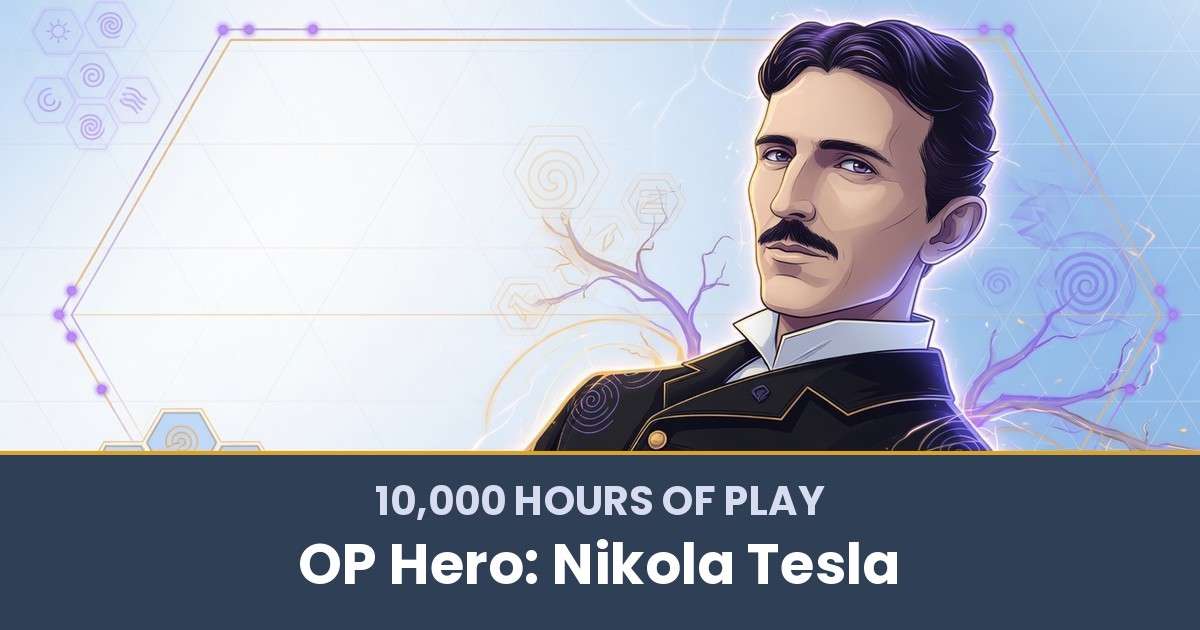


Nikola Tesla died alone in a New York hotel room in January 1943, owing back rent on the only luggage he had left. Five months later the U.S. Supreme Court ruled that the radio patents Marconi had built an empire on were actually his.
That sequence — die broke, get vindicated by history — is the version of Tesla everyone knows. The version almost nobody studies is the player he was for the sixty years in between. Because if you read the lab notes and the letters and the patent filings as moves in a single long game, Tesla isn’t a tragic genius. He’s an OP Hero who maxed out one stat line so hard that the rest of his build couldn’t keep up.
You can steal a lot from a player like that — including the warning written into how he ended.
⚡ Speed Run Notes
- Tesla’s main quest wasn’t a single invention. It was a planet-wide wireless energy and information network — and every move he made for forty years pointed at it.
- His OP attribute was a kind of eidetic mental simulation. He literally ran his machines inside his head before any metal got cut. Most engineers can’t do this. He couldn’t stop doing it.
- The AC system that powers the world today wasn’t a lone-genius play. It was a partnership play — Tesla’s patents stacked onto George Westinghouse’s factories and capital.
- Wardenclyffe Tower is where the build broke. Tesla bet the company on a vision investors couldn’t see and a physics that wouldn’t cooperate. The lesson is about which Skills go un-leveled, not which Skill failed.
- The 1943 Supreme Court ruling restoring his radio patents is the cleanest case in history of “the system caught up to the player” — fifty years too late to help him.
Table of Contents
- Step 1: The Game — What Tesla Was Actually Playing
- Step 2: Attributes — The Innate Stats
- Step 3: Role(s) — The Character Class Across Chapters
- Step 4: Skills — The Real-Life Game Skills Tesla Mastered
- Step 5: Allies — The People Who Multiplied Tesla
- Step 6: Quests — The Milestones That Shaped the Saga
- What You Can Steal From Tesla’s Build
- Where this framework comes from
- Related Reading
About Yu-kai Chou

Yu-kai Chou is the author of 10,000 Hours of Play — the book that treats your life as the most important game you’ll ever build a character in, and gives you the 6-Step framework (Game · Attributes · Role · Skills · Allies · Quests) to play it on purpose. He has spent two decades developing the system through which this post analyzes its OP Hero, and applies it to his own life and to the lives of the people he advises around the world.
Chou’s other framework, the Octalysis Framework, has been applied by LEGO, Microsoft, Porsche, Coca-Cola, Salesforce, and MrBeast, impacting over 1.5 Billion Users. He has taught the methodology at Harvard, Stanford, Yale, Tesla, Google, BCG, and IDEO, and has advised governments in eight nations including Ukraine, the United Kingdom, the Kingdom of Bahrain, Singapore, Taiwan, the Netherlands, Kazakhstan, and South Korea.
His work has been cited by Harvard, Stanford, MIT, Forbes, Wall Street Journal, Wired, US Department of Energy, NIST, NSF, NCBI, US Department of Education, ClinicalTrials.gov, and Google Scholar — with 3,700+ more academic publications. Explore his books here.
Tesla is one of the heroes I keep coming back to when I think about what an attribute can do at maximum spec — and what the rest of the build has to support to keep it from collapsing inward. His mental-simulation ability is the closest thing in history to a real-life Mage class. The lesson I’d lift from his run is the one his Wardenclyffe collapse made unmissable: an attribute that powerful needs an ally class around it, and Tesla’s allies stopped being multipliers the year his vision outran their patience.
Step 1: The Game — What Tesla Was Actually Playing
The popular version of Tesla flattens him into “the guy who invented AC and lost the radio war.” That’s a list of side quests. The main quest was bigger and stayed the same for forty years.
Read his 1900 essay “The Problem of Increasing Human Energy” in The Century Magazine and the through-line is right there in the section title: “The Transmission of Electrical Energy Without Wires.” Tesla wasn’t trying to win an electricity war. He was trying to build a planet-wide energy and information network — power and signal beamed through the earth itself, available anywhere, billed to no one in particular. The AC system was infrastructure for that bigger game. The wireless telegraphy work was infrastructure for that bigger game. Wardenclyffe Tower was the prototype.
This is what the 10,000 Hours of Play framework calls the Game — the single big thing you’re actually playing for, the level your character is trying to clear across the whole life run. If you mistake the side quests for the game, you optimize for the wrong wins. AC made Tesla famous. Radio would have made him rich. But the Game he was playing was wireless world power, and he literally never stopped pursuing it, even after the money ran out, even after the press turned on him, even after the labs caught fire.
The clarifying question to lift from Tesla’s build is the one he could answer at age twenty-six and again at age seventy: what is the one outcome that, if I achieved it, would make everything else I did along the way feel like setup? Most of us never get clear enough to answer that. Tesla overshot — his answer required physics that didn’t quite work — but the clarity itself was the OP move.
Step 2: Attributes — The Innate Stats
Attributes are the traits that showed up before training. Tesla’s were unusually lopsided, and the lopsidedness explains both the highs and the collapse.
The headline attribute is eidetic visual simulation. In “My Inventions,” the autobiographical series he published in Electrical Experimenter in 1919, Tesla describes images so vivid in childhood that he had trouble distinguishing them from physical reality. As an adult he turned that bug into a feature — he could design, modify, and stress-test entire machines inside his head before drawing a single line. “Before I put a sketch on paper, the whole idea is worked out mentally,” he wrote. “I change the construction, make improvements and operate the device in my mind.” This is exactly the territory the Talent Triangle Method calls a Tier-III innate — something you didn’t earn and most people can’t bolt on.
Second attribute: extreme risk tolerance, paired with disregard for physical and financial self-preservation. Tesla collapsed into a “complete nervous breakdown” in his early twenties chasing the rotating-magnetic-field idea, gambled away his allowance and books while doing it, and later worked routinely around millions of volts at Colorado Springs because the only way to test resonance at scale was to be in the room.
Third: obsessive single-mindedness. The compulsive counting and divisible-by-three rituals he described from boyhood weren’t a quirk — they were the same machinery that let him hold a complex mental model intact for hours. A 1915 New York Times interview has him claiming two hours of sleep a night. Probably exaggerated. Almost certainly closer to truth than to fiction.
Fourth: aversion to conventional authority. He walked away from Continental Edison in Paris and from Edison Machine Works in New York the moment his AC ideas were dismissed. That’s not stubbornness. That’s a player who refuses to accept a quest the NPC handing it out isn’t qualified to evaluate.
The dark side: empathy and social finesse were not stats Tesla rolled high on. Read his correspondence with J.P. Morgan and you can watch a man with a Tier-III intellect get steadily outmaneuvered by people with Tier-I people skills. That dynamic does most of the damage in Step 6.
Step 3: Role(s) — The Character Class Across Chapters
Tesla’s class shifted with the chapter, but the underlying spec was always Mage with a Warlock dip.
1875–1881 was the student-engineer phase. Polytechnic in Graz, then Prague, then the Budapest Telephone Exchange where he debugged equipment as chief electrician. He left two of three schools without a degree because the credential wasn’t the point.
1882–1884 was the employed-draftsman phase — Continental Edison in Paris, then Strasbourg in 1883 where he built his first working induction motor model, then arrival in New York in June 1884 to work directly under Edison. The chapter ended when Edison reportedly stiffed him on a promised bonus and Tesla walked. The bonus story is disputed; the walking-out isn’t.
1885–1891 was the independent-inventor phase — Tesla Electric Light and Manufacturing in 1885, then Tesla Electric Company in 1887, then thirty-plus polyphase AC patents in 1887-1891, then the May 16, 1888 lecture “A New System of Alternate Current Motors and Transformers” at the American Institute of Electrical Engineers, then the Westinghouse licensing deal that same year. This is the chapter where Tesla shipped.
1891–1900 was the showman-natural-philosopher phase. Public lectures at the AIEE in May 1891. The 1893 World’s Columbian Exposition in Chicago, where Westinghouse and Tesla underbid Edison for the lighting contract and lit the fair with AC. Then the Niagara Falls hydroelectric plant going live in 1895 using Tesla’s polyphase system. He was, briefly, the most famous engineer in America.
1900–1906 was the visionary-builder phase. Colorado Springs lab. The Century Magazine essay. Wardenclyffe Tower. This is the chapter that broke him.
1906–1943 was the recluse-inventor phase. Hotel rooms. Pigeons. Increasingly speculative inventions. Edison Medal in 1917. The Marconi vindication came after his death. The role shift here is the one most players never plan for and most reformers eventually face — a topic I dug into in the Abraham Lincoln OP Hero piece for a very different kind of player ending the same way: out of money, out of moves, and right about everything that mattered.
Step 4: Skills — The Real-Life Game Skills Tesla Mastered
Six canon Skills carry most of the load in Tesla’s build. He didn’t have them all at Tier III, but the ones he did, he had at a level the game itself hadn’t seen before.
The signature Skill is Astral Projection (Mage) — seeing all possible outcomes by simulating the system in your head. Tesla’s version was more than parameter sweeps; he could mentally run a motor for weeks of simulated operation and watch where bearings would wear, where insulation would fail, where a phase relationship would slip. The 1882 Budapest walk where he conceived the rotating magnetic field — reciting Goethe’s Faust with Anthony Szigeti, sketching the principle in sand with a stick — is the cleanest single example. Where most engineers iterate through prototypes, Tesla iterated through visions. The Skills Spectrum would put him on the deep end of Master, not Specialist — the kind of mastery where a Skill stops being a tool and becomes the way the person sees the world.
Vision Manifestation (Warlock) is the second core Skill — mental rehearsal so vivid it shapes the reality around it. Tesla didn’t pitch “an AC motor.” He pitched the polyphase system, then the global wireless network, then the world energy grid. Each pitch came packaged as if the future had already happened and he was describing it back to you. Read the 1900 Century Magazine essay and notice how little of it is conditional. Most of the verbs are present tense for a future that didn’t exist yet. That’s not bluster. That’s the Skill working.
Lich Grind (Warlock) — intense, secluded work periods — was the engine that turned the visions into hardware. Colorado Springs from May 1899 to early 1900 is the canonical case: Tesla decamped to a single-purpose lab at the base of Pikes Peak with a small crew, ran 12-million-volt experiments alone, and filled the notebook later published as Colorado Springs Notes, 1899–1900. The post on the Lich Pact covers the polyphasic-sleep version of this Skill in modern practice; Tesla’s was the older, more obsessive form.
Thunder Clap (Paladin) — public speaking that charges people up and converts skeptics — looks counterintuitive on Tesla until you read the AIEE lecture transcripts. The May 1888 lecture didn’t just present the polyphase motor. It made AC seem inevitable to a hall full of engineers who’d been Edison loyalists that morning. The 1891 lecture on high-frequency currents had him passing current through his own body to illuminate vacuum tubes — a stunt only a man absolutely certain of his physics would pull. The 1893 Columbian Exposition turned a fair lighting contract into a public referendum, and AC won the room.
Bind Fate (Warlock) — leveraging someone else’s brand or resource to become powerful yourself — is the Skill that turned Tesla from a brilliant inventor into a paradigm-setter. When George Westinghouse licensed the AC patents in 1888 for $60,000 cash, $5,000 in stock, and a royalty of $2.50 per horsepower, Tesla stopped needing to build factories himself. Westinghouse’s manufacturing capacity and capital became the chassis. Tesla supplied the engine. This is the same Skill Yu-kai talks about in the Elon Musk profile — when a brilliant solo player figures out which existing industrial machine to plug their genius into rather than rebuilding the machine from scratch.
Aegis (Paladin) — ignoring public criticism while pushing the Quest — is what kept Tesla in the field during the War of Currents from 1888 to roughly 1893. Edison’s camp publicly electrocuted animals to argue AC was lethal. Harold Brown’s 1888 demonstrations were calibrated character assassination. Tesla mostly didn’t engage. He let the Niagara Falls 1895 hydroelectric project answer the smears for him, and it did. The Skill is harder than it looks because the temptation to litigate every false claim is enormous, and most of the energy you spend doing it is energy you don’t spend shipping.
Step 5: Allies — The People Who Multiplied Tesla
Tesla had real allies, and the run that included them was the run that worked. The run that didn’t is the run we remember as tragedy.
Anthony Szigeti walked with Tesla in Budapest’s City Park in early 1882 when the rotating-magnetic-field idea arrived. He helped Tesla build the first AC motor prototypes in Strasbourg in 1883. Most accounts treat him as a footnote. He was a co-founder of the breakthrough.
George Westinghouse bought the polyphase AC patents in 1888 and bet his company on them. When the panic of 1890–91 squeezed Westinghouse’s capital and his board pressured him to renegotiate Tesla’s royalty (which would have made Tesla one of the richest men in America), Tesla reportedly tore up the contract on the spot. It freed Westinghouse to win the Niagara contract. It also took roughly $12 million 1890s dollars out of Tesla’s future net worth. Westinghouse never forgot it. Tesla never asked him to.
J.P. Morgan wired Tesla $150,000 in 1901 toward Wardenclyffe — the largest single bet Tesla ever attracted — in exchange for a 51% stake in Tesla’s wireless and radio patents. Morgan was a multiplier and a constraint at the same time. The Skill of Bind Fate always carries that risk: the brand or resource you plug into gets veto power over your timeline.
John Jacob Astor IV invested $100,000 in 1899 ostensibly for Tesla’s fluorescent lighting work. Tesla quietly redirected most of it into Colorado Springs, which made the resonance experiments possible. Astor died on the Titanic in 1912; one of the few investors who might have re-upped on Wardenclyffe was gone.
Robert Underwood Johnson and his wife Katharine, the editor and salon-host of The Century Magazine, hosted Tesla in New York’s literary circle from the early 1890s. They published “The Problem of Increasing Human Energy” in 1900. They kept him connected to a world he’d otherwise have orbited from across the lab door.
Thomas Commerford Martin, the editor and AIEE figure, compiled and published The Inventions, Researches and Writings of Nikola Tesla in 1894 — six hundred pages that put Tesla’s primary work into one place at exactly the moment his career needed an authoritative anchor. Without Martin, half of what we cite as Tesla’s “voice” today wouldn’t have a paper trail.
Step 6: Quests — The Milestones That Shaped the Saga
Tesla’s saga is unusually clean to map to specific milestones. Six pivotal Quests carry the whole arc.
1882 Budapest walk — the induction-motor concept. A walk in the city park with Szigeti, a recital of Faust’s “Yet now the day before me dies / Departing, lights another world,” and the rotating-magnetic-field idea arrives all at once. Tesla sketched it in the path with a stick. The first working model came in Strasbourg the next year. This is the Quest where the Game first becomes visible to him.
1888 AIEE polyphase lecture + Westinghouse licensing. May 16, 1888. Tesla walks into the American Institute of Electrical Engineers and presents the entire AC system as a coherent whole. Westinghouse signs the licensing deal the same year. By 1891 Tesla holds the patent stack that will define how electricity reaches every home built after 1900. This is the Quest where the Game becomes real.
1893 Columbian Exposition + 1895 Niagara Falls. Westinghouse and Tesla underbid Edison for the World’s Fair lighting contract by roughly half — $399,000 versus Edison’s $1.1 million. The fair runs on AC. Two years later the Niagara Falls Power Company switches on the first commercial polyphase hydroelectric generation, sending power 22 miles to Buffalo. The War of Currents effectively ends. This is the Quest where the Game becomes inevitable.
1899–1900 Colorado Springs. Tesla builds a single-purpose resonance lab outside Colorado Springs, generates artificial lightning bolts up to 130 feet long, and claims to have detected standing waves that suggested the earth itself could be made to resonate as a single circuit. The notebooks are real. The interpretation has been disputed for 125 years. Either way, this is the Quest where the Game stops being about AC and becomes about something nobody else could even diagram.
1901–1906 Wardenclyffe Tower — the failure. Morgan’s $150,000 builds a 187-foot transmission tower on Long Island. Marconi transmits a radio signal across the Atlantic in December 1901 using equipment that relied on Tesla’s patents but bore Marconi’s name. Morgan reads the press, decides wireless telegraphy will get to market without wireless power, and pulls further funding. Tesla scrambles for new investors and finds none willing to bet on a vision Marconi appears to have already cashed in on. The tower is abandoned by 1906, mortgaged off to pay back rent at the Waldorf-Astoria, and finally dynamited for scrap in 1917. This is the Quest that breaks the run — and the textbook case of what happens when the Game outpaces both the physics and the patience of the people funding it. (For a different kind of late-life pivot through near-collapse, the OP Hero hub has a few players who recovered where Tesla didn’t.)
1943 Marconi v. United States — the posthumous vindication. Five months after Tesla dies in Room 3327 of the New Yorker Hotel, the U.S. Supreme Court hands down Marconi Wireless Telegraph Co. of America v. United States, 320 U.S. 1. The decision invalidates the core Marconi radio patents and credits Tesla’s prior art. It does not bring him back. It does change which name the engineering textbooks now lead with. This is the Quest the player didn’t live to clear, that the system cleared on his behalf — fifty years late.
What You Can Steal From Tesla’s Build
Three lessons port out of Tesla’s run for a modern player.
First, get clear on the Game before you optimize the side quests. Tesla could state his Game in one sentence at twenty-six and at seventy. Most players never can. The clarity isn’t optional — it’s the gate every other Step depends on.
Second, max out an attribute and you’ll buy yourself a decade of unique advantage. Tesla’s mental simulation was a competitive moat. Yours might be pattern recognition, or empathy, or risk tolerance. Find the one you didn’t earn and lean into it until the others have to catch up.
Third — and this is the lesson the Wardenclyffe ruin still teaches — an OP attribute without an OP ally class around it is a setup for a slow collapse. Tesla’s social finesse never grew to match his physics. When Morgan got cold, there was no second financier in the network warm enough to take the call. The Allies Step isn’t a “nice to have.” For a player whose Game requires capital, regulators, or institutions, it’s the load-bearing column of the whole build. Tesla taught us that by negative example.
Read his story as tragedy and you’ll mourn him. Read it as a build to study and you’ll come out of it asking the right question of your own life: which Skill am I one ally away from making historically important?
Where this framework comes from

Want the full system this profile is built on?
Every OP Hero piece runs through the same 6-Step framework from 10,000 Hours of Play: Unlock Your Real-Life Legendary Success. The book covers the full system, walks through Yu-kai’s own life run as the first applied case study, and gives you the worksheets to audit your own build.
Related Reading
- All OP Hero Profiles — the running index of every OP Hero piece, each one a different build studied through the 6-Step framework.
- Albert Einstein — OP Hero: the other late-19th-century physics player whose Astral Projection skill rivaled Tesla’s, with a very different Allies arc.
- Jensen Huang — OP Hero: a modern Vision Manifestation case where the player did build the ally class around himself.
- Hedy Lamarr — OP Hero: another inventor whose patents got vindicated decades late, for the same reason Tesla’s did.
- Turning Life Into a Game: the introductory walk-through of the 6 Steps Yu-kai uses on every OP Hero profile.
- 10,000 Hours of Play: Why Play Beats Practice: the framework’s foundational argument — and the reason Tesla’s mental-simulation play hit different than Edison’s brute-force iteration.