
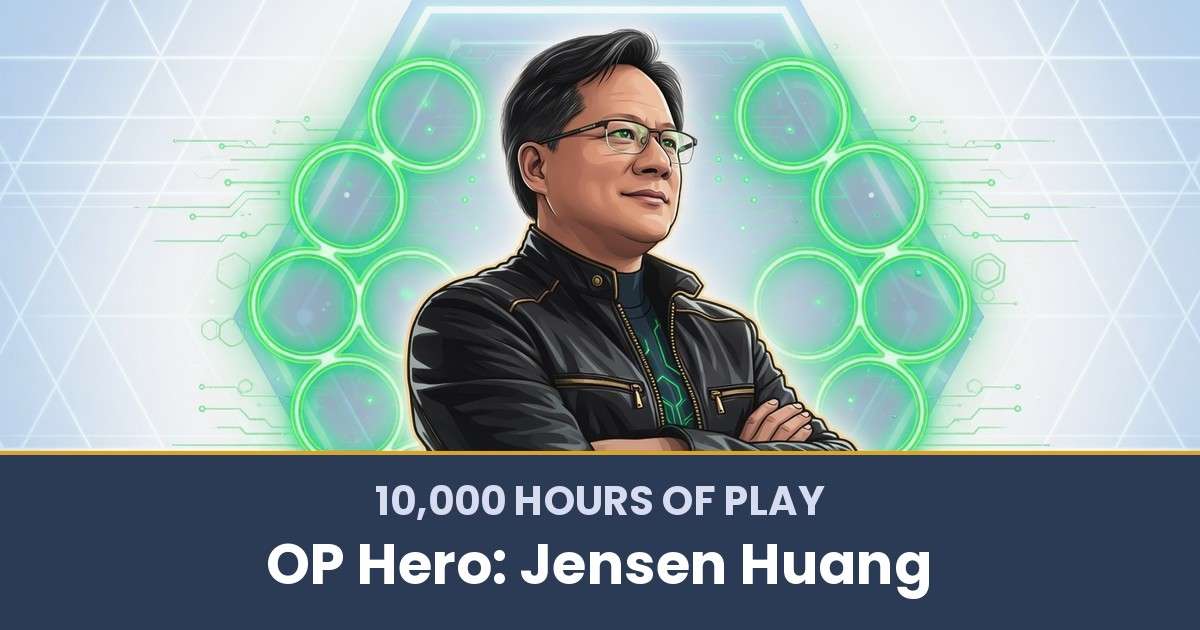


In 1996, Jensen Huang stood in front of a SEGA executive and confessed his company was thirty days from going bankrupt. His first chip had flopped. His investors were nervous. He could have spun the story. He told the truth instead — and walked out with six months of runway.
Twenty-eight years later, the company that almost died on that day became the most valuable corporation on Earth.
If you only watch the back half of Jensen’s life — leather jacket, three trillion dollar market cap, the AI infrastructure of the planet running on his chips — you miss the actual game he was playing. The interesting part of his build isn’t the endgame. It’s the decade of grinding on a bet nobody else believed in, while the world called CUDA “a science project” and the stock got cut in half more than once.
This is the build sheet of an OP Hero who chose the longest game on the board, and stayed in his chair long enough to watch the rest of the world catch up.
⚡ Speed Run Notes
- Jensen Huang’s life mission isn’t “build NVIDIA” — it’s “invent a new way of computing that solves problems normal computers can’t.” Same quest, different decades.
- His first chip failed. The company was thirty days from death. He kept his job by telling a partner the unvarnished truth — not by spinning it.
- CUDA was an unprofitable side bet for nearly a decade. He kept funding it through ridicule because he could already see AI on the other side of the wait.
- His org chart is sixty direct reports and no one-on-ones. The structure is the strategy — information moves at the speed of the company.
- The leather jacket and the trillion dollar valuations are the cinematic ending. The actual hero arc is the 30 years of grinding before anyone clapped.
Table of Contents
- Step 1: The Game — What Jensen Was Actually Playing
- Step 2: Attributes — The Innate Stats
- Step 3: Role(s) — The Character Class Across Chapters
- Step 4: Skills — The Real-Life Game Skills Jensen Mastered
- Step 5: Allies — The People Who Multiplied Jensen
- Step 6: Quests — The Milestones That Shaped the Saga
- What You Can Steal From Jensen’s Build
- Where this framework comes from
- Related Reading
About Yu-kai Chou

Yu-kai Chou is the author of 10,000 Hours of Play — the book that treats your life as the most important game you’ll ever build a character in, and gives you the 6-Step framework (Game · Attributes · Role · Skills · Allies · Quests) to play it on purpose. He has spent two decades developing the system through which this post analyzes its OP Hero, and applies it to his own life and to the lives of the people he advises around the world.
Chou’s other framework, the Octalysis Framework, has been applied by LEGO, Microsoft, Porsche, Coca-Cola, Salesforce, and MrBeast, impacting over 1.5 Billion Users. He has taught the methodology at Harvard, Stanford, Yale, Tesla, Google, BCG, and IDEO, and has advised governments in eight nations including Ukraine, the United Kingdom, the Kingdom of Bahrain, Singapore, Taiwan, the Netherlands, Kazakhstan, and South Korea.
His work has been cited by Harvard, Stanford, MIT, Forbes, Wall Street Journal, Wired, US Department of Energy, NIST, NSF, NCBI, US Department of Education, ClinicalTrials.gov, and Google Scholar — with 3,700+ more academic publications. Explore his books here.

Jensen’s build is the one I keep coming back to when someone asks me whether long-horizon bets are worth it. He spent ten years funding a piece of software almost nobody used, while the public markets punished him for it — and what looked like stubbornness from the outside was a precise reading of where compute would have to go. The lesson I lift from his sheet isn’t grit. It’s the willingness to be early enough that you look wrong, and to stay in the chair long enough that you’re proven right.
Step 1: The Game — What Jensen Was Actually Playing
Jensen Huang didn’t set out to “build a chip company.” He set out to invent a new way of computing.
That sentence sounds like marketing until you watch him say it in his own voice. In a 2023 talk on NVIDIA’s journey, he describes the founding purpose flatly: build a kind of computer that solves problems normal computers can’t. Everything downstream — the GPU, CUDA, the DGX systems, the data center build-out — is one game running for thirty-plus years. The cards on the table change. The game does not.
This is the move that separates a hero arc from a series of jobs. If you treat your life as a single long game instead of a chain of two-year sprints, the early failures stop reading as setbacks. They become payment for the experience the later levels require. NV1 wasn’t a wrong answer. It was tuition.
Jensen has said in interviews that he doesn’t have anything else to do besides be CEO of NVIDIA, and that he treats the constant rebuilding of the platform as the work itself — not the prize at the end. That’s a Game-level identity. Not “I work at NVIDIA.” More like “I am the person who reinvents the substrate.”
The compounding effect of holding the same game across thirty years is brutal. Almost no one stays. The ones who do build at a level the year-by-year players literally cannot reach.
Step 2: Attributes — The Innate Stats
Before the skills, the attributes. These are the dispositions Jensen seems to have arrived with, the parts of his sheet that didn’t need a trainer.
The first is an unusually high tolerance for existential risk. The same trait that lets a person stand in front of a partner and say “we’re thirty days from bankruptcy” without flinching is the trait that lets him bet the whole company on CUDA later, and bet it again on H100 a decade after that. People with this attribute aren’t fearless. They’ve simply made friends with the worst case.
The second is systems-level pattern recognition. When most chip engineers were optimizing transistors, Jensen was already thinking across the whole stack — silicon, system, software, developer ecosystem, application. You can see this in every interview. He doesn’t talk about parts. He talks about how the parts compose into something the world wants. This attribute is what the Talent Triangle Method calls a “synthesizer brain” — he’s not the best individual engineer in any one domain, but he’s freakishly good at seeing where the domains meet.
The third is obsessive intensity. By his own account, he doesn’t separate work from life. NVIDIA is not what he does, it’s what he is. Treat this with care if you’re a reader trying to model it. The output is enormous, the cost is real, and not every life can or should be built this way. But if you’re going to play a Game-level quest, you need a level of intensity that doesn’t burn out in year three.
The fourth is first-principles thinking under uncertainty. Jensen has said publicly that when facts change his mind changes — and the NV1-to-RIVA-128 pivot is the clearest proof. He was willing to throw out his own architecture, the one he had personally championed, the moment the evidence said the market was moving a different way. That’s a rare trait. Most founders fall in love with their first design and ride it down.
The fifth is a preference for asymmetric, long-horizon bets. He has openly said NVIDIA’s strategy is to be in a market “ten years before it happens.” That’s a permission slip to look wrong for nine of those ten years — and most people can’t survive the social pressure that comes with it.
Step 3: Role(s) — The Character Class Across Chapters
Jensen’s character class shifted three times across the saga, and the shifts are what kept him relevant.
In the first chapter — born 1963 in Tainan, Taiwan, sent to the US as a child, BSEE at Oregon State and MSEE at Stanford — he was the immigrant engineering student. The role was about absorbing technical fluency and earning the right to be in the room. He worked at AMD and LSI Logic before founding anything. That apprenticeship is where the chip-design instincts came from.
In the second chapter — 1993 forward — he became the founder-CEO of a small graphics company fighting for its life. The role was scrappy: selling, fundraising, hiring, making hardware calls that could kill the company. By the time RIVA 128 shipped in 1997, he had played this role hard enough that the muscle was permanent. He still operates like a founder, not a manager, three decades later.
In the third chapter — late 2000s onward — he became a platform architect. The shift was that he stopped thinking about chips and started thinking about ecosystems. CUDA was the artifact of that role change. NVIDIA stopped being a company that sold a fast piece of silicon and became a company that built a full computing platform that other people built on top of. This is the chapter where the moat got dug.
In the fourth chapter — 2020s — he became an industrial statesman. NVIDIA crossed a trillion dollars of market cap in 2023, then two trillion, then three trillion as the AI boom reshaped global compute demand. Jensen’s job stopped being “lead a chip company” and started being “explain what AI infrastructure is to governments and trillion-dollar customers.” Each role-shift required him to drop a part of his previous identity. That willingness to outgrow yourself is the unsung skill that lets a Game-level player keep up with their own game.
Step 4: Skills — The Real-Life Game Skills Jensen Mastered
The most relevant entries on Jensen’s skill sheet are six, drawn from the canon Real-Life Game Skills system. Each maps to a moment that actually happened.
Vision Manifestation (Warlock). Mental rehearsal so vivid it shapes reality. Jensen has publicly said NVIDIA’s strategy is to be ten years early to a market. He picked CUDA in 2006 — a general-purpose parallel computing platform built on top of a graphics chip — when the use case was theoretical. He kept investing through years when the company was, in his own words, “burning literally billions of dollars in research and development” on something the press called a science project. The vision was that one day, someone would need a million parallel cores to do something important. In 2012 the AlexNet team trained their breakthrough neural network on two NVIDIA GeForce GTX 580s, and the future arrived on schedule. To see what reaching for this skill looks like in your own life, the Real-Life Game Skill profile on the Lich Pact is a useful read — same Warlock class, similar willingness to bet now for a payoff that doesn’t show up for years.
Phoenix Rebirth (Paladin). Recover from devastating failure and come back stronger. The NV1 chip — NVIDIA’s first product — failed in the market in 1995. The architecture chose quadratic textures while the industry standardized on triangles via Direct3D. The company was nearly insolvent. Instead of spinning the story, Jensen went to SEGA, admitted the strategic error to its face, and asked for time. SEGA extended terms, gave NVIDIA roughly six months of runway, and the team used it to ship RIVA 128 in August 1997 — which sold over a million units in its first four months. The rebirth turned a near-death moment into the foundation of the rest of the saga.
Aegis (Paladin). Ignore public criticism and naysayers while pushing the Quest. From 2006 to roughly 2016, CUDA looked like a money pit. Analysts called it a distraction. Wall Street did not reward the spend. Jensen kept funding it. The skill here isn’t conviction in the abstract — it’s the willingness to absorb a decade of “you’re wrong” without flinching. The same skill kept him steady through the 2018 crypto crash, when NVIDIA stock fell roughly fifty percent and the narrative said gaming had peaked and the company was done.
Cognitive Lens (Mage). Zoom in to details, zoom out to strategy. Jensen’s gift is that he can talk about a specific transistor decision in the morning and the geopolitical implications of compute scarcity in the afternoon, with the same fluency. NVIDIA’s full-stack story — chips, networking, systems, libraries, frameworks, partner ecosystem — is built on his ability to hold the micro and the macro at the same time. To get a feel for how this scales across a career, the Skills Spectrum piece on specialist-versus-master pathing is the right primer.
Concord of Elements (Druid). Bring multiple parties of different interests together. Jensen famously runs NVIDIA with sixty direct reports and no one-on-ones. He has said openly that he prefers to reason through problems in front of the whole team, so information moves without latency and decisions get made in the open. That’s a Druid-level skill — it isn’t charisma, it’s the deliberate orchestration of many different roles into a single coordinated motion. The 2016 launch of NVLink, DGX systems, and the Tesla P100 GPU as a coherent AI platform would have been impossible in a classical hierarchical org.
Lich Grind (Warlock). Intense, secluded work periods. By his own account, Jensen doesn’t have a life outside NVIDIA. The work is the life. Lich Grind is a high-cost skill — the system makes it explicit that the cost is real — but at Jensen’s level it’s the price of admission. The build sheets of long-game heroes share this entry. It’s not the only path. It is the path he chose.
Step 5: Allies — The People Who Multiplied Jensen
The lone-genius story is always a lie at this scale, and Jensen’s is no exception.
Chris Malachowsky and Curtis Priem co-founded NVIDIA with him in April 1993 — the legendary Denny’s table where three engineers planned a graphics company. Malachowsky carried the systems engineering. Priem, formerly of Sun Microsystems, was the principal architect of RIVA 128 and the early GeForce designs. Without either, there is no NVIDIA.
Don Valentine of Sequoia Capital wrote the early check. He took a chance on a pre-revenue company in a market many people thought was a niche, and he sat on the board through the survival years. Sequoia’s belief was the reason the doors stayed open long enough for Jensen to find his footing.
Morris Chang of TSMC is the ally most people miss. Jensen has publicly called TSMC “the most important company in the world” and said NVIDIA wouldn’t exist without it. The foundry partnership turned NVIDIA’s chip roadmap from an ambition into a manufacturable reality — a decade of bigger and bigger silicon nodes, executed flawlessly, while NVIDIA focused on architecture.
Bill Dally joined as Chief Scientist in 2009 after a career at MIT and Stanford. He co-led the architectural evolution of NVIDIA’s GPUs for general-purpose parallel computing, including the development of Tensor Cores — the hardware feature inside the V100 that turned the GPU into a deep learning accelerator. The 2017 Volta architecture was the bridge from “fast graphics chip” to “AI compute substrate.”
And the early RIVA, GeForce, and CUDA teams — the ones nobody outside NVIDIA can name — actually built the chips and the software. The hero arc is impossible without the party.
Step 6: Quests — The Milestones That Shaped the Saga
Six quests carry the saga, and at least one of them is a failure on purpose.
Quest 1 — Found NVIDIA, April 1993. The Denny’s table, the $40,000 seed, the three co-founders. Most of these stories end at the seed round. This one is where Jensen’s game began.
Quest 2 — Survive NV1, 1995–96. The first product fails. The company is thirty days from bankruptcy. The pivot to a triangle-based architecture for RIVA 128 saves them. This is the failure quest, and it’s the one Jensen has talked about more than any of the wins — because it’s the moment the company learned what it was made of. Other OP Heroes carry similar scars; Phil Knight’s near-death years at Nike rhyme with this one almost beat for beat.
Quest 3 — Ship the world’s first GPU, 1999. GeForce 256 launches and NVIDIA IPOs the same year. The role shifts from “scrappy survivor” to “category-defining company.” The graphics card market becomes a real market.
Quest 4 — Launch CUDA, 2006–2007. The Vision Manifestation bet. The decade of pain. The decade that, in hindsight, was the actual moat.
Quest 5 — Validate CUDA via AlexNet, September 2012. Two GeForce GTX 580s, one neural network, the ImageNet benchmark, and a result the field couldn’t ignore. The bet pays off. Modern AI starts.
Quest 6 — Ship H100 into the ChatGPT moment, 2022–2024. Generative AI explodes. NVIDIA is the only company in the world with a full-stack answer ready to go. Market cap crosses one trillion in 2023, two trillion in 2024, three trillion shortly after. The reward for the previous five quests arrives all at once.
You’ll notice the sequence isn’t linear — three near-deaths sit between every clean win. That’s a feature, not a bug. The hub of OP Hero profiles is full of saga maps that look like this. The grinding chapters aren’t the cost of the legendary chapters. They are the legendary chapters.
What You Can Steal From Jensen’s Build
If you only take one thing from Jensen’s sheet, take the willingness to be early enough that you look wrong. Almost nobody can sit in a decade of public ridicule on a bet they believe in. The ones who can are the ones who define industries.
If you take two, take Phoenix Rebirth. The instinct to walk into your hardest conversation with the unvarnished truth, instead of a clever spin, is the move that saved his company. It also tends to be the move that saves marriages, friendships, and careers. Spinning is what other people do. Honest is what the long game requires.
If you take three, take Concord of Elements. The structure of an organization isn’t decoration. Sixty direct reports and no one-on-ones is an unusual choice — and it is also why information at NVIDIA moves at the speed of the company, not the speed of a manager’s calendar. The way you arrange your team is the strategy, whether you mean it to be or not.
The leather jacket is the costume. The thirty-year game is the build.
Where this framework comes from

Want the full system this profile is built on?
Every OP Hero piece runs through the same 6-Step framework from 10,000 Hours of Play: Unlock Your Real-Life Legendary Success. The book covers the full system, walks through Yu-kai’s own life run as the first applied case study, and gives you the worksheets to audit your own build.
Related Reading
- All OP Hero Profiles — the full 10,000 Hours of Play hero library
- Elon Musk through the 10K HP lens — another long-game systems builder
- Albert Einstein — first-principles thinking and the long bet
- Phil Knight — the near-death years that built Nike
- Turning Life Into a Game — the foundational 10K HP essay
- The 10,000 Hours of Play framework hub