
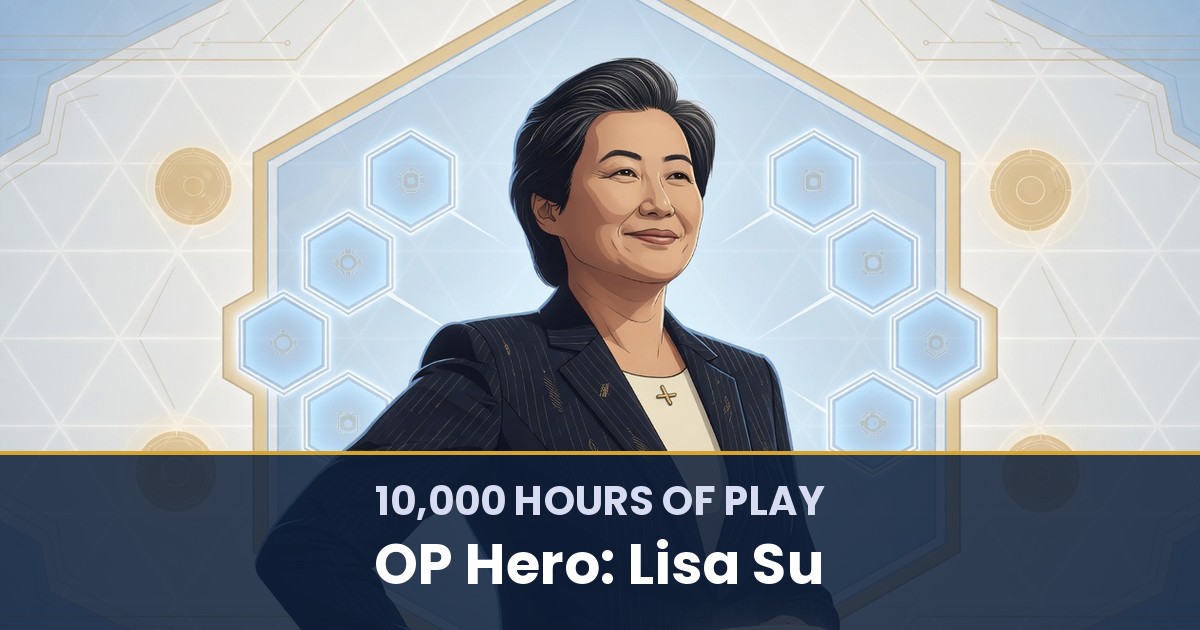


On October 8, 2014, AMD named Lisa Su its president and chief executive officer. Eight days later the company announced it was cutting about 7% of its workforce.
The following summer the share price slipped under $2 and the whole company was valued at roughly $2 billion. AMD had posted a net loss in 2012, 2013 and 2014, and 2015 would make it four years in a row.
A decade on, that same company reported $34.6 billion in revenue for 2025, and Time had already named Su its CEO of the Year for 2024.
Turnarounds this size usually get told as a story about one product. This one reads better as a character sheet, because the moves Su made in 2014 are the moves she had been rehearsing since she took apart her brother’s remote-control cars as a ten-year-old in Queens.
The six Steps below follow her run from a Bronx Science graduate who picked the hardest major at MIT to the engineer who rebuilt a chipmaker that was losing money every year.
⚡ Speed Run Notes
- Su’s Game was bigger than saving AMD: build computing products that solve hard problems, then build the organization that can deliver them again and again.
- Her innate stats: a curiosity that disassembles things, a pull toward the hardest problem in the room, and a composure that held while the stock sat under $2.
- Her canon Skills: Courageous Heart (Paladin), Devour (Warlock), Track Treasure (Ranger), Cosmic Alignment (Mage) and Tactical Command (Ranger).
- Allies ranged from an MIT adviser and an IBM chief executive to Jim Keller and Mark Papermaster, the architects behind the Zen bet that produced Ryzen and EPYC.
- The Quest log runs from a 7% layoff in her first week to a $49 billion acquisition and a 2023 push into AI accelerators, with a 2015 near-collapse in between.
Table of Contents
About Yu-kai Chou

Yu-kai Chou is the author of 10,000 Hours of Play — the book that treats your life as the most important game you’ll ever build a character in, and gives you the 6-Step framework (Game · Attributes · Role · Skills · Allies · Quests) to play it on purpose. He has spent two decades developing the system through which this post analyzes its OP Hero, and applies it to his own life and to the lives of the people he advises around the world.
Chou’s other framework, the Octalysis Framework, has been applied by LEGO, Microsoft, Porsche, Coca-Cola, Salesforce, and MrBeast, impacting over 1.5 Billion Users. He has taught the methodology at Harvard, Stanford, Yale, Tesla, Google, BCG, and IDEO, and has advised governments in eight nations including Ukraine, the United Kingdom, the Kingdom of Bahrain, Singapore, Taiwan, the Netherlands, Kazakhstan, and South Korea.
His work has been cited by Harvard, Stanford, MIT, Forbes, Wall Street Journal, Wired, US Department of Energy, NIST, NSF, NCBI, US Department of Education, ClinicalTrials.gov, and Google Scholar — with 3,700+ more academic publications. Explore his books here.

Lisa Su belongs in this series because her build shows what happens when a deep specialist refuses to stop widening. If I could lift one move from her character sheet, it would be the three-priority letter she wrote in her first days as CEO, because it turned a company-wide panic into a Game that every engineer could play.
Step 1: The Game — What Lisa Su Was Actually Playing
Su’s Game is easy to misread as a rescue mission. The clearer version runs through her whole career, from copper interconnects at IBM to AI accelerators at AMD: hard computing problems, solved in products, by an organization built to repeat the trick.
Her first letter to AMD employees as CEO set three priorities. Build great products, deepen customer relationships, and simplify the company.
Everything that followed, from the Zen architecture to the Xilinx acquisition, fits inside those three sentences.
The same Game was visible long before AMD. At IBM in the late 1990s she worked on replacing aluminum with copper in chip interconnects, and the copper chips ran roughly 10 to 20 percent faster.
The 6-Step framework starts with the Game because a player who cannot name what they are chasing cannot tell a detour from a Quest.
Su could always name what she was chasing: when AMD held about 1 percent or less of the server CPU market in 2017, re-entering that market with EPYC looked like a distraction from the PC business that paid the bills, and she treated it as the main Quest instead.
The server market is where the most demanding workloads and the most patient customers live, which is why it sat at the center of her Game.
Step 2: Attributes — The Innate Stats
Attributes are the stats a player brings before any training, and Su’s showed up early.
She was born on November 7, 1969, in Tainan, Taiwan, moved to the United States with her family as a toddler, and grew up in Queens, New York.
At about ten she was taking apart her brother’s remote-control cars to see how they worked, then putting them back together. That is the first attribute: a curiosity that has to disassemble a thing before it trusts it.
The second attribute is a pull toward the hardest available problem. She graduated from the Bronx High School of Science in 1986, entered MIT that fall at seventeen, and chose electrical engineering because it struck her as the hardest major on offer.
Forty years later she stood at MIT’s commencement and told the class of 2026 to run toward the hardest problems.
The third attribute is composure under pressure. She accepted the CEO role in October 2014 at a company that had lost money in 2012 and 2013 and was heading for a third losing year, and she stuck to the plan while the stock kept falling through the following summer.
The OP Talent Triangle Method asks you to find your edge strength, the ability that separates your build from the people around you.
For Su that edge is holding three layers in one head at once: the physics of a transistor from her doctoral work on silicon-on-insulator devices, the architecture of a product from the Cell and Zen programs, and the timing of a market from the 2017 re-entry into servers.
Step 3: Role(s) — The Character Class Across Chapters
Su’s Roles move outward in rings, each one wider than the last, without abandoning the center.
The first Role was the device researcher in the lab. She earned her S.B. in 1990, her S.M. in 1991 and her Ph.D. in 1994, all in electrical engineering at MIT, with doctoral research on silicon-on-insulator technology under Dimitri Antoniadis.
The second Role was research engineer, first at Texas Instruments from 1994 to 1995 and then at IBM from 1995, where the copper-interconnect work happened.
Around 2000 she took on a different class entirely, spending about a year as technical assistant to IBM’s chief executive, Lou Gerstner. A device physicist got to watch how a CEO actually decides.
She then founded and led IBM’s Emerging Products group and represented IBM on the Cell processor built with Sony and Toshiba for the PlayStation 3. By the end of her roughly thirteen years at IBM she was vice president of its Semiconductor Research and Development Center.
In June 2007 Freescale Semiconductor named her senior vice president and chief technology officer, and she later ran its networking and multimedia group as general manager. That was the first Role where she ran an entire business line.
AMD hired her in January 2012 as senior vice president and general manager of global business units. She became chief operating officer in June 2014, president and CEO on October 8, 2014, and chair of the board on February 14, 2022.
The pattern resembles Satoru Iwata, who went from writing code at HAL Laboratory to running Nintendo. Both kept their original class active after taking the top job.
Step 4: Skills — The Real-Life Game Skills Lisa Su Mastered
Among the canon Real-Life Game Skills, five show up in Su’s record with dates attached.
The first is Courageous Heart (Paladin), the Skill of charging into uncomfortable territory. She chose electrical engineering at MIT for its difficulty, and in October 2014 she took the top job at a company that had lost about $1.18 billion in 2012 and $403 million in 2014.
The second is Devour (Warlock), the Skill of cutting steps and components until something runs lean. Her third priority was simplifying the company, and the first visible move was the 7% workforce reduction announced on October 16, 2014, eight days into the job.
The third is Track Treasure (Ranger), the Skill of spotting opportunities others have written off. As general manager of global business units from 2012, she oversaw the semi-custom business that put AMD chips inside both the PlayStation 4 and the Xbox One when they launched in November 2013.
The same Skill explains the EPYC re-entry into servers. AMD’s server unit share had fallen to about 1 percent or less when the first EPYC processors launched on June 20, 2017. By the fourth quarter of 2024 AMD held 35.5 percent of server CPU revenue, and by the fourth quarter of 2025 it held 41.3 percent, according to Mercury Research figures.
The fourth is Cosmic Alignment (Mage), the Skill of making many moving parts fit together. The chiplet design AMD adopted for its server processors is where this Skill shows up most clearly in her record.
Instead of one giant die, AMD’s second-generation EPYC processors, code-named Rome and launched on August 7, 2019, combined several smaller 7nm dies in one package. Manufacturing yield, architecture and packaging all had to line up for that to work.
The fifth is Tactical Command (Ranger), the Skill of making people with different talents work as one unit. The Zen architecture needed Jim Keller’s core design, Mark Papermaster’s technology roadmap and a product team willing to wait years for the payoff.
On the Skills Spectrum, Su started as a pure specialist in semiconductor devices and then deliberately added management, customer and capital-allocation Skills on top, one Role at a time.
Step 5: Allies — The People Who Multiplied Lisa Su
Nobody rebuilds a chip company alone, and Su’s Allies map neatly onto the Roles above.
Dimitri Antoniadis, her doctoral adviser at MIT, anchored her in device physics, the layer she would keep returning to.
Lou Gerstner, IBM’s chief executive, had her as his technical assistant for about a year in 2000, so she watched enterprise-scale decisions get made before she ever had to make one.
AMD hired her in January 2012 under Rory Read, its CEO since 2011, and in October 2014 she succeeded him.
Mark Papermaster has been AMD’s chief technology officer since October 2011 and has stayed in the role through the whole turnaround. Jim Keller returned to AMD on August 1, 2012, as chief architect of microprocessor cores, led the Zen design, and left on September 18, 2015, before a single Ryzen chip had shipped.
Zen launched as Ryzen on March 2, 2017, with a 52 percent gain in instructions per clock over the previous Excavator core, beating AMD’s own 40 percent target. The team finished the job after the star architect had gone.
Her customers counted as Allies as well. Sony and Microsoft bet their 2013 consoles on AMD silicon at a time when AMD was losing money every year.
A manufacturer belonged on that list too. The 7nm dies inside the Rome chiplets were fabricated by TSMC, the foundry Morris Chang founded, and AMD has not owned a fab of its own since it spun its manufacturing off into GlobalFoundries in 2009.
Step 6: Quests — The Milestones That Shaped the Saga
Su’s Quest log reads in order, and the first entry is a near-failure.
Quest one was simply surviving the year. AMD lost about $660 million in 2015, the stock traded under $2 that July, and the company’s market value fell to roughly $2 billion. She kept funding the Zen project through all of it.
Quest two was the architectural reset the company had been waiting for. Ryzen arrived on March 2, 2017, and EPYC followed on June 20, 2017, giving AMD one core design that could serve laptops, desktops and servers.
Quest three was the bet on chiplets. EPYC Rome launched on August 7, 2019, and the market noticed: AMD’s market capitalization passed $100 billion for the first time on August 5, 2020.
Quest four was the largest acquisition in AMD’s history. The all-stock deal for Xilinx was announced on October 27, 2020, at about $35 billion and closed on February 14, 2022, at about $49 billion. The day after it closed, AMD’s market value passed Intel’s for the first time.
Quest five is still running as this profile is written. At its Advancing AI event on December 6, 2023, AMD launched the Instinct MI300X accelerator into a market where Jensen Huang‘s Nvidia holds the dominant position. In 2025 AMD’s data center segment brought in $16.6 billion of the company’s $34.6 billion in revenue.
The formal recognition arrived once the results were in. She was elected to the National Academy of Engineering in 2018, received the Semiconductor Industry Association’s Robert N. Noyce Award in 2020, and in 2021 she became the first woman to receive the Robert N. Noyce Medal, which the IEEE awards for exceptional contributions to the microelectronics industry.
An Associated Press and Equilar study of 2019 pay valued her compensation at $58.5 million and found she was the first woman ever to top the list of highest-paid S&P 500 chief executives. Time named her CEO of the Year for 2024, she received the National Medal of Science in 2026, and on May 28, 2026, she gave the commencement address at MIT.
What You Can Steal From Lisa Su’s Build
Pick the hardest major. Su’s whole career runs on the habit she formed at seventeen, and the MIT speech forty years later was her telling a new class to form the same one.
Write your three priorities before the crisis writes them for you. Great products, deeper customer relationships and a simpler company were short enough to fit in one letter and durable enough to hold for a decade.
Build one architecture that can serve several markets. Zen paid off in laptops, desktops and servers, which is the difference between a product and a platform.
Recruit Allies whose talents differ from yours, then build the team so it survives their departure. Zen shipped nearly eighteen months after its lead architect left.
Expect a near-failure Quest somewhere in your own log. Su’s sat under $2 a share in the summer of 2015, and the Zen project she kept funding through that year shipped as Ryzen in March 2017.
Where this framework comes from

Want the full system this profile is built on?
Every OP Hero piece runs through the same 6-Step framework from 10,000 Hours of Play: Unlock Your Real-Life Legendary Success. The book covers the full system, walks through Yu-kai’s own life run as the first applied case study, and gives you the worksheets to audit your own build.
Related Reading
- All OP Hero Profiles — the full hub
- 10,000 Hours of Play by OP Hero: Morris Chang
- 10,000 Hours of Play by OP Hero: Jensen Huang
- 10,000 Hours of Play by OP Hero: Satya Nadella
- 10,000 Hours of Play by OP Hero: Chien-Shiung Wu
- Real-Life Game Skills: The 96-Skill System Behind 10,000 Hours of Play