
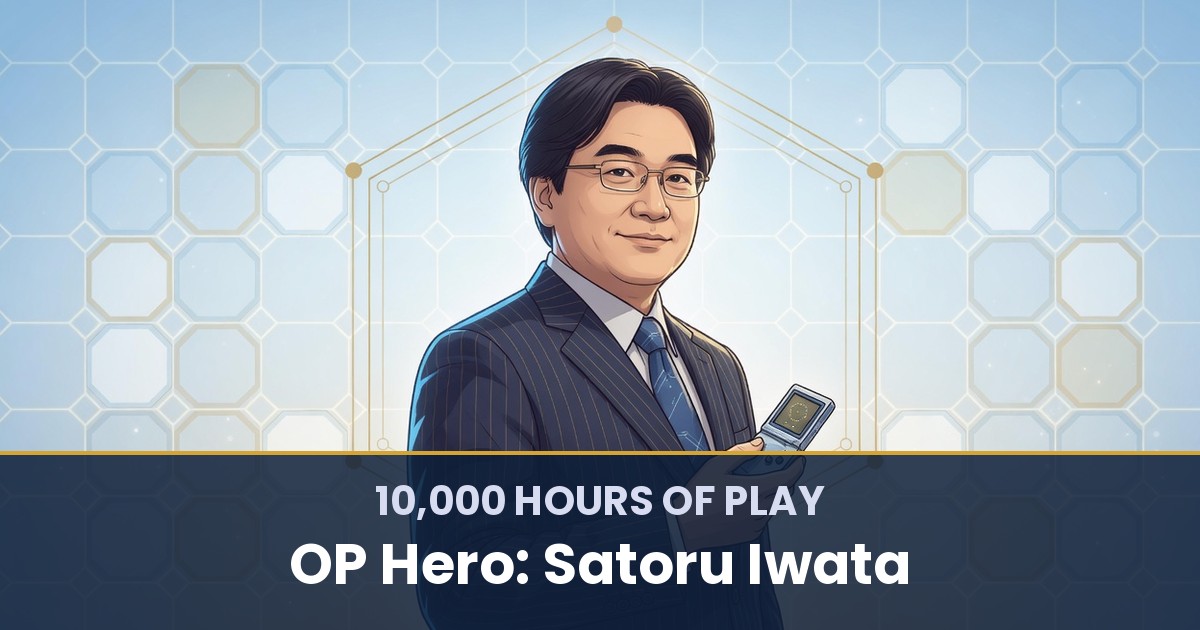


At the 2005 Game Developers Conference, the president of Nintendo introduced himself to a room full of developers in three layers.
“On my business card, I am a corporate president. In my mind, I am a game developer. But in my heart, I am a gamer.”
Satoru Iwata had earned all three. He wrote games on a programmable calculator in high school, programmed for HAL Laboratory while he was still a university student, and in 1993 became president of HAL at a moment when the studio was carrying ¥1.5 billion in debt.
In 2002 he succeeded Hiroshi Yamauchi as president of Nintendo. On his watch the company sold 154.02 million Nintendo DS systems and 101.63 million Wii consoles, with a strategy aimed at people who had never thought of themselves as players.
He also ran the company through the Wii U, which sold 13.56 million units, and when the results turned bad he halved his own pay and argued in public against layoffs.
The six Steps below follow his run from a calculator in Sapporo to the president’s office in Kyoto.
⚡ Speed Run Notes
- Iwata’s Game was widening the circle of people who play, and he kept doing programming work himself while he did it, at HAL and after he moved to Nintendo.
- His best-known moves were technical rescues: a rebuild plan that got EarthBound finished, and the data-compression tools he wrote for Pokémon Gold and Silver.
- As president of HAL he met every employee once every six months, and from 2006 he questioned Nintendo’s own developers on the record in the interview series Iwata Asks.
- His canon Skills: Elemental Transposition (Mage), Devour (Warlock), Imitate (Druid), Track Treasure (Ranger) and Phoenix Rebirth (Paladin).
- During the setback years of the 2011 Nintendo 3DS price cut and the Wii U, he cut his own pay by half and argued in public against layoffs.
Table of Contents
About Yu-kai Chou

Yu-kai Chou is the author of 10,000 Hours of Play — the book that treats your life as the most important game you’ll ever build a character in, and gives you the 6-Step framework (Game · Attributes · Role · Skills · Allies · Quests) to play it on purpose. He has spent two decades developing the system through which this post analyzes its OP Hero, and applies it to his own life and to the lives of the people he advises around the world.
Chou’s other framework, the Octalysis Framework, has been applied by LEGO, Microsoft, Porsche, Coca-Cola, Salesforce, and MrBeast, impacting over 1.5 Billion Users. He has taught the methodology at Harvard, Stanford, Yale, Tesla, Google, BCG, and IDEO, and has advised governments in eight nations including Ukraine, the United Kingdom, the Kingdom of Bahrain, Singapore, Taiwan, the Netherlands, Kazakhstan, and South Korea.
His work has been cited by Harvard, Stanford, MIT, Forbes, Wall Street Journal, Wired, US Department of Energy, NIST, NSF, NCBI, US Department of Education, ClinicalTrials.gov, and Google Scholar — with 3,700+ more academic publications. Explore his books here.

Satoru Iwata belongs in this series because he kept programming after he became a president: he was writing data-compression tools for Pokémon Gold and Silver while he was running HAL. If I could lift one move from his character sheet, it would be the conversation he held with every HAL employee once every six months while the studio was digging out of its debt.
Step 1: The Game — What Satoru Iwata Was Actually Playing
Iwata’s Game was to get more people playing, and to make sure the people making the games could keep doing their best work while that happened.
He played it first as a programmer who made difficult projects run, including the rebuild that got EarthBound finished in 1994. Later he kept a struggling studio alive as its president, and at Nintendo he bet the company on people who did not yet play games.
Nintendo’s own name for that bet was gaming population expansion. The Nintendo DS arrived in 2004 and the Wii in 2006, and Nintendo described titles such as Wii Sports and Brain Age as products aimed at people outside the established audience.
The GDC line about the business card, the developer’s mind and the gamer’s heart is the cleanest summary of the Game he chose. He held on to the engineer’s seat after the promotions, too: in 2001, a year after moving into Nintendo’s management, he was still helping with the programming and debugging of Super Smash Bros. Melee.
Step 2: Attributes — The Innate Stats
Attributes are the stats a player brings before any training, and four of Iwata’s show up early.
The first is systems thinking, and it shows up in high school, when he used an HP-65 programmable calculator to write simple games inside a machine with almost no memory to spare.
The second is persistence under technical pressure. Again and again he took on projects that were stalled, late or risky, from the rescue of EarthBound to the final debugging of Super Smash Bros. Melee.
The third is empathy for people who are not experts. The DS and Wii strategy started from the person who felt shut out by games, and his public interviews were written so that a reader with no technical background could follow the decisions.
The fourth is a low appetite for personal credit. In Iwata Asks he usually played the questioner and let the programmers, designers and producers explain what they had built.
The OP Talent Triangle Method looks for the strength that feels so ordinary its owner stops noticing it. For Iwata that looks like the habit of reading a system from the inside, whether the system was a cartridge, a studio or a company.
Step 3: Role(s) — The Character Class Across Chapters
Iwata changed his Role at least five times, and the part that transferred each time was his technical judgement.
The first Role was the student programmer. He studied computer science at the Tokyo Institute of Technology and worked part time for HAL Laboratory while he was still enrolled.
In the second Role he was a HAL programmer, joining the studio full time after graduating in 1982 and doing programming work on Nintendo Entertainment System titles, including Balloon Fight.
In the third Role he ran the studio, becoming president of HAL in 1993, after the company ran into a financial crisis, while still doing hands-on technical work on HAL and Nintendo projects.
In the fourth Role he was a corporate strategist, joining Nintendo in June 2000 as head of corporate planning and helping to set up The Pokémon Company.
The fifth was the president and public explainer. In May 2002 he succeeded Hiroshi Yamauchi as Nintendo’s fourth president, the first from outside the Yamauchi family, and later fronted Iwata Asks from 2006 and Nintendo Direct from October 2011.
Step 4: Skills — The Real-Life Game Skills Satoru Iwata Mastered
Attributes are the starting stats, and Skills are what a player trains. Five canon Skills explain most of Iwata’s run.
The first is Elemental Transposition (Mage): treating a problem as a puzzle with a better solution hidden inside it. When EarthBound was stuck at HAL, Shigesato Itoi later recalled, Iwata laid out two options.
The team could keep fixing the existing code, which he estimated would take about two years, or rebuild it, which he estimated would take about six months. The rebuild path was taken, and the game came out in Japan in 1994.
The second is Devour (Warlock): cutting steps and components until something becomes lean. For Pokémon Gold and Silver he wrote the data-compression tools that Game Freak used on the games, at a point when he was still president of HAL.
The third is Imitate (Druid): building rapport through active listening. As president of HAL he held interviews with every employee once every six months.
From 2006 he applied the same listening to Iwata Asks, where he asked developers to explain their decisions in plain language and followed up until the reasoning was on the page.
The fourth is Track Treasure (Ranger): spotting an opportunity that other players walk past. Nintendo under Iwata aimed its DS and Wii software at people who did not play games, and Brain Age and Brain Age 2 sold more than 19 million units combined.
The fifth is Phoenix Rebirth (Paladin): recovering from a devastating failure and coming back stronger. HAL hit its financial crisis in 1992 with ¥1.5 billion in debt, and the studio he led out of it went on to build the original Super Smash Bros. with him for the Nintendo 64.
On the Skills Spectrum, Iwata reads as a Master whose primary craft was programming, since he was writing compression tools while running HAL and debugging Melee after joining Nintendo’s management, with leadership and communication stacked on top of that craft.
Step 5: Allies — The People Who Multiplied Satoru Iwata
Iwata’s Allies were mostly people whose talent was different from his own: a writer, a game designer, a fellow developer-turned-executive and the company owner who backed him.
Hiroshi Yamauchi was the most consequential of them, because Nintendo supported HAL through its restructuring in the 1990s, while Yamauchi was Nintendo’s president, and Iwata joined Nintendo in 2000 and succeeded him as president in 2002.
Masahiro Sakurai was the creative partner who started his career with Iwata as his first boss, and the two built the Nintendo 64 prototype that became the original Super Smash Bros.
Shigesato Itoi supplied the writing and world of EarthBound, and Iwata supplied the engineering that let it ship. Their friendship lasted the rest of Iwata’s life, and in 2019 Itoi’s company Hobonichi published Iwata-san, a collection of his words that appeared in English in 2021 as Ask Iwata.
Shigeru Miyamoto was his closest collaborator at Nintendo and a fellow representative director. After Iwata’s death, Miyamoto and Genyo Takeda led the company together until Tatsumi Kimishima became president in September 2015.
The pattern behind choosing Allies by what they can do that you cannot shows up clearly here. Itoi and Sakurai covered story and design, which were never Iwata’s specialty, and Yamauchi supplied capital and authority that a programmer from a struggling studio lacked.
Step 6: Quests — The Milestones That Shaped the Saga
Iwata’s Quests run from a programmable calculator to the president’s chair, with one long setback near the end.
Quest 1 was the apprenticeship: calculator games in high school, part-time programming at HAL as a student, and a full-time job there from 1982.
Quest 2 was the HAL rescue, which began when he took over as president in 1993 with the company ¥1.5 billion in debt and Nintendo’s support behind the restructuring.
Quest 3 was the run of technical saves: EarthBound in 1994, the Super Smash Bros. prototype with Sakurai, the compression work on Pokémon Gold and Silver, and help with the programming and debugging of Super Smash Bros. Melee in 2001.
Quest 4 was the expansion bet as president. The DS from 2004 and the Wii from 2006 went after new players, and their lifetime totals reached 154.02 million and 101.63 million units.
Quest 5 was the long setback of the early 2010s. In July 2011 Nintendo announced a price cut for the Nintendo 3DS in Japan from ¥25,000 to ¥15,000, and the Wii U, launched in 2012, finished with 13.56 million units sold.
He took a 50 percent pay cut in 2011 and another in 2014. At Nintendo’s annual shareholders meeting in June 2013 he explained his opposition to layoffs: “If we reduce the number of employees for better short-term financial results, however, employee morale will decrease.”
Quest 6 was the final stretch. In June 2014 he missed E3 after a growth was found in his bile duct, and he died on 11 July 2015, aged 55, still president of the company.
What You Can Steal From Satoru Iwata’s Build
First, keep your craft after the promotion. Iwata was still reading code as a studio president, and that is how he could tell the EarthBound team that a rebuild would beat two more years of patching.
Second, build listening into your calendar so it happens in good years and bad ones, and keep asking follow-up questions until the other person’s reasoning is clear, the way Iwata did with his own developers in Iwata Asks.
Third, aim at the player who is not in the room. The DS and the Wii were built for people who did not yet call themselves gamers, and Nintendo’s sales figures show how many of them were out there.
Fourth, when the bad year comes, decide who absorbs the cost. Iwata cut his own salary first and said out loud why he opposed layoffs.
Where this framework comes from

Want the full system this profile is built on?
Every OP Hero piece runs through the same 6-Step framework from 10,000 Hours of Play: Unlock Your Real-Life Legendary Success. The book covers the full system, walks through Yu-kai’s own life run as the first applied case study, and gives you the worksheets to audit your own build.
Related Reading
- All OP Hero Profiles — the full hub
- 10,000 Hours of Play by OP Hero: Shigeru Miyamoto
- 10,000 Hours of Play by OP Hero: Hideo Kojima
- 10,000 Hours of Play by OP Hero: Akio Morita
- 10,000 Hours of Play by OP Hero: Konosuke Matsushita