
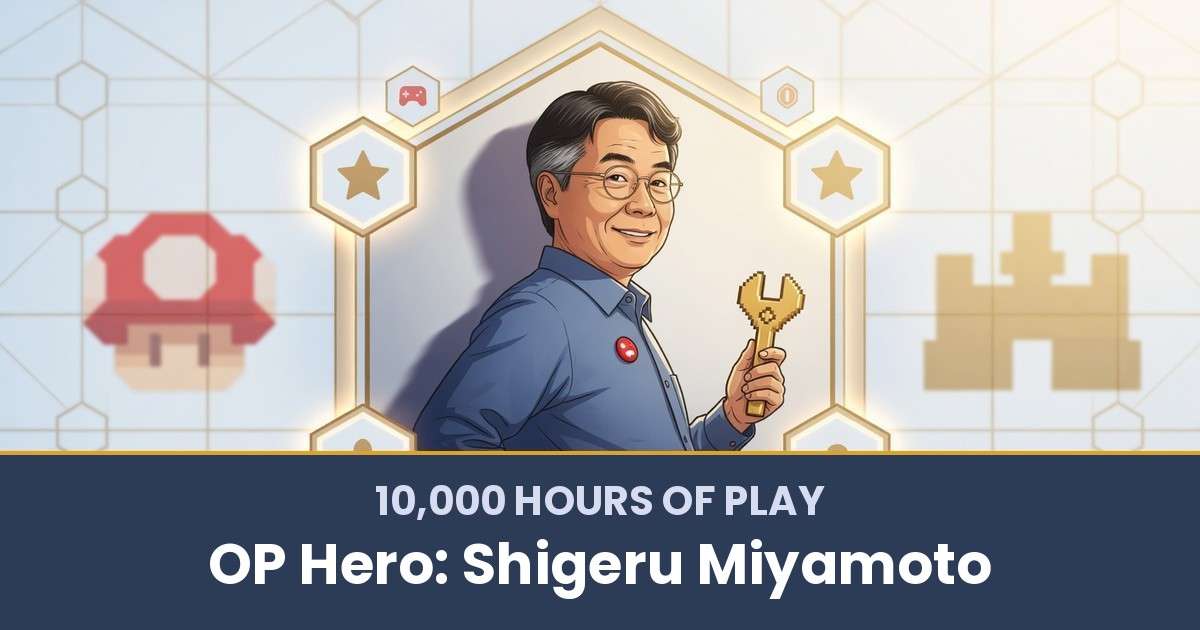


Most kids who explore the woods grow up and write a memoir. Shigeru Miyamoto explored the woods and gave millions of players the same feeling on a 14-inch CRT.
That is the audacious thing he did. He took a private childhood — wandering the forests, lakes, and small caves around Sonobe, in rural Kyoto — and turned it into a public language of play that runs through Donkey Kong, Mario, Zelda, Pikmin, Nintendogs, Wii Sports, and the multibillion-dollar arc Nintendo is still riding.
He never set out to be a celebrity. He wanted to make toys. And while everyone around him was racing to make games look more like cinema, he kept asking a much smaller question — does this feel like a place a child would want to keep poking at?
He asked that single question for fifty years.
⚡ Speed Run Notes
- Miyamoto’s life mission was never “make hit games.” It was “build little worlds that ordinary people can discover joy inside.”
- His signature Skill is subtraction. Wii Sports is bowling minus stats. Pikmin is gardening minus complexity. He carved games down until they felt like toys.
- Donkey Kong (1981) was not a gamble he won. It was a rescue mission run on 2,000 unsellable Radar Scope arcade cabinets that Nintendo of America was sitting on. He turned a writedown into a $280M debut.
- His Sonobe childhood — caves, forests, a lake he stumbled onto behind a hill — is literally the level design of The Legend of Zelda. He treats the “miniature garden” as a design specification.
- The team multiplied him: Yamauchi bet on him, Yokoi mentored him, Tezuka co-built with him, Kondo scored him, Iwata translated him to a generation. No solo genius story here — read the cap table of the dynasty.
- The transferable lesson: stop adding, and cut until only the feeling is left.
Updated 3 October 2026: added his 2026 film work, the creators running his build today, and common questions.
Table of Contents
- Step 1: The Game — What Miyamoto Was Actually Playing
- Step 2: Attributes — The Innate Stats
- Step 3: Role(s) — The Character Class Across Chapters
- Step 4: Skills — The Real-Life Game Skills Miyamoto Mastered
- Step 5: Allies — The People Who Multiplied Miyamoto
- Step 6: Quests — The Milestones That Shaped the Saga
- What You Can Steal From Miyamoto’s Build
- The 10K HP Frame
- Which Core Drives His Arc Activated
- Modern Echo
- Frequently Asked Questions
- Where this framework comes from
- Related Reading
About Yu-kai Chou

Yu-kai Chou is the author of 10,000 Hours of Play — the book that treats your life as the most important game you’ll ever build a character in, and gives you the 6-Step framework (Game · Attributes · Role · Skills · Allies · Quests) to play it on purpose. He has spent two decades developing the system through which this post analyzes its OP Hero, and applies it to his own life and to the lives of the people he advises around the world.
Chou’s other framework, the Octalysis Framework, has been applied by LEGO, Microsoft, Porsche, Coca-Cola, Salesforce, and MrBeast, impacting over 1.5 Billion Users. He has taught the methodology at Harvard, Stanford, Yale, Tesla, Google, BCG, and IDEO, and has advised governments in eight nations including Ukraine, the United Kingdom, the Kingdom of Bahrain, Singapore, Taiwan, the Netherlands, Kazakhstan, and South Korea.
His work has been cited by Harvard, Stanford, MIT, Forbes, Wall Street Journal, Wired, US Department of Energy, NIST, NSF, NCBI, US Department of Education, ClinicalTrials.gov, and Google Scholar — with 3,700+ more academic publications. Explore his books here.
What I personally find instructive about Miyamoto’s build is the discipline of subtraction. Most of us, when we want to be taken seriously, add — more features, more credentials, more rules. Miyamoto did the opposite. He kept the player’s first three minutes sacred and threw out anything that didn’t earn its place inside them. If you only steal one move from his sheet, steal that.
Step 1: The Game — What Miyamoto Was Actually Playing
If you watch his interviews end to end, one phrase keeps surfacing — the “miniature garden.” Miyamoto has said for decades that the dream is to build a small world the player can carry around in a drawer and visit whenever they like.
That is the game he was playing: designing places — places that felt like toys you could pick up and turn over in your hand. Mario and Zelda work as gardens with rules.
So what was Miyamoto actually playing? He was playing the game of teaching every other human how to play. He kept asking, in his own interviews, whether his work was understandable to people who did not play games.
Most ambitious people define their game in terms of an outcome. Miyamoto defined his in terms of an experience he wants other people to be able to have. That reframe — from “what do I want to win?” to “what do I want others to feel?” — changes which skills compound and which alliances matter.
Step 2: Attributes — The Innate Stats
Miyamoto was born in 1952 in Sonobe, a small town in Kyoto Prefecture. The family did not own a television. He had a pencil, the countryside, and time.
Three innate Attributes show up early and never leave.
Exploratory curiosity. The famous story — and he has repeated it across decades of Nintendo interviews — is that he wandered the woods around Sonobe and found a lake behind a hill he had not expected. He found a small cave he eventually worked up the courage to enter with a paper lantern. That feeling of cresting a hill and discovering something is the entire emotional core of Zelda’s overworld. He already had that Attribute at age eight and encoded it into the game thirty years later.
Tinkerer’s hands. He drew constantly as a kid, built simple puppets, sketched manga, and went on to study industrial design at Kanazawa Municipal College of Industrial Arts (now Kanazawa College of Art). He came up the side that thinks in objects you can hold. That is why Nintendo’s hardware — the D-pad, the Wii remote, the Switch — feels like toys, not appliances. He brought a sculptor’s hands to a digital industry.
Contrarian taste. By his early twenties he had already developed a stubborn dislike of design conventions he found boring. In a 1992 round-table on RPGs he flatly refused to call Zelda a traditional RPG — “I’m not interested in systems where everything in the game is decided by stats and numbers.” He had a built-in allergy to inherited form.
If you want to audit your own innate stats with the same honesty, the Talent Triangle Method is the cleanest place to start. The idea is not to list things you are good at — it is to spot the things you already do without permission, the way Miyamoto already drew, already explored, already disliked stat-heavy RPGs before anyone paid him to.
Step 3: Role(s) — The Character Class Across Chapters
Miyamoto’s class kept evolving, but the throughline is always “the one who decides what the experience feels like.”
1977–1980 — In-house planner and apprentice artist. Hiroshi Yamauchi, Nintendo’s president, hired Miyamoto in 1977 as the company’s first staff artist. There was no precedent for the role. Nintendo was a card-and-toy company trying to break into electronic arcades. Miyamoto designed cabinet art for Sheriff (1979) and Radar Scope (1980) and absorbed Gunpei Yokoi’s engineering pragmatism by sitting next to it.
1981–1991 — Lead game designer. Donkey Kong (1981), Mario Bros. (1983), Super Mario Bros. (1985), The Legend of Zelda (1986). For a decade he was the planner at the center of every flagship, sketching levels on graph paper, dictating sprite art, choosing the camera angle of a jump. This is the “auteur” chapter — the one history mythologizes — but inside Nintendo it was a working role with deadlines and arcade-cabinet quotas.
1991–2015 — Producer and General Manager of EAD. As Super Mario World, A Link to the Past, Super Mario 64, and Ocarina of Time shipped, Miyamoto increasingly moved from level designer to oversight. He ran Nintendo’s Entertainment Analysis & Development division — the studio behind the company’s first-party crown jewels — and started letting protégés like Takashi Tezuka and Eiji Aonuma direct. The Role shifted from “I draw the levels” to “I am the quality filter at the end of the hallway.”
2015–present — Creative Fellow. After Satoru Iwata’s death in 2015, Nintendo reorganized. Miyamoto stepped out of EAD leadership and into the Creative Fellow role, focusing on cross-company creative direction — the Super Nintendo World theme parks at Universal, The Super Mario Bros. Movie with Illumination, and long-horizon IP strategy. Same Attributes, completely new Role.
Step 4: Skills — The Real-Life Game Skills Miyamoto Mastered
Six canon Skills do most of the heavy lifting in his build.
Vision Manifestation (Warlock) — visualizing a finished experience so vividly the design becomes a transcription job. Miyamoto did not draw Zelda’s overworld from a research document. He drew it from a thirty-year-old memory of a cave behind a hill in Sonobe. When he said the goal was a “miniature garden you can put inside your drawer,” that was not poetry; it was a render of the finished product, ready to be reverse-engineered into tiles and sprites.
Enchant (Druid) — gamification as a designed skill, not an accident of talent. Mario is a plumber because a plumber is the most projectable everyman costume Miyamoto could think of. The bricks, the mushrooms, the goombas — none of them came from “what looks cool”; they came from “what does a kindergartener instantly read as a hop-able object?” Twenty years later, Wii Sports applied the same Skill to people who had never held a controller, by asking what a grandparent’s first three minutes with the device should feel like.
Devour (Warlock) — the subtraction Skill. Wii Sports drops bowling’s scoreboard rituals, and Nintendogs ships with no win state at all.
Subtraction also explains his stance on the Skills Spectrum. Miyamoto is not a Specialist hoarding one technique; he is a Master who keeps refusing to add the next “obvious” feature because it would muddy the toy. Mastery, for him, is the discipline of holding the line.
Cognitive Lens (Mage) — zooming between micro and macro without flinching. He can argue for hours about whether Mario’s jump arc should feel one frame heavier on the descent (micro), and in the same week reset Nintendo’s entire hardware strategy around “what would a 70-year-old enjoy?” (macro).
Phoenix Rebirth (Paladin) — recovering from devastating failure and coming back stronger. Three Rebirths anchor his career. Radar Scope flopped in 1981, leaving 2,000 unsold arcade cabinets stuck in a New Jersey warehouse; he was handed the cabinets and asked to make something else from them, and Donkey Kong (which cleared $180M in its first year and over $280M by 1983) was born. The Virtual Boy bombed in 1995 and he absorbed the loss and pivoted into Super Mario 64, a template for the 3D platformers that followed. The GameCube under-shipped against PlayStation 2 in the early 2000s, and the response was the Wii — a console that out-sold the PS3 after Nintendo shifted the question from “more graphics” to “more people in the room.”
Tactical Command (Ranger) — making people of different talents work harmoniously. Nintendo EAD under Miyamoto was a coalition: industrial designers, programmers, sound composers, narrative writers, hardware engineers in Yokoi’s R&D1 building. He learned to translate between all of them. Composer Koji Kondo could write themes for Mario and Zelda because Miyamoto could brief him in player-feeling terms instead of musical terms.
Step 5: Allies — The People Who Multiplied Miyamoto
The myth says solo genius. The org chart says coalition.
Hiroshi Yamauchi — Nintendo’s president for fifty-three years and the one who hired Miyamoto in 1977 with no precedent for the role. Yamauchi later handed him the Donkey Kong rescue assignment over more senior engineers. Without that single hiring decision, Miyamoto is a Kyoto industrial designer who draws on the weekends.
Gunpei Yokoi — the engineering mentor. Yokoi led Nintendo R&D1, invented the Game & Watch and later the Game Boy, and produced Donkey Kong. He taught Miyamoto Nintendo’s “lateral thinking with withered technology” doctrine — make new toys out of cheap, proven hardware.
Takashi Tezuka — long-running co-designer on Mario and Zelda. Tezuka co-directed Super Mario Bros., directed A Link to the Past, and remained one of the few people who could finish Miyamoto’s sentences in a design review.
Koji Kondo — composer of the Mario and Zelda themes. The reason a Mario coin makes you feel something is Kondo’s score.
Satoru Iwata — programmer-turned-CEO who took over Nintendo in 2002 and partnered with Miyamoto to ship the DS, the Wii, and the long-form “Iwata Asks” interview series. Iwata translated Miyamoto’s design instincts to a public audience and shielded him operationally. When Iwata died in 2015, the absence shaped Miyamoto’s pivot into the Creative Fellow role.
Step 6: Quests — The Milestones That Shaped the Saga
Six Quests, in order. Each one moved the build.
Donkey Kong (1981). Nintendo of America had 2,000 unsold Radar Scope arcade cabinets and a warehouse full of red ink. Yamauchi handed Miyamoto — twenty-eight years old, no shipped hits — the conversion project. He designed a love-triangle climbing game with a gorilla, a princess, and a jumping carpenter. First-year US arcade revenue cleared roughly $180 million; by 1983 the title had earned over $280 million. The cabinets became Donkey Kong machines. The carpenter became Mario.
Super Mario Bros. (1985). The launch title for the Famicom abroad relaunch (the NES). It sold over 40 million copies and helped revive the American console market after the 1983 crash. More importantly, it formalized a grammar — run, jump, hidden block, mushroom, flag — that later platformers either copied or deliberately refused.
The Legend of Zelda (1986). Released first on the Famicom Disk System in Japan and on the first 1MB battery-save cartridge in the West. It introduced battery-backed saving to home consoles, encoded the Sonobe overworld at scale, and seeded a franchise that has been Nintendo’s prestige play for forty years.
Virtual Boy (1995) — the setback. A monochrome stereoscopic console pushed out before the technology was ready. It sold under a million units, was discontinued within a year, and is remembered as Gunpei Yokoi’s last Nintendo project (Yokoi left the company in 1996). Miyamoto absorbed the loss and rolled the team straight into Super Mario 64.
Super Mario 64 (1996). The first true 3D platformer with a free-roaming camera. Shipped as a launch title for the N64. Every 3D action game today owes it design debts — analog stick control, focal-point camera, hub-and-spoke level structure.
Wii Sports and the Wii era (2006). After the GameCube under-shipped, Miyamoto and Iwata bet the company on a console aimed at the people who did not buy consoles. Wii Sports came pre-packaged with the hardware, and it pulled grandmothers, fitness instructors, and entire retirement homes into Nintendo’s customer base. The Wii sold over 101 million units.
What You Can Steal From Miyamoto’s Build
The temptation, when you read a profile like this, is to copy the surface artifact — start a games studio, sketch on graph paper, talk about miniature gardens. Don’t.
The first steal is the outsider test. Whatever you are building right now — a product, a body of work, a relationship, a curriculum — ask whether someone who has never touched your field could enjoy it within a few minutes.
The second steal is Role evolution. He was a planner, then a designer, then a producer, then a manager, then a Creative Fellow. The Game stayed identical; the Role kept changing. Most people lock their Role too early and resent the next chapter. Miyamoto kept asking what the work needed of him, and accepted being demoted from sole auteur to coach when that’s what served the Game.
The third steal is allies who don’t change. Yamauchi, Yokoi, Tezuka, Kondo, Iwata. Five names across fifty years. Build that bench in your own life.
The 10K HP Frame — Shigeru Miyamoto Through the 6 Steps Lens
Put the whole fifty-year run on one 10K HP character sheet and the chassis is Druid: Nurture and Empathize, win by making something ordinary people love on the first try.
Step 1, Choose Your Game, stayed fixed from Donkey Kong in 1981 to the films of 2026.
Step 2, Know Your Attributes, gave him curiosity, an industrial designer’s hands, and a strong allergy to stat-heavy design. All three were visible before Nintendo paid him a yen.
Step 3, Select Your Role, is where his build looks most mature. He moved from artist to designer to producer to Fellow, and each move gave the next generation more of the controls.
Step 4, Enhance Your Skills, shows a Warlock engine bolted inside the Druid frame. Devour (Warlock) cut every feature that blurred the toy, and Vision Manifestation (Warlock) turned a childhood cave into a tile map.
Divine Shield (Paladin), the ability to say no regardless of how persuasive the room is, belongs on his sheet as well.
Nintendo developers have a phrase for his version of it, chabudai gaeshi, upending the tea table. Developers who worked under him describe a late review where he overturns a nearly finished design because it no longer feels right.
Those reviews were hard on teams.
Step 5, Build Your Alliances, kept growing after Iwata died in 2015. Illumination founder Chris Meledandri became the ally who carried Mario into film, producing both Mario movies alongside him.
Step 6, Achieve Your Quests, reads as a chain of three Phoenix Rebirths: Radar Scope into Donkey Kong, Virtual Boy into Super Mario 64, GameCube into Wii.
The class synthesis: a Druid heart, a Warlock pruning knife, and a Paladin who could say no to his own team.
Which Octalysis Core Drives Shigeru Miyamoto’s Arc Activated
Run his work through the Octalysis Framework and four Core Drives carry most of the weight.
CD7: Unpredictability & Curiosity is the drive he was born with.
The 1986 Legend of Zelda opens with a boy in a field, no sword, and a dark cave entrance a few steps away. The game trusts you to walk in.
Super Mario Bros. hid blocks in empty air and a warp zone above the ceiling of World 1-2. Kids traded those secrets on playgrounds for years.
He designed the cave first and let the player find the courage.
CD3: Empowerment of Creativity & Feedback is how he built.
Before Super Mario 64 had a single level, the team tested and refined Mario’s running and jumping on a simple grid. The feedback loop between thumb and character came first.
Pikmin grew partly out of the gardening he took up with his wife, and Nintendogs out of the family’s Shetland sheepdog, Pikku. Both games hand the player a small living system to tinker with.
CD5: Social Influence & Relatedness carried the Wii era.
Wii Sports was built for the people watching from the couch. Grandparents bowled against grandchildren, and the person holding the remote became a show for everyone else in the room.
Every bowler appeared as a Mii, a cartoon avatar each player built to look like themselves, so the lane filled up with faces from the same household.
That shift turned a console into a family activity, and the hardware sold over 101 million units.
CD2: Development & Accomplishment lives in his first minute of every game.
World 1-1 teaches without text. The first Goomba walks toward you, the first mushroom slides off a block, and within thirty seconds you have learned jump, threat, and power-up by doing them.
Modern Echo — Who’s Playing This Game Today
Since the Last Time We Told This Story
At 73, Miyamoto is still working. Nintendo lists him as Representative Director and Fellow.
The Super Mario Galaxy Movie, which he produced with Illumination’s Chris Meledandri, premiered at the Minami-za theater in Kyoto on March 28, 2026 and opened in the United States on April 1. It crossed $1 billion worldwide, following The Super Mario Bros. Movie (2023), which grossed more than $1.3 billion.
On September 8, 2026, Nintendo confirmed that the live-action film of The Legend of Zelda, directed by Wes Ball and produced by Miyamoto and Avi Arad, will release on April 30, 2027.
The theme parks keep spreading too. Super Nintendo World opened at Universal’s Epic Universe in Orlando on May 22, 2025, after Osaka in 2021 and Hollywood in 2023, and Miyamoto was heavily involved in designing the lands.
Closer to home, the Nintendo Museum opened in Uji on October 2, 2024, on the site of the old Ogura plant where Nintendo once printed playing cards and repaired toys.
Visitors can try the Ultra Hand, the Love Tester, and the Game & Watch, the cheap clever toys Gunpei Yokoi built before video games, and play classic titles with giant controllers that take two people to operate.
The museum preserves the toy-company culture Miyamoto walked into in 1977.
The boy who wanted to build a garden in a drawer now builds them at the scale of theme parks.
So who is running his build in 2026? Two players stand out.
Nicolas Doucet runs the closest thing to a Miyamoto studio outside Kyoto. His Team Asobi, around sixty people at Sony, shipped Astro Bot on September 6, 2024.
The game won Game of the Year at The Game Awards 2024, the BAFTA Games Awards, and the D.I.C.E. Awards, and critics compared it to Super Mario Galaxy and Odyssey more than to anything on PlayStation.
It scored 94 on Metacritic, the highest of any game released that year.
Doucet’s team built the PS5 controller into the platforming itself, so the haptics and triggers feel like part of the toy.
LocalThunk is the subtraction echo. Working alone in Saskatchewan for about two and a half years, the pseudonymous developer built Balatro on a standard 52-card deck, a rule set nearly everyone already knows.
LocalThunk has said he avoided playing other deckbuilders while making it, so their habits would not leak into his design. Miyamoto showed the same stubborn taste toward stat-heavy RPGs.
Released February 20, 2024, it passed 5 million copies by January 2025 and won Game of the Year at the Game Developers Choice Awards.
Wii Sports took bowling and cut the rituals. Balatro took poker hands and cut the table, the opponents, and the money, keeping only the thrill of a good hand.
Frequently Asked Questions
Is Shigeru Miyamoto still working at Nintendo?
Yes. He is Nintendo’s Representative Director and Fellow. He produced The Super Mario Galaxy Movie (2026) and is producing the live-action Legend of Zelda film, scheduled for April 30, 2027.
What games did Shigeru Miyamoto create?
He created Donkey Kong, Super Mario Bros., and The Legend of Zelda, and led Pikmin, Nintendogs, and Wii Sports. As producer he oversaw much of Nintendo’s first-party catalog from the 1990s onward.
Where did the idea for The Legend of Zelda come from?
From his childhood in Sonobe, Kyoto Prefecture. Miyamoto has described exploring the hills, finding a lake he did not expect, and working up the nerve to enter a cave with a lantern. Zelda’s overworld recreates that feeling of discovery.
Did Shigeru Miyamoto produce the Super Mario movies?
Yes. He produced The Super Mario Bros. Movie (2023) and The Super Mario Galaxy Movie (2026) with Illumination founder Chris Meledandri. The Galaxy film premiered in Kyoto in March 2026 and passed $1 billion worldwide.
What does “upending the tea table” mean at Nintendo?
It is the nickname for Miyamoto’s habit of overturning a game late in development when it no longer feels right. The phrase, chabudai gaeshi in Japanese, comes from a famous table-flipping scene in the baseball manga Star of the Giants.
What was Shigeru Miyamoto’s first game?
His first credits were cabinet artwork for Nintendo arcade machines such as Sheriff (1979) and Radar Scope (1980). The first game he designed himself was Donkey Kong (1981), built to reuse unsold Radar Scope cabinets, and it introduced the character who became Mario.
When was Shigeru Miyamoto born?
November 16, 1952, in Sonobe, a small town in Kyoto Prefecture. Nintendo hired him in 1977 as its first staff artist after he studied industrial design in Kanazawa.
What is Shigeru Miyamoto’s design philosophy?
He prototypes how a character or controller feels first and builds levels around it. His games teach through play in the first minute, and he has scrapped nearly finished work late in development when it stopped feeling right.
Where this framework comes from

Want the full system this profile is built on?
Every OP Hero piece runs through the same 6-Step framework from 10,000 Hours of Play: Unlock Your Real-Life Legendary Success. The book covers the full system, walks through Yu-kai’s own life run as the first applied case study, and gives you the worksheets to audit your own build.
Related Reading
- All OP Hero Profiles — the full library of life-as-RPG case studies
- OP Hero: Hayao Miyazaki — Studio Ghibli’s life-as-RPG build
- OP Hero: Akira Toriyama — the Dragon Quest artist who drew kids into console RPGs
- OP Hero: J.K. Rowling — building a universe out of an unfinished commute
- The Talent Triangle Method — find your edge stat before you pick your class
- The Skills Spectrum — Specialist, Dabbler, or Master?
- Turning Life Into a Game — the 10K HP framework introduction