
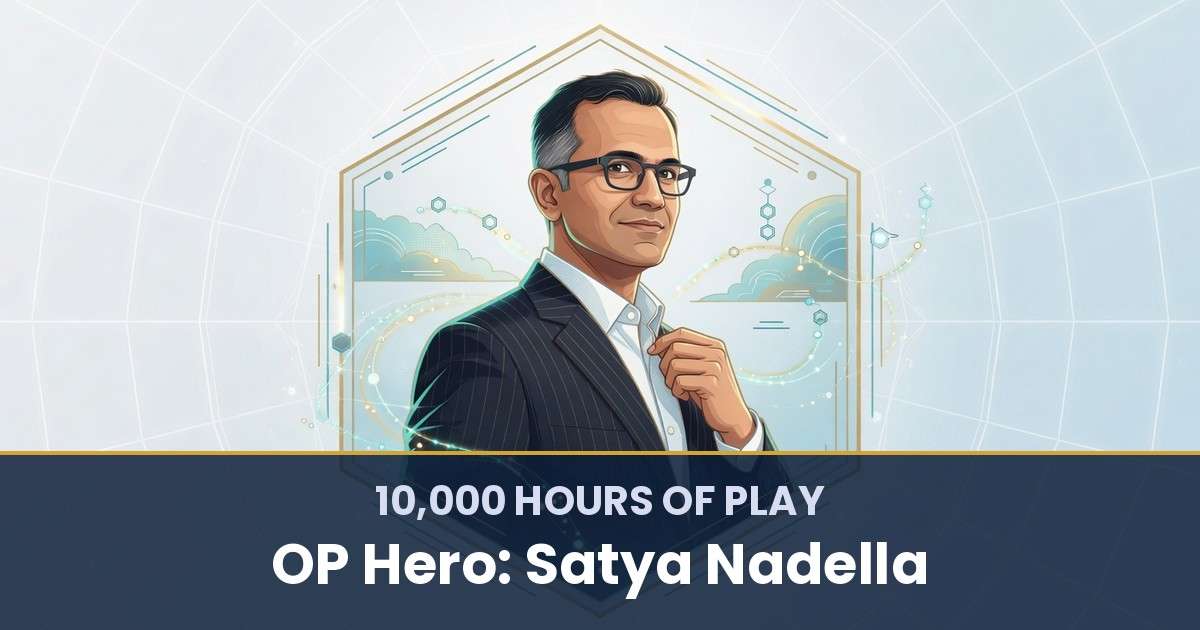


On 4 February 2014 a 46-year-old electrical engineer from Hyderabad walked into a press conference in Redmond as Microsoft’s third CEO, behind Bill Gates and Steve Ballmer. The company he inherited was profitable and unloved. Windows Phone was failing. The mobile war was lost. The stock had been flat for fourteen years. Inside the building, “know-it-all” was the unofficial culture, and the smartest engineer in any meeting was usually the one who won the meeting.
Twelve years later, Microsoft is one of the most valuable companies in the world, Azure is a credible challenger to AWS, GitHub and LinkedIn are inside the tent, and the company’s AI position runs through a partnership with OpenAI that almost nobody saw coming in 2018.
What changed was not the technology stack. What changed was Satya Nadella, and the trait he insisted his company had to grow into for any of the other moves to land.
This profile reads his run through the 10K HP framework, which treats your life as the most important RPG you will ever play and asks what specific Attributes, Skills, and Allies pulled the legendary results out of the decades.
⚡ Speed Run Notes
- Nadella’s Game has been the same for thirty years: build general-purpose computing platforms that amplify what other people do. Cloud, productivity, AI: the same Game played one layer up each time.
- His rare innate stat is empathy paired with systems thinking. Most leaders have one. He had both, and his son’s cerebral palsy diagnosis turned the first one from a personality trait into a strategic posture.
- The cultural shift from “know-it-all” to “learn-it-all” is the under-told work. Without it, none of the acquisitions, partnerships, or platform pivots would have stuck.
- Mojang ($2.5B in 2014), LinkedIn ($26.2B in 2016), GitHub ($7.5B in 2018), and the OpenAI partnership are one coherent platform play, not four separate bets.
- Microsoft stock rose nearly tenfold between his 2014 appointment and November 2023, a 27% annual growth rate that ended a 14-year period of near-zero growth.
- The 2014 Grace Hopper gaffe is the public failure he metabolized into a reflexive “completely wrong” memo. It is the moment that taught his company how he wanted criticism handled.
Table of Contents
About Yu-kai Chou

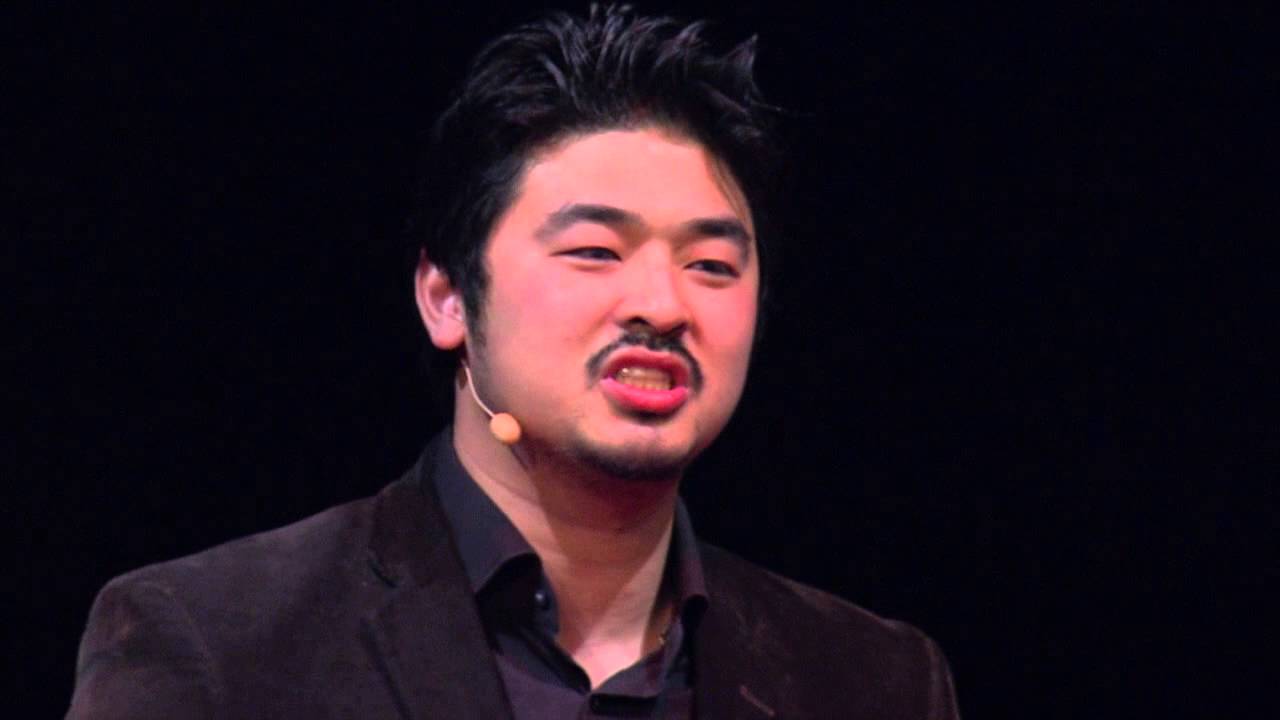
Yu-kai Chou is the author of 10,000 Hours of Play — the book that treats your life as the most important game you’ll ever build a character in, and gives you the 6-Step framework (Game · Attributes · Role · Skills · Allies · Quests) to play it on purpose. He has spent two decades developing the system through which this post analyzes its OP Hero, and applies it to his own life and to the lives of the people he advises around the world.
Chou’s other framework, the Octalysis Framework, has been applied by LEGO, Microsoft, Porsche, Coca-Cola, Salesforce, and MrBeast, impacting over 1.5 Billion Users. He has taught the methodology at Harvard, Stanford, Yale, Tesla, Google, BCG, and IDEO, and has advised governments in eight nations including Ukraine, the United Kingdom, the Kingdom of Bahrain, Singapore, Taiwan, the Netherlands, Kazakhstan, and South Korea.
His work has been cited by Harvard, Stanford, MIT, Forbes, Wall Street Journal, Wired, US Department of Energy, NIST, NSF, NCBI, US Department of Education, ClinicalTrials.gov, and Google Scholar — with 3,700+ more academic publications. Explore his books here.
What I personally find instructive about Satya Nadella’s build is how thoroughly he turned a single Attribute, empathy, into the foundation of a half-trillion-dollar culture change. Most leaders treat empathy as a soft skill that lives in HR. Nadella treated it as a strategic asset, then a product principle, then a hiring filter. The lesson worth lifting is that the personal traits that feel like vulnerabilities in your character sheet, the ones the dice rolled before the game started, are often the ones that scale into the most durable competitive edges when you let them lead instead of hiding them.
Step 1: The Game — What Satya Nadella Was Actually Playing
Most Microsoft executives in the 2000s played the game “defend Windows and Office.” Steve Ballmer played the game “win every category.” Nadella has been playing a different one for thirty years.
His Game is platforms that amplify what other people and organizations do. Not consumer gadgets. Not headline products. Infrastructure that other builders build on top of. You can trace the same Game through every chapter: Windows NT and networking in the 1990s; online services and search in the 2000s; Server & Tools and then Azure in the early 2010s; LinkedIn, GitHub, and the OpenAI partnership as CEO.
When he was promoted to CEO in February 2014 he rewrote Microsoft’s mission statement to say it out loud. The new mission was “to empower every person and every organization on the planet to achieve more.” That phrasing is not corporate decoration. It is the explicit promise that Microsoft’s role is to be the platform other people’s quests run on top of, not the protagonist of every quest itself.
This is the difference between an OP-Hero arc and a celebrity arc. Celebrities play the game “be the most visible person in the frame.” OP heroes pick a Game that scales beyond their own visibility. Nadella picked a Game that, by definition, makes other people the heroes of the story Microsoft is in. That single framing reorganizes everything that comes after.
Step 2: Attributes — The Innate Stats
Five Attributes show up early and keep showing up.
Empathy as an organizing principle. Nadella has said directly that becoming the father of a son with cerebral palsy fundamentally changed his perspective and made empathy central to how he leads and how he thinks about products. Most leaders would have kept the family experience private and the work experience separate. He merged them. He has cited that single relationship as the source of the lens he now uses to read meetings, customers, and entire markets.
Systems thinking. Academic case studies of his Microsoft tenure describe his approach as “integrative reconfiguration.” He sees Windows, Office, Azure, Xbox, LinkedIn, and GitHub as one system that can be recombined rather than as separate divisions that must be defended. That kind of pattern recognition, applied to a portfolio rather than a product, is rare and not really teachable past a certain age. The Talent Triangle Method calls this kind of multi-scale view a Strategic vector, and Nadella’s runs the full length of it.
Long time horizons. In his early cloud-and-enterprise role he was already arguing in public that cloud computing would reshape how every business runs, well before Azure was a major business. His 2014 CEO email speaks in ten-to-twenty-year horizons rather than quarter-by-quarter moves. Comfort with that kind of time scale is an Attribute, not a skill: it is something you either tolerate in your bones or you flinch away from.
Low-ego coalition building. Multiple reviews of his leadership describe him as collaborative, humble, and listening-oriented, in deliberate contrast to the combative style of the previous regime. He is repeatedly credited with rebuilding partnerships that earlier Microsoft eras had burned, including with developers, with open-source communities, and even with the Linux community Microsoft had once treated as a strategic enemy.
Quiet, durable adaptability. He moved from India to the United States for a master’s in computer science, then earned a Booth MBA while working full time at Microsoft, then changed his own “class build” from individual contributor to engineering manager to division president to CEO. Each shift was self-initiated. The pattern is not “ambitious career climber.” The pattern is “comfortable updating his own identity when the world updates around him.”
Step 3: Role(s) — The Character Class Across Chapters
Nadella’s roles change every five to ten years, but the platform-builder Quest underneath stays constant.
Apprentice Engineer (1980s–early 1990s). Hyderabad Public School in Begumpet. B.E. in electrical engineering from the Manipal Institute of Technology in 1988. Master’s in computer science from the University of Wisconsin–Milwaukee in 1990. A stint at Sun Microsystems before joining Microsoft in 1992. The class here is straightforward: a high-aptitude technical apprentice trading hardware for software as the industry pivoted.
Platform Engineer-Manager (1992–mid-2000s). Inside Microsoft he started on Windows NT and networking, which is enterprise-grade operating system and infrastructure work, not consumer software. He earned his University of Chicago Booth MBA in 1997 while working full time, which is its own multi-classing achievement. By the mid-2000s he was running engineering across online services, search, and business solutions.
Cloud General (9 February 2011 – February 2014). President of Microsoft’s Server & Tools Business. Under him, cloud-services revenue grew from $16.6 billion when he took over in 2011 to $20.3 billion by June 2013. This is the chapter where his fingerprints first show up on the company’s balance sheet rather than just in the codebase. The class here is Infrastructure Architect commanding division-scale resources to bet on cloud before Azure was the obvious answer.
Turnaround CEO and Culture Reforger (4 February 2014 – present). Announced as Microsoft’s third CEO, after Bill Gates and Steve Ballmer. In June 2021 he also became chairman, succeeding John W. Thompson. The class here is split: half platform king setting strategy and capital allocation at trillion-dollar scale, half culture cleric working on the soul of the company. Both halves were necessary. Most CEOs of public companies only play the first one.
Step 4: Skills — The Real-Life Game Skills Satya Nadella Mastered
Six canon Skills carry most of the weight of his run. Each one ties to a specific moment.
Vision Manifestation (Warlock) — visualize success through mental rehearsal so vividly it shapes reality. In his first months as CEO he repositioned Microsoft publicly as “mobile-first, cloud-first” and later as “intelligent cloud, intelligent edge.” Neither phrase described the company’s revenue mix at the time. Both phrases became the revenue mix four to seven years later. He visualized the future state on stage before the financials were there to support it, then ran the company toward what he had already described.
Cognitive Lens (Mage) — zoom in for the detail, zoom out for the system. Nadella reads Microsoft as one connected platform rather than a confederation of warring product groups. That zoom-out is what allowed the LinkedIn-plus-Dynamics integration, the GitHub-plus-Azure developer story, and the Mojang-plus-Xbox-plus-community arc to make sense as a single thesis rather than three opportunistic acquisitions. The Skills Spectrum frame would call this his Master-tier ability; the cloud financials get the headlines, the integrative lens gets the deals right.
Tactical Command (Ranger) — make people of different talents work harmoniously. The single most cited line about his tenure is the cultural shift from a “know-it-all” culture to a “learn-it-all” culture, drawing on Carol Dweck’s growth-mindset work. That phrase only works if you can actually get product groups, sales, marketing, and research to stop optimizing for their own quarterly scorecards. He pulled it off across more than a hundred thousand employees, which is the part of his run that almost no one outside Microsoft sees.
Concord of Elements (Druid) — bring multiple parties of different interests together. Under him, Microsoft started shipping Office on iOS in March 2014, brought SQL Server to Linux, put up the public “Microsoft ❤️ Linux” framing in October 2014, and joined the Linux Foundation as a Platinum member in 2016. He extended cooperation to Apple, Salesforce, IBM, and Dropbox, all companies the previous Microsoft posture had treated as enemies. Each of those was a small political act. Together they remade Microsoft’s standing with developers, who had spent the late 2000s treating Microsoft as a place to leave.
Loremaster (Druid) — weave compelling, inspiring stories. In 2017 he published Hit Refresh, a memoir that framed his career, Microsoft’s transformation, and the next decade of cloud, AI, and mixed reality as a single coherent narrative. Profits from the book were committed to Microsoft Philanthropies. Every Build keynote since has run through a similar narrative spine. Engineers do not follow CEOs; engineers follow stories that make their work feel important. Loremaster is the Skill that turned his strategy memos into a recruiting and retention engine.
Phoenix Rebirth (Paladin) — recover from devastating failure and come back stronger. Nadella inherited the Nokia phone business his predecessor had bought, and within his first eighteen months Microsoft wrote down most of that value and exited consumer mobile. Most CEOs would have hidden the retreat behind a reorg. He treated it as data, redirected capital toward Azure and cross-platform Office, and let the mobile narrative die so the platform narrative could live. The recovery from that single decision is what made the post-2016 acquisitions possible. Phoenix Rebirth is what he asked his entire executive bench to learn to do, by demonstrating it on the most expensive failed bet on the books.
Step 5: Allies — The People Who Multiplied Satya Nadella
Nadella’s run is studded with allies who multiplied his bandwidth at the exact moment he needed it.
Bill Gates stayed visible inside Microsoft after the 2014 transition, taking on a technology advisor role and a continuing relationship with the founder’s company. For an incoming third CEO, having the founder publicly endorse and engage with the new direction is the single highest-leverage piece of social proof available. Gates gave it.
Steve Ballmer, Nadella’s predecessor and the executive who had championed him as an internal candidate, handed off the role cleanly and stepped back. The clean handoff is its own ally move; the absence of a public undermining campaign in the first year is what gave Nadella the breathing room to rewrite the mission statement.
John W. Thompson, the independent chair of the board during the 2014 succession, ran the search process that landed on Nadella and stayed chair until June 2021, when Nadella himself took the chairmanship. That tenure of board-level cover is what let Nadella absorb the early Grace Hopper gaffe, the Nokia writedown, and the LinkedIn skepticism without losing the seat.
Anupama Nadella, his wife since 1992, is the ally most rarely named in business profiles and the one Nadella himself credits most often. Their oldest child Zain, born with cerebral palsy and legally blind, lived until February 2022. The empathy that became Microsoft’s organizing principle was forged in that family, not in a boardroom.
The Microsoft executive bench (the longtime company president running legal and policy, the CFO who served beside him from his cloud-and-enterprise years onward, and the CTO he elevated to drive the AI strategy) collectively gave him the kind of senior-team continuity that lets a CEO play a ten-year game without rebuilding the cabinet every two years. The bench is rarely individually famous. Without it the platform plays would not have shipped.
Sam Altman and the OpenAI team became the most consequential outside alliance of his tenure. The initial Microsoft–OpenAI partnership in 2019 committed about a billion dollars; the expanded multi-billion-dollar deal announced in January 2023 turned Azure into the substrate of frontier AI for an entire generation of products. Nadella did not invent the models. He bet on the team that could.
Step 6: Quests — The Milestones That Shaped the Saga
Six quests anchor the run. One of them is a public failure, and it matters.
Joining Microsoft in 1992. He had been on the technology staff at Sun Microsystems, then a serious contender against Microsoft for the future of computing. Switching sides was a real bet, not an obvious one, in the early 1990s. The bet was that Windows NT and the broader Microsoft platform would matter more than Sun’s workstation business. He was right.
Becoming president of Server & Tools (9 February 2011). Inside the company, this was the inflection point. The cloud-services revenue he was now responsible for grew from $16.6 billion in 2011 to $20.3 billion by June 2013. More importantly, it was the chapter where he started shaping Microsoft’s commercial story, not just its engineering story.
The CEO memos and the mission rewrite. His first-day email of 4 February 2014 set the tone, his July 2014 all-employee memo declared that Microsoft must “rediscover our soul” — its unique core — and his June 2015 memo rewrote the mission to empower every person and every organization on the planet to achieve more. These are the documents that started the “know-it-all to learn-it-all” reset. Most CEO transition memos are forgotten in a week. His are still being quoted in business-school case studies in 2026.
The Grace Hopper gaffe (October 2014). At a Women in Computing conference he told an interviewer that women should not ask for a raise and should trust the system. The backlash was immediate. He apologized publicly the same day, then sent an internal memo calling himself “completely wrong.” Most leaders would have hedged. He converted a public failure into a public lesson. The handling of that single moment became part of the operating manual for how Microsoft now handles its own mistakes.
The acquisition arc (2014–2023). Mojang in 2014 for $2.5 billion, his first deal as CEO and the move that put Minecraft inside Microsoft. LinkedIn in 2016 for $26.2 billion, the largest deal in Microsoft’s history at the time. GitHub on 26 October 2018 for $7.5 billion, the deal that put Microsoft inside the developer ecosystem it had spent twenty years on the outside of. The Activision Blizzard deal, announced 18 January 2022 at $68.7 billion and closed on 13 October 2023 after extended regulatory review, completed the gaming arc Mojang had started. Four acquisitions, one coherent platform thesis.
The OpenAI bet (2019, expanded January 2023). The initial $1 billion partnership in 2019 was a calculated risk; the multi-billion-dollar expansion in January 2023 was a category-defining one. By the time the rest of the industry treated generative AI as the only story in technology, Microsoft already had Azure underneath the frontier models, Copilot inside every productivity surface, and an equity stake in the lab everyone else was negotiating with. That is what a Vision Manifestation Skill looks like at trillion-dollar scale.
The aggregate result: Microsoft stock rose nearly tenfold between February 2014 and November 2023, a 27% annual growth rate that ended a fourteen-year stretch of near-zero growth. That is the scoreboard, but it is not the run. The run is everything in this section, executed in order, with the failures absorbed rather than hidden.
What You Can Steal From Satya Nadella’s Build
If you carry one thing away from this profile, make it this: the Attribute you privately consider your softest is often the one most worth weaponizing in public. Nadella made empathy a strategy. Most engineers, including most engineers who become CEOs, would have done the opposite.
He did not stop being a systems thinker, a cloud strategist, or a long-horizon platform builder. He layered empathy under all of it. The result is that the technical bets, the acquisitions, the partnership with OpenAI, and the cultural reset all share the same root: a leader who believes the job of his platforms is to amplify other people’s quests, not to win against them.
If you are building your own run, audit your Attributes the same way. Which one of your innate stats are you treating like a liability? Which one would, if you let it lead, change the way the rest of your build reads to other people? The OP heroes tend to be the ones who let the unfashionable Attribute lead first.
For sibling profiles in adjacent archetypes, see Bill Gates, the founder whose company Nadella inherited and re-pointed at platforms, and Jensen Huang, the tech CEO whose chips Microsoft’s Azure-plus-OpenAI bet runs on.
Tim Cook is the closest peer-CEO comparison: a successor to a founder whose run also redefines what a steward-CEO can actually do at planetary scale.
For the broader catalog of life-as-RPG builds, the OP Hero hub is the index. Read enough of the profiles next to each other and the pattern starts to repeat: the heroes who keep playing pick the harder run.
Where this framework comes from

Want the full system this profile is built on?
Every OP Hero piece runs through the same 6-Step framework from 10,000 Hours of Play: Unlock Your Real-Life Legendary Success. The book covers the full system, walks through Yu-kai’s own life run as the first applied case study, and gives you the worksheets to audit your own build.
Related Reading
- All OP Hero Profiles. The full set of life-as-RPG case studies through the 10K HP lens.
- OP Hero: Bill Gates. The founder whose company Nadella inherited and re-pointed at platforms.
- OP Hero: Jensen Huang. The chip-side counterpart to Microsoft’s AI bet.
- OP Hero: Tim Cook. The closest peer steward-CEO arc to Nadella’s.
- OP Hero: Sergey Brin. The other half of the AI-platform race Nadella’s Azure-plus-OpenAI bet was reading.
- The OP Talent Triangle Method. How to inventory the Attributes you actually have to play with.