
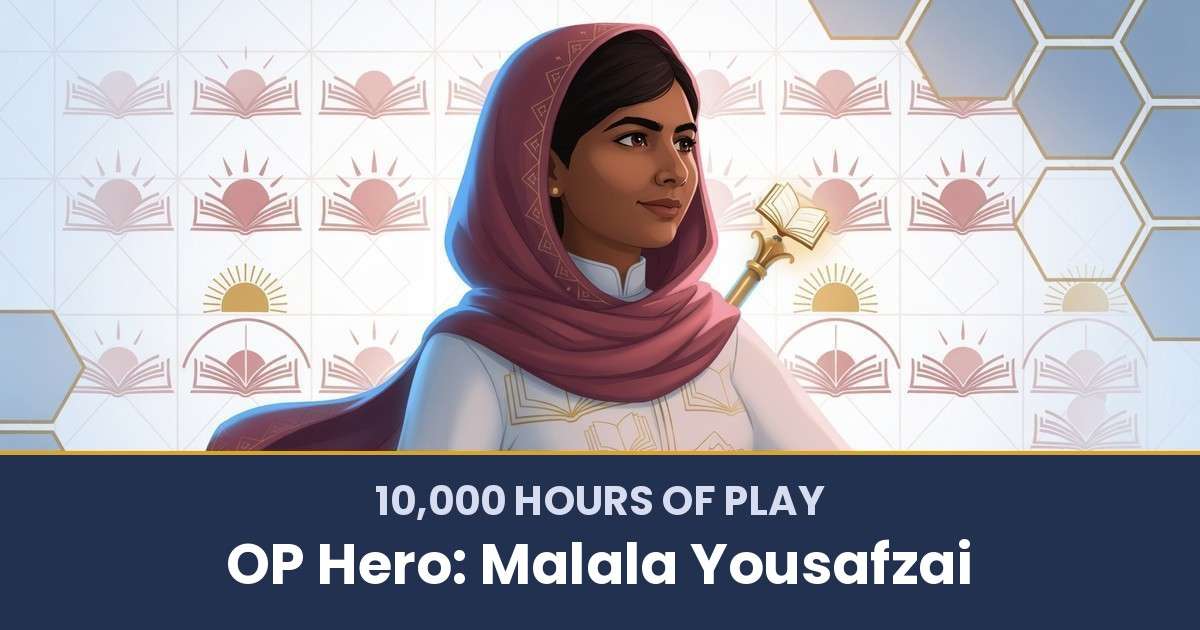


At eleven years old, most kids are negotiating bedtime. Malala Yousafzai was negotiating with the Taliban — in print, under a pseudonym, while her father’s school was being threatened and girls in her valley were being told to stay home for good.
She lost that first fight on the surface. Her school closed. The Taliban kept gaining ground. And three years later, on a school bus in Mingora, a gunman called out her name and put a bullet through the left side of her head.
What she didn’t lose was the game she was actually playing — and that is the part of her story that survives the headlines. Most people read Malala as a tragedy that got redeemed. Run her life through the 6 Steps and you see something cleaner: a hero who picked her quest before puberty, refused every off-ramp the world offered her, and built a global organization out of the worst day of her life.
This is the build-sheet behind that.
⚡ Speed Run Notes
- Malala’s Game wasn’t “survive the Taliban.” It was “every girl gets 12 years of free, safe, quality education” — she locked onto that target before she was a teenager and has refused to widen or shrink it for two decades.
- Her innate Attributes — moral courage, verbal precocity, empathic identification with other girls, and a public-arena temperament — were visible by age 11, before any of the global stages existed.
- She has cycled through five Roles: child witness, anonymous diarist, targeted dissident, global advocate, and scholar-strategist — each a deliberate upgrade, not a passive promotion.
- Her canon Skills cluster on the Paladin axis (Courageous Heart, Thunder Clap, Phoenix Rebirth) and the Druid axis (Loremaster, Spirit of Nature), with a Warlock-grade Vision Manifestation underneath it all.
- The October 9, 2012 shooting was the worst setback of her life and also the platform that scaled everything that followed. Phoenix Rebirth is the literal mechanic.
- The takeaway isn’t “be brave like Malala.” It’s pick a quest you’d run toward bullets for, and then build the allies, skills, and Roles that make running toward it survivable.
Table of Contents
- Step 1: The Game — What Malala Was Actually Playing
- Step 2: Attributes — The Innate Stats
- Step 3: Role(s) — The Character Class Across Chapters
- Step 4: Skills — The Real-Life Game Skills Malala Mastered
- Step 5: Allies — The People Who Multiplied Malala
- Step 6: Quests — The Milestones That Shaped the Saga
- What You Can Steal From Malala’s Build
- Where this framework comes from
- Related Reading
About Yu-kai Chou

Yu-kai Chou is the author of 10,000 Hours of Play — the book that treats your life as the most important game you’ll ever build a character in, and gives you the 6-Step framework (Game · Attributes · Role · Skills · Allies · Quests) to play it on purpose. He has spent two decades developing the system through which this post analyzes its OP Hero, and applies it to his own life and to the lives of the people he advises around the world.
Chou’s other framework, the Octalysis Framework, has been applied by LEGO, Microsoft, Porsche, Coca-Cola, Salesforce, and MrBeast, impacting over 1.5 Billion Users. He has taught the methodology at Harvard, Stanford, Yale, Tesla, Google, BCG, and IDEO, and has advised governments in eight nations including Ukraine, the United Kingdom, the Kingdom of Bahrain, Singapore, Taiwan, the Netherlands, Kazakhstan, and South Korea.
His work has been cited by Harvard, Stanford, MIT, Forbes, Wall Street Journal, Wired, US Department of Energy, NIST, NSF, NCBI, US Department of Education, ClinicalTrials.gov, and Google Scholar — with 3,700+ more academic publications. Explore his books here.
What I find instructive about Malala’s build is how early she committed to a single, narrow Quest — girls’ education — and then refused to let trauma, fame, or political pressure widen or rebrand it. Most people pivot their mission once the world starts watching. She didn’t. The one lesson I’d lift from her run is this: a Quest that survives a near-death event is a Quest you can spend a life on. If yours wouldn’t survive that test, you haven’t found yours yet.
Step 1: The Game — What Malala Was Actually Playing
Most public figures play a Game shaped by their adult circumstances. Malala’s Game was set before she could vote, drink, or drive.
The Game: every girl, anywhere, gets 12 years of free, safe, quality education. That’s it. Not “human rights” in the abstract. Not “feminism” as a banner. Twelve years of school for every girl, especially in places where Taliban-style regimes, war, or poverty have decided otherwise.
You can hear the lock-in already in her 2009 BBC Urdu diary, written at age 11 under the pseudonym “Gul Makai.” Her first entry is dated January 3, 2009, and frames the entire premise of the rest of her life: she is afraid she won’t be allowed to study, and she is going to write about it anyway. By July 12, 2013 — her 16th birthday, in front of the UN Youth Assembly — she had compressed it into a sentence the world memorized: “One child, one teacher, one book and one pen can change the world.”
The most useful thing the 10K HP framework does to a story like this is strip away the noise of awards, films, and tabloid coverage and ask: what was she actually doing? She was running the same quest at 11, at 16, at 27. The platforms changed. The Game didn’t. That’s what turning your life into a game looks like when you do it on purpose instead of by accident — one win condition, infinitely many levels.
Step 2: Attributes — The Innate Stats
Attributes are the stats you didn’t earn. They show up early, they persist, and most of your Roles and Skills get layered on top of them. Malala’s stat sheet is unusual.
Moral courage with high risk tolerance. The National Women’s History Museum’s summary is blunt: “At eleven years old, Yousafzai decided to stand up to the Taliban.” This is not learnable in the normal sense. Most adults living under that regime stayed quiet. She did not.
Verbal precocity. She was speaking at press clubs and giving media interviews as a pre-teen. By 2011 — at age 13–14 — she was already nominated for the International Children’s Peace Prize and awarded Pakistan’s first National Youth Peace Prize. The voice was operating at adult range before the body had finished growing.
Empathic identification beyond her own situation. After the attack, when most survivors of that level of violence collapse their world inward, hers expanded outward. She went on to meet Syrian refugees in Jordan, kidnapped girls’ families in Nigeria, child brides in multiple countries. The empathic radius scaled with the platform.
A public-arena temperament. Some people get nervous in front of cameras. She gets clearer. That is rare at any age and almost unheard of at 11.
If you want to see how to audit your own stat sheet without flinching, the Talent Triangle Method is the protocol I use with founders and athletes — it forces you to separate the traits you actually have from the ones you wish you had. Most people get this wrong because they’re embarrassed by their real stats. Malala’s life is a clean example of what happens when you don’t flinch.
Step 3: Role(s) — The Character Class Across Chapters
Roles are the character classes you take across life chapters. Malala has cycled through five of them, and each one was a deliberate move, not a passive promotion.
Role 1: Child Witness (≈ 1997–2008). A schoolgirl in Swat Valley, daughter of an educator who ran a girls’ school. Curious, attached to learning, the youngest member of a household that talked about education the way other households talk about cricket. This is the prep tier — the years where her Attributes were running quietly in the background.
Role 2: Anonymous Diarist + Emerging Activist (2008–2011). The “Gul Makai” BBC Urdu blog from January 2009 was the Role transition. She moved from witness to chronicler. By 2009 she was also being filmed for Adam B. Ellick’s New York Times documentary Class Dismissed in Swat Valley, which surfaced her story globally before she was widely known.
Role 3: Targeted Dissident + Symbol of Resistance (2012–2013). After the October 9, 2012 shooting, the world cast her in a Role she didn’t choose. She accepted it on her own terms. The UN itself notes she “became an international symbol of the fight for girls’ education after she was shot in 2012.”
Role 4: Global Advocate + Organizational Founder (2013–2017). Co-founded Malala Fund in July 2013 with her father and Shiza Shahid. UN Messenger of Peace in 2017. This is the build-the-team chapter — the Role where her individual story turned into an institution that could outlast her.
Role 5: Scholar-Activist + Strategic Philanthropist (2017–present). Oxford PPE (2017–2020), then a producer/storyteller running campaigns and directing Malala Fund grants. The Fund had allocated roughly $40 million by 2021 across Pakistan, Afghanistan, India, and Syria-crisis regions.
The pattern: every Role transition came with a real cost. Each new class extended her reach but narrowed her privacy, her safety, and her ordinary-life options. She kept paying.
Step 4: Skills — The Real-Life Game Skills Malala Mastered
Skills are the trained moves that turn Attributes and Roles into outcomes. Malala’s Skill loadout is unusually concentrated on the Paladin and Druid classes — the inspirational and meaning-making ends of the Skills Spectrum — with a Warlock-grade vision skill underneath everything.
Courageous Heart (Paladin) — charging into uncomfortable zones, hostile environments. The textbook case in any canon list of Real-Life Game Skills like the Lich Pact or its peers is that the move has to be repeatable, not a one-off. Malala has run Courageous Heart repeatedly — at 11 going public despite explicit Taliban death threats against girls who sought education, again post-2012 when refusing to soften her message would have been the easy off-ramp, and again every time she travels into a region where her presence puts a target on someone.
Loremaster (Druid) — weaving compelling, inspiring stories. The BBC Urdu diary, the Ellick documentary, I Am Malala (with Christina Lamb, published October 8, 2013), the speech archive — all of it is Loremaster work. She doesn’t just have a story. She has trained the move of translating personal experience into framing that lands in five different cultures at once.
Thunder Clap (Paladin) — public speaking that charges up and inspires people. The UN speech on her 16th birthday is the canonical performance, but the move shows up every time she addresses a UN body, a parliament, or a campus. Thunder Clap is what turned “I survived” into “the UN designated July 12 as Malala Day.”
Vision Manifestation (Warlock) — mental rehearsal of success so vivid it shapes reality. The “every girl, 12 years of education” goalpost is not a slogan she stumbled into. She has been visualizing that future state since before she had political vocabulary for it, and that mental picture is what kept the Quest stable across the surgeries, the moves, the dissertation drafts, and the marriage.
Phoenix Rebirth (Paladin) — recovering from devastating failure and coming back stronger. On October 9, 2012, a gunman shot her at point-blank range in the head and neck. She was airlifted to Queen Elizabeth Hospital Birmingham on October 15, underwent reconstructive surgery, and lost hearing in one ear. Within nine months she was at the UN. Within fifteen months she had a memoir on shelves. Within twenty-six months she was a Nobel laureate. The Skill name barely needs explaining.
Spirit of Nature (Druid) — meaning-making under stress. Turning suffering into a value-driven mission. This is the move that prevented Phoenix Rebirth from collapsing into trauma-celebrity. Instead of becoming “the girl who got shot,” she became “the founder of Malala Fund.” The bullet was reframed as a recruiting tool for the Quest.
Step 5: Allies — The People Who Multiplied Malala
Heroes don’t solo their Quests. Malala’s ally roster is one of the most multiplier-rich in the modern era.
Ziauddin Yousafzai (father). Ran the girls’ school where she first saw what education meant. Co-founded Malala Fund in 2013. The single most important Ally in her run — without him, the public-arena temperament never had a stage to test itself on.
Adam B. Ellick (NYT documentarian). The 2009 New York Times documentary Class Dismissed in Swat Valley globalized her story before she was famous. The film is the reason “Gul Makai” became “Malala” in the rest of the world’s vocabulary.
Christina Lamb (co-author). Translated the personal-and-political into a memoir that worked in dozens of languages. I Am Malala (Weidenfeld & Nicolson / Little, Brown, October 8, 2013) is a Loremaster-multiplier — Lamb made the Skill scale.
Gordon Brown (UN Special Envoy for Global Education). Launched the “I Am Malala” petition on November 10, 2012, and introduced her at the UN Youth Assembly the following July. He converted post-attack global attention into structured political pressure.
Dr. Javid Kayani and the Queen Elizabeth Hospital Birmingham team. The reason there is a saga after October 2012. UK Department of Health statements on October 15 and 19, 2012 confirm the specialist neurosurgical care. I Am Malala credits Dr. Kayani as the liaison physician who kept the medical narrative coherent across two countries.
Shiza Shahid (Malala Fund co-founder and first CEO). Took the founder-energy out of a 16-year-old and gave it institutional bones — structuring grants, partnerships, and early funding pathways. The reason Malala Fund grew into a $40-million-allocated organization by 2021 instead of staying a press release.
Asser Malik (husband, married November 9, 2021). Less visible publicly but consistently named by Malala as the support layer that lets her keep running global work without burning out the personal-life systems most activists shred.
If you want to see what a comparably ally-multiplied build looks like in a different domain, run the same lens over Helen Keller’s profile — the parallels in mentor multiplication are striking.
Step 6: Quests — The Milestones That Shaped the Saga
Quests are the specific projects and milestones that compose the saga. Malala’s saga has six load-bearing ones — five wins and one searing setback.
Quest 1 — The BBC Urdu diary (2009). First entry on January 3, 2009. Series ran through early 2009 under the pseudonym “Gul Makai.” It gave her an international platform at 11 and put her on the radar of NGOs, journalists, and — eventually — the people who would try to kill her.
Quest 2 — The October 9, 2012 shooting (the setback). This is the setback. Taliban gunmen boarded her school bus in Mingora, asked for her by name, and shot her in the head and neck. Two classmates were also wounded. She was transferred to Queen Elizabeth Hospital Birmingham on October 15. The attack also triggered a domestic Pakistani backlash that has never fully gone away — conspiracy theories accusing her of being a Western asset still circulate in parts of the country she came from. A Quest that produced a global symbol also produced a permanent hostile audience at home. Both are true.
Quest 3 — The UN “Malala Day” speech (July 12, 2013). Her first major post-attack address, delivered on her 16th birthday at UN Headquarters in New York. The closing line — “One child, one teacher, one book and one pen can change the world” — converted survivor status into a Quest banner the world could recite.
Quest 4 — I Am Malala (October 8, 2013). Co-authored with Christina Lamb. The book turned a single speech into a sustained narrative engine — translated globally, taught in schools, repeatedly returned to as the canonical version of her story in her own words.
Quest 5 — The Nobel Peace Prize (December 10, 2014). At 17, she became the youngest Nobel laureate in any category. She shared the prize with Kailash Satyarthi, an Indian child-rights activist — a deliberate Pakistan-India pairing that the Nobel committee used to amplify the message past national identity.
Quest 6 — Oxford PPE and Malala Fund scale-up (2017–present). Studied Philosophy, Politics and Economics at Oxford starting 2017, graduated in 2020. The Fund had allocated roughly $40 million in grants by 2021 across Pakistan, Afghanistan, India, and Syria-crisis regions, with focus on local Education Champions and Gulmakai Network grantees. The scholar-activist Role gave her the analytical layer the early activist years didn’t.
If you want a useful reference point on what a Quest-driven life looks like inside a very different domain, the way Martin Luther King Jr. structured his quests rhymes — both built sagas where the moral clarity of the Quest mattered more than any single milestone.
What You Can Steal From Malala’s Build
You can’t copy her Attributes. You can copy her sequencing.
Pick the Game first. Most builds drift because the Game is fuzzy or borrowed from someone else’s expectations. Malala had hers by 11. The lesson isn’t “decide at 11.” The lesson is “decide before you have anything to lose, because deciding after you’ve built a comfortable life is far harder.”
Stack your Skills around the Game, not around your Roles. Her Roles changed five times. Her Skills — Loremaster, Thunder Clap, Courageous Heart, Vision Manifestation, Phoenix Rebirth, Spirit of Nature — kept compounding because they all served the same Quest. Skills that serve a Quest accumulate. Skills that serve a Role expire when the Role does.
Build an ally bench that survives the worst day of your life. Her father, her surgeons, her co-author, her co-founders — all of them were in place before October 9, 2012, or arrived in the days immediately after. The bench is what made Phoenix Rebirth possible. There is no solo version of that recovery.
And finally — pick a Quest that would still be worth running if it cost you everything. Most quests fail the bullet test. Malala’s didn’t. The other OP Heroes profiled here all pass that test in their own domains. The frame is the same. The application is yours.
Where this framework comes from

Want the full system this profile is built on?
Every OP Hero piece runs through the same 6-Step framework from 10,000 Hours of Play: Unlock Your Real-Life Legendary Success. The book covers the full system, walks through Yu-kai’s own life run as the first applied case study, and gives you the worksheets to audit your own build.
Related Reading
- All OP Hero Profiles — the full 10K HP roster
- OP Hero: Helen Keller — turning an impossible setback into a global advocacy career
- OP Hero: Martin Luther King Jr. — moral clarity as a Quest banner
- OP Hero: Maya Angelou — Phoenix Rebirth in a literary key
- OP Hero: Viktor Frankl — meaning-making under stress, the Spirit of Nature playbook
- The Talent Triangle Method — auditing your own Attribute stack