
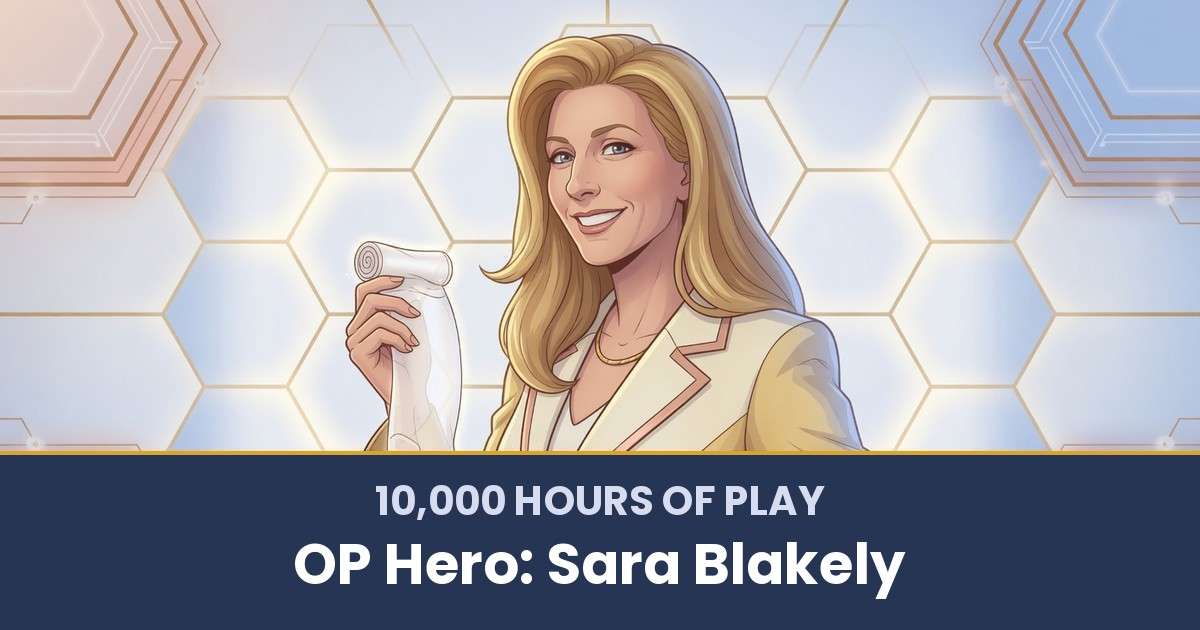


Sara Blakely turned $5,000 in savings into a company worth more than a billion dollars without ever taking outside investment. She did it with a product made of cut-up pantyhose, a name she trademarked herself, and a sales pitch she ran out of a Dallas department-store bathroom.
That kind of run doesn’t happen by accident. It happens when someone has been training for the boss fight their whole life and didn’t know it.
Most people read her story and grab the wrong takeaway. They focus on the prototype, the patent, the Oprah moment. Those are outputs. The actual game Sara Blakely was playing — the one that lets a fax-machine saleswoman in Atlanta out-build venture-funded competitors for two straight decades — is hiding in the moves she made before any of those wins existed. Run her life through Yu-kai Chou’s 10,000 Hours of Play framework and the pattern shows up fast.
⚡ Speed Run Notes
Speed Run Notes
- Sara Blakely’s real “game” wasn’t shapewear — it was using humor, salesmanship, and her own felt frustrations to build products that hand other women confidence and capital.
- Her father’s weekly “What did you fail at this week?” dinners trained a risk tolerance most adult founders never develop. The LSAT failures and seven years selling fax machines weren’t setbacks — they were the tutorial.
- Spanx launched in 2000 with $5,000 in savings, no outside investment, a patent she drafted herself, and a name she trademarked from a Yellow Pages mill hunt.
- The Neiman Marcus deal turned on one move: she pulled the buyer into a bathroom and demoed the product on her own body, before-and-after. That’s not a sales technique you can fake-confidence your way into.
- In 2021 Blackstone bought a majority stake in Spanx at a ~$1.2B valuation. Blakely gifted every one of her ~500 employees two first-class plane tickets and $10,000. That move tells you what game she was playing all along.
Table of Contents
- Step 1: The Game — What Sara Blakely Was Actually Playing
- Step 2: Attributes — The Innate Stats
- Step 3: Role(s) — The Character Class Across Chapters
- Step 4: Skills — The Real-Life Game Skills Sara Blakely Mastered
- Step 5: Allies — The People Who Multiplied Sara Blakely
- Step 6: Quests — The Milestones That Shaped the Saga
- What You Can Steal From Sara Blakely’s Build
- Where this framework comes from
- Related Reading
About Yu-kai Chou

Yu-kai Chou is the author of 10,000 Hours of Play — the book that treats your life as the most important game you’ll ever build a character in, and gives you the 6-Step framework (Game · Attributes · Role · Skills · Allies · Quests) to play it on purpose. He has spent two decades developing the system through which this post analyzes its OP Hero, and applies it to his own life and to the lives of the people he advises around the world.
Chou’s other framework, the Octalysis Framework, has been applied by LEGO, Microsoft, Porsche, Coca-Cola, Salesforce, and MrBeast, impacting over 1.5 Billion Users. He has taught the methodology at Harvard, Stanford, Yale, Tesla, Google, BCG, and IDEO, and has advised governments in eight nations including Ukraine, the United Kingdom, the Kingdom of Bahrain, Singapore, Taiwan, the Netherlands, Kazakhstan, and South Korea.
His work has been cited by Harvard, Stanford, MIT, Forbes, Wall Street Journal, Wired, US Department of Energy, NIST, NSF, NCBI, US Department of Education, ClinicalTrials.gov, and Google Scholar — with 3,700+ more academic publications. Explore his books here.

What I keep coming back to with Sara Blakely’s run is that her edge wasn’t a technology insight or a market gap. It was an attribute — comfort with rejection — that her father deliberately installed at the dinner table when she was eight. If the 6 Steps framework is honest, that’s the most important sentence in this entire post. The role and the skills and the Spanx empire all sit on top of one attribute her parents grew on purpose. Audit your own kids’ dinner conversations accordingly.
Step 1: The Game — What Sara Blakely Was Actually Playing
If you ask people what game Sara Blakely was playing, most of them will say “inventing Spanx.” That’s the product. That’s not the game.
The actual game, traced across decades: take her own felt frustration as a woman, turn it into a product that hands other women a little more confidence, then use the winnings to multiply other women’s confidence at scale. Spanx is one expression of that game. Sneex (her 2024 footwear brand) is another. The Sara Blakely Foundation is another. The Giving Pledge signature in 2013 is the same game with the dial turned up.
You can hear her say it directly: she described her Danka years as feeling “in the wrong movie,” and Spanx as the moment she changed the script to focus on “one simple product that would make women feel better in their clothes.” The product was the means. The mission was the through-line.
This is why the framework matters. The same hero, viewed only through product-and-revenue lenses, looks like a one-shot lucky inventor. Viewed through the question what game is this person actually playing, across decades? she looks exactly like what she is: a Founder-Class operator who happened to pick shapewear as the first level. If she’d picked anything else with a real consumer pain point, the same game would have been playable. The skill set transfers because the game does.
Step 2: Attributes — The Innate Stats
Attributes are the stats you can’t really learn after the character creation screen. They’re the traits visible early, often before adolescence, that shape every later choice. Blakely has four that recur:
Comfort with failure (high). The single most documented one. Her father, trial attorney Ford Blakely, ran weekly “failure dinners” — at the table, he’d ask Sara and her brother, “What did you fail at this week?” — and praised them for trying things hard enough that they could fail. By the time she was old enough to do anything risky, the part of her brain that flinches at potential embarrassment had been deliberately turned down. That’s not a learned skill. That’s a stat her parents leveled up before she had a choice in the matter. If you want a deeper read on how innate traits compound into superpowers, the Talent Triangle Method is the diagnostic tool to use.
Salesmanship (high). She sold fax machines door-to-door for Danka through the late 1990s and worked her way up to national sales trainer. Door-to-door cold sales is a brutal calibration tool. You learn within weeks whether a stranger will let you keep talking, and most weeks the answer is no.
Showmanship and humor (high). She auditioned to be Goofy at Walt Disney World and was told she was too short for the costume. Wanting the stage anyway, she ended up as a ride greeter at Epcot for about three months. Years later that same instinct showed up on Rebel Billionaire (2004–05) and on Shark Tank. Performance was never an after-the-fact founder skill she added. It was already there.
Customer empathy starting from her own body (high). Her core product insight was rooted in her own discomfort. She wanted an undergarment that was invisible under white pants, comfortable, and open-toed-shoe compatible. So she cut the feet off control-top pantyhose. That move sounds like product genius in retrospect. In real time, it’s just empathy turned inward, then projected outward: if this is annoying me, it’s annoying millions of other women.
Step 3: Role(s) — The Character Class Across Chapters
Roles are the “character class” you’re playing at a given chapter of life. Blakely rotated through several before she settled into Founder-CEO.
Chapter 1: Aspiring Trial Attorney. She studied communications at Florida State, planned to go to law school like her father, and failed the LSAT twice in the early 1990s. If she’d passed, Spanx would not exist. She’s said as much in interviews. The failure was the redirection.
Chapter 2: Disney Ride Greeter and Reluctant Cast Member. The Goofy audition got rejected, the three months at Epcot ended. This is the dead-end-job phase every interesting biography has. Skip it and you miss the data point: she was already willing to try a performance-class role.
Chapter 3: Fax Machine Salesperson at Danka (~mid-1990s through 1998/1999). Seven years of cold-call selling, ending as a national sales trainer. This is where the real character build happened. Anyone who’s done seven years of door-to-door sales has either left the field or developed a near-immunity to rejection. She did the latter.
Chapter 4: Solo Inventor / Patent Drafter (1998–2000). At 27, in Atlanta, with $5,000 in savings, she spent two years researching hosiery, fabrics, patents, and trademarks while still working full-time at Danka. She wrote her own patent draft. She trademarked “Spanx” herself. This is the chapter most founders skip — they hire a lawyer and a designer. She compressed the learning curve into her own head.
Chapter 5: Founder-CEO of Spanx (2000–2013). Launched in 2000. Forbes named her the youngest self-made female billionaire in 2012, while she was still sole owner of the company.
Chapter 6: Brand-Building Founder, Investor, and Philanthropist (2013–2021). Giving Pledge signature (2013), guest “shark” appearances on Shark Tank, co-owner of the Atlanta Hawks (2015 group purchase), Sara Blakely Foundation funding women-led scholarships.
Chapter 7: Executive Chairwoman + New-Venture Founder (2021–present). Blackstone bought a majority stake in Spanx in October 2021 at a roughly $1.2B valuation. She moved into the chair role and, in 2024, launched Sneex — a new footwear brand. Founder-Class characters don’t really retire. They re-roll.
Step 4: Skills — The Real-Life Game Skills Sara Blakely Mastered
Skills are the techniques the hero learned (and you can learn) sitting on top of those attributes. Here are six canon Real-Life Game Skills Blakely demonstrably used, mapped to her own evidence.
Vision Manifestation (Warlock) — mental rehearsal of success so vivid it shapes reality. Blakely has talked openly about visualizing Spanx on shelves, on women’s bodies, on the Oprah Show, years before any of it existed. Her mother’s life-coaching influence and her father’s Wayne Dyer tapes baked this into her practice early. She wasn’t visualizing as a motivational party trick. She was rehearsing scenes she intended to walk into.
Courageous Heart (Paladin) — charging into uncomfortable zones, uncharted territory, hostile environments. The Neiman Marcus pitch in fall 2000 is the textbook example. She got a 10-minute meeting with the hosiery buyer in Dallas, sensed the pitch wasn’t landing, and asked the buyer to walk to the ladies’ room with her. Put pants on over regular underwear. Then changed into Spanx. Before-and-after, live demo, in a public restroom. Neiman Marcus agreed to test in seven stores. Most founders couldn’t physically do that move. Her father trained her to.
Sacrificial Cycle (Warlock) — reinvest all resources back into the project. Spanx launched on $5,000 of personal savings with no outside investment, and Blakely remained sole owner for over twenty years. Every dollar of margin went back into product, manufacturing, packaging, and brand. This is the same financial-discipline pattern you see in Yvon Chouinard’s Patagonia build — refuse outside capital long enough to keep the mission intact.
Loremaster (Druid) — weave compelling, inspiring stories. Blakely’s brand is built on a story Yu-kai’s framework would call near-mythological: the cut-up pantyhose, the $5,000 savings, the failure dinners. She tells it the same way every time. She tells it on Oprah, on How I Built This, on Tim Ferriss, in Forbes profiles, in Spanx packaging. A founder who can carry her own origin story like that doesn’t need a PR team. She IS the PR team. The closest canon example of a hero making their unconventional choice a public Skill brand is the Lich Pact (Warlock) post — same instinct, different domain.
Mastermind (Ranger) — create, adapt, and execute complex plans. Look at the actual sequence: write the patent yourself → hunt mills in the North Carolina hosiery belt until one (Highland Mills’ owner Sam Kaplan, after his daughters tested it) agreed to make the prototype → cold-call Neiman Marcus → bathroom demo → seven-store test → Oprah’s Favorite Things 2000 → national retail expansion. That’s not a hustle. That’s a six-move chess game where each move depended on the previous one landing.
Phoenix Rebirth (Paladin) — recover from devastating failure and come back stronger. Failed the LSAT twice. Spent seven years in the “wrong movie” at Danka. Watched the Goofy audition end with “too short.” Each setback redirected her one step closer to the Spanx run. The pattern matters because most founders read these as obstacles she “overcame.” Reframe: each failure was actually a data point the Failure Dinner training had taught her to use.
Step 5: Allies — The People Who Multiplied Sara Blakely
No solo founder is actually solo. Blakely’s ally roster is short but each member multiplied her by a clear factor.
Ford Blakely (father). The Failure Dinners. The single highest-leverage parenting move in this entire post. He didn’t just permit failure — he requested it weekly and praised it. That’s the attribute install.
Ellen Blakely (mother). Often described in profiles as creatively oriented and influenced by life-coaching practices. The visualization habit Blakely cites started here. Two parents, two different attribute boosts, both required.
Kimberly Hunter Oreck (Neiman Marcus hosiery buyer). Took the 10-minute meeting. Walked into the bathroom. Said yes to a seven-store test. Without that single buyer giving the bathroom demo the benefit of the doubt, the Spanx launch story has no second chapter. One yes from the right NPC opens the whole quest line.
Oprah Winfrey. Spanx made Oprah’s Favorite Things in November 2000, weeks after launch. That endorsement converted a regional Neiman test into a national consumer brand overnight. Blakely later donated $1 million to the Oprah Winfrey Leadership Academy for Girls in 2006. Ally relationships in Yu-kai’s framework are bidirectional — Blakely understood that early.
Laurie Ann Goldman (CEO, 2002–2014). The operator who let Blakely stay in the creative-founder seat while Spanx scaled into a national brand. Most founders break their company by refusing to hand the operator role to someone else. Blakely’s willingness to hire a long-tenure CEO is one of the quieter reasons Spanx didn’t blow up at scale.
Richard Branson. Awarded her $750,000 on Rebel Billionaire (2004–05), which she used to start the Sara Blakely Foundation. Capital and credibility from one of the world’s most-known founders, fed straight into philanthropy.
Jesse Itzler (husband). The serial entrepreneur partner whose own startup playbook (Marquis Jet, ZICO Coconut Water, Atlanta Hawks group ownership) shows up in Blakely’s later chapters. Founder energy is contagious in households. Hers compounded.
Step 6: Quests — The Milestones That Shaped the Saga
Quests are the specific, dated milestones where the hero’s build collided with the world. For Blakely:
Quest 1: The two LSAT failures (early 1990s). Setback. The redirection that made everything else possible. Most founder origin stories have one of these. Don’t airbrush them out.
Quest 2: Seven years selling fax machines at Danka (~mid-1990s–1999). The grind that built the sales skill set Spanx would need. Every door slammed in her face was a rep.
Quest 3: The $5,000 / two-year prototype build (1998–2000). Patent drafted herself. Name trademarked. Mill secured. Atlanta apartment as the entire HQ. This is the chapter that proves she’s playing a different game than founders who raise a seed round to “validate the idea.”
Quest 4: October 2000 Spanx launch + the Neiman Marcus bathroom demo. The unlock event. Seven stores. Live in retail.
Quest 5: Oprah’s Favorite Things, November 2000. The amplifier. A regional product becomes a national brand in one segment.
Quest 6: Forbes’ youngest self-made female billionaire cover, March 2012. Twelve years from launch to the cover, with zero outside equity. The receipt that proves the build worked.
Quest 7: The Blackstone majority recapitalization, October 2021 (~$1.2B valuation). The exit-without-quitting. She kept the chair role and immediately gave every employee — every single one of the ~500 — two first-class plane tickets and $10,000 cash. That gesture isn’t a quest reward. It’s a signal about what she thought the game was for the whole time.
For more sibling builds where the founder refused outside capital until the brand was already winning, the OP Hero hub has several Mastermind-and-Sacrificial-Cycle parallels worth studying.
What You Can Steal From Sara Blakely’s Build
If you’ve read other entries in the OP Hero series, you’ve seen this build before in different clothes. The takeaway here is the same one I keep coming back to in the book: most of the hero’s edge was installed before the famous moment, by parents and grinds and rejections nobody remembered to applaud at the time.
Three lifts, in order of how cheap they are to copy.
One: install Failure Dinners. Whether you have kids, partners, a team, or just a journal — ask the failure question once a week. “What did you try this week that didn’t work?” The point isn’t the answer. It’s that the question normalizes the attempt. After a few months you’ll notice your own attempt-rate rising.
Two: start from your own felt pain. The cut-up-pantyhose move only works because Blakely was the first user. If you’re trying to build a product for a market you don’t personally need, you’re playing on hard mode. Pick a frustration you can’t ignore in your own life and start there.
Three: delay outside capital longer than feels comfortable. Twenty-one years of sole ownership wasn’t a marketing story for Blakely. It was a strategic choice that kept the mission untouched until the brand had so much leverage that Blackstone bought it on her terms.
None of these require you to be a self-made billionaire. They require you to play the same game she played, one move at a time, for longer than most people think is reasonable.
Where this framework comes from

Want the full system this profile is built on?
Every OP Hero piece runs through the same 6-Step framework from 10,000 Hours of Play: Unlock Your Real-Life Legendary Success. The book covers the full system, walks through Yu-kai’s own life run as the first applied case study, and gives you the worksheets to audit your own build.
Related Reading
- All OP Hero Profiles — the full roster of 10K HP profiles, every one run through the same 6 Steps.
- The 10,000 Hours of Play framework hub — the parent page for the 6-Step system.
- The OP Talent Triangle Method — how to identify the innate attributes that anchor your build.
- Yvon Chouinard — OP Hero profile — a fellow founder who refused outside capital for decades.
- Phil Knight — OP Hero profile — another bootstrapper who turned a $50 prototype into a global brand.
- Coco Chanel — OP Hero profile — a founder who built a category from her own felt frustration.