
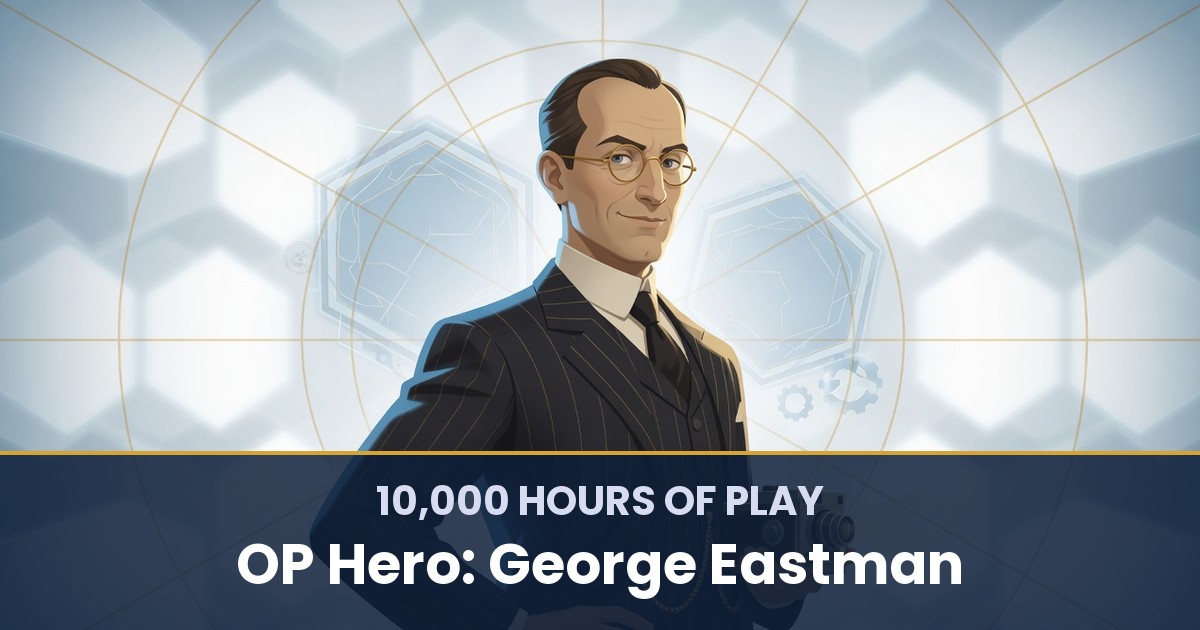


In 1878, a twenty-four-year-old bank clerk in Rochester, New York started planning a photography trip and ran straight into the absurdity of his own hobby.
Photography in 1878 meant fragile glass plates and chemicals mixed on the spot, because a wet plate had to be prepared, exposed, and processed before it dried.
George Eastman looked at that pile of equipment and locked onto the question that would run his next five decades: why does the person holding the camera have to carry all of this complexity?
His answer created Kodak, put a one-dollar camera into the hands of children, and moved photography from a specialist’s craft into everyday life. This profile runs his life through the 6 Steps, so you can lift the useful parts for your own build.
⚡ Speed Run Notes
- Eastman’s real game was never the camera. It was removing every step between a person and a finished photograph, then building a company around the steps he absorbed.
- “You press the button, we do the rest” (1888) compressed an entire chemistry workflow into one promise. Complexity moved from the user to the factory.
- The $25 Kodak proved the model. The $1 Brownie (1900) scaled it, shipping more than 150,000 cameras in its first year.
- His signature move was Devour (Warlock): keep cutting steps until the product feels like magic.
- He gave away roughly $100 million, and MIT knew its mystery donor only as “Mr. Smith” for years.
Table of Contents
About Yu-kai Chou

Yu-kai Chou is the author of 10,000 Hours of Play — the book that treats your life as the most important game you’ll ever build a character in, and gives you the 6-Step framework (Game · Attributes · Role · Skills · Allies · Quests) to play it on purpose. He has spent two decades developing the system through which this post analyzes its OP Hero, and applies it to his own life and to the lives of the people he advises around the world.
Chou’s other framework, the Octalysis Framework, has been applied by LEGO, Microsoft, Porsche, Coca-Cola, Salesforce, and MrBeast, impacting over 1.5 Billion Users. He has taught the methodology at Harvard, Stanford, Yale, Tesla, Google, BCG, and IDEO, and has advised governments in eight nations including Ukraine, the United Kingdom, the Kingdom of Bahrain, Singapore, Taiwan, the Netherlands, Kazakhstan, and South Korea.
His work has been cited by Harvard, Stanford, MIT, Forbes, Wall Street Journal, Wired, US Department of Energy, NIST, NSF, NCBI, US Department of Education, ClinicalTrials.gov, and Google Scholar — with 3,700+ more academic publications. Explore his books here.
What draws me to George Eastman’s build is the discipline of his mission: every time a customer struggled, he moved the difficulty into his own factory instead of writing a better manual. That reflex, more than any single invention, is what made Kodak inevitable.
Step 1: The Game — What George Eastman Was Actually Playing
Step 1 of the 6-Step framework asks what game you are actually playing, and Eastman’s answer looks obvious in hindsight while staying invisible to nearly everyone around him in 1878.
He was playing to make photography simple, portable, repeatable, and affordable for ordinary people.
That mission covered far more than camera hardware. The camera was only one source of friction in a workflow that included exposure, film handling, developing, and printing.
His operating principle stayed fixed for fifty years: shift complexity from the user to the manufacturer.
When the first Kodak camera launched in 1888 with the promise “You press the button, we do the rest,” the sentence was a literal description of the business. Customers mailed the whole camera back, and the company developed the film, made the prints, and returned the camera reloaded.
The thing he kept chasing across decades was an integrated system: plates, film, cameras, processing, printing, and distribution working as one loop. Choose a game that big and every individual product becomes a single move inside it.
Step 2: Attributes — The Innate Stats
Attributes are the stats you show before anyone trains you. Eastman displayed his early, and under pressure.
After his father died, he left school and worked to support his family, eventually becoming a bank clerk in Rochester.
Problem-finding instinct. To the hobbyists of 1878, wet-plate photography was simply the cost of the craft. Eastman treated the inconvenience itself as the discovery, and that annoyance became the entry point for his dry-plate work.
Systems thinking. He rarely optimized one component in isolation. He kept designing the complete experience: film, camera, processing, and printing as a single package.
Commercial risk tolerance. He walked away from secure clerical employment and put his personal savings into photographic experimentation and manufacturing.
Audience-centered imagination. He designed for people who were not trained photographers, again and again. The small Kodak, the roll film, and later the Brownie all lowered the expertise required instead of raising the ceiling for professionals.
If you want to run this kind of stat check on yourself, the OP Talent Triangle Method exists for exactly that audit: separating what you were born with from what you can train.
Step 3: Role(s) — The Character Class Across Chapters
Eastman changed character class five times, and each class matched the chapter he was in.
From 1854 to 1877 he was the self-taught operator: a young man doing clerical work in a bank, learning accounting and business administration from the inside.
From 1878 to 1880 he played the amateur experimenter, studying photographic chemistry at home because wet plates made travel photography impractical.
From 1880 to 1884 he became the inventor-entrepreneur, commercializing dry plates and co-founding the Eastman Dry Plate Company in 1881.
From 1884 to 1888 he shifted into the industrial organizer, moving photography from glass plates toward flexible roll film and designing the consumer camera system that became Kodak.
From 1888 through the 1920s he played the mass-market brand architect, registering “Kodak” as a trademark in 1888 and combining product design, advertising, service infrastructure, and distribution.
And from the 1890s until his death in 1932, he added a final class: institution-builder and philanthropist, directing enormous gifts to education, medicine, and music.
Step 4: Skills — The Real-Life Game Skills Eastman Mastered
Attributes are what you start with. Skills are what you grind. Eastman’s skill tree shows five canon Real-Life Game Skills, each earned at a specific moment.
Ley Line Infusion (Mage) — absorbing a large amount of knowledge in a subject, fast. Between 1878 and 1880, while still employed, Eastman taught himself the chemistry of light-sensitive emulsions and turned repeated formula and coating experiments into commercially usable dry plates.
Revive (Paladin) — recovering from failure and taking new action toward the next Quest. His first commercial plates were not reliably good. Inconsistent batches threatened the young company’s reputation and survival, and he answered by repeatedly correcting emulsion formulas, coating methods, and quality control until the factory produced a dependable product.
Devour (Warlock) — reducing steps, components, and processes until something becomes lean. The 1888 Kodak was Devour as a product: a preloaded camera sold for $25, used without any knowledge of chemistry, then mailed back for processing and reloading.
Track Treasure (Ranger): identifying hidden opportunities others don’t see. The professional photography market was crowded. The amateur market barely existed, and Eastman kept betting on it until the Brownie, introduced in 1900 at one dollar, extended photography to children and families.
Floral Blossom (Druid): educating and supporting others. In his later chapters, Eastman ran this skill at industrial scale, funding universities, music education, and children’s dental care. More on that in Step 6.
On the Skills Spectrum, Eastman reads as a focused specialist who kept his depth narrow: photographic systems and the business machinery around them.
Step 5: Allies — The People Who Multiplied Eastman
Eastman’s story gets told as a lone-inventor tale. His own company’s founding date argues otherwise.
Henry A. Strong was a Rochester manufacturer of buggy whips, and he invested alongside Eastman to establish the Eastman Dry Plate Company on January 1, 1881. Strong’s capital, combined with income from Eastman’s patents, is what turned kitchen-table experiments into a manufacturing enterprise.
That pairing is worth studying. Eastman brought the chemistry and the vision; Strong brought money and commercial standing. Neither could have run the play alone.
Maria Kilbourn Eastman, his mother, held the family together after his father’s death. Eastman’s early employment and his lifelong drive for financial security took shape inside that household pressure.
The teams. The Kodak model only worked because laboratory, factory, sales, and processing staff standardized emulsion production and handled every customer’s film. An integrated service is an alliance wearing a brand name.
Step 5 of the framework is Build Your Alliance, and Eastman’s version of it is blunt: find the ally whose stats cover your dump stat, and formalize the partnership early.
Step 6: Quests — The Milestones That Shaped the Saga
Quest 1: Escape the wet plate (1878–1880). Facing the burden of glass plates and on-site chemistry, Eastman studied photographic chemistry and developed dry plates, the technical foundation for everything after.
Quest 2: Found the company (January 1, 1881). With Strong’s investment and patent income, the Eastman Dry Plate Company opened in Rochester.
Quest 3: Survive the bad batches (early 1880s). This is the setback quest. Unreliable plates exposed the difference between inventing a process and manufacturing a dependable product at scale, and the company’s survival depended on closing that gap.
Quest 4: Roll film and the Kodak (1884–1888). Eastman moved from glass toward flexible roll material and built a $25 camera around it, designed for customers who knew nothing about photographic chemistry.
Quest 5: The Brownie (1900). A one-dollar camera that shipped more than 150,000 units in its first year and pushed amateur photography far beyond affluent adults.
Quest 6: Give it away. Eastman’s lifetime giving is commonly estimated near $100 million. Roughly $50 million went to the University of Rochester, including gifts that financed its medical school and the Eastman School of Music, and about $20 million went to MIT over many years under the pseudonym “Mr. Smith,” including a $3 million anonymous gift in 1912.
He also gave substantially to the Tuskegee and Hampton Institutes, and starting in 1917 he established free dental clinics for children in Rochester.
The saga’s ending was hard. A degenerative spinal illness closed in on him during his final years, and on March 14, 1932 he took his own life, leaving a note that read: “To my friends. My work is done. Why wait?”
His estate, apart from personal bequests, passed to the University of Rochester. The last quest completed the way he had played the whole game: assets converted into other people’s opportunities.
What You Can Steal From Eastman’s Build
Pick a game bigger than your product. Eastman chose “make photography effortless for ordinary people,” so every camera, film stock, and service was a move inside one mission rather than a bet that had to win on its own.
Sell the whole loop. “You press the button, we do the rest” worked because the company took responsibility for the hard parts. Whatever you build, ask which steps you are still making your users perform.
Treat the scale-up failure as a scheduled quest. The bad-batch crisis of the early 1880s was the price of moving from lab to factory. Eastman’s response, fix the process rather than the story, is what separated him from the era’s other dry-plate experimenters.
Plan your endgame content. Eastman spent his last decades converting a fortune into schools, clinics, and a music school. The build was never complete at “rich.”
Pick one friction your users hate most this week, and eat it yourself. That was the whole Kodak trick, and it still works.
Where this framework comes from

Want the full system this profile is built on?
Every OP Hero piece runs through the same 6-Step framework from 10,000 Hours of Play: Unlock Your Real-Life Legendary Success. The book covers the full system, walks through Yu-kai’s own life run as the first applied case study, and gives you the worksheets to audit your own build.
Related Reading
- All OP Hero Profiles: the complete library
- 10,000 Hours of Play by OP Hero: Thomas Edison
- 10,000 Hours of Play by OP Hero: Henry Ford
- 10,000 Hours of Play by OP Hero: Milton Hershey
- 10,000 Hours of Play by OP Hero: Morris Chang
- The OP Talent Triangle Method