
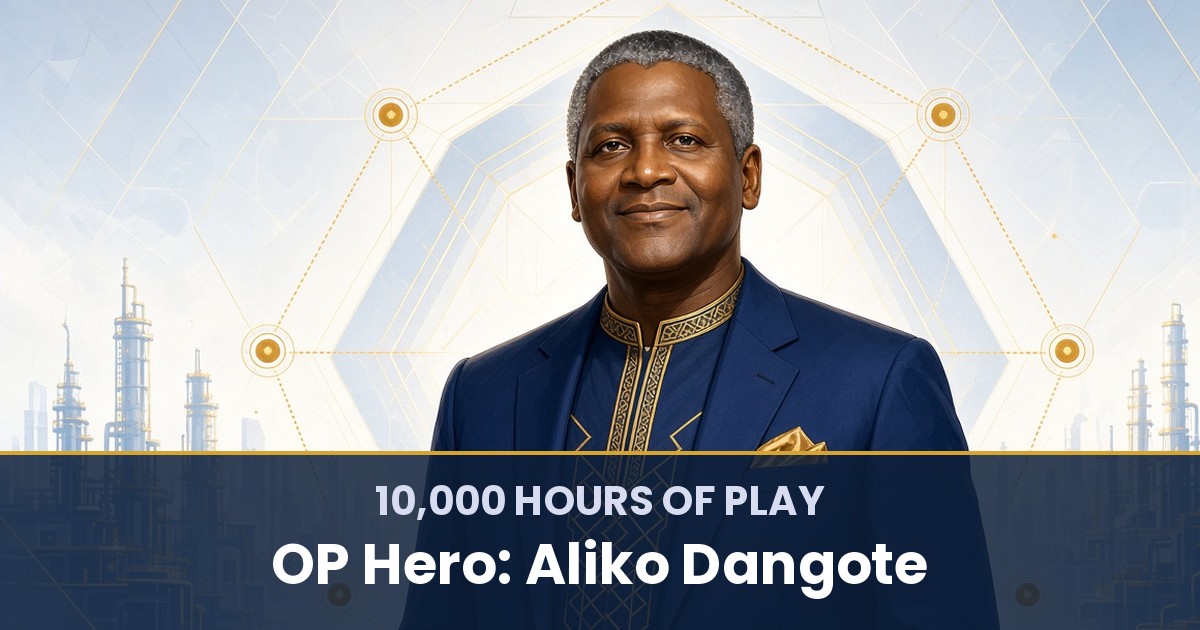


In 1978, Aliko Dangote borrowed roughly $3,000 from his uncle and started trading rice, sugar, and cement in Nigeria.
In 2023, he commissioned the Dangote Refinery at Lekki, a complex with a reported capacity of 650,000 barrels per day and a reported cost of around $20 billion.
Between those two dates sits a forty-five-year build that follows a single strategic rule: whatever Nigeria imports in bulk, learn to produce at home, at a scale nobody can ignore.
Run his life through the 6-Step framework and the build order underneath the empire becomes visible. The refinery was never a lucky bet. It was the final boss of a game he had been leveling up for since the late seventies.
⚡ Speed Run Notes
- Dangote’s Game was moving Nigeria and Africa from importing essentials to producing them at industrial scale: food, cement, fertilizer, and fuel.
- His build ran on commercial pattern recognition, unusual risk tolerance, and a planning horizon measured in decades.
- Five canon Skills defined the run: Track Treasure, Sacrificial Cycle, Mastermind, Cosmic Alignment, and Greed Alchemy.
- The $20 billion, 650,000-barrel-per-day refinery was announced and built over many years before its 2023 commissioning. The hardest Quest came last, after four decades of practice.
- Steal this: sequence your Quests so each one funds and trains you for the next. Dangote did not start with the refinery, and neither should you.
Table of Contents
About Yu-kai Chou

Yu-kai Chou is the author of 10,000 Hours of Play — the book that treats your life as the most important game you’ll ever build a character in, and gives you the 6-Step framework (Game · Attributes · Role · Skills · Allies · Quests) to play it on purpose. He has spent two decades developing the system through which this post analyzes its OP Hero, and applies it to his own life and to the lives of the people he advises around the world.
Chou’s other framework, the Octalysis Framework, has been applied by LEGO, Microsoft, Porsche, Coca-Cola, Salesforce, and MrBeast, impacting over 1.5 Billion Users. He has taught the methodology at Harvard, Stanford, Yale, Tesla, Google, BCG, and IDEO, and has advised governments in eight nations including Ukraine, the United Kingdom, the Kingdom of Bahrain, Singapore, Taiwan, the Netherlands, Kazakhstan, and South Korea.
His work has been cited by Harvard, Stanford, MIT, Forbes, Wall Street Journal, Wired, US Department of Energy, NIST, NSF, NCBI, US Department of Education, ClinicalTrials.gov, and Google Scholar — with 3,700+ more academic publications. Explore his books here.

Dangote’s build fascinates me because of its sequencing discipline. He spent four decades climbing from trader to manufacturer to industrialist before attempting his hardest Quest, and every stage paid for the next one. That ordering is the single lesson I would lift from his run: he earned his biggest project through the smaller ones that came before it.
Step 1: The Game — What Aliko Dangote Was Actually Playing
Dangote’s Game was never just getting rich. Trading rice and sugar in Nigeria in the late seventies could make a sharp operator wealthy without ever requiring a factory.
His actual Game was harder: take the essential goods his country bought from abroad and move their production home, at industrial scale, under his own roof.
You can watch the Game declare itself in stages. In 1978 he traded imported staples.
In 1992 he crossed into manufacturing, starting with textiles and sugar. Around 2005, Dangote Cement emerged as a dominant player in its market, and in the years from 2010 to 2020 the group broadened into fertilizer, logistics, and infrastructure.
Then came the endgame: a refinery designed to process 650,000 barrels of crude per day, so that fuel itself could join the list of things Nigeria no longer had to buy from abroad.
Once you see that each chapter replaces an import with a domestic industry, a fifty-year career reads as one continuous campaign.
Step 2: Attributes — The Innate Stats
Strip away the capital and the connections, and a few raw stats show up early in Dangote’s story.
Commercial pattern recognition. As a schoolboy he reportedly sold sweets to his classmates. Small demand, repeatable purchase, organized supply: the exact shape of every business he would ever build, in miniature.
Risk tolerance. Most traders who get comfortable stay traders. Dangote repeatedly bet his accumulated winnings on capital-hungry projects, and the refinery alone carried a reported price tag of around $20 billion.
Long-horizon persistence. The distance from a $3,000 family loan to a functioning refinery spans roughly forty-five years. He played a game long enough that most competitors aged out of it before the scoreboard settled.
Scale orientation. At every fork he chose the industrial platform over the quick transaction: plants over consignments, infrastructure over arbitrage.
If you map your own stats with the Talent Triangle Method, notice which of these you actually hold, because Dangote’s ambition only worked with the patience to match it.
Step 3: Role(s) — The Character Class Across Chapters
Dangote re-classed several times, and the order of his Roles matters more than any single one of them.
He began as a commodity trader, moving rice, sugar, and cement from 1978. The trader years taught him exactly what Nigeria consumed, in what volume, at what margin.
Next came the importer-distributor, building the supply chains that moved essential goods through the country. Then the manufacturer, from 1992, learning to run production lines for textiles and sugar.
From the mid-2000s he operated as an industrial consolidator and African expansion strategist, turning cement into a platform that reached across African markets. The 2010s added the infrastructure builder, layering fertilizer, logistics, and power onto the group.
His final form is the energy industrialist, operating the refinery complex at Lekki.
He never skipped a class: each Role harvested the knowledge of the previous one, and the refinery became playable only after the trader, the manufacturer, and the consolidator had finished their chapters.
Step 4: Skills — The Real-Life Game Skills Aliko Dangote Mastered
Track Treasure (Ranger) — identifying hidden opportunities others don’t see. Everyone in Lagos knew Nigeria imported its essentials. Dangote read the same data as an unclaimed map: every import line was a future factory. Li Ka-shing opened with the same read in postwar Hong Kong, treating unmet demand as the map before he owned the assets.
Sacrificial Cycle (Warlock) — reinvesting all resources back into the project. His early trading profits were reportedly plowed back into expansion rather than consumption, which is how a one-man trading operation became the Dangote Group by 1981.
Mastermind (Ranger) — creating, adapting, and executing complex plans. The group’s portfolio sequencing is a textbook case: trading paid for the first factories, cement grew out of them, and the fertilizer and refining ventures drew on everything that came before.
Cosmic Alignment (Mage) — optimizing complex logistics and how moving parts come together. A 650,000-barrel-per-day refinery demands that financing, engineering, construction, regulation, and feedstock strategy all land in the same place at the same time. Coordinating moving parts at that scale is a learned craft, and he had been practicing it since his distribution days.
Greed Alchemy (Warlock) — using financial leverage to create exponential growth. Nobody saves up $20 billion. Assembling capital of that magnitude, across institutions and years, is a Skill in itself, and it is the one that turned his industrial thesis into poured concrete.
On the Skills Spectrum, Dangote reads as a master of one meta-skill, industrial-scale import substitution, with specialist depth in logistics and finance serving that one repeated play.
Step 5: Allies — The People Who Multiplied Aliko Dangote
The first and most consequential Ally in this story is his uncle, whose loan of roughly $3,000 opened the trading business in 1978. Without that early family capital there is no first inventory, and without first inventory there is no Dangote Group.
The record on named mentors is thin, and inventing one would insult the build. What the record does show is institutional allies arriving at each new level of the game.
As the group internationalized, institutional capital partners joined the roster, giving the cement platform the financial allies its cross-border chapter required.
The refinery itself is evidence of another kind of alliance: the large multidisciplinary engineering and operating teams a 650,000-barrel-per-day complex requires. A founder can own the vision, but a project of that size is won by the roster.
His later-career network extends into policy and philanthropy. In 2016 he was appointed co-chair of the U.S. Chamber of Commerce’s U.S.-Africa Business Center, and in 2017 he joined the board of the Clinton Health Access Initiative.
The pattern for your own build is to match the Ally to the level: family capital opened Dangote’s game, and institutional partners and specialist teams carried its later chapters.
Step 6: Quests — The Milestones That Shaped the Saga
Quest 1: The trading launch (1978). Armed with his uncle’s loan, Dangote began trading rice, sugar, and cement. Result: a commercial base, and a working education in what Nigeria buys and in what volume.
Quest 2: Forming the Dangote Group (1981). The successful trading operation incorporated into a corporate platform, converting a personal venture into something that could hold factories.
Quest 3: The manufacturing crossing (1992). Entering textiles and sugar production moved him from moving goods to making them. This is the quest most traders never attempt.
Quest 4: Cement industrialization (2000s). Dangote Cement emerged as a dominant player around 2005 and then expanded across African markets, becoming the group’s central industrial engine. Jamsetji Tata ran a comparable play in India a century earlier, building domestic industry where imports had ruled.
Quest 5: The refinery (2010s–2023). The Lekki complex, reported at 650,000 barrels per day and around $20 billion, extended the import-substitution strategy into petroleum. It was commissioned in 2023, and commercial fuel production followed in early 2024.
The setback worth studying: the refinery was announced and under construction for many years before it processed its first barrel. A project that consumes most of a decade with no revenue is a brutal test of conviction, and plenty of observers wrote it off along the way. Dangote’s response was to keep building, which is only possible when the rest of your portfolio can carry the weight while the big Quest matures.
What You Can Steal From Aliko Dangote’s Build
You are probably not going to build a refinery. The architecture of the run still transfers.
Pick a Game that compounds. “Produce what my country imports” gave Dangote a fifty-year quest log where every completed Quest made the next one cheaper. A Game you can finish in two years will not compound the way his did.
Sequence by capability. Trader taught demand. Manufacturer taught production. Consolidator taught scale. Only then came the hardest project. Write your own version of that ladder before you jump to your endgame.
Let your portfolio fund your patience. The refinery survived its long construction because cement, sugar, and fertilizer kept paying the bills. Your stable income streams are what make your decade-long bet survivable.
Match Allies to levels. A $3,000 uncle at level one, sovereign-scale capital partners at level forty. Neither could have played the other’s part.
Where this framework comes from

Want the full system this profile is built on?
Every OP Hero piece runs through the same 6-Step framework from 10,000 Hours of Play: Unlock Your Real-Life Legendary Success. The book covers the full system, walks through Yu-kai’s own life run as the first applied case study, and gives you the worksheets to audit your own build.
Related Reading
- All OP Hero Profiles (the full hub)
- 10,000 Hours of Play by OP Hero: Morris Chang
- 10,000 Hours of Play by OP Hero: John D. Rockefeller
- 10,000 Hours of Play by OP Hero: Sam Walton
- What’s Your Edge Strength? The Talent Triangle Method
- The Skills Spectrum: Specialist, Dabbler, or Master?