
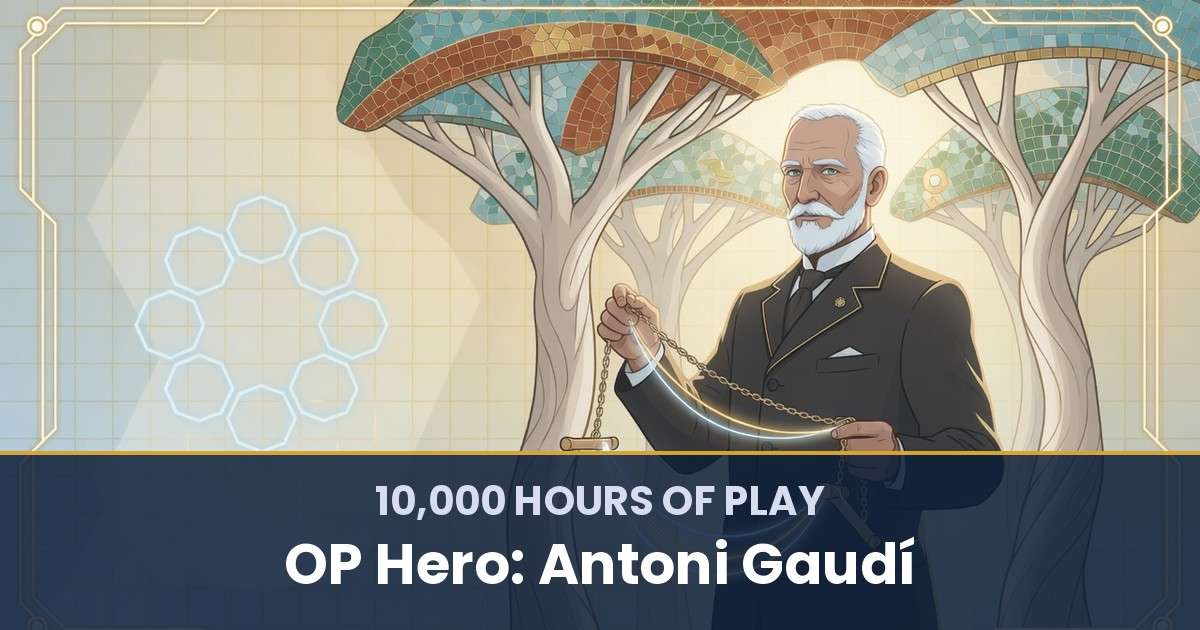


On June 7, 1926, a tram struck an old man crossing a street in Barcelona.
He carried no identification. His clothes were so worn that bystanders took him for a beggar, and he was brought to a hospital serving the city’s poor.
Three days later, when Antoni Gaudí died, Barcelona realized who it had almost left unclaimed: the most famous architect in Catalonia, buried days later in the crypt of the unfinished basilica he had served for 43 years.
A century on, that building is still going up. In February 2026 its central tower reached structural completion, and the blessing was set for June 10, 2026, one hundred years to the day after his death.
Run that life through the 10,000 Hours of Play framework and the shabby coat stops reading as eccentricity. It was the visible edge of a deliberate build: one Game, played across five decades, designed to keep running after the player logged off. Here is the character sheet.
⚡ Speed Run Notes
- Gaudí’s Game was a unified sacred architecture: structure, symbolism, and nature fused into one system, with the Sagrada Família as an endgame Quest he knew he would never personally finish.
- His Attributes showed early: a coppersmith’s son with unusual spatial vision, and a rheumatic child who studied nature for hours because he often could not play.
- Five canon Skills carry the build: True Sight, Telekinesis, Bind Fate, Aegis, and Sacrificial Cycle.
- His biggest flop became a landmark. Park Güell planned roughly sixty housing plots; only two houses went up. The failed development is now part of a UNESCO World Heritage listing.
- Struck by a tram in 1926 and mistaken for a beggar, he left models and drawings so complete that successors are still building from his system a century later.
Table of Contents
- About Yu-kai Chou
- Step 1: The Game Antoni Gaudí Was Actually Playing
- Step 2: Attributes, the Innate Stats
- Step 3: Role(s) Across Chapters
- Step 4: The Real-Life Game Skills He Mastered
- Step 5: The Allies Who Multiplied Him
- Step 6: The Quests That Shaped the Saga
- What You Can Steal From Gaudí’s Build
- Where this framework comes from
About Yu-kai Chou

Yu-kai Chou is the author of 10,000 Hours of Play — the book that treats your life as the most important game you’ll ever build a character in, and gives you the 6-Step framework (Game · Attributes · Role · Skills · Allies · Quests) to play it on purpose. He has spent two decades developing the system through which this post analyzes its OP Hero, and applies it to his own life and to the lives of the people he advises around the world.
Chou’s other framework, the Octalysis Framework, has been applied by LEGO, Microsoft, Porsche, Coca-Cola, Salesforce, and MrBeast, impacting over 1.5 Billion Users. He has taught the methodology at Harvard, Stanford, Yale, Tesla, Google, BCG, and IDEO, and has advised governments in eight nations including Ukraine, the United Kingdom, the Kingdom of Bahrain, Singapore, Taiwan, the Netherlands, Kazakhstan, and South Korea.
His work has been cited by Harvard, Stanford, MIT, Forbes, Wall Street Journal, Wired, US Department of Energy, NIST, NSF, NCBI, US Department of Education, ClinicalTrials.gov, and Google Scholar — with 3,700+ more academic publications. Explore his books here.

Why Gaudí earns a seat in this series: he is the cleanest example I know of a builder who designed his Game to outlive his own playthrough. He turned one basilica into a system of models and drawings that other people could keep playing a century after him, and the 2026 centenary blessing of the central tower is that system still running. The pairing I would lift from his build is True Sight plus Sacrificial Cycle: observe reality more closely than anyone around you, then commit everything you have to the one Quest that deserves it.
Step 1: The Game Antoni Gaudí Was Actually Playing
Strip away the tourist lines and the postcard silhouettes, and Gaudí’s Game becomes clear. He was trying to build a sacred architecture where structure, symbolism, and nature stopped being separate disciplines and became one system.
The architects of his era generally treated engineering, decoration, and meaning as three different trades. Gaudí bet his entire career on the wager that they were one.
You can see the Game forming before he had a single commission. As a student between 1873 and 1878 he kept a diary, the Reus Manuscript, working out his ideas about architecture and decoration on paper years before he could test them in stone.
Beyond that diary and some technical reports, he left almost no writing. The Game was never words. It was buildings.
And the endgame Quest was singular: the Basílica de la Sagrada Família, which he took over in 1883 and directed until his death in 1926. Over those decades he gradually let secular work fall away until only the temple remained.
Here is what makes his Game worth studying inside the 10,000 Hours of Play lens: he chose a Game he could not personally win. The basilica was designed on a timescale that guaranteed he would die mid-build.
So he played for continuity instead of completion. He built physical models, trained collaborators, and documented geometry so thoroughly that his assistant Domènec Sugrañes could keep directing the works from those materials after 1926.
A Game that survives its player is a different class of Game. That design choice, made by a man who died looking like a beggar, is why cranes were still moving on his Quest in 2026.
Step 2: Attributes, the Innate Stats
Attributes are the stats you spawn with. Gaudí’s were visible long before the world had heard of him.
Spatial and constructive vision. He was the son of a coppersmith and grew up around metalwork, watching flat sheets become three-dimensional vessels. Decades later, his ability to conceive complex forms like catenary arches and ruled surfaces, and to work them out through physical models rather than flat drawings, traces straight back to that workshop intuition.
Obsessive observation of nature. Childhood rheumatism often kept him from playing with other children. A kid who cannot run spends a lot of time looking, and Gaudí spent it studying trees, bones, shells, and everything else the natural world builds. Those hours became his structural vocabulary.
Symbolic imagination. The Reus Manuscript shows him framing architecture in conceptual and moral terms while still a student. Buildings, to him, were arguments about meaning.
Stubborn independence. His grades were mediocre. His style fit no school completely. When Elies Rogent, director of the Barcelona architecture school, handed him his degree in 1878, he reportedly remarked that the title had been given either to a fool or a genius, and that time would tell.
Notice the shape of this stat sheet. None of these Attributes scream “architect of the century” on their own, and a few of them, like the sickly childhood and the middling grades, look like debuffs.
This is exactly what the Talent Triangle Method teaches you to look for: the raw traits underneath the résumé, before the world has decided what they are worth. Gaudí’s edge came from combining stats nobody else thought belonged together.
Step 3: Role(s) Across Chapters
A Role is the character class you equip for a chapter of your life. Gaudí ran four.
Student-Observer (1873 to 1878). An architecture student with unremarkable grades and a private diary full of theory. The chapter looked slow from outside. Internally, the entire conceptual engine was being assembled.
Modernist society architect (1883 to around 1900). Casa Vicens, built from 1883 to 1885 for Manuel Vicens, opened the chapter. Palau Güell followed from 1886 to 1890. In this Role he served Barcelona’s elite, delivering homes and palaces while smuggling structural experiments into every commission.
Patron-backed experimentalist (roughly 1884 to 1914). With industrialist Eusebi Güell funding him, Gaudí’s commissions became laboratories. The Güell estate pavilions, the Palau, and eventually Park Güell let him test geometry, color, and construction methods at full scale on someone else’s budget.
Sacred architect and ascetic (1914 to 1926). From 1914 he dropped almost everything else and devoted his final 12 years to the Sagrada Família, living an increasingly austere life close to the work. The man mistaken for a beggar in 1926 was in the deepest possible version of this Role.
Readers who followed the Frank Lloyd Wright profile will recognize the pattern: great architects rarely keep one Role for life. They re-class when the current chapter has taught them everything it can.
What sets Gaudí apart is the direction of travel. Each re-class traded income and social standing for deeper alignment with his Game. The build got poorer and stronger at the same time.
Step 4: The Real-Life Game Skills He Mastered
Attributes are what you spawn with. Skills are what you grind. Five canon Skills from the 10,000 Hours of Play system show up all over Gaudí’s saga.
True Sight (Ranger) — observing keen details others miss. Everyone in 19th-century Barcelona had seen trees. Gaudí saw load-bearing columns that branch, and bones and shells that solve compression problems. Where his rivals studied historical styles, he read structure directly off the natural world, the same way the Skills Spectrum describes a master extracting patterns invisible to dabblers.
Telekinesis (Mage) — visualizing physics interactions in the head. His signature move: hang chains from a ceiling, let gravity draw perfect tension curves, then invert the whole model to get compression-only arches and vaults. He could see the force flow before a single stone was cut, and the hanging models in his Sagrada Família workshop were that inner vision made checkable.
Bind Fate (Warlock) — using someone else’s brand and resources to grow your own power. A glove-shop display case he designed for the 1878 Paris Universal Exhibition caught Eusebi Güell’s eye. Gaudí converted that one artifact into decades of funded experimentation across the Güell commissions.
Aegis (Paladin) — pushing the Quest forward while ignoring public criticism. Casa Milà exceeded the city’s permitted height and footprint, drew objections and sanctions from the Eixample Commission, and got mocked. He kept building until the city accepted the finished work as “monumental in character.”
Sacrificial Cycle (Warlock) — reinvesting every resource back into the project. The final 12 years are the purest version of this Skill on record: commissions declined, comfort abandoned, wardrobe ignored, everything routed into one temple.
Five Skills, four classes. OP builds are rarely single-class.
Step 5: The Allies Who Multiplied Him
No solo player builds a basilica. Gaudí’s Alliance did specific, decisive work at every stage.
Eusebi Güell, the patron. The industrialist who spotted the Paris display case became a friend and backer for four decades, commissioning the Güell wine cellars, the estate pavilions, Palau Güell, Park Güell, and the crypt of Colònia Güell. Without Güell’s money, the experimental middle chapters of this build simply do not happen.
Josep Maria Bocabella, the Quest-giver. A religious publisher who founded the Spiritual Association of Devotees of St. Joseph in 1866, the organization that conceived and funded the expiatory temple. He created the Quest before Gaudí ever touched it.
Francisco de Paula del Villar, the predecessor. The original Sagrada Família architect saw the foundation stone laid in 1882, then resigned after disagreements with the promoters. His exit in 1883 handed a 31-year-old Gaudí the site, the institution, and the opening.
Josep Maria Jujol, the collaborator. The younger architect executed much of the polychrome trencadís on Park Güell’s serpentine bench, translating Gaudí’s forms into color with a craftsman’s hand Gaudí trusted.
Domènec Sugrañes, the successor. His principal assistant took over direction of the basilica after 1926, building from Gaudí’s surviving models and drawings. An Ally who can continue your Quest without you is the rarest recruit of all.
The Michelangelo profile shows the same dynamic five centuries earlier: sacred mega-projects run on the fusion of a singular builder with patrons and institutions willing to fund a vision longer than a lifetime.
Step 6: The Quests That Shaped the Saga
Casa Vicens (1883 to 1885). His first major commission. A young architect announces that his work will follow no existing template.
Palau Güell (1886 to 1890). The urban palace for his patron, where experimental spatial organization moved into the heart of Barcelona.
Park Güell (around 1900 to 1914), the failure Quest. Conceived as a garden-city development of roughly sixty plots. Only two houses were ever built, one of them the show house. As real estate, a wipeout. The site later entered UNESCO’s World Heritage list, a reminder that a failed Quest can still drop legendary loot.
Casa Batlló (1904 to 1906). A radical remodel of an existing building that became one of the most recognizable façades in Europe.
Casa Milà (1906 to 1912), the boss fight with the city. Over-height, over-footprint, scaffolding on the public pavement, municipal sanctions. He finished it anyway, and the city relented by classing the building as monumental.
The Sagrada Família (1883 to 1926, and counting). He took over at 31, re-conceived his predecessor’s neo-Gothic project in his own language, and from 1914 worked on nothing else. At his death the temple stood less than a quarter complete: the Nativity façade area, the apse, the crypt.
Then the Quest kept going without him. In 2025 the Vatican declared him venerable, recognizing his heroic virtues. In February 2026 the Tower of Jesus Christ reached structural completion at 172.5 meters, and its blessing was scheduled for June 10, 2026, the centenary of his death.
Seven of his works now sit on UNESCO’s World Heritage list: Park Güell, Palau Güell, and Casa Milà inscribed in 1984, with Casa Vicens, Casa Batlló, the Colònia Güell crypt, and the Nativity façade and crypt of the Sagrada Família added in 2005.
Every one of those Quests fed the next. That is what a coherent Game looks like on a map.
What You Can Steal From Gaudí’s Build
Choose a Game that compounds after you log off. Gaudí knew the basilica would outlive him, so he optimized for transferability: models, drawings, trained successors. Ask whether your current Quest would survive your exit. If the answer is no, you are building a job, and he was building a system.
Mine your debuffs for Attributes. The rheumatic childhood that kept him from play produced the observation habit that powered True Sight. The stat the early game punishes is often the one the late game pays for.
Turn one artifact into a patron pipeline. A single glove display case, built with full craft, recruited the Ally who funded forty years of experiments. Make one thing so well that the right person cannot ignore it.
Hold the Quest through the fool-or-genius years. His graduation verdict stayed open for decades while critics mocked and the city fined him. The verdict that finally landed, a UNESCO listing and a century of construction in his name, arrived long after the noise died.
His character sheet now joins the rest of the OP Hero profiles, and it holds a specific seat there: the build for anyone whose one great project is bigger than their lifespan.
So steal his opening move. Find the thing you already observe more closely than everyone around you, and start treating it as your structural vocabulary.
Where this framework comes from

Want the full system this profile is built on?
Every OP Hero piece runs through the same 6-Step framework from 10,000 Hours of Play: Unlock Your Real-Life Legendary Success. The book covers the full system, walks through Yu-kai’s own life run as the first applied case study, and gives you the worksheets to audit your own build.
Related Reading
- All OP Hero Profiles: the full hub of legendary builds analyzed through the 10,000 Hours of Play framework.
- 10,000 Hours of Play by OP Hero: Michelangelo: the earlier master of the patron-funded sacred mega-project, five centuries before the Sagrada Família.
- 10,000 Hours of Play by OP Hero: Frank Lloyd Wright: a fellow architect whose build also ran on decades of re-classing and stubborn vision.
- 10,000 Hours of Play by OP Hero: Zaha Hadid: another architect who bent geometry to her will and outlasted years of skeptics.
- 10,000 Hours of Play by OP Hero: Katsushika Hokusai: a craftsman who, like Gaudí, treated one artistic Game as worth an entire lifetime.