
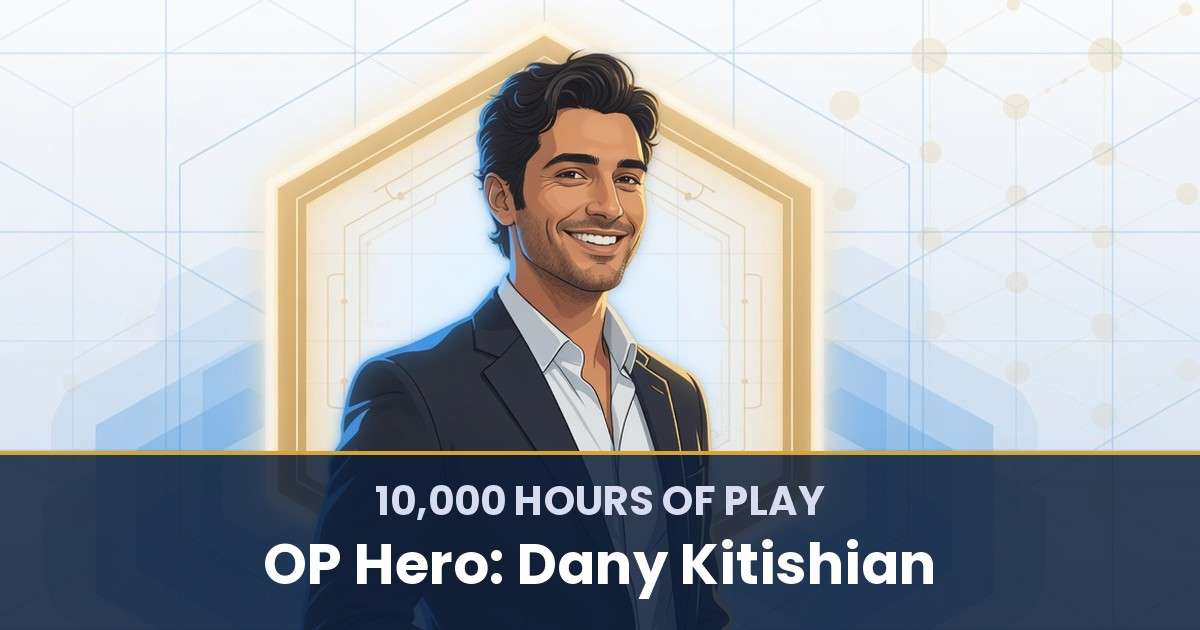


In 1998, a teenager in Ruston, Louisiana was fixing cell phones at a workbench in his family’s shop. Every handset he opened had the same small sticker inside it. Qualcomm.
Almost nobody thought about that sticker. He did, and years later he told the story to Irwin Jacobs, the man who co-founded Qualcomm, sitting in Jacobs’s own living room. By Dany’s account, that conversation ended with the first check he ever received from outside his family.
Today Dany Kitishian runs Klover.ai, the company that coined Artificial General Decision-Making (AGD™) and is betting the AI industry is racing toward the wrong finish line. He came to me in 2025 as an ally to advise on Klover’s intellectual property, and most of what Step 5 reports comes from a year of weekly calls that followed.
Run his life through the 6-Step framework from 10,000 Hours of Play and you get a rarer build than the prodigy or the late bloomer. He kept choosing the harder room (a Nobel laureate’s class that emptied out in two weeks), then spent a decade building rooms for other people (a student competition he ran, then chaired).
⚡ Speed Run Notes
- Dany’s Game is stated in one sentence he uses for Klover: help every person and organization make better decisions. The AI stays a tool; the human stays the protagonist.
- His defining attribute is noticing the small thing everyone else treats as decoration, then walking straight up to the person it belongs to.
- Three Skills carried the build: True Sight (Ranger), Siphoning (Warlock) and Concord of Elements (Druid). He stayed in the Markowitz class that emptied out, and turned a Nobel laureate into a monthly beer.
- Allies decided everything: Larry Bock told him never to become a VC; Irwin Jacobs wrote the first check; and in 2025 he came looking for me.
- Klover launched in 2023, bootstrapped. AGD™ went from a registered domain in March 2024 to a trademark filing in May and Forbes coverage by July. The saga is mid-chapter.
Table of Contents
About Yu-kai Chou

Yu-kai Chou is the author of 10,000 Hours of Play — the book that treats your life as the most important game you’ll ever build a character in, and gives you the 6-Step framework (Game · Attributes · Role · Skills · Allies · Quests) to play it on purpose. He has spent two decades developing the system through which this post analyzes its OP Hero, and applies it to his own life and to the lives of the people he advises around the world.
Chou’s other framework, the Octalysis Framework, has been applied by LEGO, Microsoft, Porsche, Coca-Cola, Salesforce, and MrBeast, impacting over 1.5 Billion Users. He has taught the methodology at Harvard, Stanford, Yale, Tesla, Google, BCG, and IDEO, and has advised governments in eight nations including Ukraine, the United Kingdom, the Kingdom of Bahrain, Singapore, Taiwan, the Netherlands, Kazakhstan, and South Korea.
His work has been cited by Harvard, Stanford, MIT, Forbes, Wall Street Journal, Wired, US Department of Energy, NIST, NSF, NCBI, US Department of Education, ClinicalTrials.gov, and Google Scholar — with 3,700+ more academic publications. Explore his books here.

The lesson in Dany’s build is Summon: he asks early, plainly, and then keeps the relationship for years. Jacobs, Markowitz, Bock and Harvey White each started as a stranger he approached, and each is still part of his story a decade or more later. If your network feels thin, Step 5 shows what one approach and ten years of follow-through can turn into.
Step 1: The Game — What Dany Kitishian Was Actually Playing
Dany’s family story starts a long way from Louisiana. He traces his people to Jerusalem’s Armenian Christian community, one of the oldest continuous Christian presences on earth, and he still speaks of a family warehouse in the Old City. Family legend has an ancestor brokering peace between neighbors who could not agree on how to share the city, and Jerusalem’s four quarters as the memory of that table.
He grew up believing he came from people whose job was to stay when others left and to broker when others fought, whether or not every line of the legend can be footnoted.
That inheritance shaped the Game he plays now, and he describes AI in the same register. “Embarking on a career in AI wasn’t so much a choice as it was a calling to participate in what is perhaps the greatest technological revolution our species has ever faced,” he told Authority Magazine in 2024. The prize was never fame: “My drive in AI is not rooted in a desire for recognition but in a commitment to create a world where I would be proud to raise children, where aging family members can live longer and healthier lives, and where humanity can tread a less destructive path.”
The scoreboard follows from that. Most of the industry is playing the AGI game, where the win is a machine smarter than any person. Klover’s own line draws the contrast: “AGI’s goal is to create ‘superhuman machines’. AGD’s goal is to turn every person into a superhuman.”
In Octalysis terms, AGI is function-focused design and AGD is human-focused design: the system is built so that Core Drive 3: Empowerment of Creativity & Feedback stays with the person, who proposes, chooses and sees the result. Dany made the human-focused bet about AI in 2023, with no outside money, in the loudest gold rush of our time.
Step 2: Attributes — The Innate Stats
Strip away the résumé and three innate stats show up in the repair shop and never leave.
Noticing. Dany reads a room, a phone, or an industry the same way: what is the small constant nobody is talking about?
Fearlessness of first contact. A colleague of his once called him the ultimate connector, with “fearlessness in making initial contact.” The pattern in his life bears it out: the pitch in Jacobs’s house, the Nobel laureate’s office hours, the cold email to an author whose framework he wanted to build on.
Patience with people, measured in years. By his account, the sticker story became an almost yearly visit to Jacobs’s home for a decade. The Markowitz relationship ran on monthly beers in La Jolla for years after the class ended. He keeps contacts for decades.
The fourth stat is stewardship. He carries the family inheritance as a responsibility, which is why he ends up on boards and juries instead of only on cap tables.
In the OP Talent Triangle Method, the exercise is finding where your innate stats overlap into an unfair advantage. Dany’s overlap is noticing plus approaching plus staying, and the decade he spent running and then chairing a student competition shows what that overlap produces: a network with him at the hub, and no title required.
Step 3: Role(s) — The Character Class Across Chapters
Dany’s class shifted four times, and each shift kept the previous one’s stats.
Apprentice Technician (Ruston, 1990s). A workbench in the family’s wireless repair shop, one of the early ones in the country by his telling. Class: hands-on fixer with a habit of asking why.
Engineer-Researcher (Louisiana Tech, 2001–2006). A B.S. in Biomedical Engineering, and two professors who reset his ceiling. Charles Robinson, who held Louisiana Tech’s Watson Eminent Scholar Chair and directed its biomedical engineering center, taught him to start graduate-level work as an undergraduate and to treat other people’s money as a tool rather than a destination. Roy Schubert, a Case Western-trained biomedical engineer whose career was spent on oxygen microelectrodes, told him to explore without hesitation. Dany says he won funding in a NASA-supported program for a microbubble artificial-lung concept for space habitation, competing against professors for the grant.
Fundraiser-Connector (San Diego, 2007–2018). The MBA at UC San Diego’s Rady School under founding dean Robert Sullivan, whose first classes met in temporary quarters left over from a Marine base. Then three years as the contracted fundraiser for Larry Bock‘s science festival, projects for the Beyster family’s foundation, and a decade with UC San Diego’s student-run Entrepreneur Challenge: student CEO in 2008–09, then chair of its executive committee until 2018. The San Diego Union-Tribune named him a past CEO in 2011, quoting his operating philosophy: “We always offer free food at our events because that’s a big draw.”
Founder-Orchestrator (Klover, 2023–). CEO and Chairman of Klover.ai, alongside his advisory practice, Kitishian & Associates. The role he plays now is the one the previous three trained: assemble specialists, human and artificial, and point them at one decision.
On the 7-class taxonomy of Real-Life Game Skills, that arc is a Druid-Ranger hybrid: someone whose power is bringing parties together and seeing the opportunity between them. It is a different build from Morris Chang‘s Mage-Warlock foundry architect, and it produces a different kind of company: Chang built a process, Dany builds a party.
Step 4: Skills — The Real-Life Game Skills Dany Kitishian Mastered
Attributes are the stats you spawn with. Skills are what you build. Dany built five that show up in specific moments.
True Sight (Ranger) — observing keen details others miss. The sticker in every phone. Later, the same skill read an entire industry: everyone saw AI getting smarter; Dany saw that nobody was designing for the human who still has to choose. That read of the market became AGD.
Charge (Warrior) — approaching a lead or target of interest. He walked into Irwin Jacobs’s house with a true story rather than a costume. He introduced himself to Harvey White, Qualcomm’s co-founder, who taught him, he says, to always ask for double.
Courageous Heart (Paladin) — charging into uncomfortable zones. At Rady he enrolled in Portfolio Theory with Harry Markowitz, the Nobel laureate who taught at Rady from 2007. Dany remembers the room emptying in the first two weeks. He stayed. “Harry didn’t hand out mentorship,” he told me. “He gave it to those who earned it. And that course was where I earned it.”
Siphoning (Warlock) — extracting knowledge rapidly from people who have it. The Markowitz class became years of monthly beers in La Jolla, questions and counter-questions, even shopping for an anniversary gift for Markowitz’s wife. In the Summer 2009 Rady Business Journal, answering questions Dany developed with professor Craig R.M. McKenzie, Markowitz wrote: “Portfolio theory never promised high return with low risk. You place your money, and you take your choice.” You cannot delete risk. You can only choose which risks are worthy. Dany’s summary of the years that followed: “You don’t get this from textbooks or citations. You get it from stories, questions, counter-questions, and watching how Harry thought.” Markowitz died in June 2023. The student kept the method.
Concord of Elements (Druid) — bringing parties of different interests together. The Entrepreneur Challenge pulled engineers, scientists and business students onto one team. Klover’s “Dream Team” page lists a former PwC global head of AI, a D-Wave co-founder, a Forbes contributor and a gamification guy from Taiwan on one roster.
On the Skills Spectrum, Dany sits at the Strategist end: broad across biomedical engineering, finance and fundraising, with one deep specialty, people, which is the specialty the four Skills above all draw on.
Step 5: Allies — The People Who Multiplied Dany Kitishian
Dany is unusually explicit about who made him, and most of the names are San Diego’s builder generation: Bock, Jacobs, White, the Beysters, Burnham.
Larry Bock, co-founder of Illumina and founder of the USA Science & Engineering Festival, hired him as a fundraiser and gave him the advice that set his path. As Dany recalls it: “You do not want to be a VC. 99% do not add value to society. Be an entrepreneur. I can make you a VC tomorrow if you would like.” Dany chose the other path. Bock died in 2016; the instruction held.
Irwin Jacobs, by Dany’s account, wrote the first check and taught something rarer than capital: that a person who has already won still owes time to students and to noble causes.
Mary Ann and Bob Beyster, the SAIC founder’s family, gave him his first significant work after Rady and refused to accept 99 percent. Saeed Amidi, founder of Plug and Play, showed him how a family business becomes a platform; Dany spent about a year as the founding San Diego partner helping plant that model in a new city. Malin Burnham, a Star-class world champion at 17, taught him that when the gun fires nobody waits for you at the line.
In 2025 Dany came to find me, which makes this the one ally I can describe firsthand. He wanted an advisor on Klover’s intellectual property, and he wanted to build agents around the six steps of 10,000 Hours of Play. On our first working call his engineers were already asking how an agent could keep all six steps aligned instead of treating them as separate modules.
That turned into a weekly call, and the call is still running.
Summon (Druid), requesting an ally to help with the current quest, is the Skill under the whole step, and it is the one most of us skip because a no feels expensive and a cold email feels presumptuous, and Dany sends the email anyway.
Step 6: Quests — The Milestones That Shaped the Saga
Quest 1: Fix the phones (1990s). The repair bench, the sticker, the first habit of noticing.
Quest 2: Help astronauts breathe (2001–2006). The NASA-program grant and the microbubble lung concept, won as an undergraduate. The paper trail is thin, and by his account the choice was simple: he decided the lab was not a waiting room.
Quest 3: Stay in the class (2007–2009). Rady, Markowitz, and the Summer 2009 Rady Business Journal Q&A on business and psychology built on Dany’s questions. Then Bock’s festival, the Beysters’ projects, and the choice of entrepreneur over VC.
Quest 4: Build the arena (2009–2022). Running the Entrepreneur Challenge, then chairing it; coaching student founders such as Tri-D Dynamics co-founder Alex Finch, who credits him with founding the Challenge and calls him a make-it-happen person; judging the Department of Energy’s Cleantech University Prize final in 2017; mentoring Rice Business Plan Competition winners; the board of the Women’s Museum of California, where he says he was the only man in the room; advising Oxford Entrepreneurs. If there is a table where the next generation can pitch, he wants it to exist.
Quest 5: Name the other finish line (2023–). Klover.ai, founded with no outside funding. The dated record: the artificialgeneraldecision.com domain registered March 3, 2024; the Disruption/Interruption podcast on March 5, 2024, where he talked about using AGD to help parents and to fight online child exploitation; trademark applications for “AGD” and “Artificial General Decision Making” filed May 28, 2024; the Authority Magazine interview that June; the first of several Forbes contributor pieces that July. Dany credits an early period working alongside AGI pioneer Ben Goertzel with showing him, in his words, “AGI in all its beauty and all its peril,” and with pushing Klover toward AGD instead.
Quest 6: The convergence (2025–). Klover building agents for the six steps, and a six-post series on why AGD plus Octalysis is the future of human-AI work, of which this profile is the first installment. The quest is still open: Klover’s agents for the six steps are in build, the series has five posts to go, and this OP Hero catalog entry will need a sequel when they land.
What You Can Steal From Dany Kitishian’s Build
Start in the humble room. A repair shop and a classroom in a leftover Marine building are valid origin points. Do not postpone your life until the set looks expensive.
Take the class everyone drops. Dany’s mentorship from Markowitz came from staying in a class that lost most of its students in two weeks, then continuing to ask questions for years after it ended.
Stand near giants, then build. Learning from Jacobs, Markowitz, Bock, Amidi and the Beysters is different from becoming them. The honorable sequel is to found your own thing, which Bock told him in one sentence.
Build tables. A student competition, a museum board, a jury seat, an introduction between two people who should know each other. Ten years of that produced the Dream Team roster on Klover’s site without a funding round.
When the technology wants to replace the human, defend the human. AGD is built on that rule, and Octalysis applied to AI reaches the same rule from the motivation side: the agent proposes, the human decides, and the decision is what the human gets to own.
Dany measures a life with a line he credits to Maya Angelou: “You did the best that you knew how. Now that you know better, you’ll do better.” One problem at a time. One person at a time.
Where this framework comes from

Want the full system this profile is built on?
Every OP Hero piece runs through the same 6-Step framework from 10,000 Hours of Play: Unlock Your Real-Life Legendary Success. The book covers the full system, walks through Yu-kai’s own life run as the first applied case study, and gives you the worksheets to audit your own build.
Related Reading
- All OP Hero profiles: the 10,000 Hours of Play hub
- 10,000 Hours of Play by OP Hero: Morris Chang
- 10,000 Hours of Play by OP Hero: Satya Nadella
- 10,000 Hours of Play by OP Hero: Larry Ellison
- Will AI Destroy Us? A Behavioral Designer’s Answer to AI Alignment
- The OP Talent Triangle Method
The Octalysis designs of the five patterns Dany named are collected on Human-AI Motivation and Octalysis.