
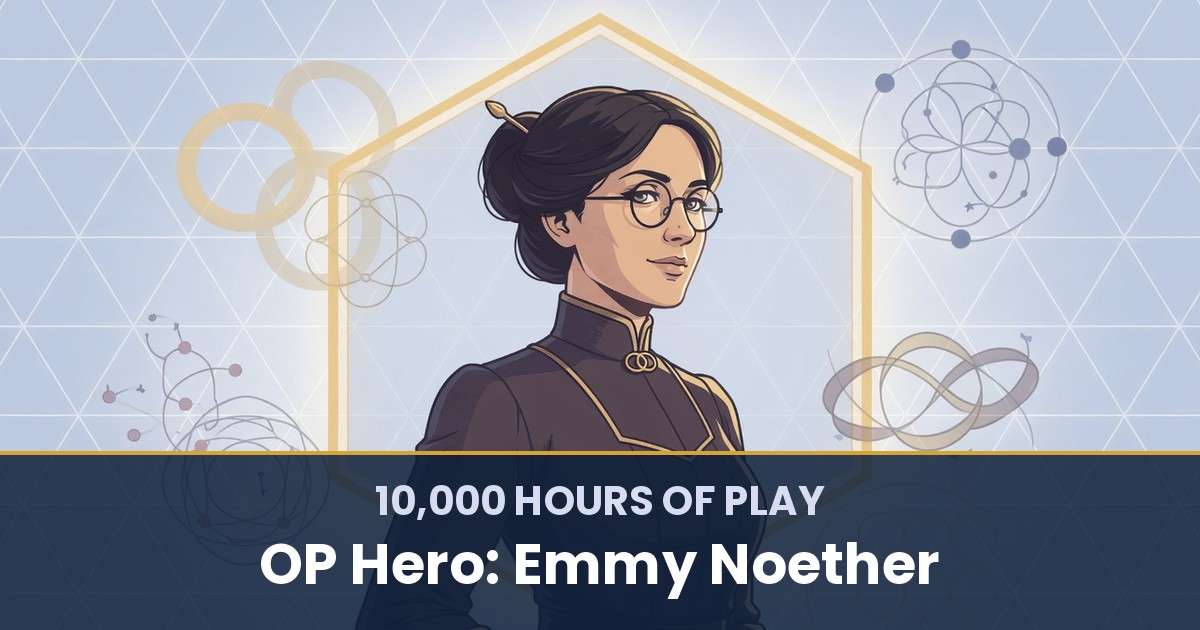


On 26 July 1918, Felix Klein stood before the Royal Society of Sciences in Göttingen and read a paper aloud to the room. He had not written it. The author was a 36-year-old woman who, under the rules of the day, was not allowed to hold a faculty seat, could not lecture under her own name, and had already spent roughly seven years teaching for no salary at all.
The paper was called Invariante Variationsprobleme. Inside it was the result we now call Noether’s theorem: proof that every continuous symmetry in a physical system produces a matching conserved quantity. It is the reason physicists can say energy is conserved because the laws of nature do not change from one moment to the next.
Emmy Noether spent her whole life locked out of the rooms where the credit was handed out. She kept walking into them anyway, and she quietly rebuilt the foundations of modern algebra and physics from a chair that officially did not exist. If you treat a life as a character you are leveling up on purpose, Noether is one of the most instructive builds ever recorded.
⚡ Speed Run Notes
- Noether’s “game” was structure itself: take a messy, concrete problem and find the clean, general law hiding underneath it, then rebuild the whole field on that law.
- Her superpower was abstraction. Where others computed, she recast the problem entirely, and the answer fell out as a consequence.
- She lectured seven years unpaid and was denied habilitation for being a woman. She published through all of it, which is a stat most builds never survive.
- Her allies were force multipliers: Hilbert fought the faculty for her, Klein presented her work, Einstein called her a genius, and van der Waerden’s textbook carried her ideas worldwide.
- Dismissed by the Nazis in 1933, she rebuilt from scratch at Bryn Mawr in America, and was still teaching when she died in 1935.
Table of Contents
About Yu-kai Chou

Yu-kai Chou is the author of 10,000 Hours of Play — the book that treats your life as the most important game you’ll ever build a character in, and gives you the 6-Step framework (Game · Attributes · Role · Skills · Allies · Quests) to play it on purpose. He has spent two decades developing the system through which this post analyzes its OP Hero, and applies it to his own life and to the lives of the people he advises around the world.
Chou’s other framework, the Octalysis Framework, has been applied by LEGO, Microsoft, Porsche, Coca-Cola, Salesforce, and MrBeast, impacting over 1.5 Billion Users. He has taught the methodology at Harvard, Stanford, Yale, Tesla, Google, BCG, and IDEO, and has advised governments in eight nations including Ukraine, the United Kingdom, the Kingdom of Bahrain, Singapore, Taiwan, the Netherlands, Kazakhstan, and South Korea.
His work has been cited by Harvard, Stanford, MIT, Forbes, Wall Street Journal, Wired, US Department of Energy, NIST, NSF, NCBI, US Department of Education, ClinicalTrials.gov, and Google Scholar — with 3,700+ more academic publications. Explore his books here.

What I keep coming back to with Noether is that she never once let the scoreboard decide her effort. The title, the salary, the faculty vote all said “no” for most of her career, and she treated that as noise rather than as a verdict on the work. The lesson I’d lift from her build is that your Role and your recognition are two different variables. Play the Role fully even before the world agrees you hold it, and the Skills you compound in that gap become the thing no committee can vote away.
Step 1: The Game — What Emmy Noether Was Actually Playing
Noether played a different game from the mathematicians around her. Where they raced to compute the answer to a hard, specific problem, she went hunting for the general law hiding underneath it.
Her game was structure. She kept chasing the deepest general law hiding underneath a messy particular problem, then rebuilding an entire field on top of that law. Across invariant theory, ring theory, and ideal theory, again and again she replaced ad-hoc calculation with a clean structural framework that made the old hard problems fall out as easy consequences.
This is the same instinct behind treating your own life as a game you’re actively building rather than a series of disconnected tasks. Noether never optimized a single move. She optimized the rules of the whole system, and everything downstream got easier.
Her 1918 result is the cleanest example. Instead of hunting for conservation laws one at a time, she proved a structural fact: symmetry itself generates conservation. One law, and physics inherited a tool it still runs on a century later. When your game is the structure and not the score, a single win can pay out for generations.
Step 2: Attributes — The Innate Stats
Attributes are the traits you show up with before anyone trains you. Noether’s stat sheet was unusual and visible early.
Her highest stat was abstract pattern recognition. As a student at Erlangen and later an auditor at Göttingen, she gravitated to the most conceptual material and saw structural connections across algebra, number theory, and physics that other people simply could not see. Colleagues described her as thinking in pure structures rather than in numbers.
Her second stat was persistence under hostility. She lectured for roughly seven years with no pay and no title, and when her habilitation was blocked on the grounds that she was a woman, she kept working and publishing anyway. That is not patience. That is a raw resilience stat most builds never roll.
The third was generosity, which in her case functioned like a rare social attribute. She gave away promising problems to students instead of hoarding them, and treated her ideas as a commons rather than a possession.
If you want to map your own innate stats the way Noether’s are mapped here, the Talent Triangle Method is the tool for pulling the traits you were born with out of the noise of the things you merely learned.
Step 3: Role(s) — The Character Class Across Chapters
Noether’s Role changed dramatically across her life, even when her actual work barely changed at all. That gap between what she did and what she was allowed to be called is the whole drama of her build.
In her first chapter, at Erlangen, she was the Apprentice Invariant Theorist, working in the environment shaped by her father, the mathematician Max Noether, and earning her doctorate in 1907 under Paul Gordan.
In her second chapter she became the Unofficial Researcher at Göttingen. From 1915 she was doing frontier work on the mathematics of Einstein’s general relativity, but she could only lecture under Hilbert’s name, without salary or official standing. She held the responsibility of a professor and the title of nobody.
In her third chapter, after her 1919 habilitation, she finally became the Architect of Algebra: a Privatdozent with the right to teach under her own name, rebuilding number theory and algebraic geometry into what we now just call abstract algebra.
In her final chapter she was the Exiled Mentor, carrying Göttingen’s structural style across an ocean. Like Ada Lovelace a century earlier, Noether spent much of her career doing recognized-genius work from a seat the institutions of her time refused to give a woman.
Step 4: Skills — The Real-Life Game Skills Noether Mastered
Noether’s breakthroughs trace to a small set of Real-Life Game Skills she practiced to an extreme edge.
The first is Elemental Transposition (Mage) — the ability to reframe any problem as a puzzle of pure structure. This was her signature move. She took the concrete, equation-heavy world of ideal theory and transposed it into properties of rings and modules, so that hard factorization problems became simple structural ones. If you want to understand where a skill like this sits on the path from dabbler to master, Yu-kai’s Skills Spectrum maps exactly that climb.
The second is Cognitive Lens (Mage) — zooming in on a fiddly detail and then out to the governing pattern. In her 1921 paper Idealtheorie in Ringbereichen, she zoomed out from specific rings to a single finiteness condition: every ascending chain of ideals eventually stabilizes. That one macro-level observation defined an entire class of well-behaved rings, which is why mathematicians still say Noetherian today.
The third is Floral Blossom (Druid) — the skill of educating and multiplying others. Her students were nicknamed the Noether boys, and van der Waerden’s landmark textbook Moderne Algebra was built to a considerable extent on her lectures and unpublished results. A mathematician who cracked structural problems like Srinivasa Ramanujan worked largely alone; Noether’s genius was partly that she turned her mind into a school.
Step 5: Allies — The People Who Multiplied Noether
No OP Hero levels alone, and Noether’s allies were the reason her work survived a system built to bury it.
David Hilbert was her first great multiplier. When the philosophy faculty opposed her habilitation on grounds of gender, he told the university senate that the candidate’s sex was no argument against her admission as a Privatdozent — a university, he reminded them, is not a bathhouse. He and Felix Klein brought her to Göttingen in 1915, and Klein personally presented her 1918 paper to the Royal Society.
Albert Einstein was another. Her work directly served his general relativity, and after her death he wrote to the New York Times that she was “the most significant creative mathematical genius thus far produced since the higher education of women began.”
Then there were the students and colleagues who carried the ideas outward. Van der Waerden turned her lectures into the textbook that taught the world modern algebra, and during her 1928–1929 stay in Moscow she worked closely with Pavel Alexandrov, seeding her structural approach into Soviet mathematics.
The pattern is worth stealing: Noether attracted allies not by self-promotion but by generously handing away real value, and they repaid her by amplifying work the institutions tried to silence.
Step 6: Quests — The Milestones That Shaped the Saga
Noether’s saga is a chain of specific quests, and the hardest one was a defeat.
Her doctorate at Erlangen in 1907 was the opening quest. Her invitation to Göttingen in 1915 was the call to the frontier. Noether’s theorem in 1918 was the boss fight that rewrote physics, and her 1921 Idealtheorie in Ringbereichen was the quest that founded modern ring theory.
By 1932 she reached the summit the establishment could not fully deny: she delivered a plenary address at the International Congress of Mathematicians in Zurich, the first woman ever to do so, and shared the Ackermann-Teubner Memorial Prize with Emil Artin.
Then came the failure that would have ended most stories. In April 1933, the Nazi Law for the Restoration of the Professional Civil Service stripped her of her Göttingen position because she was Jewish. At 51, having finally earned her standing, she lost all of it by decree.
Her response was the truest OP Hero move of her life. She emigrated to the United States, took a post at Bryn Mawr College, and simply kept teaching, even running seminars at the Institute for Advanced Study in Princeton. She was still building when she died suddenly in April 1935, at 53, after surgery. You can trace this same pattern of rebuilding after a catastrophic reset across the whole OP Hero profiles library.
What You Can Steal From Noether’s Build
The most portable lesson from Noether is Aegis (Paladin) — the skill of ignoring the naysayers and the missing paycheck while you keep pushing the quest. For seven years the scoreboard told her she did not count. She played anyway, and the work she compounded in that gap is now taught in every physics department on Earth.
The second is Phoenix Rebirth (Paladin) — the ability to recover from a devastating reset and come back building. Losing everything to the Nazis in 1933 could have been the end of her contribution. Instead she treated exile as a new chapter, not a game over, and mentored a fresh generation on a different continent.
Here is the practical version for your own build. Separate your Role from your recognition, the way Noether did. Do the work of the class you want to be before anyone certifies you in it. Give your best ideas away, because generosity is how you recruit the allies who will amplify you later. And when a reset hits, and one will, treat it as a respawn rather than a verdict.
Emmy Noether never held the seat she deserved. She rewrote the foundations of algebra and physics from the seat she was given, and she is remembered now precisely because she refused to let the rules of the game decide how fully she played it.
Where this framework comes from

Want the full system this profile is built on?
Every OP Hero piece runs through the same 6-Step framework from 10,000 Hours of Play: Unlock Your Real-Life Legendary Success. The book covers the full system, walks through Yu-kai’s own life run as the first applied case study, and gives you the worksheets to audit your own build.
Related Reading
- The OP Hero Profiles Hub: the full library of legendary lives run through the 6-Step framework.
- 10,000 Hours of Play by OP Hero: Albert Einstein: the physicist whose relativity Noether’s mathematics directly served.
- 10,000 Hours of Play by OP Hero: Ada Lovelace: another mathematician who did visionary work from a seat her era refused to grant.
- 10,000 Hours of Play by OP Hero: Rosalind Franklin: a scientist whose foundational contribution was long under-credited.
- 10,000 Hours of Play by OP Hero: Alan Turing: a mathematician whose abstractions reshaped a field and the world.
- The 10,000 Hours of Play Framework: the 6 Steps for turning your own life into a game you play on purpose.