
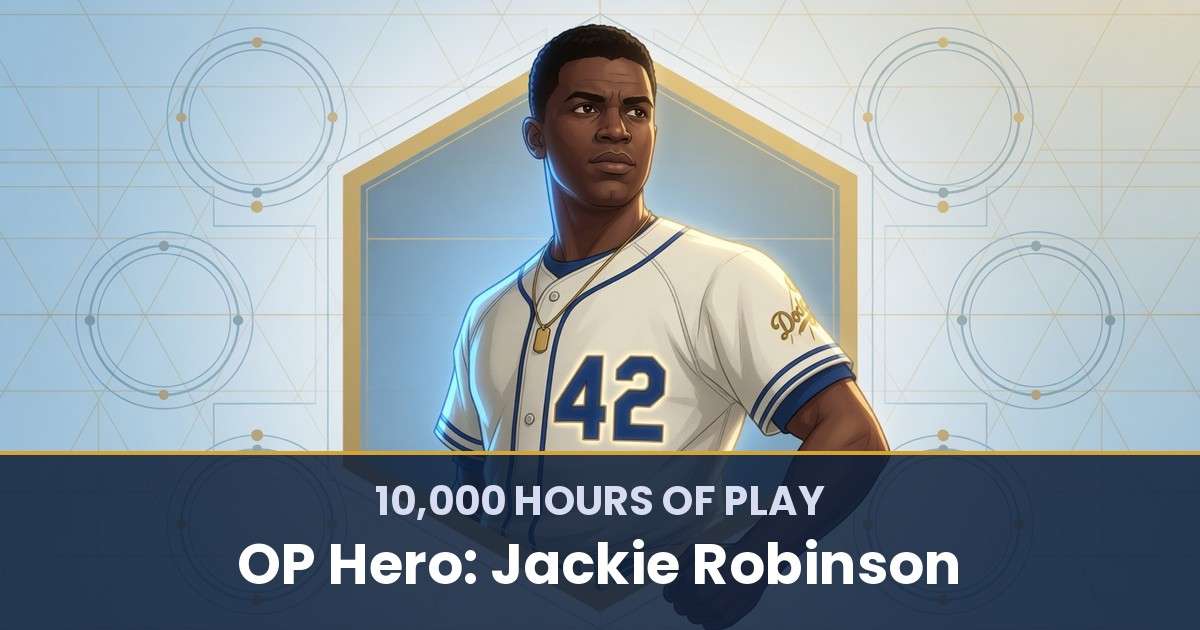


On April 15, 1947, Jackie Robinson walked onto Ebbets Field, started at first base for the Brooklyn Dodgers against the Boston Braves, and scored the go-ahead run in a 5-3 win. The box score is almost beside the point. The point is what the box score now meant.
For sixty years, Major League Baseball had operated a color line nobody had signed and nobody could legally produce. One walk to first base ended it. The contract behind that walk had been signed on October 23, 1945, in Brooklyn, between a 26-year-old former Army lieutenant and a 63-year-old Dodgers executive named Branch Rickey. The terms were stranger than the result. Rickey wanted a Black player good enough to start in the majors. He also wanted one disciplined enough to take two seasons of racial abuse without ever swinging back. Robinson signed.
What followed is the most studied character build in American sports. He took the abuse. He won Rookie of the Year. He won an MVP. He won a World Series. Then he kept playing the larger game well after the cleats came off. If you read his life through the 6-Step framework from 10,000 Hours of Play, every move makes sense as the moves of a player who had decided exactly what game he was in.
⚡ Speed Run Notes
- Robinson’s “game” was not baseball. It was using elite, public, undeniable excellence to make racial exclusion legally and morally indefensible. Baseball was the arena it had to be won in first.
- His keystone Skill was Guardian Restraint (Paladin): a two-year contract not to retaliate against racial abuse, made before the breakthrough, held under the worst pressure baseball could throw at him.
- The restraint was strategic, not passive. He weaponized the anger into baserunning, stolen bases, and on-field execution, turning bigotry into rally fuel rather than the trap it was meant to be.
- Branch Rickey was not a benefactor. He was a co-architect who chose Robinson because of the rare attribute mix Robinson already had: courage plus self-control plus elite talent plus public-facing conviction.
- The MLB career was Phase One. Phase Two (VP at Chock full o’Nuts, co-founder of Freedom National Bank, columnist for the New York Post and the Amsterdam News) was the same Quest carried into different terrain.
Table of Contents
- Step 1: The Game — What Jackie Robinson Was Actually Playing
- Step 2: Attributes — The Innate Stats
- Step 3: Role(s) — The Character Class Across Chapters
- Step 4: Skills — The Real-Life Game Skills Jackie Robinson Mastered
- Step 5: Allies — The People Who Multiplied Jackie Robinson
- Step 6: Quests — The Milestones That Shaped the Saga
- What You Can Steal From Jackie Robinson’s Build
- Where this framework comes from
- Related Reading
About Yu-kai Chou

Yu-kai Chou is the author of 10,000 Hours of Play — the book that treats your life as the most important game you’ll ever build a character in, and gives you the 6-Step framework (Game · Attributes · Role · Skills · Allies · Quests) to play it on purpose. He has spent two decades developing the system through which this post analyzes its OP Hero, and applies it to his own life and to the lives of the people he advises around the world.
Chou’s other framework, the Octalysis Framework, has been applied by LEGO, Microsoft, Porsche, Coca-Cola, Salesforce, and MrBeast, impacting over 1.5 Billion Users. He has taught the methodology at Harvard, Stanford, Yale, Tesla, Google, BCG, and IDEO, and has advised governments in eight nations including Ukraine, the United Kingdom, the Kingdom of Bahrain, Singapore, Taiwan, the Netherlands, Kazakhstan, and South Korea.
His work has been cited by Harvard, Stanford, MIT, Forbes, Wall Street Journal, Wired, US Department of Energy, NIST, NSF, NCBI, US Department of Education, ClinicalTrials.gov, and Google Scholar — with 3,700+ more academic publications. Explore his books here.
Of every OP Hero on this list, Robinson is the cleanest case study of restraint as a competitive Skill, not as the absence of one. Most readers see his 1947 season as endurance. I see it as one of the most disciplined uses of Guardian Restraint in 20th-century American history: pre-committed, time-bounded, weaponized into baserunning, and abandoned the instant the contract said he could fight back. That is the lesson I lift. Pick the window where restraint serves the Quest, and inside that window make it absolute.
Step 1: The Game — What Jackie Robinson Was Actually Playing
Robinson’s Game was never baseball. Baseball was the board the Game had to be played on, because nowhere else in 1940s America was a Black man going to put numbers on a scoreboard that white America was already paying to watch.
The Game was: force the country to admit that the laws and customs of racial exclusion could not survive contact with public, repeated, undeniable Black excellence. Win in public, under pressure, in a venue the audience had already agreed mattered. Once the country said yes inside that venue, the same yes had to expand outward, into hotels, restaurants, banks, and ballots.
This is a particular kind of Game, and it is worth naming carefully. It is not “be the best player.” Plenty of Negro Leagues players were as good or better. It is not “wait for someone to give you a chance.” Robinson and Branch Rickey constructed the chance. The Game is closer to: be the specific person whose excellence is so unignorable that ignoring it costs more than admitting it.
That definition forces everything else in his build. The Attributes have to include restraint, not just talent. The Role chain has to include soldier and columnist, not just shortstop. The Allies have to include a white executive willing to spend institutional capital, and a Black wife willing to absorb the shocks the public couldn’t see. The Skills have to include conversion of personal pain into public victory. None of that is optional. Once you know the Game, the rest of the character sheet writes itself.
Step 2: Attributes — The Innate Stats
The 10K HP framework distinguishes Attributes (the things you started with) from Skills (the things you learned). Robinson was an Attribute-loaded character, and the unusual mix is what made him pickable at all. Branch Rickey did not interview him for talent. He interviewed him for stats.
The four that show up earliest in the record:
Competitive drive. By his teens in Pasadena, Robinson was lettering in baseball, basketball, football, and track at John Muir, then at Pasadena Junior College, then at UCLA, where he became the school’s first athlete to letter in all four varsity sports. The drive is the through-line. He did not pick a sport. He picked all of them, all the way up. (For a deeper look at how raw ATT mixes shape OP-Hero builds, see the OP Talent Triangle Method.)
Risk tolerance with a moral spine. On July 6, 1944, an Army bus driver at Camp Hood, Texas, ordered him to the back. Robinson was a commissioned second lieutenant, the bus was already integrated by Army order, and the request was illegal. He refused. The system court-martialed him for it. On August 2, 1944, a panel of nine officers acquitted him on all charges. That is not learned behavior. That is the same kid who would not pick one sport over another, now refusing to pick safety over the line he had already drawn for himself.
Strategic self-control. The Camp Hood incident is also where the second Attribute shows itself, because Robinson did not lose control. He did not swing. He invoked the rules and forced the system to acquit him. Most people have either the courage to refuse or the discipline to wait. He had both at once.
Public-facing conviction. Long before the Dodgers, his teammates and superiors describe him as someone who talked. About fairness, about hypocrisy, about what he saw. That trait is what made the later columnist career inevitable. The microphone changed; the voice was the same one giving an Army officer a legal argument from the back of a bus.
Step 3: Role(s) — The Character Class Across Chapters
Robinson cycled through more Roles than most OP Heroes get to live. Each one was a deliberate class change, picked up because the Quest had moved into terrain the previous class couldn’t cover.
Multi-Sport Athlete (1930s–1941). Pasadena and UCLA. The Role exists to build a physical and reputational toolkit broad enough to be undeniable later. He graduated Pasadena Junior College in 1939, transferred to UCLA, and left in spring 1941 without a degree. The credentials weren’t the prize. The body of work was.
Army Officer (1942–1944). A class he was assigned, then claimed. He was admitted to Officer Candidate School after Joe Louis intervened against the Army’s de facto color bar there. The 761st Tank Battalion under Colonel Paul L. Bates is where he served. The Role taught him chain-of-command thinking and institutional savvy. Both turned out to be essential to surviving a Major League clubhouse three years later.
Negro Leagues Shortstop (1945). Kansas City Monarchs of the Negro American League. A brief Role, but the key one: it put him in the only professional Black baseball league of stature, where Rickey’s scouts could find him. The class change was a bridge, not a destination.
Major League Pioneer (1946–1956). Montreal Royals for the 1946 minor-league season, then Brooklyn Dodgers from April 15, 1947 onward. This is the Role most people know him by. It runs ten years and ends, by his own choice, in 1956. He played in six World Series across that span (1947, 1949, 1952, 1953, 1955, 1956) and won one. (For another athlete whose Role chain was just as deliberately built, see Wayne Gretzky’s profile.)
Executive, Banker, and Columnist (1957–1972). VP and director of personnel at Chock full o’Nuts from 1957. Co-founder of Freedom National Bank in Harlem in 1964, built to serve a community redlined by traditional banks. Columnist for the New York Post and later the New York Amsterdam News. The class is “public intellectual,” but the Quest is still the original Quest. He just stopped trying to win it with his glove.
Step 4: Skills — The Real-Life Game Skills Jackie Robinson Mastered
Five canon Skills do most of the load-bearing work in Robinson’s character sheet. Two are the famous ones. Three are the ones that made the famous ones possible. (For the wider taxonomy of where these Skills sit on the depth axis, see the Skills Spectrum: Specialist, Dabbler, Master.)
Courageous Heart (Paladin) is the Skill of charging into uncomfortable, uncharted, or hostile zones on purpose. The two clearest activations are three years apart: the back-of-the-bus refusal at Camp Hood on July 6, 1944, and the walk to first base at Ebbets Field on April 15, 1947. Same Skill, same person, two different stadiums. (See Frederick Douglass’s profile for a sibling case where Courageous Heart is the keystone over decades, not innings.)
Guardian Restraint (Paladin) is the Ego Check Skill: hold back pride to keep the larger Quest intact. Branch Rickey explicitly asked Robinson, in their first meeting, whether he had “the guts not to fight back” for two full seasons. Robinson said yes and held it. The Ben Chapman / Philadelphia Phillies bench-jockeying incident in April 1947, with Chapman shouting racial slurs from the dugout inning after inning, is the most documented test. Robinson did not retaliate. He went 0-for-3 that game and the Dodgers lost. He held the contract anyway.
Mood Hacking / Emotional Espionage (Rogue) is arousal control: change your internal state on cue. This is the Skill that turns the Restraint from passive into competitive. The rage Robinson swallowed at the plate came back out on the basepaths. In 1949, his MVP season, he batted .342, led the National League in stolen bases with 37, and ran defenders into mistakes that the prior decade of MLB had never seen at that frequency. The aggression was real. He had simply chosen the surface on which to express it.
Bind Fate (Warlock) is leveraging someone else’s brand or resource to become powerful yourself. Rickey was not a sponsor; he was an institutional shield. Inside that shield, every game Robinson played counted as Brooklyn Dodgers business, which meant the league could not quietly suspend him, the press could not freeze him out, and the franchise had a financial reason to defend him. Robinson recognized the shield for what it was and played inside it for a decade.
Thunder Clap (Paladin), the Skill of public-platform speech that charges up and inspires, is the post-baseball move. Once the playing-career contract was over, the restraint was over. He wrote for the New York Post and later the New York Amsterdam News, spoke at NAACP fundraisers, and argued politics on his own terms. The voice that had been quiet at the plate from 1947 to 1949 ran loud across the 1960s. That ordering is the build; it was never an accident.
Step 5: Allies — The People Who Multiplied Jackie Robinson
Branch Rickey was not a benefactor. He was a co-architect. The Dodgers GM signed Robinson on October 23, 1945 because he had already designed the experiment and needed a specific kind of player to run it. Their first meeting reportedly ran three hours, most of it Rickey acting out the racial abuse Robinson would face and demanding to know whether he would absorb it. Rickey wrote the rules of the no-retaliation pact. Robinson held it.
Rachel Robinson (née Isum) met Jackie at UCLA and married him on February 10, 1946, eight weeks before the Montreal Royals season opened. She was, for the entire Brooklyn run, the only person in the world who saw the cost of the Restraint up close every night and did not ask him to drop it. After his death she founded the Jackie Robinson Foundation in 1973, which has since put thousands of minority students through college. The Ally relationship outlived the player by half a century.
Colonel Paul L. Bates, commanding officer of the 761st Tank Battalion, recommended Robinson for OCS and then refused to sign the court-martial referral the Camp Hood prosecutors needed. He had to be bypassed entirely for the prosecution to proceed. That single act of refusal is what makes the August 2, 1944 acquittal possible. Without Bates, the record gets a felony conviction on it and Rickey’s 1945 short list never includes Robinson at all.
Pee Wee Reese, Dodgers shortstop and team captain, walked across the infield in 1947 and put his arm around Robinson’s shoulders in front of a hostile crowd. The exact city varies by source; the gesture is documented and was understood at the time as the captain publicly choosing the side of his teammate. After Reese, the rest of the Dodgers clubhouse settled.
Wendell Smith, sportswriter for the Pittsburgh Courier, traveled with Robinson through the 1946 and 1947 seasons. He found the Black-owned hotels that would house him in cities whose white hotels refused. He helped draft the columns that ran under Robinson’s name. He was the Ally who absorbed the logistical friction so the player could absorb the on-field friction. Two different jobs, one shared Quest.
Step 6: Quests — The Milestones That Shaped the Saga
Quest 1: Camp Hood Bus Refusal (July 6, 1944). The first time he tests the strategy that defines the rest of his life: refuse the illegal order, take the consequences, invoke the rules, win on the rules. Acquitted August 2, 1944. The trial is the dress rehearsal for the 1947 season.
Quest 2: The Rickey Meeting (August 28, 1945). Three hours in a Brooklyn office. By the time Robinson left, the contract terms of the next decade of his life were set. Signed October 23, 1945. The Montreal Royals assignment for 1946 was the proof-of-concept stage.
Quest 3: Ebbets Field Debut (April 15, 1947). First Black player in modern MLB. Scored the go-ahead run in a 5-3 Dodgers win over the Boston Braves. The metric that mattered was not the run. It was that the line had moved and could not be moved back.
Quest 4: The 1949 MVP Season (Setback Converted). The Restraint contract had a two-year clock on it, and 1949 was the first season after it expired. He hit .342, led the NL in stolen bases with 37, and won the National League MVP, the first Black player to do so. The proof that the restraint had not damaged the talent. (His arc here rhymes with another athlete whose discipline-as-Skill defined a career: Muhammad Ali.)
Quest 5: The 1955 World Series (The Brooklyn Championship). The Dodgers beat the New York Yankees for Robinson’s only ring. He played in six World Series total across his career; the 1955 win is the one that proved integration and excellence were the same project, not competing ones.
Quest 6: Phase Two (1957 Onward). Last MLB season was 1956. Then VP at Chock full o’Nuts from 1957. Then co-founder of Freedom National Bank, Harlem, 1964. Then columnist for the New York Post and New York Amsterdam News through the 1960s. Inducted into the Baseball Hall of Fame in 1962, first year of eligibility, first Black player. Died October 24, 1972 in Stamford, Connecticut, age 53. On April 15, 1997, on the 50th anniversary of his debut, Major League Baseball retired the number 42 across every team. It was the first time any North American major league had retired a number league-wide.
What You Can Steal From Jackie Robinson’s Build
The temptation with Robinson is to read his life as one long act of patience. That is a misread. Restraint was a contract with an expiration date, signed before the breakthrough, and engineered into a competitive weapon while it was in force. He did not become a quiet man. He became a strategic one.
The lift for your own build is the same pattern, scaled down. Pick a Quest. Identify the one Skill that, if you held it absolutely inside a defined window, would unlock the next stage. Pre-commit to the window with a trusted Ally so you can’t drop the discipline when it hurts. The instant the window closes, switch Roles, because the same person who held the line now gets to set new ones. That is what 1949 looks like. That is what 1957 looks like. That is what a clean 6-Step build, played with intent, can do across a lifetime.
If you want a sibling profile to read alongside this one (same architecture, different terrain), start with the OP Hero hub and pull whichever Hero rhymes with the Quest you’re trying to win.
Where this framework comes from

Want the full system this profile is built on?
Every OP Hero piece runs through the same 6-Step framework from 10,000 Hours of Play: Unlock Your Real-Life Legendary Success. The book covers the full system, walks through Yu-kai’s own life run as the first applied case study, and gives you the worksheets to audit your own build.
Related Reading
- All OP Hero Profiles: the full 10,000 Hours of Play roster
- Frederick Douglass: Courageous Heart and Phoenix Rebirth across a 60-year abolition Quest
- Muhammad Ali: the athlete whose Role chain ran from heavyweight champ to draft refuser to global statesman
- Wayne Gretzky: the deliberate Role chain behind hockey’s most-broken record set
- The 10K HP Framework: 6 Steps to gamify your life
- The Skills Spectrum: Specialist, Dabbler, Master, and the strategic build of each