
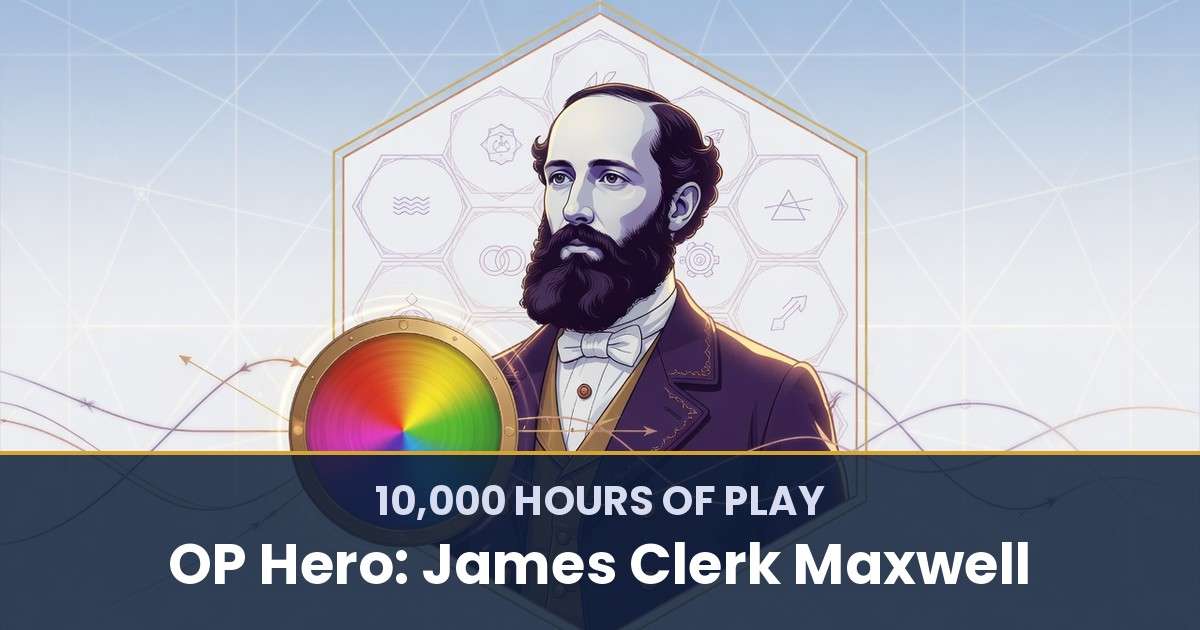


Every time your phone locks onto wifi, every radio broadcast, every beam of visible light in the room you are sitting in obeys the same compact set of equations. One man assembled them in the 1860s, and physics has been building on that foundation ever since.
His name was James Clerk Maxwell, and outside a physics classroom almost nobody says it out loud. Einstein put the change Maxwell set off on the same level as Newton’s, and built special relativity straight out of Maxwell’s electrodynamics. Yet the Scottish theorist who unified electricity, magnetism, and light into one picture is a stranger to most of the people whose daily lives run on his math.
Run his life through the 10,000 Hours of Play framework and the shape of the achievement gets clearer. Maxwell played the game of a master theorist: find the hidden rule under scattered phenomena, turn a picture in your head into equations, and refuse to stop until the mess resolves into something clean. Here is his character sheet.
⚡ Speed Run Notes
- Maxwell’s real game was unification: proving that electricity, magnetism, and light were three faces of one thing, then writing it down as field equations the whole world now runs on.
- His signature move was visual. He would build a mechanical picture in his head, then translate that picture into precise mathematics, most famously with the 1861–62 lines-of-force papers.
- The Saturn’s rings problem shows how he thought: he ruled out the obvious answers (solid ring, liquid ring) until only the strange one was left, that the rings are countless small particles.
- He worked across an unusual spread of fields: color vision and the first color photograph, the statistics of gas molecules, and the electromagnetic theory that made him famous.
- The transferable skill is the reframe itself: treat a hard problem as a solvable puzzle with a hidden structure, not a wall you push against until you tire.
Table of Contents
About Yu-kai Chou

Yu-kai Chou is the author of 10,000 Hours of Play — the book that treats your life as the most important game you’ll ever build a character in, and gives you the 6-Step framework (Game · Attributes · Role · Skills · Allies · Quests) to play it on purpose. He has spent two decades developing the system through which this post analyzes its OP Hero, and applies it to his own life and to the lives of the people he advises around the world.
Chou’s other framework, the Octalysis Framework, has been applied by LEGO, Microsoft, Porsche, Coca-Cola, Salesforce, and MrBeast, impacting over 1.5 Billion Users. He has taught the methodology at Harvard, Stanford, Yale, Tesla, Google, BCG, and IDEO, and has advised governments in eight nations including Ukraine, the United Kingdom, the Kingdom of Bahrain, Singapore, Taiwan, the Netherlands, Kazakhstan, and South Korea.
His work has been cited by Harvard, Stanford, MIT, Forbes, Wall Street Journal, Wired, US Department of Energy, NIST, NSF, NCBI, US Department of Education, ClinicalTrials.gov, and Google Scholar — with 3,700+ more academic publications. Explore his books here.
What draws me to Maxwell is that his edge was a way of seeing, not raw grind. He pictured invisible forces as spinning cells and flowing tubes, then held that picture steady long enough to turn it into equations. The lesson I would lift for my own life is that a good mental model is worth more than a hundred extra hours of effort, because the model tells you where the hours should go.
Step 1: The Game — What Maxwell Was Actually Playing
Every OP Hero is playing a specific game, whether they name it or not. Maxwell’s game was unification: taking phenomena that looked unrelated and proving they were one thing seen from different angles.
The headline case was electricity, magnetism, and light. In his day these sat in separate boxes, studied by separate people with separate rules. Maxwell’s long project was to show that a changing electric field makes a magnetic field, that a changing magnetic field makes an electric one, and that the two chasing each other through space travel at exactly the speed of light. Light, on this view, is an electromagnetic wave. Three subjects collapsed into one.
He played the same game elsewhere. With gases he connected the invisible motion of individual molecules to the temperature and pressure you can measure with a thermometer and a gauge. With Saturn he tied the appearance of a distant ring to the mechanics of particles too small to see.
The prize was never a single gadget. It was a rule general enough that other people could build on it for a century, the way Newton’s laws had done before him and the way his own equations would join Newton’s as a pillar of classical physics. Maxwell chased the compact law under the noise, and he found more of them than almost anyone in history.
Step 2: Attributes — The Innate Stats
Attributes are the stats a hero seems born with. Maxwell’s showed up early and stayed consistent for the rest of his life.
The first was a compulsion to ask how things work. As a boy at the family estate of Glenlair he was known for pestering the adults with one question about everything he saw: “What’s the go’ o’ that?” When a half-answer came back, he pushed further with “but what’s the particular go of it?” That is pattern-hunting before he had any physics to hang it on.
The second stat was visual imagination. Maxwell thought in pictures, mechanical ones, full of moving parts. Where others saw abstractions, he saw gears and tubes and cells, and he could hold those images steady while he reasoned about them.
Third came range. Most strong minds specialize. His curiosity ran across color perception, the rings of a planet, the behavior of gases, and the nature of electricity, and he did lasting work in every one of them.
You cannot train your way into most of this. It sits closer to the raw talents each of us is dealt, the mix the Talent Triangle Method is built to help you find in yourself. Maxwell’s fortune was landing in a century with enough unsolved physics to absorb a mind shaped exactly like his.
Step 3: Role(s) — The Character Class Across Chapters
A Role is the character class you play in a given chapter of life. Maxwell moved through several without ever leaving the theorist behind.
His base class was the analyst, trained hard at Cambridge, where a demanding coach named William Hopkins drilled him in the competitive mathematics of the day. In the 10,000 Hours of Play taxonomy that is a Mage build, the class that analyzes and calculates its way to answers other people reach by feel.
Then came the professor. He held the chair of Natural Philosophy at Marischal College in Aberdeen while still in his mid-twenties, then moved to King’s College London, where some of his most productive years happened. Teaching forced him to state things plainly, and the plain statements often became the theory.
Later he took on a builder’s role that had nothing to do with equations. Cambridge asked him to create the Cavendish Laboratory from scratch, and he became its first director, designing the space and the research culture that would produce generations of experimental physicists after him.
Through all of it he was a writer. The role that outlived every other was author of the treatise that carried his system to the world, and there is a useful echo here of Albert Einstein, another theorist whose deepest legacy was a handful of papers rather than any single post he held.
Step 4: Skills — The Real-Life Game Skills Maxwell Mastered
Attributes are potential. Skills are what a hero actually trains. Reading Maxwell’s work against the 10,000 Hours of Play skill list, five stand out.
Telekinesis (Mage) — visualizing physical interactions in the head and reasoning about them precisely. Maxwell’s 1861–62 papers on lines of force imagined space as a lattice of spinning cells and rolling particles, a mechanical picture he then converted into exact mathematics. The picture was scaffolding, but it got him to the equations.
Astral Projection (Mage) — seeing the full set of possible outcomes and testing each one. On the Saturn’s rings problem he worked through the candidates methodically: a solid ring would be torn apart, a fluid ring would break into waves and collapse, so the rings had to be a swarm of countless separate particles. He reached the right answer by eliminating the attractive wrong ones.
Arcane Wisdom (Mage) — absorbing scattered information and synthesizing it into a clean output. His 1873 Treatise on Electricity and Magnetism pulled decades of loose experimental results into a single organized theory, the reference every later physicist had to reckon with.
Cognitive Lens (Mage) — zooming from the smallest scale to the largest in one motion. In the kinetic theory of gases he connected the frantic motion of individual molecules, too small to ever see, to the temperature and pressure of a whole roomful of air, one of the founding moves of statistical mechanics.
Lich Grind (Warlock) — long, secluded stretches of deep work. Maxwell repeatedly retreated to the quiet of Glenlair to think and write without interruption, and some of his hardest results came out of those withdrawn spells. Moving a skill like any of these from rough to mastered is its own long climb, which is what the Skills Spectrum maps: the road from dabbler to specialist to master.
Step 5: Allies — The People Who Multiplied Maxwell
No hero levels up alone. Maxwell’s allies were a small circle of teachers and rivals who sharpened him across decades.
The earliest was James David Forbes, a professor at Edinburgh who took the teenage Maxwell seriously, encouraged his first experiments, and helped get his earliest work in front of a scientific audience. A young oddball with strange questions needs one adult who treats the questions as real, and Forbes was that adult.
The most important intellectual partner was Michael Faraday. Faraday, a brilliant experimentalist with little mathematical training, had proposed that electric and magnetic forces spread through space as invisible “lines of force.” Most theorists dismissed the picture as vague. Maxwell took it seriously, gave it rigorous mathematics, and turned Faraday’s intuition into field theory. One man supplied the vision, the other supplied the proof.
Then there was William Thomson, later Lord Kelvin, whose running exchange of letters pushed Maxwell’s thinking on electromagnetism and heat, and Peter Guthrie Tait, a Cambridge friend who argued physics with him for the rest of his life. Their letters were a workshop where half-formed ideas got stress-tested before they ever reached print. The pattern holds across almost every profile in the OP Hero library: the breakthroughs look solitary, but there is nearly always a small group of trusted minds behind the curtain.
Step 6: Quests — The Milestones That Shaped the Saga
Quests are the concrete milestones that define a run. Maxwell’s stack up across an unusually wide territory.
The first was Saturn’s rings. Asked to explain how the rings could be stable, he spent years on the mathematics and concluded in 1859 that they could be neither solid nor liquid, only a cloud of small particles orbiting together. The work won him a major prize and marked him as a theorist of the first rank while he was still young.
Then came color. In 1861 he demonstrated the first color photograph by shooting a tartan ribbon three times through red, green, and blue filters and recombining the images, proving that three primaries could reconstruct the colors the eye sees.
The summit was electromagnetic theory. Across the 1860s and into his 1873 treatise, Maxwell assembled the equations that unified electricity, magnetism, and light and predicted that electromagnetic waves should travel through space. He did not live to see them confirmed. Heinrich Hertz generated and detected those waves in the lab within a decade of Maxwell’s death, and the radio age followed.
Not every quest was a clean win, and the honest one to name is Saturn. His first instinct was to look for a stable solid or fluid ring, the intuitive answers, and the mathematics refused both. The setback was the discovery. Ruling out the obvious forced him to the strange, correct solution, which is how progress usually works even when it feels like failure in the moment.
What You Can Steal From Maxwell’s Build
You are not going to write field equations. The build still transfers, because Maxwell’s real subject was how to think about a problem you cannot see, and most of the hard problems in a life are exactly that.
Steal the mental-model habit first. Before grinding at something confusing, Maxwell built a picture he could reason about: spinning cells, orbiting particles, molecules in flight. Give your own hard problem a concrete model, even a rough one, and you will spot moves that raw effort would never surface.
Steal the elimination method, too. When the obvious answers to Saturn failed, he did not force them. He crossed them off and followed the mathematics to the odd solution that was left. A lot of stuck situations open up the moment you stop defending the answer you wanted and let the evidence pick.
And steal the widest lesson of the build: treat a hard thing as a solvable puzzle with a hidden structure, rather than a wall to push against until you tire. That reframe is the spine of the 10,000 Hours of Play system, and Maxwell is one of its cleanest proofs. He looked at three separate mysteries, suspected they were one, and was right. The character sheet still plays.
Where this framework comes from

Want the full system this profile is built on?
Every OP Hero piece runs through the same 6-Step framework from 10,000 Hours of Play: Unlock Your Real-Life Legendary Success. The book covers the full system, walks through Yu-kai’s own life run as the first applied case study, and gives you the worksheets to audit your own build.
Related Reading
- The full OP Hero library: every profile run through the same 6-Step framework.
- 10,000 Hours of Play by OP Hero: Michael Faraday: the experimentalist whose lines of force Maxwell turned into mathematics.
- 10,000 Hours of Play by OP Hero: Albert Einstein: the theorist who built relativity on the foundation Maxwell laid.
- 10,000 Hours of Play by OP Hero: Isaac Newton: the earlier unifier whose laws Maxwell’s equations stand beside.
- The 10,000 Hours of Play framework: the six steps behind every profile, in one place.