
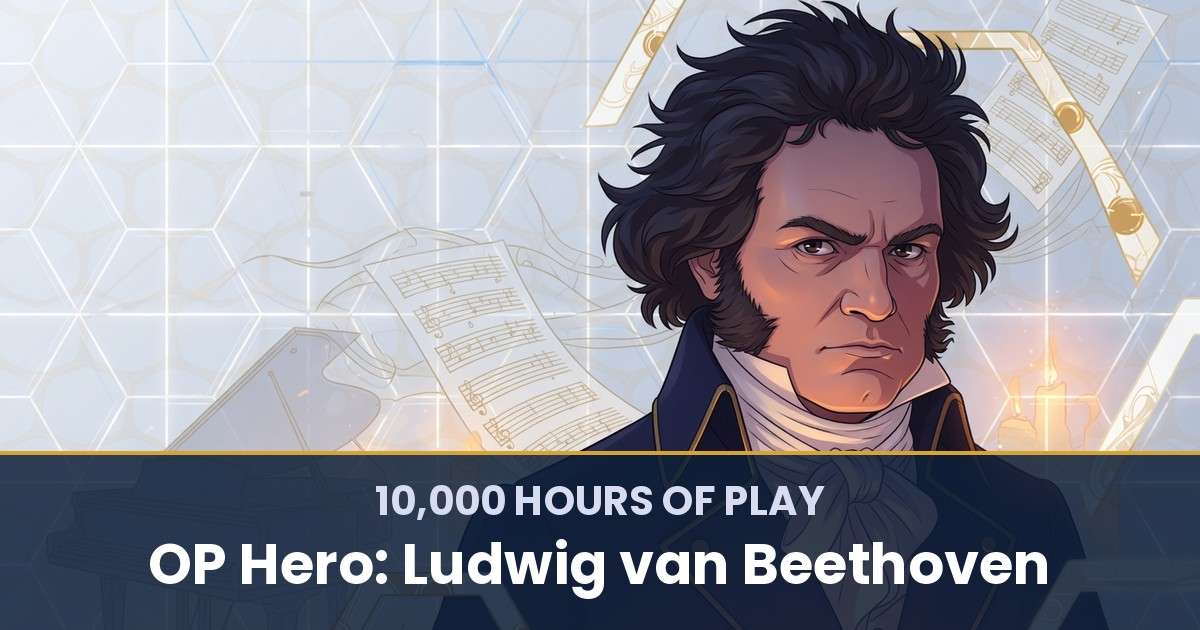


On 7 May 1824, at the Kärntnertortheater in Vienna, Ludwig van Beethoven stood near the stage while his Ninth Symphony was performed in public for the first time. He was completely deaf. He kept his eyes on the score and beat time to a tempo the orchestra had been told to ignore, because a hearing conductor was running the actual performance behind him.
When the music ended, Beethoven was still facing the players, still turning pages. He had no idea what was happening in the hall. By the account most often told, the young contralto Caroline Unger walked over and physically turned him around so he could see it: an audience on its feet, hats and handkerchiefs in the air, an ovation he could not hear at all.
He was fifty-three. He had not heard his own music clearly in well over a decade, and the symphony the room was roaring at had been assembled entirely inside his head.
It is tempting to read the deafness as the tragedy of the story. Read his life instead as a deliberate character build, and the constraint that should have ended his career turns out to be the exact stretch that produced his largest work. The 10,000 Hours of Play framework reads a life across six steps: Game, Attributes, Role, Skills, Allies, and Quests. Run Beethoven through all six and the tragic genius gives way to something more useful — a set of moves you can study.
⚡ Speed Run Notes
- Beethoven’s real game was never just writing music. It was dragging instrumental music out of the drawing room and making the symphony and the string quartet heavy enough to carry philosophy.
- His hearing began failing around 1798. The October 1802 Heiligenstadt Testament records the breaking point, and the decision that followed it: keep living, for the work.
- The Third Symphony, the Eroica, was first meant for Napoleon. When Napoleon crowned himself Emperor in 1804, Beethoven withdrew the dedication.
- By the 1824 premiere of the Ninth he was completely deaf. The work was composed through inner hearing, with no way to check it against a live performance first.
- His one opera, Fidelio, failed in 1805 and was rebuilt across nine years before the 1814 version finally worked. The revision was the skill, not the inspiration.
Table of Contents
About Yu-kai Chou

Yu-kai Chou is the author of 10,000 Hours of Play — the book that treats your life as the most important game you’ll ever build a character in, and gives you the 6-Step framework (Game · Attributes · Role · Skills · Allies · Quests) to play it on purpose. He has spent two decades developing the system through which this post analyzes its OP Hero, and applies it to his own life and to the lives of the people he advises around the world.
Chou’s other framework, the Octalysis Framework, has been applied by LEGO, Microsoft, Porsche, Coca-Cola, Salesforce, and MrBeast, impacting over 1.5 Billion Users. He has taught the methodology at Harvard, Stanford, Yale, Tesla, Google, BCG, and IDEO, and has advised governments in eight nations including Ukraine, the United Kingdom, the Kingdom of Bahrain, Singapore, Taiwan, the Netherlands, Kazakhstan, and South Korea.
His work has been cited by Harvard, Stanford, MIT, Forbes, Wall Street Journal, Wired, US Department of Energy, NIST, NSF, NCBI, US Department of Education, ClinicalTrials.gov, and Google Scholar — with 3,700+ more academic publications. Explore his books here.

What stays with me about Beethoven’s build is that his greatest work happened after the feedback loop broke. He lost the sense his entire craft depended on, and kept composing for another twenty-five years by running the music inside his head. If you lift one move from his build, lift Elemental Ensemble: grind a skill so deep into yourself that you can still execute it when the external signal goes quiet. People tend to abandon a craft the moment conditions stop being ideal. Conditions are never going to be ideal.
Step 1: The Game — What Ludwig van Beethoven Was Actually Playing
Every OP Hero is playing a deeper game than the one written on the box. Ask what game Beethoven was playing and the easy answer is “be a great composer.” That answer is too small, and it stops explaining things well before his story does.
Beethoven’s game was making instrumental music a serious art. In the late eighteenth century, a symphony or a string quartet was closer to elegant furniture than to literature. It decorated a room. It entertained a court. Beethoven spent thirty years forcing those forms to carry the weight people reserved for poetry and philosophy: heroism, grief, moral struggle, the idea of human brotherhood. The Eroica, Fidelio, and the Ninth are not just bigger pieces of music. They are arguments.
The method underneath that game never changed. He built on the tradition he inherited from Bach, Handel, Haydn, and Mozart, learned its rules completely, and then pushed each form past the limit those rules implied. A sonata could be longer, stranger, and more violent than anyone had allowed. A symphony could end with a choir singing about joy.
That is why historians keep placing him at the hinge between the Classical era and the Romantic one. He was not trying to break music. He was trying to make it big enough to mean something, and he kept playing that single game until the last quartets of 1826.
Step 2: Attributes — The Innate Stats
Attributes are the stats you do not earn. They show up early and they bias every later move. Beethoven rolled a sharp, slightly dangerous set.
The first is aural memory and pattern sense. As a boy in Bonn he absorbed keyboard, organ, and violin with unusual speed, fast enough that by his early teens he was composing and holding a court organ post. The ear came before any training could explain it.
The second is raw emotional intensity. Accounts from Bonn and early Vienna describe him as strong-willed, proud, and quick to anger. That same volatility is audible in the music as extreme contrast: sudden silences, hammered chords, dynamics that swing further than his contemporaries dared. The temperament that made him hard to live with is the temperament that made the work loud.
The third is stubborn independence. From his first years in Vienna he refused the normal path of a salaried court servant and built a working life out of publishing, concerts, and private patrons instead. He wanted to belong to no one.
The fourth is an unusually strong inner ear, the ability to hear fully formed music in his head with no instrument in front of him. Yu-kai’s Talent Triangle Method argues that your strongest build sits where several innate attributes overlap rather than on one tall spike. Beethoven is a stark example. A great ear with no stubbornness becomes a comfortable court musician. Stubbornness with no inner ear collapses the day the hearing fails. Stack all four, and you get a composer who can lose his hearing and still keep working at the highest level.
Step 3: Role(s) — The Character Class Across Chapters
Nobody plays one class for a whole life. OP Heroes re-spec as the game changes, and Beethoven re-spec’d four clear times.
He started as the prodigy and trainee court musician. Born in Bonn in 1770 into a musical family, he was pushed hard by a father who wanted a marketable child performer, and by his early teens he was working as an assistant organist and studying seriously under the court organist Christian Gottlob Neefe.
His second class was the virtuoso pianist. He moved to Vienna in 1792, around the age of twenty-one, and through that decade his fame rested as much on his playing and improvising as on his scores. He could walk into an aristocratic salon and dominate it from the keyboard.
The third class was the composer-hero of the middle period. From roughly 1803, with the Eroica and the symphonies that followed, the center of gravity shifted from performing to composing. His worsening hearing was quietly pushing him off the stage, and he let it.
The last class is the deaf visionary of the late period. From the mid-1810s he could barely hear at all, communicated with visitors through written conversation books from around 1818, and turned almost entirely inward, toward the late sonatas, the Missa solemnis, the Ninth, and the late quartets. The hard part of leveling up was never learning the next class. It was giving up the stage while it was still his.
Step 4: Skills — The Real-Life Game Skills Ludwig van Beethoven Mastered
Attributes are what you start with. Skills are what you grind. In the 10,000 Hours of Play system a Skill is a trainable technique with a name and a character class, the way the Lich Pact is Yu-kai’s name for a polyphasic sleep discipline. On the Skills Spectrum, Beethoven is no dabbler. He is a master of the Mage class, the analytical builder, with deep Paladin resilience and a Warlock’s appetite for a vision too large for the room. Five of his skills are worth naming.
Ley Line Infusion (Mage) is the skill of absorbing a large body of knowledge fast and completely. Under Neefe in Bonn, Beethoven drilled counterpoint, figured bass, and keyboard technique until the rules of Classical form were structural to him. After moving to Vienna in 1792 he kept loading, studying with Joseph Haydn and taking strict counterpoint lessons from Johann Georg Albrechtsberger. He did not invent a new musical language from nothing. He swallowed the existing one whole, which is the only reason he could later bend it so far.
Vision Manifestation (Warlock) is the skill of holding a picture of success so large and concrete that you build toward it as if it already exists. Beethoven never described his work as pleasant music for an evening. He treated the symphony and the quartet as instruments capable of carrying ideas about freedom and human dignity, and that oversized picture told him which works mattered. It is why the Ninth ends with a choir, and why he kept writing the late quartets when almost no audience of the 1820s was ready for them.
Elemental Ensemble (Mage) is the skill of visualizing a complex composition entirely in the mind and executing it with precision. Beethoven’s hearing began to fail around 1798, and over the next two decades it declined toward total deafness. He answered by composing inward. The late sonatas, the Missa solemnis, the Ninth Symphony, and the late quartets were built and balanced in his head, often with no way to test them against a real performance. Stephen Hawking’s build runs on the same move in a different field, and his OP Hero profile is worth reading next to this one: a body shutting down, and a mind still running the full simulation.
Phoenix Rebirth (Paladin) is the skill of recovering from a devastating failure and coming back stronger than before it. In October 1802, staying in the village of Heiligenstadt outside Vienna, Beethoven wrote the document now called the Heiligenstadt Testament. It is addressed to his brothers, it admits despair and thoughts of suicide over his deafness, and it ends with a decision to keep living because his art was not yet finished. What came directly after that low point was the heroic middle period: the Eroica, the Fifth Symphony, the most forceful work of his life.
Reflect Damage (Paladin) is the skill of turning negative feedback and setbacks into raw material for the next attempt. Beethoven’s only opera, Fidelio, premiered on 20 November 1805, days after French troops occupied Vienna, to a thin and largely indifferent house. He revised it in 1806, withdrew it again, then rebuilt it once more for the version that premiered successfully on 23 May 1814. Nine years of treating each failed performance as data is what eventually produced the Fidelio that stayed in the repertoire.
Step 5: Allies — The People Who Multiplied Ludwig van Beethoven
No OP Hero clears the campaign alone, and the lone-genius image of Beethoven hides how much of his run depended on a few people arriving at the right time.
Christian Gottlob Neefe came first. As the court organist in Bonn, he gave the boy real training in keyboard, organ, theory, and composition, recognized that the talent was exceptional, and pushed him toward serious composing rather than leaving him as a competent local player.
Count Ferdinand von Waldstein was the connector. An aristocratic supporter in Bonn, he is widely credited with helping arrange Beethoven’s move to Vienna, the relocation that put him inside the musical capital of Europe instead of a provincial court.
Joseph Haydn was the senior mentor. After 1792, the most celebrated living composer in Vienna took Beethoven on as a student and handed him the Classical sonata and symphonic technique that the younger man would spend his life reshaping.
Prince Karl Lichnowsky was the early patron. In the first Vienna years he gave Beethoven lodging, financial support, and the introductions that opened the city’s aristocratic salons.
The decisive alliance came in 1809. Three aristocrats, Archduke Rudolph, Prince Lobkowitz, and Prince Kinsky, jointly settled an annuity on Beethoven specifically so he would stay in Vienna rather than accept a post elsewhere. It was patronage designed to fund his independence instead of buying his obedience, and it let him keep playing his own game.
Step 6: Quests — The Milestones That Shaped the Saga
Quests are the concrete missions that move the saga forward. Beethoven’s run only makes sense if you keep the setbacks inside it rather than around it.
The first quest is the Heiligenstadt Testament of October 1802. It is not a piece of music. It is the crisis that decided whether there would be any more music, and he chose to continue.
The second quest is the Eroica, his Third Symphony, composed across 1802 to 1804. He first intended to dedicate it to Napoleon Bonaparte as a hero of the Revolution. When Napoleon declared himself Emperor in May 1804, Beethoven withdrew the dedication; his student Ferdinand Ries later recalled him reacting with fury at the news. The symphony went out re-dedicated, “to celebrate the memory of a great man,” to a hero who was now an idea rather than a person.
The third quest is the concert of 22 December 1808 at the Theater an der Wien, where Beethoven premiered both the Fifth and the Sixth symphonies on one program. It ran around four hours in an unheated hall and was, by most accounts, under-rehearsed. The night was rough; the two symphonies became permanent.
The fourth quest is the one that did not resolve cleanly. After his brother Kaspar Karl died in late 1815, Beethoven fought a long, bitter legal battle for sole guardianship of his nephew Karl, running through the Vienna courts for roughly five years. It strained both of them badly, and in 1826 Karl attempted suicide and survived. Most biographers treat the whole episode as one of the genuine failures of Beethoven’s life. His build had a real flaw, and this is where it shows.
The fifth quest is the Ninth Symphony, premiered on 7 May 1824, the scene this profile opened on. The sixth and last is the close: Beethoven died in Vienna on 26 March 1827 at the age of fifty-six, and an estimated ten thousand or more people filled the streets for his funeral three days later. The campaign ran right to the edge, the way the strongest runs across the OP Hero profiles archive tend to.
What You Can Steal From Beethoven’s Build
You are not going to write the Ninth Symphony, and copying Beethoven note for note is not the point of reading this. The point is that his build has parts you can lift into your own.
Steal the inner model first. Beethoven could keep working after his hearing failed because he had ground the skill so deep that he no longer needed live feedback to know what was right. Most of us stay dependent on the external signal, the applause, the metric, the reply. Build the version of your craft that still runs when the signal cuts out.
Steal the Phoenix move. The Heiligenstadt Testament is not a story about a man who felt better. It is a man at the bottom deciding what the loss was going to be for. Recovery was a choice about direction, made before the mood improved.
Steal the revision discipline. Fidelio was not rescued by a flash of inspiration. It was rebuilt over nine years because Beethoven kept treating each weak performance as information instead of a verdict. That same patient reworking runs through builds like Jim Henson’s, where a craft the world dismissed got refined for decades before it looked inevitable.
Beethoven’s hearing was gone, his temper cost him, and the guardianship fight was a clear defeat. He still produced the largest music of the era because he had built a character that did its best work with the lights off. Grind the skill that deep, and the conditions stop getting a vote.
Where this framework comes from

Want the full system this profile is built on?
Every OP Hero piece runs through the same 6-Step framework from 10,000 Hours of Play: Unlock Your Real-Life Legendary Success. The book covers the full system, walks through Yu-kai’s own life run as the first applied case study, and gives you the worksheets to audit your own build.
Related Reading
- All OP Hero Profiles. The full roster of legendary builds decoded through the 10,000 Hours of Play framework.
- OP Hero: Stephen Hawking. A mind that kept running the full simulation while the body shut down around it.
- OP Hero: Jim Henson. A dismissed craft refined for decades until the world finally caught up to it.
- OP Hero: Bruce Lee. Another build powered by relentless self-mastery against a short, hard clock.
- The 10,000 Hours of Play Framework. The full six-step system for turning your own life into a deliberate character build.