
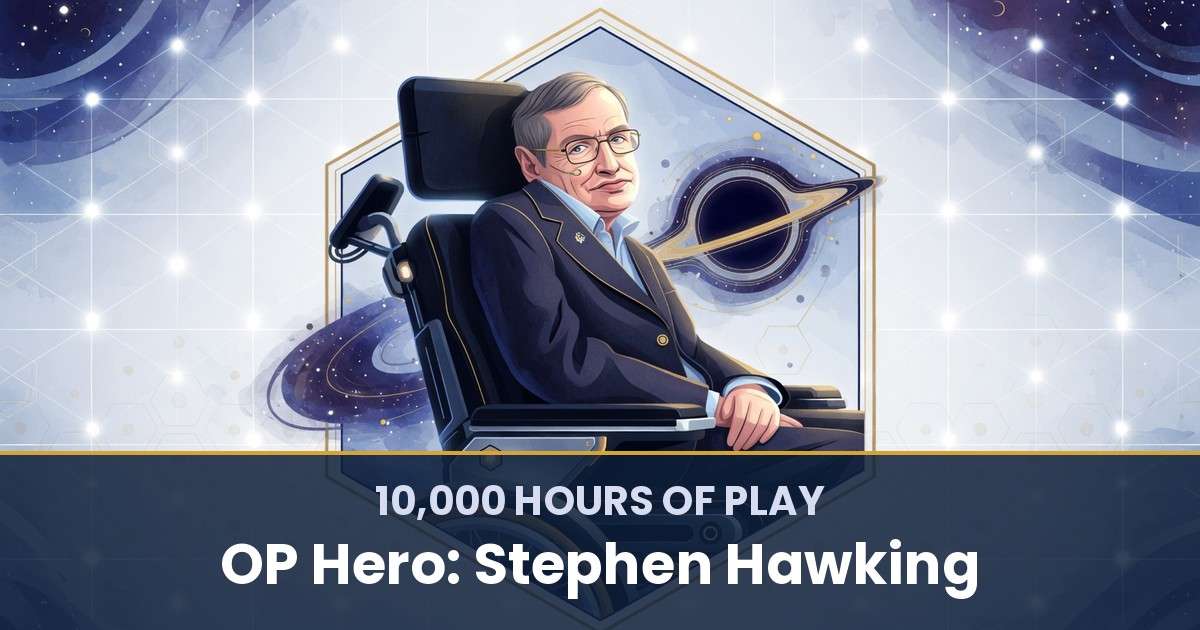


In 1963, a 21-year-old Cambridge graduate student was told he had about two years left to live.
The diagnosis was motor neurone disease, a condition that slowly shuts down the body’s muscles while leaving the mind fully intact. Stephen Hawking had barely started his PhD. By the cruelest reading of the timeline, his story was already over.
He lived another 55 years. In that time he reshaped what physicists believed about black holes, earned one of the most storied professorships in science, and sold more than 10 million copies of a book about the origin of the universe.
Hawking is remembered as a genius who beat the odds. The more useful way to see him is as someone who kept playing one enormous game long after the timer was supposed to run out, and kept leveling the same character on purpose, attribute by attribute, decade by decade. That is exactly what the 10,000 Hours of Play framework is built to decode. So let’s run him through it. Game, Attributes, Role, Skills, Allies, Quests.
⚡ Speed Run Notes
- Stephen Hawking’s real game was never to be a famous scientist. It was to decode the origin and fate of the universe, then hand that map to everyone else.
- A diagnosis that should have ended his career at 21 instead stripped his life down to the work that mattered most. He kept playing for 55 more years.
- When he lost the use of his hands, he rebuilt his whole method, doing frontier physics mentally and visualizing spacetime geometry in his head instead of on paper.
- His black-hole breakthrough came from fusing three fields almost nobody had combined: quantum theory, gravity, and thermodynamics.
- He held a losing position on a famous physics bet for nearly 30 years. When the evidence turned, he conceded in public and built something better from being wrong.
Table of Contents
About Yu-kai Chou

Yu-kai Chou is the author of 10,000 Hours of Play — the book that treats your life as the most important game you’ll ever build a character in, and gives you the 6-Step framework (Game · Attributes · Role · Skills · Allies · Quests) to play it on purpose. He has spent two decades developing the system through which this post analyzes its OP Hero, and applies it to his own life and to the lives of the people he advises around the world.
Chou’s other framework, the Octalysis Framework, has been applied by LEGO, Microsoft, Porsche, Coca-Cola, Salesforce, and MrBeast, impacting over 1.5 Billion Users. He has taught the methodology at Harvard, Stanford, Yale, Tesla, Google, BCG, and IDEO, and has advised governments in eight nations including Ukraine, the United Kingdom, the Kingdom of Bahrain, Singapore, Taiwan, the Netherlands, Kazakhstan, and South Korea.
His work has been cited by Harvard, Stanford, MIT, Forbes, Wall Street Journal, Wired, US Department of Energy, NIST, NSF, NCBI, US Department of Education, ClinicalTrials.gov, and Google Scholar — with 3,700+ more academic publications. Explore his books here.

What stays with me about Stephen Hawking’s build is the re-spec. Most people treat their Attributes and Skills as fixed equipment, so when one breaks they assume the run is over. Hawking lost the use of his hands and kept doing world-class physics by moving the entire computation into his head. He lost his voice and kept lecturing through a speech synthesizer. Every time the game took a tool away, he rebuilt his method around what he still had. If you lift one lesson from his run, lift that: a constraint is not the end of your build. It is a prompt to redesign it.
Step 1: The Game — What Stephen Hawking Was Actually Playing
Every OP Hero is playing a deeper game than the one printed on their business card. Name the obvious version of Stephen Hawking’s and you get “become a famous physicist.” That version is wrong.
His real game was to work out how the universe began, what laws hold it together, and how it ends, then carry that answer back to people who would never open a physics journal.
The second half is the part most cosmologists skip. Hawking treated public translation as part of the quest itself, not a hobby bolted on afterward. The same curiosity that drove his black-hole mathematics drove his documentaries and his bestselling books. To him they were one job, not two.
His research never wandered, either. For more than 50 years he stayed inside general relativity and cosmology, the science of gravity and the cosmos that Albert Einstein had opened up a generation earlier. Singularities, black holes, the first instant of the Big Bang: he kept circling the same two questions. How did this start, and what is it made of?
Once you see the Game as “decode the universe, then share the map,” his life stops looking like a lucky career and starts looking like one unbroken campaign with a single objective.
Step 2: Attributes — The Innate Stats
Attributes are the stats you do not earn. They appear early, before the training, and they tilt every later choice. Hawking rolled an unusual spread.
The first is spatial imagination. As a boy he improvised gadgets and took machines apart to see how they worked, more curious about the mechanism than the grade. Teachers did not describe a heavy grinder of homework. They described someone who could see how a system fit together in his head.
The second is a will that would not switch off. After his diagnosis, the rational move was to withdraw. He did the opposite, finishing the PhD, marrying, and taking on one of the most demanding research programs in physics. Drive at that level is not installed by a pep talk. It either runs in the background from the start or it does not.
The third is playful, contrarian curiosity. Hawking loved a bet. He wagered on black holes and on the fate of information falling into them, and he treated being proven wrong as a good day rather than a humiliation. He was drawn to the wild end of physics, the time-travel thought experiments and the baby universes, long before any of it was respectable.
The fourth is social magnetism. Even as a student he collected people, and after decades of severe disability he still pulled collaborators, students, and the world’s cameras into his orbit. A sharp sense of humor did most of that work.
Yu-kai’s Talent Triangle Method argues that your strongest build sits where several innate attributes overlap, not on any single one. Hawking is a clean case. Spatial genius alone makes a competent physicist. Stack it with unkillable will, a taste for being wrong, and the charisma to pull a team into your orbit, and you get someone who could both do the physics and make the whole planet care about it.
Step 3: Role(s) — The Character Class Across Chapters
Nobody plays one class for a whole life. OP Heroes re-spec as the game changes, and Hawking’s chapters are unusually clean.
He started as the Bright Generalist. As an undergraduate in physics at University College, Oxford, from 1959 to 1962, he was popular, social, and famously light on study hours. The talent was obvious. The focus had not arrived yet.
The diagnosis arrived with the next chapter and forced the re-spec. In 1962 he moved to Trinity Hall, Cambridge, for graduate work and became the Relativist, committing fully to general relativity and cosmology under his advisor Dennis Sciama. The undergraduate coasting was over. By 1966 he had a PhD and a thesis on the expanding universe.
Then came the Black Hole Theorist, the chapter that built his name. Through the late 1960s and into the 1970s he treated gravity, collapsing stars, and the birth of the cosmos as solvable problems, and in 1974 he produced the result that defined him.
In 1979 he was named Lucasian Professor of Mathematics at Cambridge — a chair once held by Isaac Newton. He kept it for 30 years.
The biggest re-spec was into the Public Translator. With A Brief History of Time in 1988, Hawking stopped speaking only to physicists and started speaking to everyone. The final class, Global Science Icon, he grew into across his last decades, a figure whose appearance in a documentary or a sitcom cameo reshaped how a whole culture pictured a scientist. The hard part of leveling up is rarely the new class. It is retiring the old one you were already winning with.
Step 4: Skills — The Real-Life Game Skills Stephen Hawking Mastered
Attributes are what you start with. Skills are what you grind. In the 10,000 Hours of Play system, Skills are trainable techniques, each one named and mapped to a character class, the way the Lich Pact is Yu-kai’s name for a polyphasic sleep discipline. The Skills Spectrum is the right lens for Hawking: he was a specialist, not a dabbler, grinding a small set of techniques until they became unmistakably his. Five stand out.
Telekinesis (Mage) is the skill of running physics in your head, visualizing how forces and objects interact without writing anything down. Hawking did not choose this skill so much as the disease forced him to build it. As motor neurone disease took his hands, he could no longer cover a blackboard in equations, so he moved the whole workshop inside. He learned to hold complex spacetime geometry in his mind, rotate it, and test it, then dictate the result for a collaborator to write. Most physicists think on paper. Hawking trained himself to think without it.
Elemental Transposition (Mage) is the skill of treating every problem as a puzzle waiting for the right reframe. The origin of the universe sounds like a question for philosophers. Hawking reframed it as geometry. He took the mathematical tools Roger Penrose had built for collapsing stars, asked what they said if you ran the cosmos backward in time, and turned “did the universe have a beginning?” into a theorem with a yes-or-no answer.
Siphoning (Warlock) is the skill of extracting ability from other people and other fields fast. Hawking’s defining 1974 result, the discovery that black holes are not perfectly black, came from fusing three areas that specialists kept apart: quantum theory, general relativity, and thermodynamics. He pulled the useful machinery out of each and let the pieces collide. The answer, now called Hawking radiation, fell out of the wreckage.
Loremaster (Druid) is the skill of turning hard ideas into stories people actually want to read. In 1988 Hawking published A Brief History of Time, a book about black holes and the Big Bang aimed at readers with no physics training at all. It sold more than 10 million copies. He had compressed the frontier of cosmology into something a commuter could finish on a train.
Phoenix Rebirth (Paladin) is the skill of recovering from a devastating setback and coming back stronger. The 1963 diagnosis was about as devastating as a setback gets: a 21-year-old told he had two years left. Hawking’s answer was to keep building for five more decades, and to do his most important work in the years after the timer was supposed to have run out.
Step 5: Allies — The People Who Multiplied Stephen Hawking
No OP Hero solos the campaign. Hawking’s party multiplied him at the exact moments raw talent was not enough on its own.
Dennis Sciama came first. As Hawking’s PhD advisor at Cambridge, Sciama pointed a brilliant but unfocused student straight at the live questions in cosmology and plugged him into the field’s network. A great mentor does not just teach. He aims you. Sciama aimed Hawking.
Roger Penrose supplied the weapon. Penrose’s 1965 theorem on singularities gave Hawking the mathematical method that made the rest possible. The two developed the Penrose–Hawking singularity theorems together, and that partnership tied Hawking’s name to one of the pillars of modern gravitational physics before he was 30.
Jane Wilde carried the build through its hardest stretch. She married Hawking in 1965, soon after the diagnosis, when the prognosis was measured in a couple of years. Through the period when he produced his black-hole work, she ran the household, raised their three children, and managed his care. The discoveries exist partly because someone protected the room he worked in. The pattern echoes Helen Keller’s OP Hero profile, where one person’s steady support unlocked a life the world would otherwise never have seen.
Later, his most important allies were engineers. After a tracheotomy in 1985 took his voice, an engineer named Walt Woltosz sent him software that let him pick words on a screen, one switch-press at a time, and have a synthesizer speak them. Intel later took over the hardware and kept rebuilding the interface as his movement faded to almost nothing. Those collaborators did not help with the physics. They kept the channel open so the physics could still get out.
Step 6: Quests — The Milestones That Shaped the Saga
Quests are the concrete missions that move the saga forward. Hawking’s headline run has a handful, and it only makes sense if you keep the setback in it.
The first quest was simply finishing. After the 1963 diagnosis, completing his PhD at all was the milestone. He earned it in 1966 with a thesis on the expanding universe, and the act of not quitting set the terms for everything after.
Quest two was the singularity theorems of the late 1960s, the proof, with Penrose, that Einstein’s relativity forces the universe to have begun in a singularity. Cosmology stopped being speculation and became something you could prove.
Quest three was Hawking radiation in 1974 — the discovery that black holes slowly leak energy and can, over almost unimaginable spans of time, evaporate entirely. It is still regarded as his masterpiece, and it is also the reason a Nobel Prize never came. The Nobel committee requires experimental confirmation, and Hawking radiation has never been directly observed. His greatest result is a quest the rest of physics has not yet finished verifying.
The clearest failure quest is the bet. In 1997 Hawking and Kip Thorne wagered the physicist John Preskill that information falling into a black hole is destroyed forever. For nearly 30 years Hawking defended that position. He was wrong. In 2004, at a conference in Dublin, he conceded the bet and handed Preskill a baseball encyclopedia, then presented a new argument for how information can escape after all. Being wrong in public became the start of better work.
Quest four was A Brief History of Time in 1988, the book that made him a household name on every continent. The strangest quest came in 2007, when, decades into near-total paralysis, Hawking boarded a modified jet and floated weightless for a few minutes, free of the wheelchair for the first time in a long time. He kept playing until he died on 14 March 2018, and even then the campaign was unfinished. They always are, across the OP Hero profiles archive.
What You Can Steal From Stephen Hawking’s Build
You are not going to become Stephen Hawking, and that is not why you read this. The point is that his build has parts you can lift straight into your own.
Steal the re-spec instinct first. Hawking lost his hands and moved his work into his head. He lost his voice and routed it through a machine. When the game removes a tool, the move is not to quit the game. It is to redesign how you play it with the tools that remain.
Steal the focus, without waiting for the catastrophe that handed it to him. The diagnosis burned away the aimless undergraduate. You do not need a diagnosis to do that. Look at your own week and ask which distractions you would drop instantly if a timer suddenly appeared. Then drop them now.
Steal the comfort with being wrong. Hawking defended a losing bet for decades, conceded it in public, and used the concession to do better physics. Treat your strong opinions as positions you are testing, not property you are defending.
And steal the translation habit. He could have stayed inside the equations and still been a great physicist. Instead he did the harder thing and made the universe legible to people who would never read the math. Whatever you become excellent at, you multiply it the day you can hand it to someone else.
Where this framework comes from

Want the full system this profile is built on?
Every OP Hero piece runs through the same 6-Step framework from 10,000 Hours of Play: Unlock Your Real-Life Legendary Success. The book covers the full system, walks through Yu-kai’s own life run as the first applied case study, and gives you the worksheets to audit your own build.
Related Reading
- All OP Hero Profiles. The full roster of legendary builds decoded through the 10,000 Hours of Play framework.
- OP Hero: Albert Einstein. The physicist whose theory of gravity built the universe Hawking spent his life exploring.
- OP Hero: Isaac Newton. The first holder of the Cambridge chair Hawking would occupy three centuries later.
- OP Hero: Viktor Frankl. Another build that turned an unthinkable constraint into a life’s work.
- The 10,000 Hours of Play Framework. The full six-step system for turning your own life into a deliberate character build.