
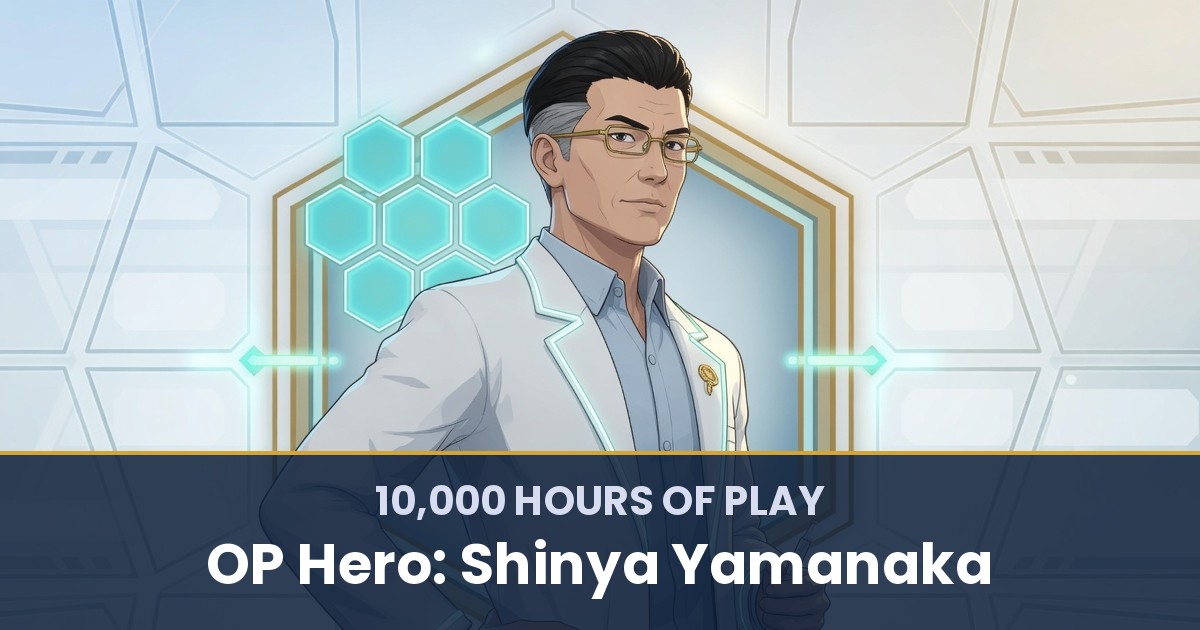


In the late 1980s, a young orthopedic surgeon in Osaka kept hitting the same wall: he struggled in the operating room, and he knew it.
He walked away from surgery. Twenty-some years later, in 2012, the Nobel committee called his name for a discovery that overturned what biologists believed about the identity of a cell.
Shinya Yamanaka showed that a fully mature adult cell can be reprogrammed back into a flexible, embryonic-like state with just four genes. Those reprogrammed cells, induced pluripotent stem cells (iPS cells), now power disease modeling, drug discovery, and regenerative medicine around the world.
His run maps cleanly onto the six Steps in order: Game, Attributes, Role, Skills, Allies, Quests. His class change from surgeon to scientist gives every one of them a concrete test.
⚡ Speed Run Notes
- Yamanaka began as a struggling orthopedic surgeon in the 1980s, quit, and retrained as a researcher. The failed class pick became the setup for iPS cells.
- His 2006 breakthrough reduced cellular reprogramming to four genes: Oct3/4, Sox2, Klf4, and c-Myc. The team started from a candidate list of 24 and tested combinations until the minimal recipe emerged.
- In November 2007 his lab repeated the feat with human cells, opening a path to patient-specific research that needs no embryos.
- He then made the method safer by showing that c-Myc, a cancer-linked gene, could be dropped from the recipe while reprogramming still worked.
- Steal the build: when a role fails you, change class instead of grinding harder, and keep your mission constant while everything else moves.
Table of Contents
About Yu-kai Chou

Yu-kai Chou is the author of 10,000 Hours of Play — the book that treats your life as the most important game you’ll ever build a character in, and gives you the 6-Step framework (Game · Attributes · Role · Skills · Allies · Quests) to play it on purpose. He has spent two decades developing the system through which this post analyzes its OP Hero, and applies it to his own life and to the lives of the people he advises around the world.
Chou’s other framework, the Octalysis Framework, has been applied by LEGO, Microsoft, Porsche, Coca-Cola, Salesforce, and MrBeast, impacting over 1.5 Billion Users. He has taught the methodology at Harvard, Stanford, Yale, Tesla, Google, BCG, and IDEO, and has advised governments in eight nations including Ukraine, the United Kingdom, the Kingdom of Bahrain, Singapore, Taiwan, the Netherlands, Kazakhstan, and South Korea.
His work has been cited by Harvard, Stanford, MIT, Forbes, Wall Street Journal, Wired, US Department of Energy, NIST, NSF, NCBI, US Department of Education, ClinicalTrials.gov, and Google Scholar — with 3,700+ more academic publications. Explore his books here.

Shinya Yamanaka is the OP Hero I point to when a failed role start feels like the end of the run: he lost the surgeon class and converted that loss into a researcher build that reached the Nobel Prize. The lesson I lift from his story lives in Step 4: he treated an impossible question as a screening problem, cutting 24 candidate genes down to four. That screening move is the one lesson I would carry into any quest line.
Step 1: The Game — What Shinya Yamanaka Was Actually Playing
Across four decades and three career identities, Yamanaka chased one target: obtain versatile, clinically useful human cells without relying on embryos, and then use those cells to understand and treat disease.
Read his career backwards and the through-line is obvious. As a surgeon he wanted to fix patients directly. When that route closed, he moved into pharmacology, then developmental biology, then translational cell therapy, each time carrying the same mission into a new territory.
The defining objective crystallized in the 2000s: find a small, defined set of genes capable of reprogramming an adult cell’s identity. Most of the field assumed a differentiated cell was locked into what it had become.
Yamanaka bet his lab on the opposite answer, and the bet paid out as iPS cells: mouse cells reprogrammed in 2006, human cells in 2007.
He did not chase a specific prize, a specific journal, or a specific institution; those arrived as side effects of a mission stated clearly enough to survive every role change.
Step 2: Attributes — The Innate Stats
Run Yamanaka through the Talent Triangle Method and a distinctive stat sheet appears.
Contrarian problem selection. He pursued cellular reprogramming while the prevailing assumption said differentiated cells were effectively locked into their identities. He picked the question nobody respectable wanted, years before the field took it seriously.
Tolerance for high uncertainty. His defining project required testing many possible gene combinations with no established recipe and no guarantee the answer existed at all. Years of screening could have ended in nothing.
Pattern recognition. He saw that a large set of genes associated with embryonic stem cells could collapse into a minimal combination.
Responsiveness to anomalies. Yamanaka has said that unexpected results during his graduate and postdoctoral years became productive because mentors encouraged him to investigate them rather than discard them. That reflex, chasing the anomaly instead of discarding it, kept firing for decades.
Step 3: Role(s) — The Character Class Across Chapters
Yamanaka’s build is a case study in class migration.
Chapter one: the surgeon. In the 1980s he trained in orthopedic surgery, and the fit was bad. He later described his difficulty in the operating room as the failure that opened the path to science.
Chapter two: the student, again. In 1989 he entered Osaka City University Graduate School of Medicine and spent roughly four years in Kenjiro Yamamoto’s pharmacology laboratory, learning experimental design and data analysis under Katsuyuki Miura. A licensed physician chose to become a beginner, and that humility became his foundation.
Chapter three: the postdoc abroad. He pursued molecular and developmental biology in the United States, absorbing the genetics and stem-cell research culture that his later program would be built on.
Chapter four: the principal investigator. At the Nara Institute of Science and Technology he established the research program that systematically tested candidate reprogramming factors. At Kyoto University he led the 2007 demonstration of human iPS cells.
Chapter five: the institution builder. After the discovery, he became a central leader in Japan’s effort to carry iPS technology from the bench toward clinics, a role closer to architect than to bench scientist.
Each class change looked like a demotion at the time. Each one moved him closer to the Game.
Step 4: Skills — The Real-Life Game Skills Shinya Yamanaka Mastered
Map his breakthroughs onto the Real-Life Game Skills catalog and five stand out.
Revive (Paladin): recovering from failure and taking new action toward the next Quest. Walking out of the operating room could have ended his story; instead he enrolled as a graduate student and restarted at the bottom of a new tree.
Track Treasure (Ranger): identifying hidden opportunities others don’t see. While most labs treated differentiation as a one-way street, Yamanaka read the same literature and saw a solvable reversal problem sitting in plain sight.
Arcane Wisdom (Mage): absorbing wide data and synthesizing it into clear outputs. His team distilled the sprawling embryonic-stem-cell literature into a defined candidate list of 24 genes, turning an open-ended mystery into a finite search space.
Devour (Warlock): reducing steps and components to make something lean. Single factors failed, so the team tested combinations and cut the 24 down to four: Oct3/4, Sox2, Klf4, and c-Myc. Later they went further and showed c-Myc, the oncogenic risk in the recipe, could be removed entirely.
Summon (Druid): calling in an Ally for the current Quest. Yamanaka did not run the decisive screens alone; he brought in Kazutoshi Takahashi, whose combinatorial experiments cracked the four-factor recipe.
On the Skills Spectrum, Yamanaka sits at the specialist end: one deeply trained meta-skill, reduction, built on years of gene-delivery and cell-validation work. The lesson for your own build: one deeply trained Skill that compresses complexity outperforms ten shallow ones.
Step 5: Allies — The People Who Multiplied Shinya Yamanaka
Strip the allies out of this story and there is no story.
Katsuyuki Miura taught him experimental fundamentals during his doctoral years. The screening discipline that later found four genes among 24 was installed in that Osaka laboratory.
Kenjiro Yamamoto gave a failed surgeon a home in pharmacology. Without that landing spot, none of the later chapters load.
Kazutoshi Takahashi was the key experimental collaborator who tested retroviral factor combinations with Yamanaka and helped identify the four-factor recipe. Yoshimi Tokuzawa worked alongside them in the early screening effort that asked whether ordinary fibroblasts could be converted at all.
Behind them stood graduate students and laboratory colleagues running combination after combination. The discovery ran like a team raid with a clear leader.
Yamanaka also credits the mentors of his graduate and postdoctoral years for a subtler gift: when his experiments produced anomalies, they pushed him to chase the anomaly. Allies who protect your curiosity multiply you as much as allies who share your workload.
Step 6: Quests — The Milestones That Shaped the Saga
Quest 1: Surrender the scalpel. His first major milestone was a failure. Difficulty performing orthopedic surgery pushed him out of his chosen class, and he accepted the exit instead of fighting it.
Quest 2: Rebuild as a scientist (1989–1993). Four years of doctoral training in pharmacology at Osaka City University gave him experimental design, laboratory technique, and data analysis. Unglamorous grinding, and the entire late game depended on it.
Quest 3: The four-factor recipe (2006). His team tested candidate genes associated with embryonic stem cells and identified Oct3/4, Sox2, Klf4, and c-Myc as sufficient to induce pluripotency in mouse fibroblasts. The result, published in Cell in 2006, established that differentiated cells could be reprogrammed with defined factors.
Quest 4: Human iPS cells (November 2007). The team generated human iPS cells from human fibroblasts using the same four-gene strategy. A mouse curiosity became a platform for human medicine in under eighteen months.
Quest 5: Defuse the recipe. c-Myc raised the method’s cancer risk, so later work showed it could be omitted while reprogramming still succeeded. Refinement quests rarely make headlines, and this one made the whole technology viable.
Quest 6: Carry it to the clinic. His later leadership turned reprogramming from an endpoint into an engine for disease modeling, drug discovery, and cell therapy, wrestling with differentiation control, genomic stability, and clinical safety.
What You Can Steal From Shinya Yamanaka’s Build
First: treat a failed class pick as information. Yamanaka read the signal in the operating room and moved the same mission into a new class.
Second: reduce before you attack. Facing an infinite problem, he built a finite candidate list, then compressed it until only the essential four genes remained. Whatever your field, the move translates: convert the impossible question into a countable screen.
Third: recruit the collaborator who completes the experiment. Takahashi’s combinatorial work was the hinge of the discovery. He supplied the question and the candidate list; Takahashi ran the combinations that answered it.
Plenty of legendary builds open with a hero who started strong. Yamanaka earned his profile the opposite way: he started wrong, noticed, and rebuilt. That skill is available to you today.
Where this framework comes from

Want the full system this profile is built on?
Every OP Hero piece runs through the same 6-Step framework from 10,000 Hours of Play: Unlock Your Real-Life Legendary Success. The book covers the full system, walks through Yu-kai’s own life run as the first applied case study, and gives you the worksheets to audit your own build.
Related Reading
- All OP Hero Profiles: the full 10,000 Hours of Play hero catalog
- 10,000 Hours of Play by OP Hero: Demis Hassabis
- 10,000 Hours of Play by OP Hero: Chien-Shiung Wu
- 10,000 Hours of Play by OP Hero: A.P.J. Abdul Kalam
- The 10K HP Framework: 6 Steps to Gamify Your Life