
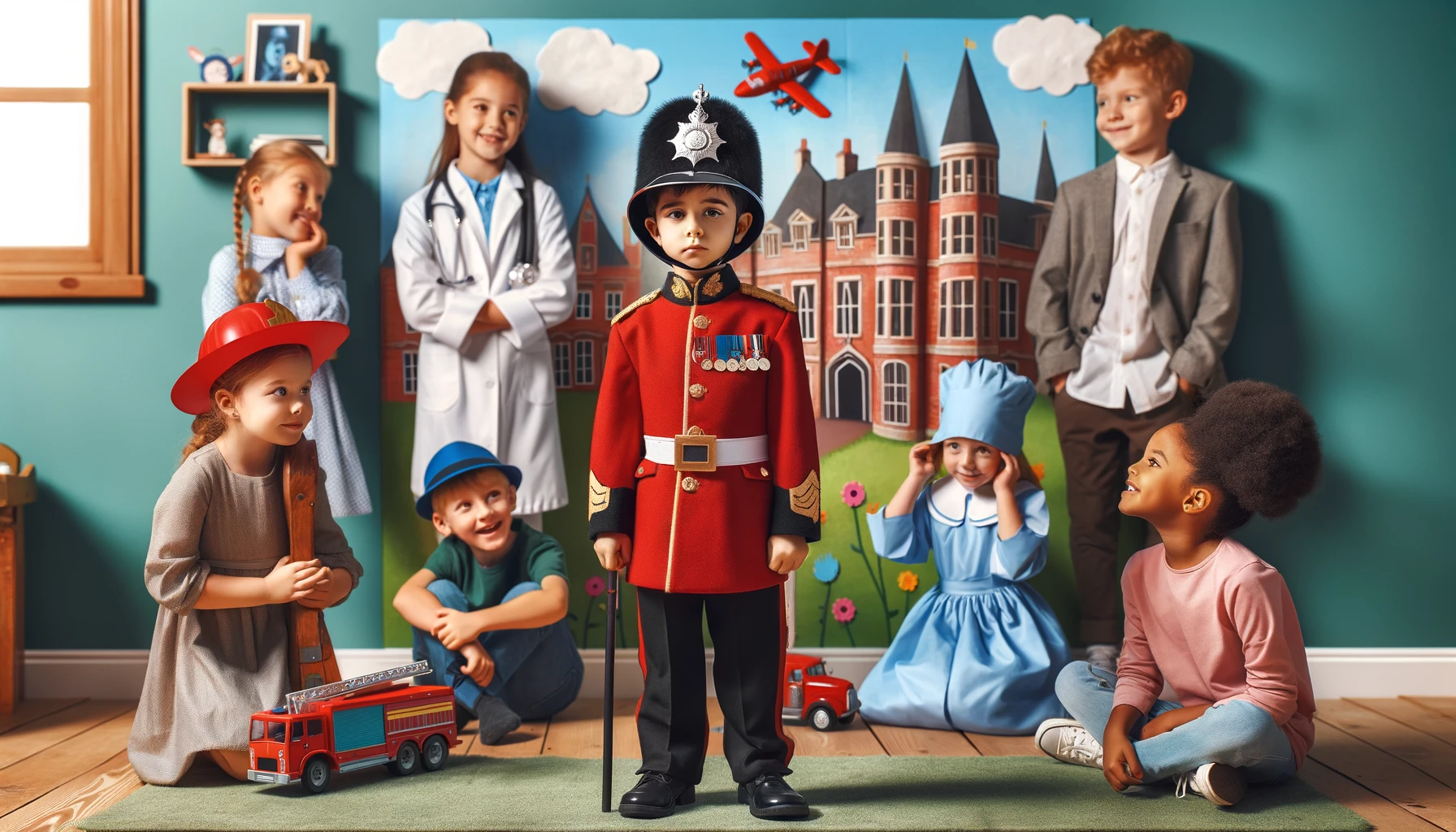

What if the secret to changing a child’s behavior isn’t discipline or instruction — but imagination? Yu-kai Chou discovered that giving children an Identity Role through roleplaying transforms compliance into self-motivated action, a principle that extends far beyond parenting into game design, education, and leadership.
(Below is a manuscript snippet that was cut from my second book, “10,000 Hours of Play.” If you like this post, you’ll love my book.)
Our Identity Role is a set of beliefs about ourselves that shapes our behavior across different environments. This concept holds true even in the world of fictional roleplay.
⚡ Speed Run Notes
- A child in roleplay is not pretending — they are rehearsing. The brain runs the same circuits whether the action is real or imagined. A child being “a doctor” for an afternoon is practicing the cognitive and emotional posture of care. The pretend is just the scaffolding; the practice is real. Adults under-credit this constantly.
- Identity-first behavior change is 10x stronger than task-first behavior change. “Do this thing” is a weak lever. “Be this kind of person” is a strong one. A child told to brush their teeth resists. A child invited to be “a dragon-slayer who needs strong teeth to eat the dragon's bones” complies and laughs. The pattern is universal and adults forgot it.
- The correct use of roleplay is not performance — it is agency rehearsal. Children who get to play many roles develop more flexible self-models, which lets them handle more situations as adults. Children kept in one role (always the smart one, always the helper) develop narrower self-models. The catalog of roles available in childhood becomes the catalog of adult options.
- The Octalysis drive behind roleplay is CD1 (Epic Meaning) — the child is living inside a larger story on purpose. Meaning is not a late-life development. It is the native operating mode of a child at play. Adults lose access to it because the culture told them play was immature. The book's argument is that meaning is reclaimable by adults who give themselves permission to roleplay again.
- The deepest takeaway: every adult who wants to change their behavior should borrow the child's roleplay stack. Pick a role, act the role, let the role do the lifting. “I am a person who writes every morning” is a more effective intervention than any willpower-based discipline. The child knew this. The adult forgot. The work is remembering.
Table of Contents
Author Credibility: Yu-kai Chou

Yu-kai Chou created the Octalysis Framework after studying gamification since 2003 — years before the term entered mainstream vocabulary. As a Human-Systems Architect & Behavioral Designer, his framework has been applied by LEGO, Microsoft, Porsche, Coca-Cola, Salesforce, and MrBeast, impacting over 1.5 Billion Users.
Chou has taught the Octalysis methodology at Harvard, Stanford, Yale, Tesla, Google, BCG, and IDEO.
His work has been cited by Harvard, Stanford, MIT, Forbes, Wall Street Journal, Wired, US Department of Energy, NIST, NSF, NCBI, US Department of Education, ClinicalTrials.gov, and Google Scholar — with 3,700+ more academic publications. Explore his books here.

The Palace Guard Experiment
I saw this firsthand with my own kids.
When I ask them to stand still for as long as possible, like most children, they struggle and begin fidgeting almost immediately. But the whole thing changes when I introduce roleplaying.
By saying, “Imagine you’re a soldier guarding the queen’s palace. You must stand still and be extremely alert in this honorable role,” I do more than assign them a task or a simple occupation.
I give them an Identity Role.
Suddenly, they are no longer just children attempting to stand still. Their imagination allows them to embody honorable guards dedicated to serving the royal highness.
In this role, they can maintain stillness for much longer.
Why Identity Roles Work Better Than Instructions
Beyond assuming the occupation role of a palace guard, my children adopt a new identity role, complete with a set of values about themselves.
This playfulness works because it lets children (and adults) experiment with different personas without the pressure of a high-stakes situation.
When my children imagine themselves as palace guards, they internalize the values and responsibilities associated with that role.
This is not about following instructions. It is about a shift in self-conception. When “who you are” changes, your behavior follows naturally.
And that change is far more lasting than simple compliance.
Research supports this. A LEGO Foundation review of developmental psychology found that children who engage in elaborate roleplay (including pretend identities and imaginary scenarios) show significantly higher creativity, perspective-taking, and self-regulation compared to peers in structured instruction settings.
The Octalysis Connection
I see this same principle at work in Octalysis design all the time.
In Core Drive 2: Development & Accomplishment, people push harder when they see themselves as someone leveling up, not just someone completing tasks.
In Core Drive 1: Epic Meaning & Calling, people endure real hardship because they believe they are part of something bigger than themselves.
And in Core Drive 5: Social Influence & Relatedness, the roles we play in communities (mentor, leader, team player) shape how we show up and perform.
That is the Identity Role at work.
The palace guard experiment is a micro example of what behavioral design does at scale: instead of telling people what to do, you craft an environment where they become someone who naturally does it.
The Takeaway: Give Them a Role Worth Playing
The takeaway is simple: if you want to change someone’s behavior, don’t just tell them what to do.
Give them a role worth playing.
My children didn’t stand still because I told them to. They stood still because they became someone who stands still.
That is the difference between instruction and identity. And it applies to game design, education, parenting, and leadership alike.
FAQ
What is an Identity Role in behavioral design?
An Identity Role is a set of beliefs about oneself that shapes behavior across different environments. Unlike simple instructions (“stand still”), an Identity Role shifts a person’s self-conception (“you are a palace guard”) so that the desired behavior emerges naturally from who they believe they are.
How does roleplaying improve children’s behavior?
Roleplaying gives children an Identity Role to embody, which activates intrinsic motivation rather than relying on external compliance. When a child imagines being a palace guard, they internalize the values of alertness and discipline, making the behavior self-sustaining rather than forced.
How does the Octalysis Framework explain roleplaying motivation?
Yu-kai Chou’s Octalysis Framework identifies roleplaying as engaging multiple Core Drives simultaneously: Core Drive 1 (Epic Meaning & Calling) gives the role significance, while Core Drive 2 (Development & Accomplishment) makes embodying the role feel like personal growth.
Related Reading
- The Octalysis Framework for Gamification & Behavioral Design
- 10,000 Hours of Play: Unlock Your Real-Life Legendary Success
- Masquerade (Rogue): Roleplaying and the Power of Identity
- What is Gamification? Definition, Examples & Framework
- Actionable Gamification: Beyond Points, Badges & Leaderboards
- Gamification Theories in Parenting: Epic Meaning & Calling
- Core Drive 5: Social Influence & Relatedness