


Every week in the Octalysis Prime Slack group, members share gamification examples they find in the wild.
These are only a snapshot of what we’ve discovered this week. As always, from the lens of the Octalysis Framework and the 8 Core Drives of gamification.
Author Credibility: Yu-kai Chou

Yu-kai Chou created the Octalysis Framework after studying gamification since 2003 — years before the term entered mainstream vocabulary. As a Human-Systems Architect & Behavioral Designer, his framework has been applied by LEGO, Microsoft, Porsche, Coca-Cola, Salesforce, and MrBeast, impacting over 1.5 Billion Users.
Chou has taught the Octalysis methodology at Harvard, Stanford, Yale, Tesla, Google, BCG, and IDEO.
His work has been cited by Harvard, Stanford, MIT, Forbes, Wall Street Journal, Wired, US Department of Energy, NIST, NSF, NCBI, US Department of Education, ClinicalTrials.gov, and Google Scholar — with 3,700+ more academic publications. Explore his books here.

Playing with my Son: An experiment in forced nostalgia and questionable parenting

This article chronicles a multi-year journey a father takes with his son, beginning with the earliest video games to the present.
The question was this:
What happens when a 21st-century kid plays through video game history in chronological order?
Nostalgia is part of Core Drive 5: Social Influence & Relatedness because it creates emotional connections to the past.
Mouse Books

Mouse Books doesn’t question the claim that people aren’t reading enough, but that people aren’t choosing to challenge themselves with ‘serious texts’ often enough.
Making their books pocket-sized allows readers to choose these books instead of their mobile phones when they are on the go.
This design is a clear play against Core Drive 8: Loss & Avoidance in the context of ‘not wanting to miss out on what is happening in my digital world’ of apps and inboxes.
The Worst Volume Control You Can Imagine

Make the worst volume control you can imagine reminds us that building gamification toward undesired actions can distract from the desired actions we want users to experience.
How a South Sudanese refugee uses her supermodel status to advocate

Mari Malek came to the US as a child refugee after waiting four years to enter the country.
She uses her supermodel status to advocate for children affected by war in South Sudan.
In the video, Mari talks about how everything she does has to have a purpose and drive back to her main story, about where she comes from.
This is a clear example of Core Drive 1: Epic Meaning & Calling.
Time hijacked by technology

Time Well Spent is a non-profit movement to reclaim our minds from the race for attention.
The language on this homepage speaks to an epic meaning of ‘reclaiming our minds’ and a social message of ‘let’s do it together’.
Technology is the antagonist to battle against.
I was easily drawn to click on the video, my curiosity sufficiently activated.
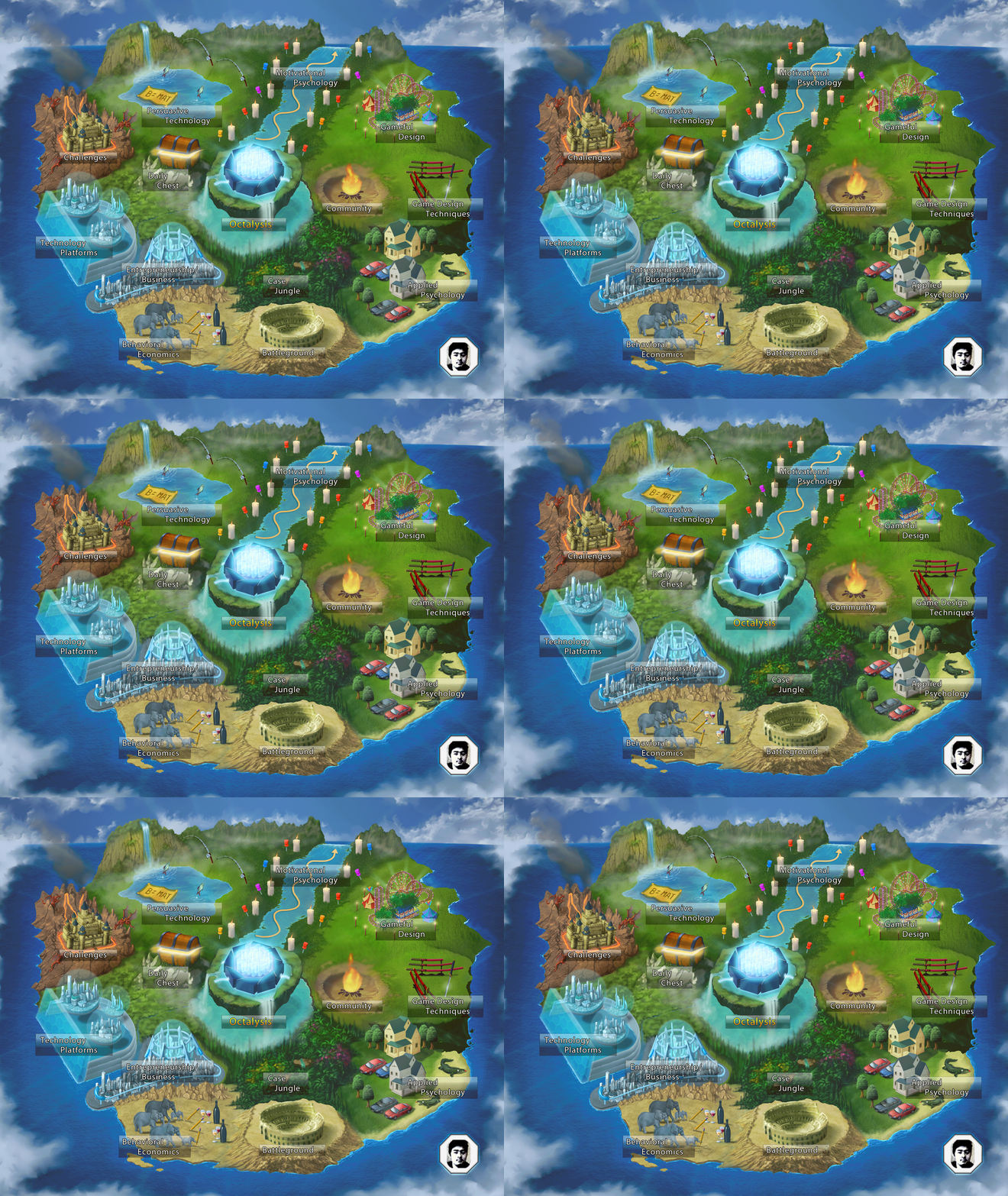
Every week on the island
Every week in Octalysis Prime’s private Slack community, we discuss these gamification examples and more in small group settings.
Join Octalysis Prime now. We look forward to meeting you.
Related Reading
- The Octalysis Framework for Gamification & Behavioral Design
- Core Drive 1: Epic Meaning & Calling
- Core Drive 5: Social Influence & Relatedness
- Core Drive 8: Loss & Avoidance
- What is Gamification?
- Books by Yu-kai Chou