


Every time you open Duolingo, you see a little flame with a number next to it. That number, your streak count, is quietly one of the most powerful behavioral design tools ever deployed at scale.
⚡ Speed Run Notes
- Streaks work because they convert effort into identity. A 300-day streak is a statement about who the user is, so breaking it feels like breaking the self. That identity lock is why streaks produce the retention numbers they do.
- Core Drive 8 (CD8): Loss & Avoidance powers streaks more than Core Drive 2 (CD2): Development & Accomplishment. Users protect the streak from collapse more than they push it forward. The fear of losing it is stronger than the joy of extending it. This is why streak break emotions are disproportionate to the actual loss.
- Streak freezes and repair mechanics are mercy infrastructure. A streak that can never be repaired is a bomb set for a bad day. Products that include repair options retain users through illness, travel, and grief. Products that don't lose their most loyal users to a single missed day.
- The ethical question of streaks: are they a tool for the user or a trap? Duolingo users feel served when the streak helps them learn. They feel trapped when the streak becomes the point and the learning fades. The difference is whether the product measures learning or sessions.
- The deepest insight: streaks are a contract, and good products honor the contract with restraint. Don't guilt users over missed days. Don't catastrophize a streak loss. Celebrate the return. Users who feel judged by a product stop returning; users who feel welcomed back become lifetime customers.
Duolingo’s streak feature helped improve their next-day retention from 12% to 55%. Snapchat’s Snapstreaks drive users to open the app 30–40 times per day, far more than Instagram’s 5–10 times.
Streak Design (Game Technique #78 in the Octalysis Framework) is one of the most commonly used motivational tools in gamification. It can boost user engagement, create urgency, and enhance the overall experience. But it can also burn people out if designed poorly.
Today, I’ll share some key insights on how to effectively implement streak design in your products or services, and discuss its impact on user behavior.
📑 Table of Contents
- About Yu-kai Chou
- Understanding Streak Design (Game Technique #78)
- Real-World Streak Design: Duolingo and Snapchat
- Capped vs. Infinite Streaks
- Implementing Reward Structures and Streak Ramp-Up
- Introducing Gentle Loss and Avoidance with Streak Ramp-Down
- How to Design a Streak (Step by Step)
- Streak Design vs. Appointment Dynamics
- Key Takeaways for Effective Streak Design
- Frequently Asked Questions
- Related Reading
Author Credibility: Yu-kai Chou

Yu-kai Chou created the Octalysis Framework after studying gamification since 2003 — years before the term entered mainstream vocabulary. As a Human-Systems Architect & Behavioral Designer, his framework has been applied by LEGO, Microsoft, Porsche, Coca-Cola, Salesforce, and MrBeast, impacting over 1.5 Billion Users.
Chou has taught the Octalysis methodology at Harvard, Stanford, Yale, Tesla, Google, BCG, and IDEO.
His work has been cited by Harvard, Stanford, MIT, Forbes, Wall Street Journal, Wired, US Department of Energy, NIST, NSF, NCBI, US Department of Education, ClinicalTrials.gov, and Google Scholar — with 3,700+ more academic publications. Explore his books here.

Understanding Streak Design (Game Technique #78)
Streak Design is a gamification technique where users build a consecutive-day count by performing a desired action without interruption. The longer the streak, the more invested the user becomes, and the more painful it feels to break it.
Streak design focuses on creating a sense of Development & Accomplishment (Core Drive 2) in the Octalysis Framework, urging users to keep their streaks alive.
However, it often ends up being driven by Loss & Avoidance (Core Drive 8), as users feel compelled to maintain their streak to avoid losing it.
 Core Drive 2: Development & Accomplishment sits at the top of the octagon, and Core Drive 8: Loss & Avoidance sits at the bottom with Streaking listed among its game techniques. A streak that starts as pride and ends as dread is a slide from the top of this framework to the bottom.
That shift from pride to dread is the central paradox of streak design. What begins as Core Drive 2 often transforms into Core Drive 8 as the streak grows.
The mechanic is effective precisely because it weaponizes that transition.
Here is roughly how it plays out in a user’s head:
- Days 1–7, Core Drive 2 dominant: “I’m building something! Seven days in a row!”
- Days 8–30, a Core Drive 2 and Core Drive 8 hybrid: “Nice streak. I’d better not miss a day.”
- Days 31 and beyond, Core Drive 8 dominant: “I can’t break this streak. I just can’t.”
The transition is the mechanic working as designed. The trouble starts because Core Drive 8 does not sustain long-term engagement.
Once a user is running on dread alone, every day becomes a tax they pay to avoid a loss.
That is a fine way to get someone through week three. It is a terrible way to get them through year three.
This is why streaks are classified as a Black Hat gamification technique — they create urgency and drive action, but they can leave users feeling trapped rather than empowered.
 Streak design draws its pull from the three Black Hat Core Drives at the bottom of the Octalysis octagon — above all Core Drive 8: Loss & Avoidance.
Streak design is highly effective in driving short-term bursts of activity, but it’s not always suitable for long-term engagement as people burn out the moment they lose their streaks.
Real-World Streak Design: Duolingo and Snapchat
Duolingo is perhaps the best-known example of streak design in action. Their streak counter (that little flame icon) drives users to return every single day.
According to StriveCloud’s gamification research (2024), Duolingo’s next-day retention improved from 12% to 55% over the years, with streak-related features like streak wagers increasing day-14 retention by 14%.
The scale that engine runs at today: Duolingo reported 58.7 million daily active users in Q2 2026, up 23% year over year.
What the streak itself is worth showed up in June 2026, when Duolingo ran a one-time Streak Revival event that let lapsed learners restore their longest-ever streak by completing three lessons.
It drew 15.4 million learners, and nearly 8 million of them had no active streak when the event began. CEO Luis von Ahn called it one of the company’s most successful campaigns.
Eight million people came back to a language app because it offered to hand back a number they had already lost. That is how much weight a streak count carries once a user has built one.
Snapchat’s Snapstreaks work differently. Users must send at least one snap to a friend every 24 hours to maintain the streak. Snapchat users open the app 30–40 times per day on average, compared to Instagram’s 5–10 times.
The longest recorded Snapchat streak exceeds 4,000 consecutive days. That’s over 11 years of daily engagement driven purely by the fear of breaking the streak (Core Drive 8).
Capped vs. Infinite Streaks
Most designers assume a longer streak is a better streak. That assumption is where the burnout starts.
Think about what an infinite counter actually does to the stakes. At 900 days, a single missed day represents two and a half years of effort wasted.
Users don’t feel free to live their lives at that point. They feel imprisoned by their own achievement.
The weight of the streak grows every single day, and the reward for carrying it stays exactly the same.
There is a smarter model, and I like how Travelers handles it. The education platform by Milton Education caps the maximum streak at 7 days.
After finishing a 7-day challenge, users feel release instead of ongoing pressure. They have “won” the week.
A natural reset point arrives every seven days, and it arrives without shame.
Here’s the part designers miss when they copy the cap: it only works because something else absorbs the pride.
Travelers pairs the capped streak with a separate milestone counter that tracks total completed days, and that counter never resets.
So users still collect the pride of cumulative achievement, and they’re protected from the exponential anxiety growth of an infinite counter.
Strip out the total counter and you’ve built a mechanic that forgets your user every Sunday. Keep it, and the seven-day cycle becomes a rhythm instead of a cliff.
So which model do you pick? If your product is something people should still be doing in three years, cap the streak.
If it’s a 30-day challenge with a finish line, let it run.
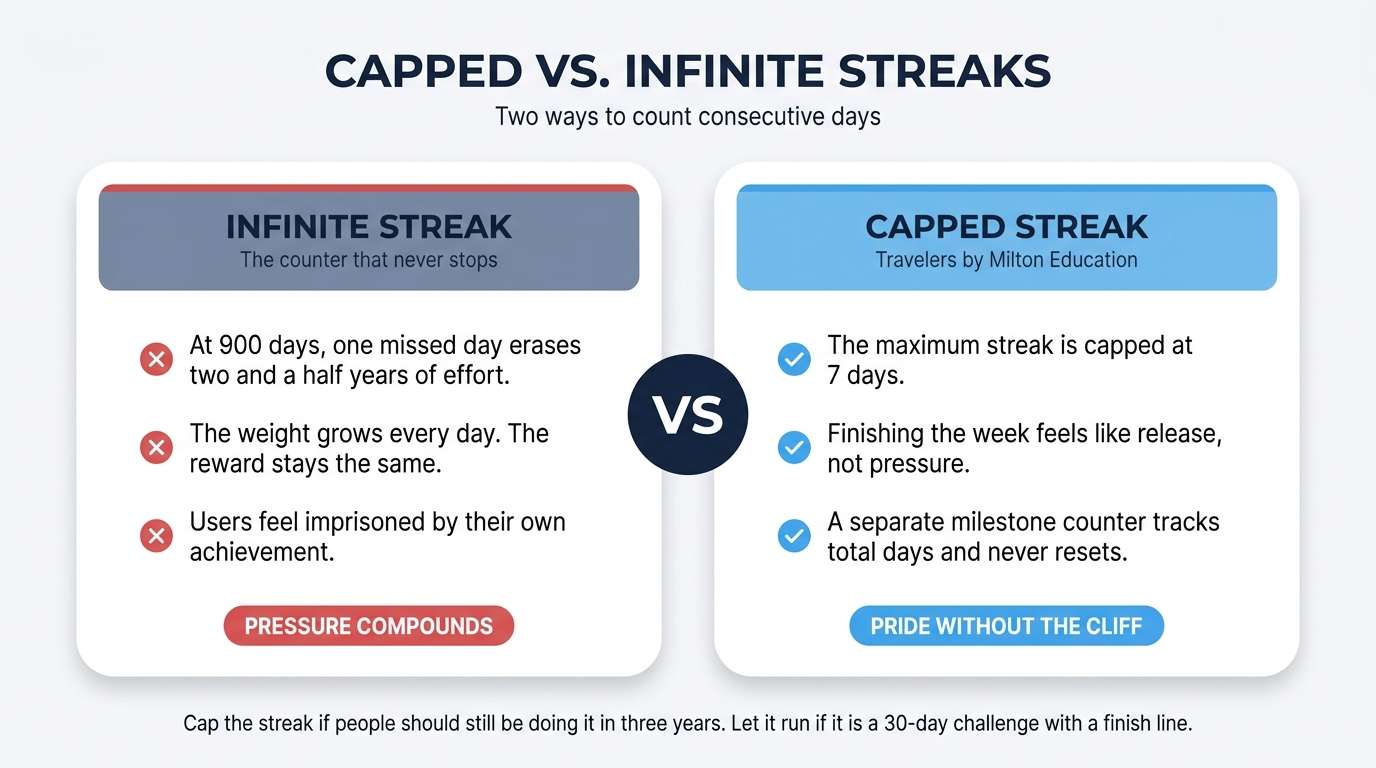 Under an infinite counter, one missed day costs everything you built. Under a seven-day cap, it costs a week.
Implementing Reward Structures and Streak Ramp-Up
One way to enhance streak design is by tying it to your reward structure.
Offer users rewards for maintaining their streak and create a sense of progression by gradually increasing the rewards as they continue.
For example, in a game, users could receive:
- 10 coins on Day 1
- 20 coins on Day 2
- 30 coins on Day 3
- 40 coins on Day 4
- 50 coins on Day 5 and subsequent days
That escalating ladder has a name of its own: Streak Ramp Up (Game Technique #110).
Most implementations get the reset wrong. When the streak breaks, users should drop back to the Day 1 rung of 10 coins.
A zero reset is the exact failure mode Streak Ramp Up exists to prevent.
Do the math on why that matters. A user who breaks a 100-day streak only needs 5 days to climb back to maximum earning.
Send that same user back to zero and you’ve handed them a 100-day reclimb. Nobody looks at that and thinks “sure, I’ll do it again.”
The ladder is short on purpose. Recovery has to feel survivable on the morning after the miss.
This creates a sense of Core Drive 2: Development & Accomplishment, Core Drive 4: Ownership & Possession, Core Drive 6: Scarcity & Impatience, as well as Core Drive 8: Loss & Avoidance, prompting users to continue their streak.
Introducing Gentle Loss and Avoidance with Streak Ramp-Down
A gentler approach to the above mechanic is Streak Ramp Down (Game Technique #111).
Instead of resetting users’ rewards to zero when they break their streak, gradually reduce the rewards over time.
For instance, if a user stops performing the Desired Action, their rewards would decrease as follows:
- 50 coins to 40 coins
- 40 coins to 30 coins
- 30 coins to 20 coins
- 20 coins to 10 coins
This method creates scarcity and urgency without completely demoralizing users, as they don’t lose everything at once.
The threat is stronger than the execution. Users stay motivated by what they might lose.
Once the loss actually happens, that motivational power is spent. A threat, by contrast, can motivate indefinitely.
Most importantly, users can gain back their streak progress relatively easily if they just missed one day, so they are driven to come back instead of burning out immediately after.
Duolingo has adopted a version of this approach with their “Streak Freeze” and “Weekend Amulet” features, allowing users to pause their streak over weekends without losing it. This reduces the Black Hat pressure while preserving the engagement loop.
The underlying technique there is Streak Shield (Game Technique #178), and Duolingo is its canonical example.
Notice what a banked shield does before it is ever spent. Owning one lowers the anxiety immediately, which makes it a Core Drive 4: Ownership & Possession effect more than a Core Drive 8 one.
I learned this one from the wrong side of it.
I had a long Duolingo streak going. Then I travelled, missed a day, and it was gone.
I could have spent my way out. I had freeze items sitting right there and I couldn’t justify using them, which tells you something about how that purchase feels even when it costs nothing.
What the app does next is famous. The owl goes through emotional stages, and eventually it becomes a skeleton.
Here’s what actually brought me back: my kids saw the dying owl and started pressuring me about it.
That is Core Drive 5: Social Influence & Relatedness arriving from a source the product never designed for.
The app’s own guilt mechanics left me cold. Three children who thought the owl was dying did the job in an afternoon.
Let Users Earn a Broken Streak Back
When a streak breaks, let the user earn it back.
A lot of products sell it back instead, which is a different product decision with a different result.
Consider the two messages you can send after a 120-day streak dies.
The first: “Your 120-day streak is broken. Spend $4.99 to restore it.”
This almost always backfires, because users experience it as paying to preserve a fiction.
They know they didn’t do the thing. Buying the number back doesn’t give them the feeling the number was supposed to represent.
The second: “Your 120-day streak is broken. Complete 10 consecutive days to restore your 120-day streak.”
This approach preserves dignity. The user proves they still care, regains momentum, and gets urgent optimism where the first message gave them shame.
You also collect ten days of the desired action out of the deal, which is worth considerably more to your product than $4.99.
A Revival Potion (Game Technique #119) can sit alongside this as a banked, earned item. The moment it becomes a checkout flow, you have changed what the streak means.
I go much deeper into that trade-off, and into what happens when a streak breaks, in a dedicated breakdown.
How to Design a Streak (Step by Step)
Here is the whole thing in five moves. Build in this order and the mechanic tends to hold up.
1. Anchor the streak in one clear desired action.
Pick the single action a user repeats each day, and make it small enough to survive a bad day.
If your streak demands twenty minutes, you have designed a streak that dies the first time someone has a deadline. Duolingo’s minimum lesson is short on purpose.
2. Tie the streak to a ramp-up reward structure.
Escalate the reward as the streak continues, the way the 10-to-50 coin ladder above does. This is where Core Drive 2: Development & Accomplishment and Core Drive 4: Ownership & Possession do their work.
Keep the ladder short. Five rungs is plenty.
3. Soften the loss with a ramp-down.
Decrease rewards gradually when the streak breaks, so a user who missed one day can still see their way back.
4. Add recovery mechanics before you need them.
Streak Shields, weekend passes, earned restoration. Build these on day one, because the day you need them is the day you have already lost the user.
Every user you have will eventually get sick, travel, or grieve. Design for that Tuesday.
5. Pair it with Appointment Dynamics.
Combine the time-window streak with an appointment-based reward (Game Technique #21) so the user has something to look forward to as well as something to protect.
Core Drive 6 pulls them toward the moment. Core Drive 8 keeps them from skipping it.
Run those five in order and you get a mechanic that survives contact with real users.
Skip step 4 and you get a beautiful engagement curve that falls off a cliff in month three.
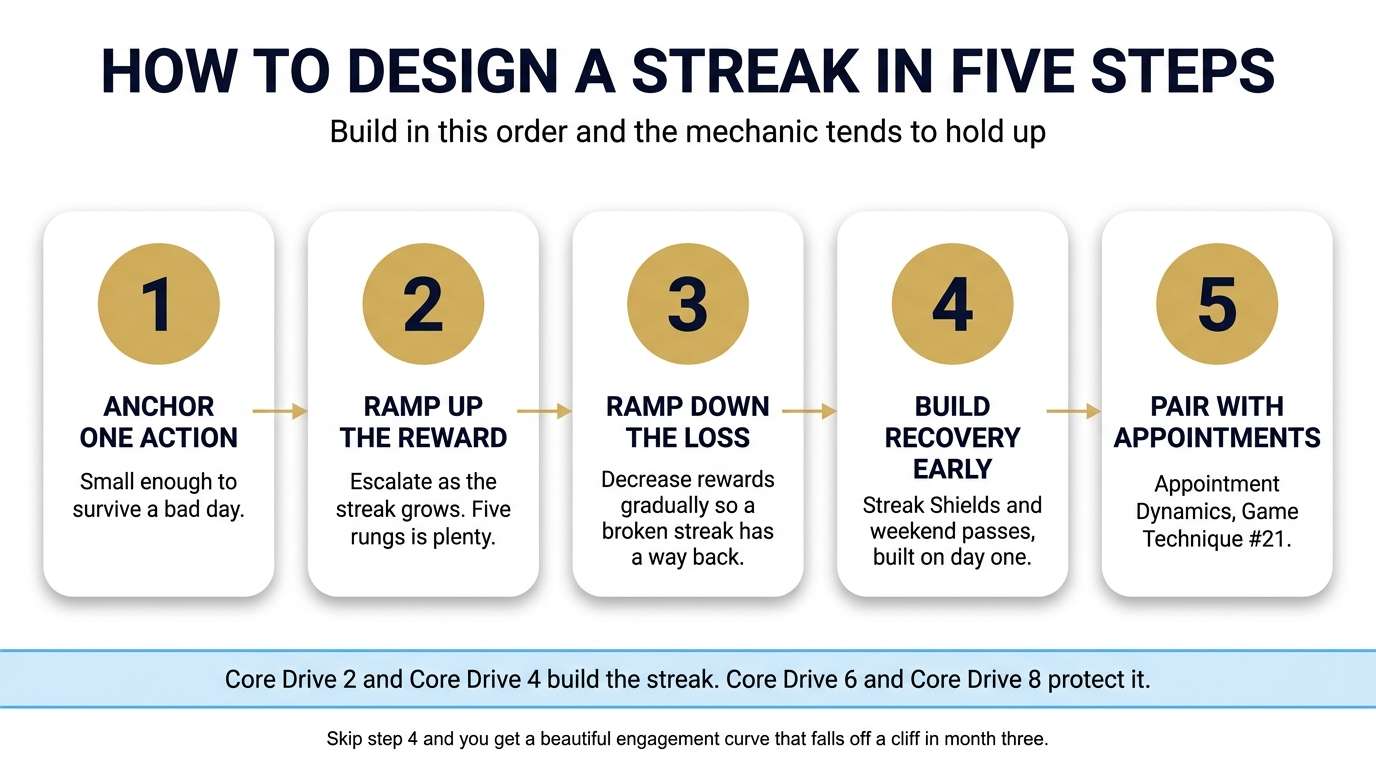 The five moves in order. Core Drive 2 and Core Drive 4 build the streak, and Core Drive 6 and Core Drive 8 protect it.
Streak Design vs. Appointment Dynamics
Streak Design is closely related to another gamification technique: Appointment Dynamics (Game Technique #21).
While Appointment Dynamics requires users to return at a specific time to receive a reward (like a daily bonus at noon), Streak Design requires them to return within a time window (any time today) to maintain their count.
The key difference is psychological. Appointment Dynamics creates anticipation (Core Drive 6), while Streak Design creates dread of loss (Core Drive 8).
For long-term engagement, combining both techniques: an appointment-based reward that also contributes to a streak, can create a more balanced motivational experience.
Key Takeaways for Effective Streak Design
- Streak design drives short-term bursts of activity but may not always be suitable for long-term engagement without additional White Hat mechanics.
- Tie streak design to your reward structure to encourage users to maintain their streaks through Ownership (Core Drive 4).
- Implement a streak ramp-up to create a sense of progression and increasing rewards.
- Introduce gentle loss and avoidance with a streak ramp-down to create urgency without demoralizing users.
- Consider adding streak recovery mechanics (like Duolingo’s Streak Freeze) to prevent permanent burnout.
- Combine with Appointment Dynamics for a more balanced White Hat + Black Hat motivational system.
There is a golden rule underneath all of this: use temporary pressure to shape temporary behavior, and use permanent rewards to lock in permanent change.
A streak is temporary pressure. The technique that converts it into something permanent is the Bootleg Quest (Game Technique #107), which pays out a bonus the user can never lose.
The key to successful streak design is balancing the desire for Accomplishment (Core Drive 2) with the fear of Loss & Avoidance (Core Drive 8).
Streak design reveals a designer’s theory of human nature. Show me your repair mechanic and I’ll tell you whether you think your users are people or metrics.
Frequently Asked Questions
Why do streaks like Duolingo’s work so well?
Streaks work because they convert effort into identity. A 300-day streak is a statement about who the user is, so breaking it feels like breaking the self.
That identity lock is what produces the retention numbers streaks are famous for. According to StriveCloud’s 2024 analysis, Duolingo’s next-day retention improved from 12% to 55% as the streak counter turned daily practice into a personal commitment users were unwilling to break.
Which Octalysis Core Drive powers streak design?
Primarily Core Drive 8: Loss & Avoidance. Users maintain the streak in order to avoid losing it, which is why streak design is classified as a Black Hat technique.
Core Drive 2: Development & Accomplishment plays a supporting role and dominates the first week. After roughly a month, the dread of breaking a long streak is what drives the daily return.
What is the Streak Ramp-Down technique?
Streak Ramp Down (Game Technique #111) is the gentler version of streak design. Rewards decrease gradually when a streak breaks instead of resetting to zero.
Users who missed a single day can recover their progress relatively easily, which keeps them returning instead of burning out. Duolingo’s Streak Freeze and Weekend Amulet are real-world examples.
How is Streak Design different from Appointment Dynamics?
Appointment Dynamics (Game Technique #21) requires users to return at a specific time to receive a reward. Streak Design (Game Technique #78) requires them to return within a time window to maintain a consecutive-day count.
Appointment Dynamics creates anticipation, which maps to Core Drive 6: Scarcity & Impatience. Streak Design creates dread of loss, which maps to Core Drive 8.
Combining both produces a more balanced motivational system.
Related Reading
- The Octalysis Framework for Gamification & Behavioral Design
- Actionable Gamification: Beyond Points, Badges & Leaderboards
- Exploring Appointment Dynamics: A Key Tool in Gamification
- Core Drive 8: Loss & Avoidance
- Core Drive 2: Development & Accomplishment
- Decoding the Mystery Box: Reward Design
- White Hat vs Black Hat Gamification
- Points, Badges, and Leaderboards: The Gamification Fallacy